Turkey Hair Transplant Cost vs UK (2026)
August 15, 2026
FUE Hair Transplant Turkey (2026)
August 15, 2026Turkey Hair Transplant Cost vs USA (2026): Complete Price Comparison
Turkey hair transplant cost vs USA is one of the most important comparisons for American patients considering hair restoration abroad in 2026. Hair transplantation is widely available in both countries, but the pricing models can be dramatically different. While many American clinics calculate the final price according to the number of grafts, clinics in Turkey frequently offer fixed or all-inclusive hair transplant packages.
Current 2026 market sources place many Turkish procedures within roughly €2,500–€6,000, depending on technique, clinic level, surgeon involvement and graft requirements. In the United States, costs can easily reach $9,000–$24,000 for approximately 3,000 grafts, particularly in major metropolitan markets and surgeon-led practices.
Turkey hair transplant cost vs USA in 2026 shows a major price difference. Hair transplants in Turkey are often offered through package pricing, while many US clinics charge according to graft count, surgeon fees and location. Turkey can therefore be significantly more affordable, especially for 3,000–4,000 graft procedures. However, price should not be the only factor. Patients should verify who designs the hairline, who opens the recipient channels, how many patients are treated daily and whether the procedure is truly doctor-led. Avoid choosing a high-volume technician clinic simply because it advertises a low price or uses a doctor’s name.
Turkey vs USA Hair Transplant 2026
The cheapest operation is not necessarily the best value. Compare the doctor, medical team, graft strategy and package — not only the advertised price.
How Much Does a Hair Transplant Cost in Turkey in 2026?
The hair transplant cost in Turkey in 2026 varies considerably. Published 2026 market estimates commonly place procedures between approximately €2,500 and €6,000, although premium doctor-led procedures may cost more.
Turkey’s pricing advantage is particularly attractive for patients requiring larger sessions. Instead of charging separately for every individual graft, many Istanbul clinics use package-based pricing. Depending on the provider, a package may combine the procedure with accommodation, airport transfers, clinic transportation, medications and postoperative support.
This means that patients searching for hair transplant Turkey packages should compare exactly what is included rather than comparing only the headline price.
How Much Does a Hair Transplant Cost in the USA in 2026?
The average hair transplant cost in the USA is substantially higher. Pricing varies according to location, surgeon reputation, technique and especially graft count.
Recent 2026 pricing research places a typical American procedure in a broad range of approximately $6,000–$15,000, while premium procedures can exceed this amount. More specifically, recent data for a 3,000-graft hair transplant in the USA places the range at approximately $9,000–$24,000, with an average around $15,000.
Major markets such as New York, Los Angeles and Miami can be particularly expensive because higher staffing, property and operating costs are reflected in the final treatment price.
TurHair vs USA Hair Transplant: What Is the Difference?
When comparing TurHair vs USA hair transplant clinics, price is only one part of the decision. TurHair’s model is designed for international patients who want transparent package pricing, doctor involvement and a structured Istanbul treatment program without the very high per-graft costs commonly seen in the United States.
At TurHair, the procedure is planned around the patient’s donor capacity, hair-loss pattern and long-term needs. Rather than treating graft numbers as a sales target, the aim is to use the donor area responsibly and create a natural-looking result.
TurHair Price vs USA Hair Transplant Cost
| Comparison | TurHair Istanbul | Typical USA Clinic |
|---|---|---|
| Starting Package | €2,500 Standard | Often several thousand dollars and frequently graft-based |
| VIP Package | €3,000 VIP | Premium surgeon-led procedures can commonly reach five figures |
| VIP PLUS | €3,500 VIP PLUS | Large FUE procedures may exceed $10,000–$15,000+ |
| Pricing Model | Package-based pricing | Frequently calculated per graft |
| Hotel | 2 nights included | Usually separate if travel is required |
| Transfers | Included | Usually not part of the surgical fee |
| Medication / Aftercare | Included according to package | Depends on clinic |
| Large Graft Sessions | Up to medically appropriate package limits | Higher graft numbers can significantly increase price |
*USA prices vary significantly by state, surgeon, graft count and technique. TurHair graft numbers are determined according to medical suitability and donor capacity, not simply the maximum number available in a package.
What Makes TurHair Different?
| Important Factor | TurHair Approach | Why It Matters |
|---|---|---|
| Named Doctor | Dr. Mehmet Sıraç Demir | Patients know who is medically responsible for their treatment plan. |
| Hairline Design | Doctor-designed in VIP packages | Natural hairline planning should reflect age, facial proportions and future hair loss. |
| Channel Opening | Doctor involvement in VIP treatment | Recipient-site direction, angle and distribution strongly affect the final appearance. |
| Donor Planning | Long-term donor preservation | The goal is not to extract the maximum number of grafts, but the appropriate number. |
| Package Transparency | Standard, VIP and VIP PLUS clearly separated | Patients can understand what is included before travelling. |
| International Patients | Hotel, transfers and coordination available | Simplifies the Istanbul treatment journey for patients arriving from the USA. |
| Technique Options | FUE, Sapphire FUE and DHI when medically suitable | Technique should be selected according to the patient, not simply as a marketing upgrade. |
TurHair Packages for 2026
| Feature | STANDARD €2,500 | VIP €3,000 | VIP PLUS €3,500 |
|---|---|---|---|
| FUE Hair Transplant | ✓ | ✓ | ✓ |
| Up to 5,000 Grafts* | ✓ | ✓ | ✓ |
| Doctor Supervision | ✓ | ✓ | ✓ |
| Doctor Hairline Design | — | ✓ | ✓ |
| Doctor Channel Opening | — | ✓ | ✓ |
| PRP | — | ✓ | ✓ |
| Sapphire FUE | — | — | ✓ |
| DHI Option | — | — | When medically suitable |
| 2-Night Hotel | ✓ | ✓ | ✓ |
| Transfers | ✓ | ✓ | ✓ |
| Medication / Cosmetics | ✓ | ✓ | ✓ |
*Up to 5,000 grafts does not mean every patient should receive 5,000 grafts. The final number depends on donor capacity, recipient area, hair characteristics and medical evaluation.
TurHair combines transparent Istanbul package pricing with doctor-led planning, donor protection and structured international patient support.
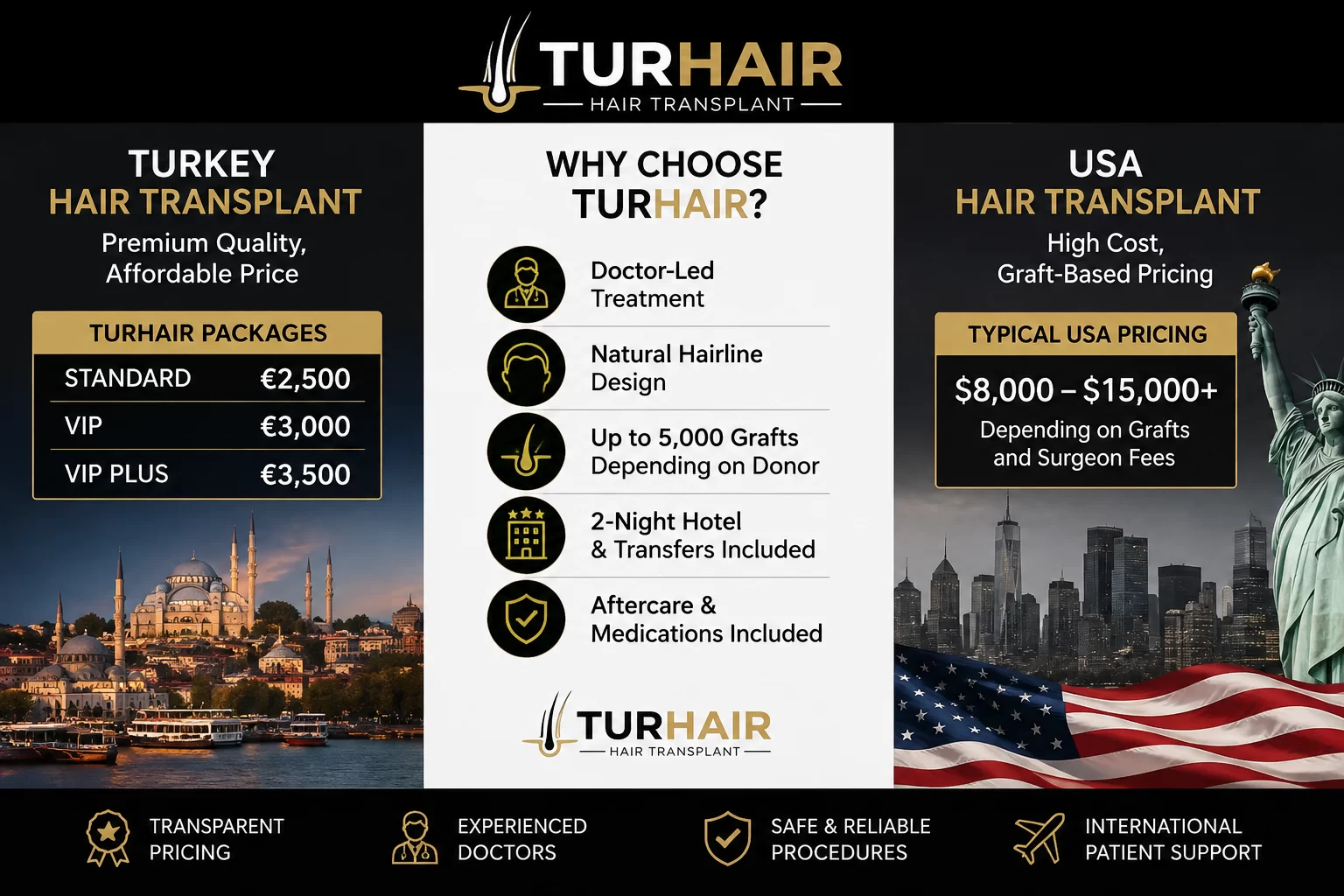
Turkey vs USA hair transplant cost comparison for 2026, including TurHair Istanbul package prices and doctor-led treatment
Why Can TurHair Cost Less Than a USA Hair Transplant?
The difference is mainly structural. A lower price in Turkey does not mean that the patient receives fewer grafts simply because treatment is performed abroad. Labor, commercial property, staffing and general operating expenses are lower in Istanbul than in major US cities such as New York, Los Angeles, Miami or San Francisco.
TurHair can therefore offer international packages from €2,500 to €3,500 while including services such as accommodation and transfers. In the USA, a multi-thousand-graft FUE procedure may cost substantially more before accommodation or travel expenses are considered.
For an American patient, the important comparison is therefore not simply “Turkey is cheaper than the USA.” The real question is whether the lower cost is combined with transparent medical responsibility and responsible surgical planning.
The TurHair Difference in One Sentence
TurHair focuses on the right doctor, the right graft number and the right long-term plan — not simply the highest graft number at the lowest advertised price.
Turkey vs USA Hair Transplant Cost Comparison
| Comparison | Turkey | USA |
|---|---|---|
| Typical 2026 Price | Approx. €2,500–€5,000 | Approx. $6,000–$15,000+ |
| 3,000 Grafts | Often package priced | Approx. $9,000–$24,000 |
| Pricing Model | Frequently fixed package | Frequently per graft / procedure |
| Hotel | Often included in international packages | Usually separate |
| Transfers | Often included | Usually not required/included |
| Potential Saving | Can be substantial | Higher overall treatment cost |
Warning: Hair Mills and Technician-Led Clinics in Turkey
Do Not Assume a Doctor’s Name Means a Doctor Performs the Surgery
Turkey has a very large hair transplant industry, and treatment models vary significantly. Many providers operate with technician-heavy or high-volume systems, while their marketing may still emphasize a doctor’s name, title or photograph. Patients should verify who actually performs the critical stages of the procedure.
One of the biggest risks when searching for a hair transplant in Turkey is confusing a medically doctor-led clinic with a high-volume technician-led hair transplant clinic. This distinction is not always obvious from a website, Instagram account or online advertisement.
In the Turkish market, it is common to encounter clinics where a doctor may be presented prominently in marketing materials while much of the practical procedure is carried out by technicians or separate teams. Some providers strongly reject the term hair mill, yet the important question is not what the clinic calls itself. The important question is who actually performs your surgery and how many patients are being treated at the same time.
What Is a Hair Mill?
The term hair mill is generally used to describe a high-volume hair transplant operation where multiple patients may be treated each day and significant parts of the procedure are delegated to technicians or rotating teams. The clinic may appear highly professional from the outside, but the medical model can be very different from a genuinely doctor-led practice.
A clinic should not automatically be labelled a hair mill simply because it is large. Instead, patients should evaluate the actual workflow. If one named doctor is supposedly responsible for many patients every day, it is reasonable to ask how that doctor can personally perform the critical surgical stages for all of them.
The Most Important Question:
“Which stages will the doctor personally perform on me?”
Red Flags of a Technician-Led Hair Transplant Clinic
| Red Flag | Why It Matters |
|---|---|
| Doctor’s name is used heavily in advertising | A doctor’s image or name does not prove that the doctor personally performs your procedure. |
| Clinic avoids explaining who opens the channels | Recipient-site creation strongly affects angle, direction and final appearance. |
| Large number of patients every day | Very high daily volume can make meaningful doctor participation difficult. |
| Different teams perform different patients | Results may depend more on whichever technician team is assigned than on the advertised doctor. |
| Exact doctor involvement is unclear before payment | Patients should know the treatment model before paying a deposit or booking flights. |
| “Doctor supervised” but no explanation | Supervision can mean very different things. Ask what the doctor actually does personally. |
| Extremely cheap price combined with very high graft promises | Patients should investigate how the clinic maintains medical quality at that price and volume. |
“We Are Not a Hair Mill” Is Not Enough
Many clinics know that international patients are now cautious about hair mills. For this reason, simply stating “we are not a hair mill” has little value unless the clinic clearly explains its medical workflow.
A provider can place one doctor’s name on the website, publish photographs of that doctor and still operate several treatment rooms with technician teams. The patient should therefore ask for specific answers rather than accepting marketing language.
For example, ask who performs the hairline design, who determines the safe graft number, who extracts the grafts, who opens the recipient channels and who performs implantation. If the clinic gives vague answers such as “our medical team” or “our specialists” without identifying the doctor’s personal role, further investigation is justified.
Important:
A clinic can deny being a hair mill. What matters is whether the actual treatment model supports that claim.
Why Channel Opening Is So Important
The recipient channels or sites help determine the direction, angle and distribution of transplanted hair. These details have a major influence on whether the final result looks natural.
A hair transplant can have good graft survival and still look artificial if the direction or angle is poorly planned. This is particularly important at the frontal hairline and temples, where even small design mistakes can become very visible.
For this reason, patients who want stronger doctor involvement should specifically ask who will perform this stage. The answer should be clear before the procedure day.
Daily Patient Volume Matters
Another useful question is: How many patients does the doctor personally manage per day?
If a clinic advertises one doctor but performs a very large number of simultaneous procedures, patients should understand how the workflow is organized. A doctor cannot realistically be in several operating rooms performing critical stages at exactly the same time.
This does not mean every clinic must treat only one patient per day. It means the claimed level of doctor involvement should be consistent with the number of procedures being performed.
Hair Mill vs Doctor-Led Clinic
| Comparison | High-Volume / Technician-Led Model | Doctor-Led Model |
|---|---|---|
| Named Doctor | May be mainly used for branding | Doctor has a clearly defined role |
| Hairline Planning | May be delegated or standardized | Individual medical and aesthetic planning |
| Channel Opening | May be performed by technicians depending on clinic model | Doctor involvement is clearly explained |
| Daily Volume | Often high | Limited enough for meaningful physician participation |
| Graft Strategy | High numbers may be emphasized in marketing | Based on donor safety and long-term planning |
| Patient Knows Who Operates | Sometimes unclear until surgery day | Explained in advance |
What Should You Ask Before Booking a Hair Transplant in Turkey?
- What is the full name of the doctor responsible for my surgery?
- Will that doctor personally examine my donor area?
- Who will design my hairline?
- Who will decide the final graft number?
- Who will perform the channel or recipient-site opening?
- Who will extract the grafts?
- Who will implant the grafts?
- How many patients will the doctor be responsible for that day?
- Will the same team stay with me throughout the procedure?
- Can the clinic explain all of this in writing before I pay?
A Doctor’s Photo Is Not the Same as Doctor-Led Surgery.
Ask who will actually perform the critical stages of your hair transplant before choosing a clinic in Turkey.
Turkey can offer excellent value for international hair transplant patients, but the market is highly varied. Patients should not assume that every clinic using a doctor’s name follows the same medical model. The safest approach is to verify the doctor’s personal involvement, daily patient volume and the exact role of technicians before making a decision.
Why Is Hair Transplantation Cheaper in Turkey Than the USA?
A lower price does not automatically mean that the medical procedure itself is inferior. Turkey and the United States operate under very different economic structures. Salaries, clinic rents, staffing costs and other operational expenses are generally lower in Turkey.
Istanbul has also developed a large international medical-tourism infrastructure. Clinics treating overseas patients can perform a relatively high volume of procedures and organize accommodation, transportation and patient coordination within standardized packages.
However, the enormous popularity of hair transplant tourism in Turkey has also created a wide range of clinic models. Patients can find experienced physician-led practices, but they can also encounter high-volume operations where significant parts of the procedure are delegated.
Therefore, price alone should never determine which clinic a patient chooses.
How Much Can an American Patient Potentially Save?
Consider a patient requiring approximately 3,000 grafts. Recent American market data indicates that this procedure may cost around $9,000–$24,000 depending on location and technique.
A Turkish package may instead cost several thousand euros. Even after adding a round-trip flight between the United States and Istanbul, the total expense can remain substantially below many American surgical quotations.
For patients needing 3,500–4,500 grafts, the difference can become even more significant because US clinics commonly increase the price according to graft volume.
Important:
A $10,000 saving has little value if poor planning damages the donor area or produces an unnatural result. Cost should be considered only after surgeon involvement, medical standards, donor management and treatment planning have been evaluated.
FUE Hair Transplant Cost: Turkey vs USA
Follicular Unit Extraction (FUE) remains one of the most requested modern hair transplantation techniques. Individual follicular units are extracted from the donor area and transplanted into recipient sites according to the surgical plan.
In America, FUE can become expensive because the final quotation is frequently related to the number of grafts. A patient requiring a small frontal restoration may therefore receive a much lower quote than someone requiring frontal, mid-scalp and crown restoration.
Turkey’s package model can make larger FUE procedures financially attractive because selected providers offer a predetermined package rather than multiplying every graft by a fixed dollar amount.
Sapphire FUE and DHI: Does the Technique Change the Price?
Yes. Sapphire FUE and DHI hair transplantation may have different pricing structures depending on the clinic. DHI can sometimes command a premium because implantation can require additional equipment, staffing or procedure time.
Patients should nevertheless be careful with marketing terminology. There is no universally superior technique for every patient. Donor quality, recipient area, existing hair, expected graft number and long-term hair-loss pattern should influence the treatment decision.
The appropriate technique should therefore be selected according to medical suitability rather than simply choosing the most expensive package.
Doctor-Led Hair Transplant vs Technician-Based Clinics
This is one of the most important factors to investigate when comparing hair transplant clinics in Turkey.
American patients may assume that a famous clinic name automatically means that the doctor personally performs the important surgical stages. That assumption should not be made in any country.
Before booking, patients should ask exactly who designs the hairline, who performs extraction, who creates recipient sites or channels, and who performs implantation. They should also determine how many patients the medical team treats during the same day.
These questions can reveal more about the treatment model than an Instagram advertisement or a heavily discounted package.
What Should Be Included in a Turkey Hair Transplant Package?
A professional international package should clearly explain what the patient is paying for. Depending on the clinic, this may include the consultation, surgical procedure, local anesthesia, blood tests, postoperative medication, hotel accommodation, airport transfers, clinic transportation, first wash and follow-up instructions.
Patients should request these details in writing before paying a deposit. They should also ask whether there are additional charges for a higher graft count, DHI, Sapphire FUE, PRP, extra hotel nights or card payments.
Is Turkey Better Than the USA for a Hair Transplant?
There is no universal answer. The United States offers highly experienced hair-restoration surgeons and gives American patients the convenience of receiving surgery close to home. The main disadvantage is usually cost.
Turkey offers a very different proposition: significantly lower operating costs, extensive medical-tourism infrastructure and a large hair-transplant industry. This can create excellent value when a patient chooses a properly qualified and transparent medical team.
But Turkey’s large market also makes careful clinic selection essential. The goal should not be to find the cheapest hair transplant in Turkey. It should be to identify a treatment model offering appropriate physician involvement, realistic graft planning and responsible donor management at a reasonable price.
Turkey Hair Transplant Cost vs USA: Final Verdict for 2026
From a purely financial perspective, Turkey clearly remains substantially cheaper than the USA for hair transplantation in 2026. A procedure costing several thousand euros in Istanbul may cost well above $10,000 in an American city, especially when thousands of grafts are required.
That difference explains why Americans continue to research terms such as hair transplant Turkey from USA, Turkey hair transplant cost 2026, 3000 grafts hair transplant cost and best hair transplant in Turkey.
However, patients should look beyond the savings. Hair transplantation permanently uses a limited donor supply. An unsuccessful operation cannot always be corrected simply by paying for another procedure.
The best comparison is therefore not simply Turkey vs USA price. Patients should compare the surgeon’s role, experience, donor strategy, hairline design, medical facility, number of daily procedures, postoperative care and realistic long-term plan.
Pay for Medical Planning — Not Marketing.
A successful hair transplant should still look natural years after the procedure, not only in the first postoperative photographs.
Hair Transplant Cost per Graft in USA vs Turkey
One of the biggest reasons for the dramatic Turkey hair transplant cost vs USA difference is the way clinics calculate prices. In the United States, patients frequently encounter a cost-per-graft pricing model. This means that the final price can increase considerably when the recommended number of grafts rises.
For example, a patient who needs only minor hairline restoration may require approximately 1,500–2,000 grafts, while advanced frontal and mid-scalp hair loss may require 3,000–4,000 grafts or more. Under a per-graft pricing structure, this difference can add thousands of dollars to the final quotation.
Turkey often follows a different model. Many clinics offer a fixed treatment package covering a medically appropriate graft range. This can make a high-graft hair transplant in Turkey considerably more affordable than a similar procedure in the United States.
2,000, 3,000 and 4,000 Grafts: Turkey vs USA
| Graft Requirement | Turkey | USA | Main Difference |
|---|---|---|---|
| 2,000 Grafts | Often included within package pricing | Price commonly linked to graft count | Turkey can offer lower total cost |
| 3,000 Grafts | Common large-session package | Can enter five-figure pricing | Savings may become substantial |
| 4,000 Grafts | Possible after donor assessment | Potentially significantly more expensive | Large price gap possible |
These examples should not be interpreted as a recommendation to transplant the maximum possible number of grafts. More grafts do not automatically mean a better hair transplant. The surgeon must consider donor density, hair caliber, scalp characteristics, recipient area and the patient’s expected future hair loss.
Why Graft Numbers Should Never Be a Marketing Competition
Patients searching for the best hair transplant in Turkey frequently encounter advertisements promising 4,000, 5,000 or even larger graft sessions. This can make graft numbers appear to be a measure of quality. They are not.
The donor area is a limited biological resource. Once follicular units are removed, they do not regenerate in the extraction area. Aggressive harvesting can therefore create visible thinning or an unnatural donor appearance.
A responsible treatment plan aims to achieve sufficient coverage while protecting the donor area for the future. This becomes especially important for younger patients whose androgenetic alopecia may continue progressing for many years.
More grafts ≠ better surgery.
The objective should be intelligent graft distribution, natural design and long-term donor preservation — not simply achieving the largest number advertised online.
New York Hair Transplant Cost vs Istanbul
The price difference becomes particularly noticeable when comparing New York hair transplant cost vs Istanbul. New York has some highly respected hair-restoration specialists, but it also has extremely high commercial rents, salaries, insurance expenses and general operating costs.
These costs inevitably influence procedure pricing. A multi-thousand-graft FUE procedure in New York can therefore represent a major financial commitment.
Istanbul operates under a considerably lower cost structure. For American patients, this means that even after purchasing international flights and spending several days in Turkey, the overall treatment cost may remain below the surgical fee alone at some US practices.
Los Angeles Hair Transplant Cost vs Turkey
A similar pattern exists when comparing Los Angeles hair transplant cost vs Turkey. Los Angeles is another major market where cosmetic and aesthetic procedures can carry premium pricing.
For a patient requiring extensive FUE restoration, travelling to Istanbul can potentially reduce the total financial burden. However, this saving should only be considered valuable when the selected Turkish provider offers appropriate medical standards and transparent physician involvement.
Choosing an overseas clinic simply because it is inexpensive can transform an initially affordable procedure into an expensive repair case later.
Does a Turkey Hair Transplant Package Include the Hotel?
One major advantage of hair transplant packages in Turkey is convenience. International patients often do not need to arrange every part of the trip separately.
Depending on the clinic and package, services may include:
- Hair transplant procedure
- Preoperative consultation
- Hairline planning
- Local anesthesia
- Hotel accommodation
- Airport transfer
- Hotel-to-clinic transportation
- Postoperative medications
- First hair wash
- Aftercare instructions
- International patient coordination
This structure makes Istanbul especially practical for patients travelling from the United States. Instead of independently coordinating surgery, hotel and local transportation, much of the logistics can be organized before arrival.
Hidden Costs Americans Should Consider
When calculating the real cost of a hair transplant in Turkey from the USA, patients should include travel-related expenses. The surgical package is only one component of the total budget.
Possible additional expenses include round-trip airfare, additional hotel nights, meals, travel insurance and personal spending. Patients should also ask whether medications, postoperative products or optional treatments such as PRP are included.
Even after these expenses are added, Turkey can remain substantially less expensive than many American hair-transplant options. Nevertheless, patients should calculate the complete trip rather than comparing a Turkish package price directly with an American surgical quotation without considering travel.
Can You Fly Back to the USA After a Hair Transplant in Turkey?
International travel after hair transplantation is common, but patients should follow their medical team’s postoperative instructions carefully. Newly implanted grafts are particularly sensitive during the early recovery period.
Patients travelling from Istanbul to the United States should understand how to protect the recipient area, manage swelling and follow the recommended washing protocol. A long international flight also means spending many hours seated, so postoperative travel should be planned with the treating medical team.
Many international patients stay in Istanbul for several nights so the clinic can perform or supervise an initial postoperative check and first wash before departure.
Hair Transplant Recovery: Turkey vs USA
The biological healing process does not become different simply because surgery takes place in another country. Whether the procedure is performed in Turkey or the United States, transplanted follicles require time to settle and enter their normal growth cycle.
Redness, temporary scabbing and swelling may occur during early recovery. The transplanted hairs commonly shed before new growth develops from the follicles. Visible improvement occurs gradually rather than immediately.
Patients should therefore be cautious of marketing promising instant density or guaranteed results. Hair transplantation is a medical procedure followed by a long biological growth process.
What Should American Patients Ask Before Booking in Turkey?
Before paying a deposit, American patients should conduct a detailed evaluation of the clinic. A professional provider should be able to answer basic questions about medical responsibility and treatment planning clearly.
10 Questions to Ask a Hair Transplant Clinic
- Who is the doctor responsible for my procedure?
- Who will design my hairline?
- Who will perform the recipient-site creation or channel opening?
- Who performs graft extraction?
- Who performs implantation?
- How many patients are treated by the team each day?
- How many grafts are medically recommended?
- How will my donor area be protected?
- What exactly is included in the quoted price?
- How does postoperative follow-up work after I return to the USA?
Is a $2,500 Hair Transplant in Turkey Safe?
A price alone cannot determine whether a procedure is safe or unsafe. A relatively inexpensive clinic may operate responsibly, while an expensive provider does not automatically guarantee an excellent result.
However, extremely low prices should encourage patients to investigate the business model carefully. Hair transplantation requires medical facilities, trained personnel, sterilization, surgical equipment, significant procedure time and postoperative care.
Patients should therefore ask how an unusually cheap provider can deliver all of these elements at the advertised price and who will actually perform the procedure.
Is Turkey Worth It for American Hair Transplant Patients in 2026?
For many suitable candidates, Turkey can offer a compelling combination of lower hair transplant prices, extensive FUE experience and established medical-tourism infrastructure. The financial difference can be particularly attractive to Americans requiring larger graft numbers.
Nevertheless, travelling thousands of miles should not be motivated by price alone. Patients should research the doctor, verify the treatment model, review genuine patient results and understand who performs every important stage of surgery.
The strongest reason to choose Turkey is not simply that it is cheaper than the United States. It is the possibility of finding a carefully planned, medically responsible procedure at a significantly lower overall cost.
USA Price vs Turkey Value
Compare the surgeon. Compare the medical responsibility. Compare the donor strategy. Then compare the price.
Hair Transplant Turkey vs USA: What Are You Really Paying For?
When comparing Turkey hair transplant cost vs USA in 2026, patients should look beyond the headline price. The total fee reflects much more than the number of transplanted grafts. It can include the surgeon’s experience, medical staff, operating facility, technology, consultation process, donor-area analysis, hairline design, postoperative support and the general operating costs of the country where treatment takes place.
This explains why two procedures involving exactly 3,000 grafts can have completely different prices. A 3,000-graft hair transplant is not a standardized product. One patient may have excellent donor density and thick hair, while another may have a weaker donor area, fine hair and extensive future hair-loss risk. The surgical strategy should therefore be individualized.
American patients considering Turkey should focus on obtaining the best balance between medical quality, surgeon involvement and reasonable cost rather than simply finding the lowest advertised package.
Hair Transplant Cost by Graft Number in 2026
Graft count remains one of the most searched subjects among patients researching hair transplantation. Searches such as 2000 graft hair transplant cost, 3000 graft hair transplant cost and 4000 graft hair transplant cost are particularly common because patients want to estimate their total budget before contacting a clinic.
| Grafts | Possible Treatment Area | Turkey Pricing | USA Pricing |
|---|---|---|---|
| 1,500–2,000 | Hairline / limited frontal restoration | Often package based | Frequently graft based |
| 2,500–3,000 | Hairline + frontal region | Common package range | Cost can rise substantially |
| 3,500–4,000 | Potentially larger frontal/mid-scalp coverage | May remain within package limits | Often significantly more expensive |
| 4,000+ | Advanced cases after donor assessment | Medical assessment essential | Potential high five-figure total |
The table is intended as a general comparison rather than a graft recommendation. No responsible clinic should promise a specific graft number without evaluating the patient’s donor area and hair-loss pattern.
Why a 5,000-Graft Promise Should Be Evaluated Carefully
Some patients specifically search for a 5000 graft hair transplant in Turkey because large numbers can sound like better value. This is not necessarily true. Extracting more follicular units than necessary may unnecessarily reduce donor reserves.
The donor area has a finite number of safely usable follicles. This becomes especially important for patients in their twenties and thirties because androgenetic alopecia may continue progressing after transplantation.
A responsible doctor must think about how the patient’s hair could look not only one year after surgery, but also five, ten or fifteen years later. Preserving donor resources can therefore be just as important as creating immediate density.
Your Donor Area Is Limited.
A successful hair transplant is not about extracting the maximum number of grafts. It is about using the correct number intelligently.
Hair Transplant in Turkey for Americans: Is the Flight Worth It?
Travelling from the United States to Istanbul is obviously less convenient than visiting a clinic in the same city. However, the substantial price difference means that many patients are willing to take an international flight.
For example, an American patient may compare a five-figure domestic quotation with a significantly lower Turkey hair transplant package. Even after adding airfare and personal travel expenses, the total cost may remain considerably lower.
The calculation becomes particularly relevant for patients requiring several thousand grafts. Because many US providers use graft-based pricing, extensive restoration can rapidly increase the final treatment cost.
Should You Combine a Hair Transplant With an Istanbul Vacation?
Istanbul is one of the world’s most visited cities, which makes combining medical travel with tourism attractive. However, patients should remember that a hair transplant is still a medical procedure.
The first days after surgery should prioritize recovery rather than intensive sightseeing. Patients may experience temporary swelling, redness and visible crusting around the transplanted area. The scalp also needs protection from trauma and excessive sun exposure.
If tourism is important, it may be more practical to explore Istanbul before surgery and reserve the postoperative period for lighter activities and recovery.
USA vs Turkey: Hairline Design Matters More Than Price
A natural hair transplant is not simply a question of density. Hairline design can strongly influence whether the final result looks natural.
The frontal hairline should take facial proportions, age, existing hair, expected future loss and donor capacity into consideration. An excessively low or aggressive hairline may look attractive immediately but create problems if native hair continues to disappear behind the transplanted area.
This is one reason patients should ask who personally designs the hairline and who creates the recipient sites. Whether surgery takes place in America or Turkey, medical planning should remain central to the procedure.
Turkey vs USA: Donor Area Management
The donor region, usually located around the back and sides of the scalp, supplies follicles for transplantation. These resources are limited, which means donor management is one of the most important parts of long-term hair restoration.
Overharvesting can leave visible thinning, patchiness or an unnatural appearance. The risk becomes more important when very large graft sessions are promoted without adequate assessment.
Patients should therefore be cautious about choosing a clinic purely because it promises more grafts than competing providers. A smaller but strategically planned procedure can sometimes provide a more natural and sustainable outcome.
Does an Expensive US Hair Transplant Guarantee Better Results?
No medical procedure can be judged solely by its price. A higher American price can reflect higher operating expenses, physician fees, local salaries and facility costs. It does not automatically mean that every expensive procedure will produce a superior cosmetic outcome.
The opposite is also true. Turkey’s lower operating costs do not automatically mean that every Turkish clinic offers exceptional value.
Patients should compare objective factors: physician credentials, before-and-after cases, medical responsibility, donor strategy, communication, postoperative support and transparency about who performs each stage.
What Is a Hair Mill and Why Does It Matter?
The term hair mill is commonly used online to describe high-volume hair transplant businesses where numerous patients may be processed daily and significant procedural responsibilities can be delegated among teams.
Not every large clinic should automatically receive this label. The more useful approach is to ask specific questions. How many procedures take place each day? Which doctor is responsible for the patient? Does that doctor personally participate in critical surgical stages? Is the same medical team responsible throughout the procedure?
A clinic’s website, luxury transfer vehicle or social-media following does not answer these medical questions.
Why Doctor Involvement Can Change the Value Equation
Turkey’s biggest financial advantage is meaningful only when the patient also receives an appropriate level of medical involvement. A patient saving thousands of dollars should still know exactly who is responsible for the surgical plan.
Important stages can include donor evaluation, graft-number planning, hairline design, recipient-site planning and management of potential complications. The exact workflow can vary between medical teams, but responsibility should always be transparent.
When comparing Turkey vs USA hair transplant prices, this information allows patients to make a much more meaningful comparison than simply placing two dollar amounts side by side.
Hair Transplant Turkey vs USA: Long-Term Value
Hair transplantation should be considered a long-term investment rather than a short-term cosmetic purchase. The transplanted follicles are intended to provide lasting improvement, while the surrounding native hair may continue thinning over time.
This means treatment planning should consider future hair loss. An aggressive first procedure can consume valuable donor grafts that might be needed later.
A strong long-term plan may therefore include conservative graft allocation, appropriate medical management when clinically suitable and realistic expectations regarding density.
Think Beyond the First Year.
The best hair transplant plan considers how your hair may look at 40, 50 and 60 — not only how it looks 12 months after surgery.
How to Compare Hair Transplant Quotes Correctly
When comparing a hair transplant quote from Turkey with a quote from the USA, patients should create a like-for-like comparison. Determine the estimated graft count, technique, physician involvement, postoperative care and everything included in the price.
A $12,000 quotation cannot fairly be compared with a €2,000 advertisement if the two providers offer completely different levels of medical participation. Similarly, an expensive clinic should be able to explain what justifies its premium.
The most useful question is therefore not simply, “How much does a hair transplant cost?” Instead ask: What exactly am I receiving for this price, and who is medically responsible for my procedure?
Final Cost Perspective for US Patients in 2026
The substantial difference in hair transplant prices between Turkey and the USA is likely to remain one of the main reasons American patients consider travelling to Istanbul in 2026. Lower operating expenses, package pricing and Turkey’s established medical-tourism sector can create significant financial savings.
But the best value is not necessarily the cheapest package. The objective should be a natural-looking result achieved through responsible graft extraction, intelligent placement and a treatment plan that protects future options.
American patients who research beyond the price tag can therefore use Turkey’s cost advantage more intelligently. Compare qualifications, physician involvement, daily patient volume, donor management, genuine results and aftercare before making a final decision.
Turkey Can Save You Money. The Right Medical Team Protects Your Hair.
Cost matters. Doctor involvement, donor preservation and long-term planning matter more.
Turkey Hair Transplant Cost vs USA: Which Country Offers Better Value in 2026?
For patients comparing Turkey hair transplant cost vs USA in 2026, value should be measured by much more than the initial surgical fee. A successful hair transplant combines appropriate patient selection, realistic graft planning, donor preservation, natural hairline design, medical responsibility and long-term follow-up. Price becomes meaningful only after these factors have been evaluated.
Turkey remains attractive because international patients can potentially access experienced hair-restoration teams at significantly lower prices than those commonly encountered in the United States. At the same time, the enormous size of the Turkish hair transplant market means patients must carefully distinguish between different treatment models.
The objective should therefore be to find a doctor-led hair transplant in Turkey at a reasonable price rather than simply searching for the cheapest available package.
How Much Does 2,500 Grafts Cost in Turkey vs USA?
A procedure involving approximately 2,500 hair grafts may be considered for some patients with frontal hair loss, depending on the size of the recipient area, donor characteristics and desired density.
In the United States, the price may be influenced directly by the number of grafts. If a provider uses a per-graft system, increasing the procedure from 2,000 to 2,500 or 3,000 grafts can noticeably increase the final quotation.
In Turkey, many international clinics instead offer package pricing. A 2,500-graft procedure may therefore fall within the same package category as a larger session, provided the recommended graft count is medically appropriate.
This pricing structure is one reason searches for 2500 graft hair transplant cost in Turkey have become relevant among American patients comparing domestic and overseas treatment.
How Much Does 3,500 Grafts Cost in Turkey vs USA?
Patients with more extensive frontal and mid-scalp thinning may be advised to consider approximately 3,500 grafts, although only a proper assessment can determine an appropriate number.
At this level, the financial difference between Turkey and America can become much more noticeable. In a graft-based pricing system, another 500 or 1,000 grafts may add thousands of dollars to an American quotation.
By comparison, some Turkish clinics offer packages covering larger graft sessions without multiplying every individual graft by a separate fee. This does not mean graft numbers should be unlimited. Donor safety should always determine the maximum appropriate extraction.
The Safest Graft Number Is Not the Highest Graft Number.
Every follicular unit should have a purpose within the patient’s long-term restoration plan.
Turkey vs USA Hair Transplant: Total Trip Cost Example
An American patient should calculate the total cost of getting a hair transplant in Turkey, not simply the procedure price. International travel introduces expenses that would not necessarily exist when receiving treatment close to home.
| Expense | Turkey | USA |
|---|---|---|
| Hair Transplant | Generally lower package price | Generally higher surgical fee |
| Flights | International airfare required | None or domestic travel |
| Hotel | Often included in packages | May be unnecessary or separate |
| Local Transfers | Frequently included | Patient’s responsibility |
| Total Financial Impact | Can remain significantly lower | Can become expensive with high graft counts |
Even after airfare is included, an Istanbul procedure may still offer considerable savings compared with a five-figure American quotation. However, flight prices vary according to departure city, travel dates and booking time, so they should always be calculated separately.
Miami Hair Transplant Cost vs Turkey
Miami has become an important American market for cosmetic medicine and hair restoration. Patients researching Miami hair transplant cost vs Turkey may find a wide range of prices, from lower-cost offers to premium surgeon-led procedures.
Turkey can still be considerably cheaper because of differences in labor expenses, commercial costs and medical-tourism infrastructure. Yet the same rule applies in both locations: an attractive price does not establish the quality of a procedure.
Patients should investigate physician involvement, surgical planning and genuine results rather than assuming that either an American or Turkish location automatically guarantees a particular standard.
Chicago Hair Transplant Cost vs Istanbul
The same comparison applies to patients researching Chicago hair transplant cost. American procedures involving several thousand grafts can require a substantial budget, especially when performed by established hair-restoration surgeons.
For someone willing to travel, Istanbul may provide a lower-cost alternative. The patient should nevertheless consider the additional time required for international travel and the practical differences in postoperative follow-up.
A strong Turkish provider should offer clear instructions for communication after the patient returns home and explain how postoperative questions will be handled.
Can Turkey Offer the Same FUE Technology as the USA?
Modern FUE hair transplantation is widely performed internationally. The basic principle does not become fundamentally different simply because the operation takes place in Istanbul instead of New York or Los Angeles.
Technology alone, however, should not be confused with surgical quality. Extraction punches, implantation devices and sapphire blades are instruments. The result still depends heavily on planning, execution and appropriate use of the available donor supply.
Patients should therefore be cautious when a clinic focuses almost exclusively on device names without clearly explaining the medical team and treatment strategy.
Sapphire FUE Turkey vs USA
Sapphire FUE in Turkey is frequently marketed to international patients. The term generally refers to the use of sapphire blades during recipient-site creation rather than an entirely separate follicular extraction method.
Some clinics charge additional fees for Sapphire FUE, while others include it within selected packages. Patients should ask whether the technique provides a meaningful advantage for their specific case rather than automatically assuming a premium option will produce a better result.
Individual anatomy, hair characteristics, graft placement and medical planning remain critical regardless of the instrument used.
DHI Hair Transplant Turkey vs USA Cost
DHI hair transplant cost in Turkey may differ from standard FUE packages because implantation with pen-style devices can require a different workflow and additional personnel or procedure time.
DHI is often marketed as a premium technique, but it should not automatically be considered superior for every patient. Some cases may be suitable for DHI, while others may be better addressed using another implantation approach.
Technique selection should therefore follow medical assessment rather than advertising.
Is Hair Transplantation Permanent?
This question is particularly important for patients considering spending thousands of dollars in either Turkey or the USA. Follicles successfully transplanted from appropriate donor areas are generally selected because they are relatively resistant to androgenetic hair loss.
However, the patient’s existing non-transplanted hair can continue thinning. This is why long-term planning matters. A technically successful hair transplant can still appear less balanced years later if progressive hair loss was not considered during the original design.
Patients should discuss future hair-loss patterns and whether medical therapy may be appropriate with a qualified healthcare professional.
Can You Get a Second Hair Transplant Later?
Yes, some patients undergo more than one procedure. A second hair transplant may be considered because hair loss has progressed, additional density is desired or different areas require treatment.
But every additional procedure depends on the remaining donor supply. This is another reason aggressive harvesting during the first operation can be problematic.
A conservative first procedure can preserve more options for the future. This principle applies whether the first operation costs $15,000 in the United States or several thousand euros in Turkey.
Before Choosing a Clinic, Ask:
- Who evaluates my donor capacity?
- Who decides the graft number?
- Who designs my hairline?
- Who creates the recipient sites?
- How many operations are performed each day?
- What happens if I need another procedure in the future?
Why Before-and-After Photos Need Context
Before-and-after photographs are useful when researching the best hair transplant clinic in Turkey, but images should be evaluated carefully. Lighting, hair length, styling, wet versus dry hair and camera angles can dramatically affect the appearance of density.
Patients should look for comparable cases showing clear donor and recipient areas. Results involving similar hair-loss patterns and hair characteristics may be more informative than simply viewing the clinic’s most dramatic transformation.
Video results can also provide additional perspective because they may make it more difficult to hide differences in lighting, angles and styling.
Why Extremely Cheap Hair Transplant Deals Can Be Misleading
Turkey’s competitive market means patients may encounter exceptionally low offers. A low price is not automatically evidence of poor treatment, but patients should understand what is being sacrificed to achieve that price.
Is physician involvement reduced? Are many patients being treated simultaneously? Are additional services excluded? Is the advertised price only an introductory figure? Does the quotation change after arrival?
Transparency is therefore essential. A reputable provider should explain what the price includes and what, if anything, can create additional charges.
The True Meaning of “Best Hair Transplant Value”
The best hair transplant value is not necessarily the lowest dollar-per-graft figure. A better definition is obtaining appropriate medical planning, responsible donor management and a natural result for a reasonable overall cost.
This is where Turkey can become attractive for American patients. The lower economic cost base can allow a patient to spend substantially less without necessarily choosing the lowest tier of the market.
Instead of asking, “What is the cheapest hair transplant in Turkey?” a more useful question is, “Which provider offers the strongest medical involvement and long-term planning within my budget?”
Turkey Hair Transplant Cost vs USA 2026: The Bottom Line
For most price comparisons, hair transplantation in Turkey remains significantly less expensive than in the United States. The difference can become particularly large when a patient requires 3,000–4,000 grafts because many American clinics use graft-based pricing while Turkish providers commonly use package structures.
However, international patients should never allow the financial saving to become the only reason for selecting a clinic. Hair transplantation permanently changes both the donor and recipient areas. Poor decisions can therefore have long-term consequences.
Compare the doctor, the actual surgical team, the clinic’s daily patient volume, donor planning, hairline strategy, postoperative support and total package cost. When these factors are carefully evaluated, Turkey can offer American patients a compelling combination of hair transplant affordability, established medical-tourism infrastructure and access to experienced hair-restoration professionals.
Don’t Compare Price Alone.
Compare who performs your surgery, how your donor is protected and what your hair is expected to look like years from now.
Turkey Hair Transplant Cost vs USA: Why American Patients Are Looking Abroad in 2026
The growing interest in Turkey hair transplant cost vs USA is not driven by price alone. American patients increasingly research international options because a hair transplant involving several thousand grafts can represent a substantial financial commitment in the United States. Turkey, particularly Istanbul, has developed a large infrastructure specifically designed for international hair transplant patients.
This creates a different patient experience. Instead of arranging the procedure, accommodation and local transportation independently, overseas patients can often purchase a package combining several services. The convenience of this model, combined with lower operating costs in Turkey, helps explain why searches such as hair transplant in Turkey for Americans, Turkey hair transplant packages 2026 and USA vs Turkey hair transplant cost continue to attract attention.
However, international travel also makes research more important. A patient living thousands of miles away should understand exactly who is responsible for the operation and how postoperative communication will work after returning home.
Boston Hair Transplant Cost vs Istanbul
Boston is home to an advanced healthcare sector, but medical and cosmetic procedures in major American cities can involve high overhead expenses. Patients researching Boston hair transplant cost may therefore find that a large FUE procedure requires a considerable budget.
Istanbul can provide a different cost structure. Lower staffing and operating expenses, combined with specialized medical-tourism services, can reduce the overall treatment price. Even after adding international airfare, some American patients may find that the total expense remains lower than a comparable domestic procedure.
Price should still be compared together with physician involvement, treatment planning and postoperative care rather than in isolation.
Texas Hair Transplant Cost vs Turkey
Patients in Texas may find considerable variation between hair transplant clinics in Dallas, Houston, Austin and other cities. The final hair transplant cost in Texas can depend heavily on graft count, surgeon reputation and the technique selected.
For patients requiring extensive restoration, travelling to Turkey can become financially attractive. A Turkish package may cover several services that would otherwise need to be purchased separately.
The decision, however, should not be reduced to a simple calculation of dollars per graft. Hair transplantation is permanent surgery performed on a limited donor supply. The quality of planning can therefore be more important than the initial saving.
Hair Transplant Turkey vs USA: What Makes a Quote Expensive?
Patients sometimes wonder why one clinic quotes $7,000 while another requests $15,000 or more for what appears to be the same operation. Several variables can affect the cost of hair transplantation.
| Cost Factor | Why It Matters | Questions to Ask |
|---|---|---|
| Graft Count | Larger procedures require more time and resources | Is the price per graft or fixed? |
| Doctor Involvement | Physician-led treatment may require more dedicated medical time | Which stages does the doctor personally perform? |
| Technique | FUE, DHI and other workflows may have different costs | Why is this technique recommended for me? |
| Location | Rent, salaries and operating costs vary by country and city | What is included in the final quote? |
| Aftercare | Follow-up systems vary between providers | Who do I contact after returning home? |
Why the Cheapest Cost per Graft Can Be the Wrong Comparison
The phrase hair transplant cost per graft is useful for understanding pricing, but it can also oversimplify the procedure. Follicular grafts are not identical commercial units. Some contain one hair, while others contain two, three or more hairs. Their strategic placement also affects the visual result.
Single-hair follicular units may be important for creating a softer, natural-looking frontal transition. Multi-hair grafts can contribute more visual density when appropriately positioned behind the hairline.
Therefore, the number of grafts alone does not explain the quality of a transplant. How those grafts are selected and distributed matters enormously.
3,000 Grafts Are Not Just 3,000 Numbers.
Selection, distribution, direction, angle and long-term planning determine how effectively those grafts are used.
Hairline Transplant Cost in Turkey vs USA
Not every patient requires thousands of grafts across the entire scalp. Some patients primarily want frontal restoration and therefore research hairline transplant cost in Turkey compared with the USA.
Hairline restoration can require fewer grafts than extensive frontal and crown transplantation, but the artistic and technical demands remain significant. The frontal hairline is the most visible part of a hair transplant and strongly influences whether the result appears natural.
Designing a hairline too low may consume unnecessary grafts and create problems if hair loss progresses. A conservative design can provide a more age-appropriate appearance while preserving donor follicles.
Crown Hair Transplant Cost: Turkey vs America
The crown can be particularly demanding because of its relatively large surface area and natural whorl pattern. Patients searching for crown hair transplant cost should understand that the area can consume a substantial number of grafts.
For someone with both frontal and crown hair loss, trying to achieve maximum density everywhere in a single session may not always be realistic. The medical team may prioritize the frontal region because it typically has a stronger visual impact.
When American clinics charge according to graft count, extensive crown restoration can also increase the final cost considerably. Package-based pricing in Turkey can reduce the financial impact, but donor limitations remain exactly the same regardless of price.
Is 4,000 Grafts Enough for a Full Hair Transplant?
There is no universal answer. 4,000 hair grafts can create significant coverage in one patient and provide insufficient coverage in another. The result depends on the size of the bald area, donor density, hair shaft diameter, hair-to-skin contrast, curl characteristics and desired density.
This is why online graft calculators should only be treated as rough educational tools. Photographs and medical assessment provide much more useful information.
Patients should be skeptical of clinics that guarantee an exact graft count before reviewing the donor area.
Turkey Hair Transplant Package: What Should Be Written in the Quote?
Before travelling from the USA, patients should request a written quotation explaining what the Turkey hair transplant package actually contains.
A transparent quotation should clarify the planned technique, approximate graft strategy, number of hotel nights, transportation arrangements, medications, postoperative care and any optional services.
It should also explain whether additional fees can arise. For example, patients should ask whether a different implantation technique, extra hotel night, additional procedure or other optional service changes the final price.
Why Daily Patient Volume Matters
One frequently overlooked question is how many hair transplants a clinic or doctor manages each day. This is particularly important when evaluating large-volume providers.
A clinic may advertise the name of a doctor, but patients should determine how that doctor participates when several procedures are occurring simultaneously.
Rather than relying on labels, ask direct questions: How many patients will the doctor be responsible for on my surgery day? Which stages will the doctor personally perform?
Clear answers make it easier to understand the actual treatment model.
Should You Choose a Clinic Based on Google Reviews?
Reviews can provide useful information about communication, transportation, hotel organization and patient experience. However, they should not replace medical research.
Hair transplant results take many months to develop. A review written several days after surgery may accurately describe customer service but cannot fully evaluate the final hair-growth result.
Patients should therefore combine reviews with long-term before-and-after cases, physician credentials, independent discussions and direct questions about surgical responsibility.
Turkey Hair Transplant Before and After Results: What to Check
When evaluating Turkey hair transplant before and after photographs, look beyond dramatic transformations. Try to find patients with similar hair-loss patterns, donor characteristics and hair type.
Examine the hairline closely. Does it appear excessively straight or artificial? Are there irregularities creating a natural transition? Is the direction of growth consistent with surrounding hair?
Whenever possible, examine donor-area photographs as well. A successful transplant should not achieve recipient density by creating an obviously depleted donor region.
Evaluate Both Sides of the Procedure
The recipient area shows what was added. The donor area shows what it cost biologically. Both should be assessed when judging a hair transplant result.
Can American Patients Have an Online Consultation Before Flying?
Many international hair transplant providers offer preliminary evaluations using photographs. This allows the medical team to review the general pattern of hair loss and provide an initial estimate before the patient purchases flights.
Patients are commonly asked to provide clear photographs of the front, both sides, crown and donor region. Good lighting and unedited images are important.
However, an online assessment has limitations. Final graft planning may change after an in-person examination because photographs cannot always demonstrate scalp characteristics or donor density precisely.
How Long Should Americans Stay in Turkey?
The required stay depends on the clinic’s protocol and travel schedule. Many international patients plan several days in Istanbul so there is sufficient time for arrival, consultation, surgery and an early postoperative check before departure.
Patients should avoid creating an unnecessarily tight itinerary. Flight delays and postoperative needs should be considered, particularly when travelling from the United States.
Ask the clinic for a recommended schedule before booking non-refundable flights.
What Happens After Returning to the USA?
Aftercare is especially important when undergoing surgery abroad. Patients should receive clear instructions covering washing, sleeping position, exercise, sun exposure, haircuts and the expected stages of recovery.
They should also know how to contact the clinic if questions arise. Digital follow-up through photographs or video communication can help international teams monitor recovery after patients return home.
For urgent or unexpected medical problems, patients should seek appropriate local medical care rather than relying solely on online communication with an overseas clinic.
Turkey vs USA: Where Should You Get Your Hair Transplant?
Patients who prioritize staying close to home, in-person postoperative access and avoiding international travel may prefer treatment in the United States. Those who prioritize affordability may find Turkey significantly more attractive.
Neither country should be judged as one single clinic. Excellent and poor treatment models can exist in any large market. The individual doctor and medical team matter more than the flag outside the building.
This is the most important point when researching Turkey hair transplant cost vs USA in 2026: Turkey’s economic advantage can be substantial, but the quality of that investment depends on choosing the right provider.
Final Advice for American Patients Considering Turkey
Start by determining whether you are actually a suitable candidate for hair transplantation. Then compare providers according to medical involvement, donor strategy, realistic graft planning, documented results and long-term support.
Only after these questions are answered should price become the deciding factor.
A hair transplant can affect your appearance for decades. Saving several thousand dollars is valuable, but preserving your donor area and achieving a natural result are considerably more important.
Turkey vs USA: Don’t Buy Grafts. Choose a Medical Plan.
The best value combines responsible doctor involvement, natural design, donor protection and transparent pricing.
Turkey Hair Transplant Cost for US Patients: Is It Still Affordable in 2026?
For American patients researching Turkey hair transplant cost in 2026, Istanbul continues to stand out because the total treatment price can be substantially lower than in many US cities. This difference becomes particularly important when a patient requires a larger FUE session involving several thousand follicular grafts.
However, affordability should not be confused with choosing the lowest advertised price. The Turkish hair transplant market includes very different treatment models, ranging from doctor-led practices to high-volume operations. Two clinics advertising a similar number of grafts may therefore offer completely different levels of medical involvement.
A meaningful Turkey vs USA hair transplant comparison should examine who performs the important stages of surgery, how the donor area is evaluated, how the hairline is planned, how many patients are treated each day and what type of postoperative support is available.
Hair Transplant Turkey Cost for 1,000 to 5,000 Grafts
Patients frequently search according to graft number because it provides a simple way to estimate the size of a procedure. Nevertheless, graft requirements vary significantly between individuals.
| Graft Range | Potential Use | Turkey | USA |
|---|---|---|---|
| 1,000–1,500 Grafts | Small hairline or temple restoration | May fall within minimum package pricing | Often calculated by graft or procedure |
| 2,000–2,500 Grafts | Hairline and frontal restoration | Common package range | Cost rises with graft count |
| 3,000–3,500 Grafts | Potential frontal and mid-scalp coverage | Frequently package priced | Can become a five-figure procedure |
| 4,000–5,000 Grafts | Advanced cases if donor permits | Donor assessment essential | Potentially very high total cost |
These numbers are educational examples rather than treatment recommendations. A patient should never choose 4,000 grafts simply because a clinic includes up to 4,000 grafts in its package. The medically appropriate number should be determined by donor capacity and the desired treatment area.
Why Hair Transplant Cost per Graft Is Higher in the USA
The hair transplant cost per graft in the USA reflects the wider American cost structure. Physician time, qualified staff, commercial rent, insurance, administration and operating-room expenses can all contribute to the final fee.
This becomes especially noticeable in large procedures. If a clinic charges according to graft count, the difference between 2,000 and 4,000 grafts can represent a major increase in the patient’s budget.
Turkey’s lower operating costs and international package system create a different economic model. This can allow some clinics to offer larger procedures at prices that would be difficult to match in the United States.
Philadelphia Hair Transplant Cost vs Turkey
Patients researching Philadelphia hair transplant cost may find prices that vary according to physician, graft number and procedure type. As in other large American cities, extensive FUE procedures can require a considerable investment.
For these patients, Istanbul may appear attractive because the procedure, hotel and local transfers can potentially be combined within a single international package.
Nevertheless, the lower Turkish price should be evaluated alongside medical responsibility. Patients should confirm the identity of the doctor and understand the doctor’s role before booking flights.
San Francisco Hair Transplant Cost vs Istanbul
San Francisco and the wider Bay Area have some of the highest living and business costs in the United States. These economic conditions can also influence cosmetic medical procedures.
Someone comparing San Francisco hair transplant cost vs Turkey may therefore encounter a particularly large difference. Even after adding international airfare to Istanbul, treatment abroad can potentially remain financially attractive.
But a lower price should never compensate for inadequate research. Hair transplantation permanently removes follicles from the donor area, so poor extraction or planning can create problems that are difficult to reverse.
Washington DC Hair Transplant Cost vs Turkey
The same principle applies to Washington DC hair transplant prices. American patients may have access to experienced surgeons but face considerably higher procedure costs than international medical-tourism destinations.
Turkey can reduce the financial barrier to surgery, particularly for patients who require several thousand grafts. Yet the best international option should still be chosen according to medical quality rather than destination popularity.
A Cheap Flight + Cheap Surgery Is Not the Goal.
The goal is responsible surgery at a cost that makes medical and financial sense.
Are Turkey Hair Transplant Packages Really All-Inclusive?
The phrase all-inclusive hair transplant Turkey appears frequently in online advertising, but patients should never assume that every package contains the same services.
One package may include surgery, hotel accommodation, airport transfers, clinic transportation, medication and postoperative washing. Another may include only the procedure and transportation.
Patients should therefore request an itemized list before paying. If the clinic uses the phrase “all-inclusive,” ask exactly what “all” means.
Flights are generally not included in standard hair transplant packages, and extra hotel nights or optional treatments may create additional expenses.
What Is the Best Time of Year to Travel to Turkey for a Hair Transplant?
A hair transplant can generally be performed throughout the year when medically appropriate. However, travel preferences and postoperative lifestyle may influence when an American patient chooses to visit Istanbul.
During hot summer months, patients need to be especially careful about direct sun exposure and sweating during early recovery. Cooler periods may feel more comfortable for some patients.
The more important factor is choosing dates that allow enough time for recovery. Patients should avoid scheduling surgery immediately before an important wedding, business event, intensive vacation or sports activity.
How Long Before a Hair Transplant Looks Normal?
Patients comparing hair transplant Turkey vs USA should remember that recovery follows the same biological principles in both countries. The appearance immediately after surgery is not the final result.
Small crusts typically develop around transplanted grafts during early healing. Redness may persist for different lengths of time depending on skin type and individual recovery.
The transplanted hairs commonly enter a shedding phase before new growth begins. This process can concern patients who are not prepared for it, but temporary shedding of transplanted hair shafts can be part of normal recovery.
When Do Hair Transplant Results Start Growing?
Hair transplantation requires patience. New growth generally develops gradually over several months rather than appearing immediately after the procedure.
Early growth may initially appear fine and uneven. Density and hair caliber can improve progressively as more transplanted follicles enter their growth cycles.
Final maturation can take many months. This is why patients should be cautious when evaluating a clinic using only very early postoperative photographs.
Hair Transplant Timeline
First days: early healing, redness and crusting.
Following weeks: transplanted hair shafts may shed.
Following months: gradual new growth becomes visible.
Long term: density, texture and appearance continue to mature.
Should American Patients Choose FUE or DHI in Turkey?
Many patients researching hair transplant Turkey cost encounter packages labelled FUE, Sapphire FUE or DHI. These terms can make technique selection appear more important than the surgeon or treatment plan.
In reality, the appropriate approach depends on the patient’s individual characteristics. DHI may be useful in selected situations, while another implantation method may be more practical for other patients.
Patients should ask why a particular technique is recommended rather than automatically selecting the most expensive package.
Why Hair Direction and Angle Matter
Natural density is not created only by placing a large number of grafts. The direction and angle of transplanted hair can strongly influence the appearance of the final result.
This is particularly important around the frontal hairline and temples, where unnatural angles can make a transplant obvious even when graft survival is good.
Crown restoration requires attention to the patient’s natural whorl pattern. Simply placing grafts without respecting existing growth direction can produce an artificial appearance.
This is another reason patients should evaluate surgical planning rather than choosing a clinic solely according to cost per graft.
Does More Density Mean a Better Hair Transplant?
Patients naturally want strong density, but maximum density cannot always be created safely in one operation. Recipient blood supply, available donor follicles and the size of the treatment area all influence what can reasonably be achieved.
Trying to create excessive density can also consume donor grafts that may be needed if hair loss progresses later.
The ideal plan seeks an appropriate balance between cosmetic density and long-term donor preservation.
How Important Is the Doctor During Hair Transplant Surgery?
Patients considering hair transplant surgery in Turkey should clearly understand the division of responsibilities within the medical team.
Different jurisdictions and medical practices can use different workflows, and trained assistants may participate in certain stages. The key issue is transparency and appropriate medical oversight.
Patients should know who creates the treatment plan, who evaluates the donor area, who designs the hairline and who performs the critical surgical stages relevant to their procedure.
If a clinic avoids answering these questions before payment, that should encourage further investigation.
Hair Transplant Turkey vs USA: Convenience vs Savings
The strongest practical advantage of undergoing surgery in America is proximity. Patients can potentially attend consultations and follow-up appointments without international travel.
Turkey’s primary advantages are generally lower costs and an established infrastructure for overseas patients. For someone facing a large American quotation, those savings can be compelling.
The decision ultimately depends on priorities. Some patients may prefer paying more to remain close to home, while others may be comfortable travelling when they find an international medical team that meets their standards.
Questions About Price That Every Patient Should Ask
- Is the quotation fixed or calculated per graft?
- Is there a maximum graft number within the package?
- Does the package include hotel accommodation?
- Are airport and clinic transfers included?
- Are postoperative medications included?
- Does DHI or Sapphire FUE cost extra?
- Can the final price change after arrival?
- Are postoperative consultations included?
- Are there additional payment or card fees?
- What happens if fewer grafts are medically appropriate than originally estimated?
Turkey vs USA Hair Transplant 2026: Price Is Only One Part of the Decision
The large hair transplant cost difference between Turkey and the USA makes Istanbul a logical destination to research. For patients requiring extensive restoration, the potential saving can be significant.
But hair transplantation should never be purchased like a commodity. The donor area is limited, the aesthetic result is highly visible and poor planning may affect future treatment options.
The strongest strategy is to first identify providers offering transparent medical responsibility and appropriate long-term planning. Once unsuitable clinics have been eliminated, patients can compare prices among the remaining options.
In that context, Turkey’s lower economic cost structure can become a genuine advantage. American patients may potentially obtain a carefully planned procedure while spending considerably less than they would for a comparable high-graft treatment in the United States.
First Compare Medical Quality. Then Compare Cost.
Turkey’s biggest advantage is not being the cheapest destination — it is the possibility of achieving strong value when lower costs are combined with responsible medical planning.
Turkey Hair Transplant Cost vs USA (2026): 30 Frequently Asked Questions
Below are answers to the most common questions about Turkey hair transplant cost vs USA, graft prices, FUE, DHI, Istanbul packages, doctor involvement and technician-led hair transplant clinics.
1. How much does a hair transplant cost in Turkey in 2026?
Hair transplant prices in Turkey vary according to the clinic, doctor involvement, technique, graft requirements and services included. International packages are commonly priced at several thousand euros and may include accommodation, transfers, medications and postoperative support.
2. How much does a hair transplant cost in the USA in 2026?
Hair transplant costs in the USA vary significantly according to surgeon, city, technique and graft number. Large FUE procedures involving several thousand grafts can commonly reach five-figure prices.
3. Is a hair transplant cheaper in Turkey than in the USA?
Generally, yes. Turkey usually offers substantially lower hair transplant prices because operating, staffing and business costs are lower and package-based pricing is common. Patients should compare medical quality and doctor involvement as well as price.
4. Why are hair transplants cheaper in Turkey?
Lower operating expenses, labor costs and an established medical-tourism infrastructure contribute to Turkey’s lower prices. A lower price does not automatically indicate lower quality, but treatment models vary significantly between clinics.
5. How much can an American save by getting a hair transplant in Turkey?
Potential savings can amount to several thousand dollars, particularly for patients requiring 3,000–4,000 grafts or more. The actual saving depends on the US quotation, Turkish package price, airfare and additional travel expenses.
6. How much does a 3,000-graft hair transplant cost in Turkey vs USA?
In Turkey, 3,000 grafts may fall within a fixed international package. In the USA, many providers use graft-based pricing, meaning a 3,000-graft procedure can become considerably more expensive.
7. How much does a 4,000-graft hair transplant cost in Turkey?
Some Turkish clinics include larger sessions within package pricing. However, 4,000 grafts should only be extracted when the donor area can safely support that number. A higher graft count is not automatically a better procedure.
8. Is 5,000 grafts safe in one hair transplant?
Not for every patient. Safe graft capacity depends on donor density, scalp characteristics, hair caliber, extraction pattern and future hair-loss risk. A medical assessment should determine the appropriate graft number.
9. What is included in a Turkey hair transplant package?
Depending on the provider, packages may include the procedure, consultation, hotel accommodation, airport and clinic transfers, medications, postoperative washing and aftercare support. Patients should request a written list of inclusions.
10. Are flights included in Turkey hair transplant packages?
Usually not. International airfare is generally purchased separately by the patient. Always confirm exactly what the advertised package includes before booking.
11. What is a hair mill in Turkey?
“Hair mill” is an informal term commonly used for high-volume operations where numerous patients may be treated each day and substantial procedural work may be delegated across technician teams. Patients should evaluate the actual workflow rather than relying only on labels.
12. Are all hair transplant clinics in Turkey doctor-led?
No. Treatment models differ substantially. A doctor’s name or photograph on a website does not necessarily mean that doctor personally performs the critical stages of every procedure.
13. How can I identify a technician-led hair transplant clinic?
Ask who designs the hairline, evaluates the donor area, decides the graft number, creates the recipient sites, extracts the grafts and performs implantation. Vague answers about an unnamed “medical team” warrant further investigation.
14. Why does doctor involvement matter in a hair transplant?
Medical planning influences donor preservation, graft distribution, hairline design and the long-term strategy. Patients should understand the doctor’s exact responsibilities before agreeing to treatment.
15. Who should design the hairline?
Hairline planning should account for facial proportions, age, donor capacity, existing hair and likely future hair loss. Patients seeking doctor-led treatment should confirm the physician’s personal role in this planning stage.
16. Why is recipient channel opening important?
Recipient-site creation can influence the angle, direction, distribution and appearance of transplanted hair. Patients should know who performs this stage and how it fits into the clinic’s surgical workflow.
17. Is FUE cheaper in Turkey than in the USA?
FUE is generally considerably less expensive in Turkey, especially for larger sessions. Many Turkish providers use package pricing, while US pricing may increase according to graft count.
18. Is Sapphire FUE better than regular FUE?
Sapphire blades are one tool used during recipient-site creation. They should not automatically be considered superior for every patient. Technique selection should depend on individual medical and surgical requirements.
19. Is DHI more expensive than FUE?
DHI can be priced higher at some clinics because it involves a different implantation workflow. However, the most expensive technique is not necessarily the best technique for a particular patient.
20. Is Turkey safe for hair transplantation?
Turkey has an established hair-transplant and medical-tourism sector, but standards vary between providers. Patients should research physician credentials, facility standards, treatment responsibilities and postoperative support before booking.
21. Is the cheapest hair transplant in Turkey a good idea?
Price should never be the only criterion. Extremely low prices should encourage questions about daily patient volume, physician involvement, staffing, facility standards and what is actually included in the package.
22. How many days should an American stay in Istanbul for a hair transplant?
The recommended stay depends on the provider’s protocol. Patients should allow sufficient time for arrival, consultation, surgery and early postoperative care rather than planning an unnecessarily tight itinerary.
23. Can I fly back to the USA after my hair transplant?
International patients commonly fly home after completing the clinic’s initial postoperative protocol. The exact timing should be discussed with the treating medical team because recovery circumstances differ between patients.
24. How long does hair transplant recovery take?
Early healing occurs during the first days and weeks, while transplanted hairs commonly shed before new growth develops. Cosmetic growth and maturation occur gradually over many months.
25. Are hair transplant results permanent?
Follicles selected from appropriate donor areas are intended to provide long-term growth, but surrounding non-transplanted hair may continue thinning. This makes long-term planning particularly important.
26. Can I have a second hair transplant later?
Some patients undergo additional procedures because hair loss progresses or further coverage is desired. The feasibility of another operation depends heavily on the remaining donor supply.
27. Is Istanbul better than New York for a hair transplant?
Istanbul can offer significantly lower pricing, while New York offers the convenience of domestic treatment for US patients. The better option depends on the individual doctor, treatment model, budget and patient’s willingness to travel.
28. How much does TurHair cost in 2026?
TurHair Istanbul offers a Standard package at €2,500, VIP at €3,000 and VIP PLUS at €3,500. Package features differ, and the medically appropriate graft number is determined according to the patient’s donor capacity and treatment plan.
29. What makes TurHair different from high-volume hair transplant clinics?
TurHair emphasizes transparent medical responsibility, donor preservation and doctor involvement. VIP treatment includes doctor-led hairline design and channel opening rather than presenting graft quantity alone as the primary measure of value.
30. Is Turkey worth it for an American hair transplant patient in 2026?
Turkey can offer substantial savings compared with many US hair transplant prices, particularly for larger procedures. The strongest value comes from combining that cost advantage with an appropriately qualified medical team, transparent doctor involvement, responsible donor management and long-term planning.
Turkey Hair Transplant: Compare More Than Price
Ask who performs the critical stages, how your donor area will be protected and how many patients the medical team treats — then compare the cost.
Explore More Hair Transplant Guides
Learn more about hair transplant costs in Turkey, doctor-led procedures, FUE and DHI techniques, graft prices, hair transplant safety and how Turkey compares with the USA and Europe.
Hair Transplant USA vs Turkey (2026): Cost & Quality Comparison
New York vs Istanbul Hair Transplant Cost Comparison
Los Angeles vs Istanbul Hair Transplant (2026)
Hair Transplant Turkey Cost 2026: Complete Price Guide
How Much Does a Hair Transplant Cost in Turkey?
Hair Transplant Turkey Price Per Graft (2026)
3000 Grafts Hair Transplant Cost in Turkey
DHI Hair Transplant Cost in Turkey (2026)
Hair Transplant Cost in Europe vs Turkey
Cheap vs Expensive Hair Transplant: What Is the Difference?
Is a Cheap Hair Transplant Worth the Risk?
Why Hair Transplant Costs in Turkey Vary Between Clinics
Doctor-Led Hair Transplant Cost in Turkey
Doctor-Led Hair Transplant Turkey: Why Doctor Involvement Matters
Surgeon Performed Hair Transplant in Turkey
Technician Hair Transplant Turkey: What Patients Should Know
Doctor vs Technician Hair Transplant: Key Differences
How to Choose a Hair Transplant Clinic in Turkey
Hair Transplant Repair Turkey: Correcting Failed Results
Hair Transplant Revision Turkey: Failed Transplant Correction
Can a Bad Hair Transplant Be Repaired?
Hair Transplant in New York vs Turkey: 2026 Comparison
Hair Transplant London vs Turkey: Cost & Quality
Is a Hair Transplant Worth It in 2026?
Best Hair Transplant in Turkey Price (2026)
Best Hair Transplant Doctor in Turkey (2026)
Best Hair Transplant Clinic in Istanbul
Hair Transplant Turkey Before and After Results
Related guides covering hair transplant prices, graft costs, doctor-led procedures, technician clinics, FUE, DHI and international hair transplant comparisons.