Best Hair Transplant in Turkey Price
August 13, 2026
How to Avoid Hair Mills?
August 15, 2026Doctor vs Technician Hair Transplant: Why the Difference Matters
When researching a hair transplant, most patients compare prices, graft numbers, techniques, hotels and package details. However, one of the most important questions is often overlooked: Who will actually perform the critical stages of your hair transplant?
The difference between a doctor-led hair transplant and a technician-led procedure may significantly influence the planning, safety and natural appearance of the final result. Hair transplantation is not simply a process of moving follicles from one area to another. It requires medical evaluation, donor management, aesthetic judgment and long-term planning.
In this guide, we explain the main differences between a doctor and a technician in hair transplantation, which stages require medical expertise and what every patient should ask before booking a procedure.
Doctor vs Technician Hair Transplant: What Is the Difference?
The main difference between a doctor-led and technician-led hair transplant is who performs the critical medical stages. In a doctor-led clinic, the doctor personally plans the procedure, designs the hairline and creates the recipient channels. In a technician-led clinic, these stages may be performed mainly by technicians, often with limited doctor involvement.
Doctor-Led vs Technician-Led Hair Transplant
- Hairline design: In a doctor-led clinic, the doctor designs the hairline according to the patient’s facial structure, age and future hair-loss pattern.
- Recipient channel creation: The doctor creates the channels that determine the angle, direction, distribution and density of the transplanted hair.
- Medical planning: The doctor evaluates the donor area, graft requirements and long-term hair-loss risks.
- Doctor involvement: Doctor-led clinics clearly explain which stages are performed by the doctor and which tasks are handled by the medical team.
- Patient volume: Technician-led or high-volume clinics may operate on several patients simultaneously, while doctor-led clinics usually limit daily procedures.
- Final result: Naturalness depends heavily on hairline planning, channel angle, direction and graft distribution—not only on the number of grafts.
What Is a Doctor-Led Hair Transplant?
A doctor-led hair transplant is a procedure in which a qualified physician is actively involved in the most important medical and aesthetic stages of treatment. The exact responsibilities may depend on local regulations and the clinic’s working model.
In a genuinely doctor-led clinic, the physician commonly performs or directly controls stages such as:
- Medical consultation and diagnosis
- Evaluation of the donor and recipient areas
- Hair-loss assessment
- Hairline design
- Graft distribution planning
- Recipient-site or channel creation
- Medical supervision during surgery
- Management of possible complications
The goal is not only to transplant as many grafts as possible. A responsible doctor must consider the patient’s age, facial proportions, donor capacity, hair-loss pattern and the possibility of future hair loss.
What Is a Technician Hair Transplant?
Hair transplant technicians are trained members of the surgical team. They can play an important role in graft extraction, graft preparation, counting and implantation, depending on the procedure, their training and the laws of the country where the treatment is performed.
The presence of technicians is not automatically a negative sign. Many high-quality clinics work with experienced medical assistants and technicians. The real concern is whether technicians are working under proper medical supervision or whether they are independently performing almost the entire operation without meaningful doctor involvement.
Some high-volume clinics advertise a doctor’s name, but the patient may only see the doctor briefly before surgery. The remainder of the procedure may then be delegated to a rotating technical team. This is why patients should request clear information about who performs every stage.
Doctor-Led Hair Transplant Clinic
TurHair & Dr. Demir vs Technician-Led Hair Transplant Clinics
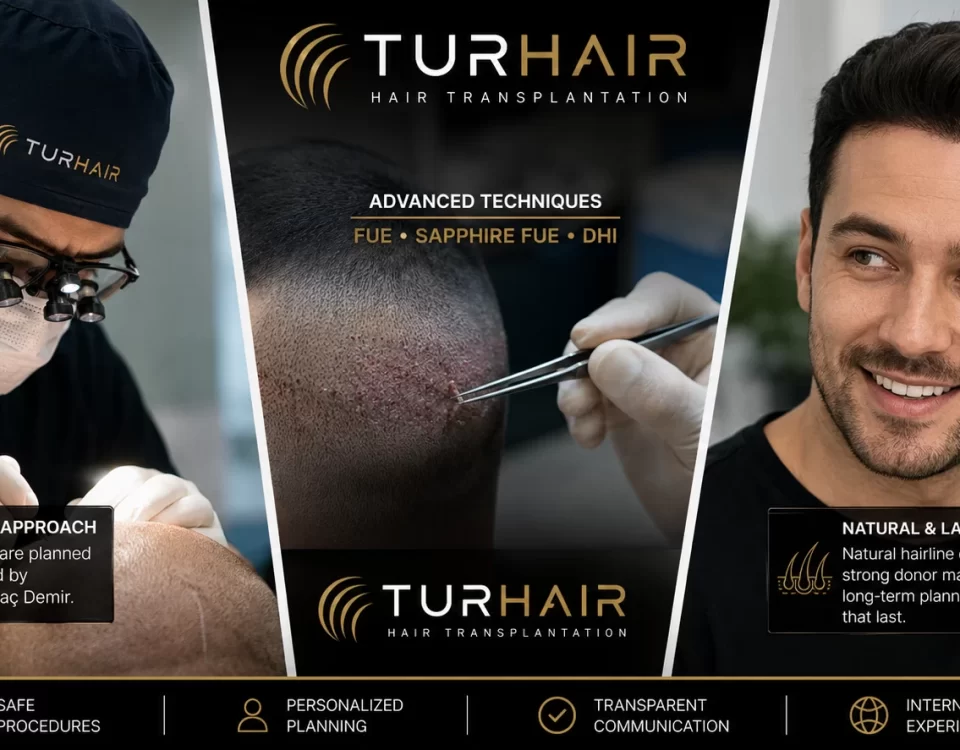
The main difference is not simply the FUE, Sapphire FUE or DHI technique. The real difference is who designs the hairline, who creates the recipient channels and who takes medical responsibility for the final result.
At TurHair, the Critical Stages Are Performed by Dr. Demir
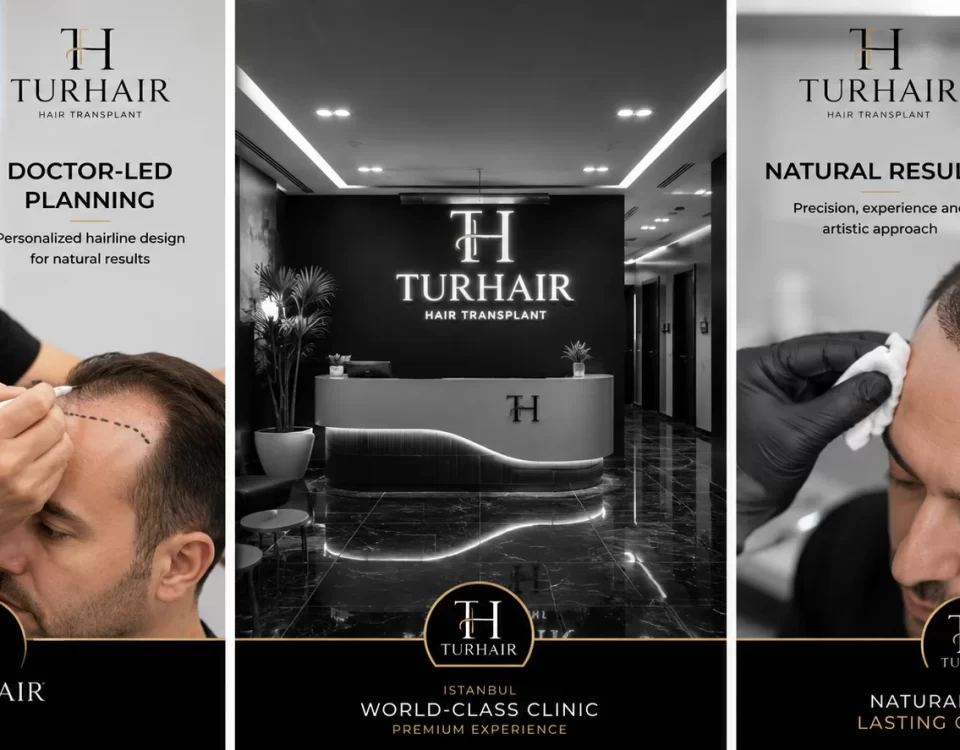
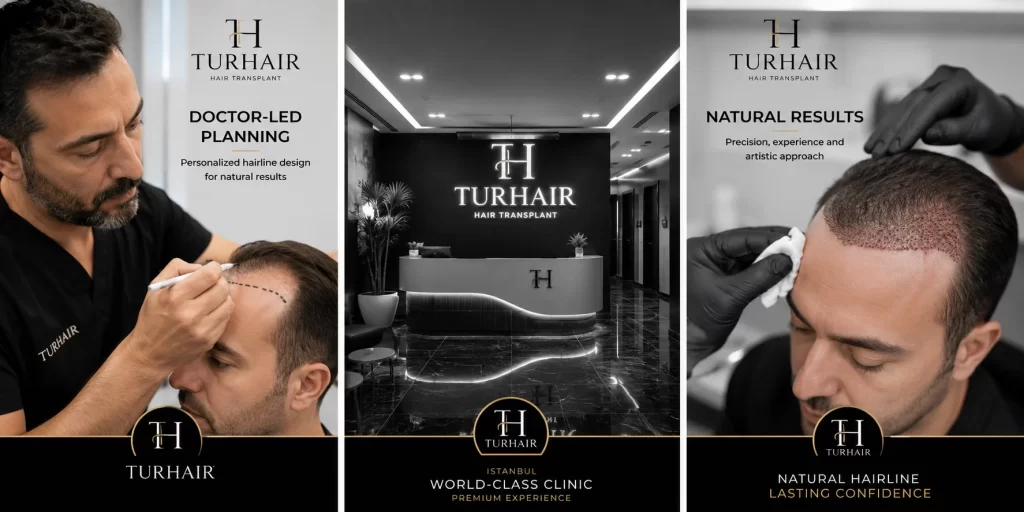
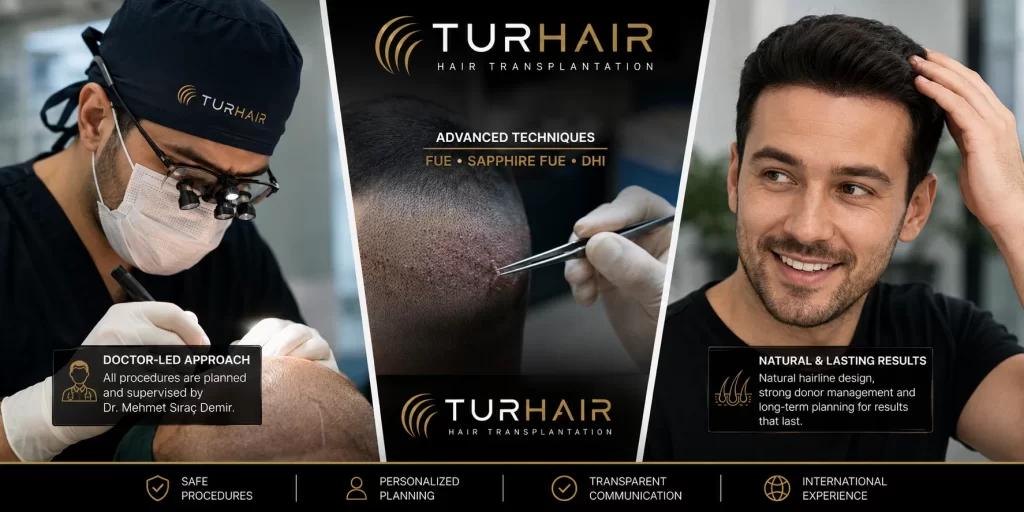
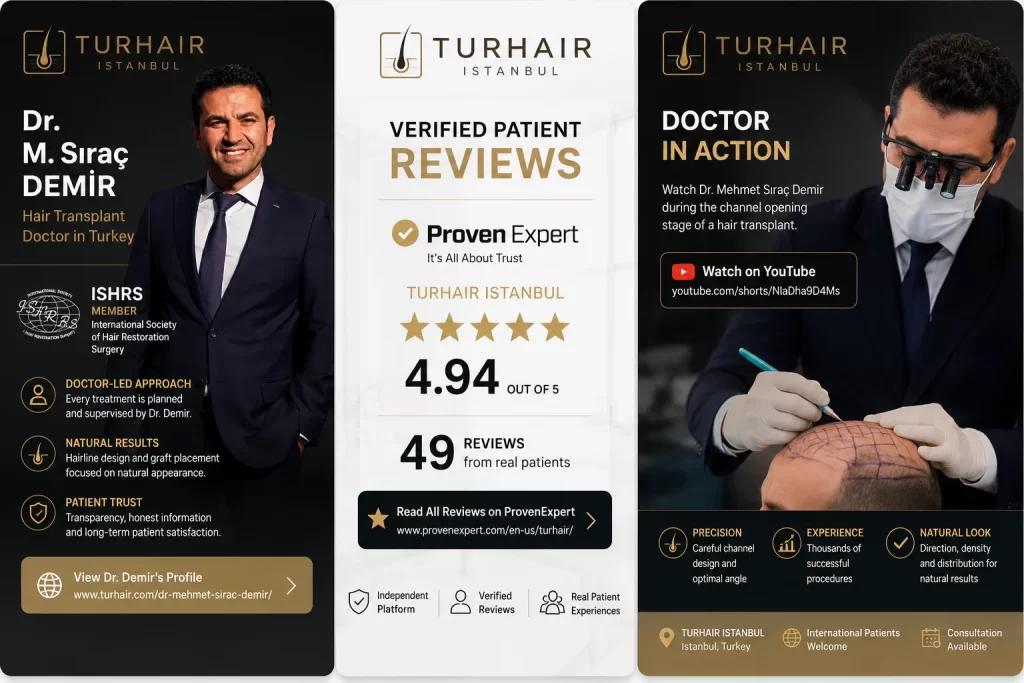
At TurHair, Dr. Demir personally performs the hairline design and recipient-channel creation. In our clinical approach, these two stages determine approximately 80% of the visible aesthetic outcome, because they directly influence the direction, angle, distribution, density and natural appearance of the transplanted hair.
| Comparison | TurHair & Dr. Demir | Technician-Led / High-Volume Clinics |
|---|---|---|
| Hairline Design | Personally designed by Dr. Demir according to facial proportions, age, donor capacity, existing hair and future hair-loss risk. | May be delegated to technicians or created from a standard template used for multiple patients. |
| Recipient-Channel Creation | Performed personally by Dr. Demir to control the angle, direction, depth and distribution of the transplanted grafts. | May be performed by rotating technical teams with limited or indirect doctor involvement. |
| Medical Evaluation | The donor area, hair-loss pattern, scalp condition and medical suitability are assessed within a doctor-led treatment plan. | Assessment may be brief, standardized or mainly handled by sales consultants before the patient meets a doctor. |
| Graft Distribution | Planned according to visual priority, donor limits, natural density transitions and long-term preservation. | May focus mainly on achieving the highest advertised graft number during a single session. |
| Donor Area Protection | Extraction planning aims to protect the donor area and preserve grafts for possible future hair loss. | High-volume extraction may increase the risk of uneven harvesting or unnecessary donor depletion. |
| Number of Patients | A limited-patient model allows more time for individualized planning and direct doctor involvement. | Several patients may be treated simultaneously by different teams under the same clinic name. |
| Medical Responsibility | The physician’s identity and responsibilities are clearly explained before surgery. | Patients may hear general expressions such as “our medical team” without knowing who performs each critical stage. |
| Treatment Philosophy | Personalized, medically supervised and focused on natural-looking, long-term results. | May be package-based, technique-focused and optimized for high daily patient volume. |
Why Is Hairline Design So Important?
A hair transplant can achieve good graft growth and still look unnatural if the hairline is designed incorrectly. The hairline must be appropriate for the patient’s age, forehead structure, facial proportions, existing hair direction and possible future hair loss.
An excessively straight, symmetrical or low hairline may look artificial and consume valuable donor grafts. Dr. Demir designs each hairline individually rather than using the same template for every patient.
Why Is Channel Creation One of the Most Critical Stages?
Recipient channels determine where the grafts will be placed and how the transplanted hair will grow. Their angle, depth, direction and distribution strongly influence the final density and natural appearance.
Channels created at an incorrect angle may cause the hair to grow in an unnatural direction. Poorly distributed channels may create visible gaps, inconsistent density or an artificial frontal appearance.
For this reason, Dr. Demir personally creates the recipient channels at TurHair. This allows the physician who designed the hairline to directly control how the grafts will be positioned within that design.
Angle
Determines how naturally the transplanted hair emerges from the scalp.
Direction
Helps the new hair follow the natural flow of the surrounding hair.
Distribution
Controls visual density and the transition between the hairline and central areas.
Depth
Supports appropriate graft positioning while minimizing unnecessary tissue trauma.
Is the Hair Transplant Technique More Important Than the Doctor?
FUE, Sapphire FUE and DHI are methods and instruments used during hair transplantation. They do not independently design a natural hairline or determine the correct angle and direction of every graft.
A sapphire blade or an implanter pen is only a tool. The final result depends on the experience, planning and aesthetic judgment of the person using it.
At TurHair, the selected technique is adapted to the patient. The patient is not adapted to a fixed marketing package.
The Role of Technicians at TurHair
Experienced technicians and medical assistants remain important members of the hair transplant team. They may assist with graft extraction, preparation, counting and implantation according to the treatment protocol.
The difference is that technicians do not replace the doctor in the stages that define the medical and aesthetic plan. At TurHair, the hairline design and channel creation are performed by Dr. Demir, while the technical team works within his plan and supervision.
Why Patients Choose TurHair and Dr. Demir
- Hairline design personally performed by Dr. Demir
- Recipient-channel creation personally performed by Dr. Demir
- Individual graft and donor-area planning
- Limited-patient, doctor-led clinic model
- Clear separation between medical and technical responsibilities
- Long-term focus rather than maximum-graft marketing
Frequently Asked Questions
Who designs the hairline at TurHair?
Dr. Demir personally designs the hairline according to the patient’s facial proportions, age, donor capacity, hair characteristics and long-term hair-loss pattern.
Who creates the recipient channels?
Dr. Demir personally performs the recipient-channel creation stage. This allows him to control the angle, direction, depth and distribution of the transplanted grafts.
Do technicians participate in the operation?
Yes. Experienced technicians assist during appropriate technical stages, but they work according to the treatment plan designed and medically supervised by Dr. Demir.
Why does TurHair emphasize design and channel creation?
In TurHair’s clinical approach, hairline design and channel creation account for approximately 80% of the visible aesthetic result because they determine how the transplanted hair is positioned and how naturally it grows.
What is the main difference between TurHair and technician-led clinics?
The main difference is direct physician involvement. At TurHair, Dr. Demir personally performs the hairline design and recipient-channel creation instead of delegating these critical stages entirely to technicians.
The Technique Is a Tool. The Result Depends on the Plan.
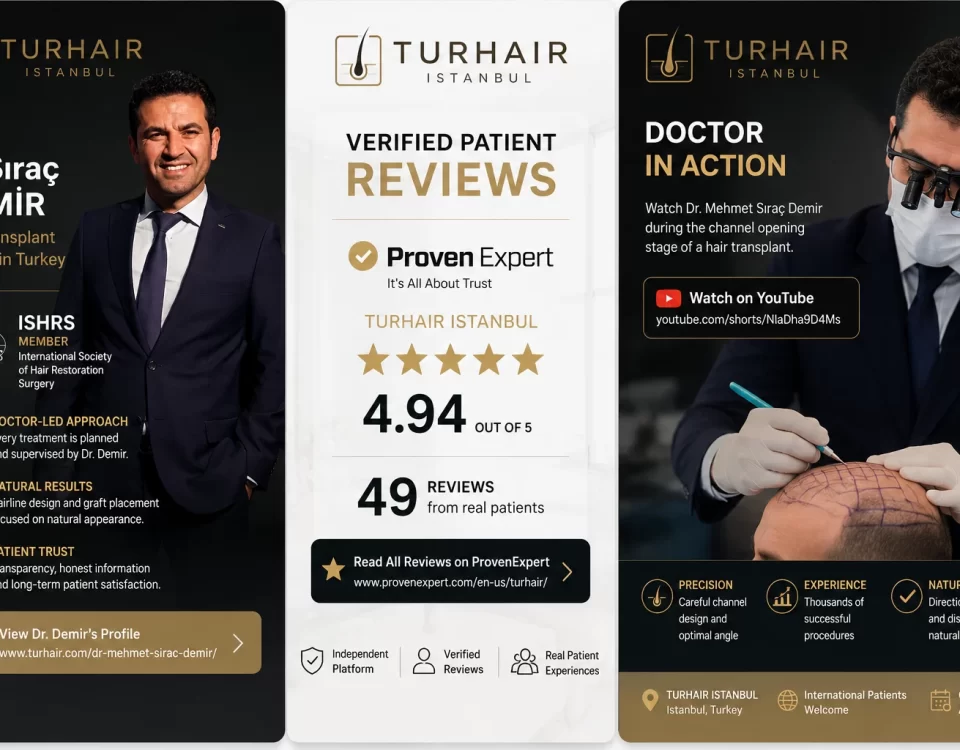
At TurHair, your hairline is designed and your recipient channels are created personally by Dr. Demir for a natural, individualized and medically supervised hair transplant.
TurHair Patient Care. Dr. Demir Medical Responsibility.
A transparent doctor-led hair transplant model combining personalized medical planning with professional international patient support.
Doctor vs Technician Hair Transplant: Key Differences
| Doctor-Led Hair Transplant | Technician-Led Hair Transplant |
|---|---|
| Medical diagnosis is performed by a doctor. | Medical evaluation may be limited or standardized. |
| Hairline design is based on medical and aesthetic planning. | Hairline design may be delegated or based on a standard template. |
| Donor capacity and future hair loss are considered. | The focus may be placed mainly on the current procedure. |
| The doctor performs or controls critical surgical stages. | Most stages may be completed by technicians. |
| Medical complications can be assessed directly. | Doctor availability may be limited. |
Why Hairline Design Should Not Be Standardized
The hairline is one of the most visible elements of a hair transplant. Even if graft growth is successful, an unnaturally low, straight or symmetrical hairline can make the result look artificial.
A properly designed hairline should take into account:
- The patient’s age
- Forehead and facial proportions
- Natural hair direction
- Hair calibre and density
- Existing miniaturized hair
- Expected future hair loss
- Available donor capacity
A young patient may request a very low hairline, but this may consume too many grafts and create problems if hair loss progresses. Medical and aesthetic judgment is therefore essential when creating a long-term plan.
Why Recipient-Site Creation Is a Critical Stage
During many FUE and Sapphire FUE procedures, small recipient sites or channels are created in the areas where the grafts will be placed. The angle, direction, depth and distribution of these sites can strongly influence the final appearance.
Incorrect direction may produce hair that grows unnaturally. Poor distribution can result in visible gaps or inconsistent density. Excessively deep or closely positioned incisions may also increase the risk of tissue trauma and poor graft survival.
Patients should ask who creates the recipient sites and what experience that person has. In a doctor-led clinic, this stage is commonly performed or directly supervised by the physician responsible for the treatment plan.
Donor Area Overharvesting
The donor area is not unlimited. Every extracted follicular unit reduces the number of grafts available for future procedures. Removing too many grafts, or extracting them unevenly, may cause visible thinning, patchiness or permanent donor damage.
This problem is known as donor overharvesting. It is one of the most difficult hair transplant complications to correct because the follicles removed from the donor area do not grow back there.
A responsible treatment plan should balance coverage with donor preservation. Advertising extremely high graft numbers does not always mean that the procedure is better. The correct number depends on the patient’s individual anatomy and long-term needs.
Possible Risks of a Poorly Planned Hair Transplant
Every surgical procedure carries potential risks. These risks may increase when planning is inadequate, hygiene standards are poor or the medical team lacks experience.
Possible hair transplant complications include:
- Unnatural or plug-like hairline
- Low graft survival
- Uneven density
- Incorrect hair direction
- Donor overharvesting
- Visible scarring
- Infection
- Excessive bleeding or swelling
- Skin necrosis in rare cases
- Need for corrective surgery
No clinic can guarantee a completely risk-free procedure. However, careful patient selection, proper medical planning, an experienced team and appropriate follow-up can help reduce avoidable problems.
Questions to Ask Before Booking a Hair Transplant
Before paying a deposit or booking flights, ask the clinic these questions:
- What is the full name and qualification of the doctor?
- Who will perform my medical consultation?
- Who will design my hairline?
- Who will determine the number and distribution of grafts?
- Who will extract the grafts?
- Who will create the recipient sites or channels?
- Who will implant the grafts?
- Will the doctor remain available during the procedure?
- How many patients does the clinic treat each day?
- What happens if a medical complication occurs?
- Can the clinic show long-term results from similar patients?
- Who provides postoperative follow-up?
Be cautious if the clinic avoids answering these questions or repeatedly refers only to “our medical team” without identifying the doctor and explaining their role.
Does a Doctor-Led Hair Transplant Guarantee a Perfect Result?
No ethical clinic should guarantee a perfect result. Hair growth depends on several factors, including donor quality, hair characteristics, circulation, smoking, medical conditions, postoperative care and the progression of future hair loss.
A doctor-led procedure does not eliminate every risk. Its main advantage is that the treatment is planned and supervised with medical accountability, rather than being approached as a standardized cosmetic service.
How to Identify a Genuine Doctor-Led Clinic
A genuine doctor-led hair transplant clinic should clearly display the doctor’s name, qualifications and professional background. Patients should receive transparent explanations about which stages are performed by the doctor and which are delegated to trained team members.
Other positive signs include:
- A limited number of procedures per day
- Personalized treatment plans
- Realistic graft estimates
- Honest discussion of limitations
- Long-term donor preservation
- Clear postoperative support
- Consistent before-and-after photography
Final Thoughts: Doctor or Technician for Hair Transplant Surgery?
The question is not whether technicians should participate in hair transplantation. Experienced technicians can be valuable members of a well-organized surgical team. The important issue is whether the procedure is medically planned, properly supervised and performed with clear responsibility.
Patients should avoid choosing a clinic based only on the cheapest package, the highest advertised graft number or a popular technique such as FUE or DHI. The experience of the doctor, the quality of the team and the level of medical involvement are often more important than marketing terminology.
Before booking your treatment, find out exactly who will design your hairline, manage your donor area, create the recipient sites and supervise the operation. A hair transplant creates permanent changes. Choosing a transparent, experienced and genuinely doctor-led hair transplant clinic can help protect both your appearance and your limited donor supply.
Frequently Asked Questions
Can a technician perform a hair transplant?
The tasks a technician may legally perform depend on local laws and medical regulations. Technicians commonly assist with extraction, graft preparation and implantation under medical supervision. Patients should confirm which stages are performed by the doctor.
What is the most important stage of a hair transplant?
Every stage is important, but diagnosis, hairline design, donor planning and recipient-site creation have a major influence on the long-term appearance of the result.
Is a cheap hair transplant more dangerous?
A low price does not automatically mean unsafe treatment. However, unusually cheap packages may involve high patient volumes, limited doctor involvement or standardized planning. Patients should investigate what is included and who performs the surgery.
How can I verify that a clinic is doctor-led?
Ask for the doctor’s full name, qualifications and exact role during the operation. Confirm who performs the consultation, hairline design, graft planning and recipient-site creation.
Why Some Hair Transplant Clinics Minimize the Doctor’s Role
Hair transplantation has become a highly competitive international industry. In popular destinations, some clinics try to reduce costs by treating several patients at the same time and delegating most of the procedure to technical teams. This business model can make hair transplant packages cheaper, but it may also reduce the amount of time a doctor spends with each patient.
In some cases, a doctor may appear only for a short consultation, sign the medical documents or briefly inspect the patient before the operation begins. The extraction, hairline preparation, recipient-site creation and implantation may then be completed almost entirely by technicians.
This does not mean that every clinic using technicians provides poor treatment. Experienced technicians are essential members of many successful hair transplant teams. The important difference is whether they are working within a clearly defined, medically supervised system or replacing the doctor during stages that require medical and aesthetic judgment.
Patients searching for a doctor-led hair transplant should therefore ask for specific details rather than relying on general phrases such as “the procedure is performed by our medical team.”
What Is a Hair Mill Clinic?
The term hair mill clinic is commonly used to describe a high-volume hair transplant facility that performs multiple procedures every day, often with limited physician involvement. These clinics may offer attractive prices, hotel packages, airport transfers and large graft numbers.
A high number of daily patients is not automatically proof of poor quality. However, the hair mill model may create several concerns:
- Patients may receive standardized hairline designs.
- The doctor may have limited time for individual assessment.
- Different technical teams may produce inconsistent results.
- Donor area planning may focus on the current operation rather than future needs.
- Postoperative communication may be handled mainly by sales staff.
- Patients may not know who will perform the procedure until surgery day.
One of the most important signs of a reliable clinic is transparency. The clinic should clearly explain how many patients are treated each day, who performs each stage and how the supervising doctor remains involved throughout the operation.
Doctor-Led FUE vs Technician-Led FUE
FUE hair transplantation involves extracting individual follicular units from the donor area and implanting them into areas affected by hair loss. Although FUE is often marketed as a single technique, the quality of the result depends heavily on planning and execution.
In a doctor-led FUE procedure, the physician typically evaluates donor density, identifies areas of miniaturization, determines safe extraction zones and plans how the grafts should be distributed. The doctor may also create the recipient sites, depending on the clinic’s protocol and local laws.
In a technician-led FUE procedure, these decisions may be made according to a standard clinic routine. This can be problematic because donor strength, hair calibre, scalp condition, hair-loss pattern and future progression are different for every patient.
FUE should not be considered a simple mechanical extraction process. Removing a follicular unit at an incorrect angle can damage the graft. Extracting too many follicles from the same area may create visible thinning. Placing grafts without considering natural direction can produce an artificial appearance.
The technique name alone does not determine quality. Patients should focus on the experience of the person performing each stage and the level of medical supervision provided.
Doctor-Led DHI vs Technician-Led DHI
DHI hair transplantation generally refers to implantation with a pen-shaped device, often known as an implanter pen. In marketing, DHI is sometimes presented as an advanced alternative that automatically guarantees higher density, faster recovery or better graft survival.
In reality, an implantation tool cannot replace proper diagnosis, donor management or hairline planning. The experience of the team using the device is more important than the device itself.
During a doctor-led DHI procedure, the physician should determine whether the technique is suitable for the patient, how many grafts can safely be extracted and how the final density should be distributed. The doctor should also evaluate whether DHI is genuinely beneficial for the treatment area.
In a technician-led DHI clinic, the procedure may be sold mainly as a premium package without clearly explaining who performs the critical steps. Patients should remember that DHI pens are tools. They do not independently determine angle, depth, density or long-term aesthetic design.
Can a Bad Hair Transplant Be Repaired?
A failed or unnatural hair transplant can sometimes be improved with a corrective procedure, but repair surgery is usually more complicated than a first operation. The treatment options depend on the type of problem, the remaining donor capacity and the condition of the scalp.
Common reasons patients seek corrective hair transplantation include:
- An unnaturally straight or low hairline
- Plug-like graft placement
- Poor density
- Incorrect hair direction
- Visible donor scarring
- Overharvested donor areas
- Large gaps between transplanted grafts
- Asymmetrical hairline design
Correction may involve removing incorrectly placed grafts, redistributing existing hairs, adding density, using scalp micropigmentation or redesigning the frontal hairline. However, not every problem can be fully corrected.
If the donor area has already been severely overharvested, the number of available grafts may be limited. This is one reason why choosing the right clinic for the first procedure is so important.
How Doctor Experience Can Influence Natural Results
A natural hair transplant requires more than graft growth. The transplanted hair must match the patient’s existing hair in direction, angle, density and distribution.
Single-hair grafts are usually preferred in the front of the hairline, while grafts containing multiple hairs may be placed further behind to improve visual density. Using thick multi-hair grafts directly at the front can create a plug-like appearance.
An experienced hair transplant doctor should understand how to:
- Create irregular micro-variations in the hairline
- Adjust the design according to facial proportions
- Place grafts at natural angles
- Preserve donor follicles for future hair loss
- Blend transplanted hair with existing hair
- Avoid placing excessive density in poorly vascularized areas
These decisions require both medical understanding and aesthetic experience. They cannot be replaced by a fixed template or a standard graft-count package.
The Problem With Guaranteed Graft Numbers
Some clinics advertise packages containing a guaranteed number of grafts before examining the patient in person. This may appear attractive, especially to patients with advanced hair loss, but a high graft number is not always a sign of quality.
The safe number of grafts depends on:
- Donor area density
- Hair thickness
- Scalp elasticity
- Follicular unit distribution
- Previous procedures
- Future hair-loss risk
- The size of the recipient area
Extracting the maximum possible number during a single session may leave the donor area weak and visibly depleted. A doctor-led clinic should recommend the number of grafts that is medically and aesthetically appropriate, not simply the largest number that can be used in marketing.
Red Flags When Choosing a Hair Transplant Clinic
Patients should be cautious when they notice one or more of the following warning signs:
- The clinic refuses to provide the doctor’s full name.
- The sales representative cannot explain who performs each stage.
- The doctor’s qualifications are difficult to verify.
- The clinic promises a guaranteed perfect result.
- A very high graft number is offered without proper examination.
- The same hairline design appears on every patient.
- The clinic performs many procedures simultaneously.
- The price changes constantly during the sales conversation.
- Before-and-after photos use inconsistent lighting or angles.
- The clinic avoids discussing risks or limitations.
A trustworthy clinic should be willing to explain both the benefits and limitations of hair transplantation. It should not pressure the patient into making an immediate payment or use fear-based sales tactics to force a booking.
Why Transparency Is More Important Than Marketing
Terms such as Sapphire FUE, DHI, painless hair transplant and maximum graft transplant are frequently used in advertising. While some tools and methods may be useful in appropriate cases, marketing terminology should not distract patients from the most important questions.
Who designed the hairline? Who assessed the donor area? Who created the recipient sites? Who will be responsible if a complication occurs?
A transparent clinic should provide clear answers before the patient travels. The patient should understand the doctor’s role, the technician’s role, the expected graft range, the limitations of the donor area and the realistic outcome.
The best hair transplant decision is not based on the most impressive advertisement. It is based on medical responsibility, honest communication, careful planning and a team that understands the permanent nature of the procedure.
Why Medical Evaluation Before Hair Transplant Surgery Is Essential
One of the biggest differences between a doctor-led hair transplant clinic and a high-volume clinic is the quality of the medical evaluation before surgery. A hair transplant is a medical procedure, not simply a cosmetic service. Every patient presents unique characteristics that should be carefully assessed before planning treatment.
A qualified hair transplant doctor should evaluate several factors, including the pattern of hair loss, donor area quality, scalp condition, family history, current medications, previous procedures, age, and future expectations. This evaluation helps determine whether surgery is appropriate and what type of result can realistically be achieved.
Not every patient is an ideal candidate for immediate surgery. Some patients may benefit from medical treatment first, while others should postpone surgery until their hair loss becomes more stable. Honest medical advice can sometimes mean recommending that a patient wait rather than scheduling surgery immediately.
A thorough consultation also allows the doctor to explain possible limitations. Patients with extensive hair loss, poor donor density, very fine hair or multiple previous procedures may require different treatment strategies than younger patients with localized hairline recession.
The Importance of Long-Term Hair Loss Planning
Hair transplantation produces permanent changes, but hair loss itself often continues throughout life. This is why experienced doctors think beyond the first operation. A successful result should continue to look natural ten or even twenty years after surgery.
Many young patients request an aggressive juvenile hairline because they want maximum density. While this may appear attractive initially, future hair loss can leave transplanted hair isolated if the surrounding native hair continues to thin.
A doctor-led clinic should consider future Norwood progression, family history, donor reserves and long-term aesthetics before deciding where each graft should be placed.
This type of planning helps preserve donor resources while maintaining flexibility for possible future procedures.
Understanding Donor Area Capacity
The donor area is one of the most valuable resources in hair transplantation. Every patient has a limited supply of permanent follicular units that can safely be transplanted during their lifetime.
Donor capacity depends on several factors:
- Hair density
- Hair thickness
- Hair colour
- Scalp elasticity
- Follicular unit distribution
- Previous surgeries
- Overall donor health
Patients sometimes believe that extracting more grafts automatically produces a better result. In reality, removing too many follicles during a single session can permanently reduce donor density and create visible thinning.
Proper donor management focuses on achieving balanced coverage while protecting future options if additional procedures become necessary.
Natural Hairline Design Requires Experience
A natural-looking hairline cannot simply be copied from another patient. Every face has different proportions, forehead dimensions, temple angles and hair characteristics.
Experienced doctors generally avoid perfectly straight or symmetrical hairlines because natural hairlines contain subtle irregularities. Small variations help create a softer appearance that blends naturally with existing hair.
Hair calibre also influences design. Patients with coarse hair often require fewer grafts to achieve visual density than patients with fine hair. Curl pattern, skin colour contrast and hair direction also influence the final appearance.
These details explain why individualized planning is far more important than standardized templates.
Hair Transplant Technology Cannot Replace Experience
Modern hair transplant clinics frequently advertise Sapphire FUE, DHI, robotic extraction, advanced implantation systems and other technologies. While these tools may be useful in selected cases, technology alone does not guarantee excellent results.
A sapphire blade is simply an instrument. An implanter pen is simply an implantation device. Their effectiveness depends entirely on the experience of the medical team using them.
Excellent results have been achieved with different techniques over many years because careful planning, proper execution and realistic expectations remain more important than marketing terminology.
How Patient Selection Influences Success
One characteristic of responsible medical practice is appropriate patient selection. Ethical clinics understand that not every patient should undergo surgery immediately.
Examples include:
- Patients with uncontrolled medical conditions.
- Patients experiencing rapid hair loss.
- Patients with unrealistic expectations.
- Patients with insufficient donor capacity.
- Patients suffering from active scalp disease.
In some situations, medical treatment, observation or lifestyle modification may be recommended before considering surgery.
A clinic that recommends surgery for every patient without careful assessment should encourage additional questions from prospective patients.
Setting Realistic Expectations
Hair transplantation can significantly improve appearance, but it cannot restore the density of childhood hair. Even the most experienced surgeons work within biological limitations.
Patients should understand that:
- Density depends on donor supply.
- Hair growth requires time.
- Results continue developing for 12–18 months.
- Future hair loss may require additional treatment.
- Individual healing varies.
Responsible doctors discuss these realities before surgery rather than promising unrealistic outcomes.
Why Communication Matters
Communication is often overlooked when comparing clinics, yet it plays a major role throughout the patient journey. Before surgery, patients should receive clear explanations regarding the procedure, expected recovery, possible risks and postoperative care.
After surgery, ongoing communication becomes equally important. Patients may have questions regarding washing, medications, swelling, exercise, shedding and hair growth.
A structured follow-up programme helps identify concerns early and provides reassurance during the recovery period.
Questions Patients Rarely Ask — But Should
Many patients focus exclusively on price or graft numbers. However, asking additional questions can provide valuable insight into a clinic’s philosophy.
- How is donor preservation planned?
- How many years has the doctor performed hair transplantation?
- How many similar cases has the clinic treated?
- How are complications managed?
- What happens if additional surgery becomes necessary?
- Will postoperative photographs be compared over time?
- How is long-term hair loss monitored?
The quality of these answers often tells patients more than any advertisement or promotional video.
Final Advice Before Choosing a Hair Transplant Clinic
Selecting a hair transplant clinic is an important long-term decision. Patients should compare more than prices or package offers. Medical experience, transparency, individualized planning and realistic communication are all valuable indicators of quality.
Whether considering FUE, Sapphire FUE or DHI, patients should clearly understand who performs every stage of the procedure, how donor resources will be protected and what level of medical supervision will be provided throughout treatment.
A successful hair transplant is the result of careful diagnosis, thoughtful planning, skilled execution and appropriate follow-up care. Taking time to research these factors before surgery can help patients make informed decisions and set realistic expectations for long-term results.
Common Hair Transplant Mistakes That Can Affect Long-Term Results
One of the biggest misconceptions about hair transplantation is that the procedure ends once the grafts have been implanted. In reality, every stage of the operation influences the final outcome. A successful hair transplant depends on proper diagnosis, individualized planning, surgical precision, postoperative care, and realistic patient expectations.
Many disappointing outcomes are not caused by poor graft survival alone. Instead, they result from planning mistakes made before the first follicle is extracted. Understanding these common errors can help patients choose a qualified doctor-led hair transplant clinic and avoid unnecessary complications.
1. Choosing a Clinic Based Only on Price
Price is naturally an important consideration, especially for patients travelling abroad for treatment. However, selecting the cheapest clinic without evaluating medical quality can be a costly mistake.
Very low prices may reflect high patient volume, shorter consultation times or limited physician involvement. Patients should always compare what is included in the treatment rather than focusing only on the advertised package price.
Questions such as who performs the consultation, who designs the hairline and who supervises the procedure are often more important than the difference of a few hundred euros.
2. Focusing Only on Graft Numbers
Many advertisements promote extremely high graft numbers. While a larger number of grafts may seem attractive, more is not always better.
The correct graft count depends on the patient’s donor density, scalp condition, pattern of hair loss and long-term treatment plan. Extracting unnecessary grafts simply to advertise a larger procedure may increase the risk of donor depletion.
Experienced doctors generally recommend the number of grafts that provides the best balance between coverage today and donor preservation for the future.
3. Ignoring Future Hair Loss
Hair transplantation should never be planned only for the present. Most forms of androgenetic alopecia continue to progress over time.
If future hair loss is ignored, patients may eventually develop isolated transplanted areas surrounded by thinning native hair. This can create an unnatural appearance and require additional corrective procedures.
Long-term planning is one of the most important advantages of a doctor-led approach. Every graft should be placed with the future in mind.
4. Standardized Hairline Designs
Every patient’s face is unique. The ideal hairline depends on forehead size, facial proportions, age, hair characteristics and personal goals.
Using the same hairline template for every patient may produce acceptable short-term photographs but unnatural long-term results.
Natural hairlines contain small irregularities, varying densities and gradual transitions. These subtle characteristics are often what make a transplant appear invisible.
5. Poor Donor Area Management
The donor area contains a limited supply of permanent follicles. Once removed, these follicles cannot regenerate in the donor region.
Removing grafts unevenly or excessively may leave visible thinning, especially when patients choose shorter hairstyles. Proper donor management requires careful extraction patterns that preserve a natural appearance while maintaining sufficient reserves for future procedures.
This is why experienced clinics spend significant time evaluating donor capacity before surgery begins.
6. Unrealistic Expectations
Hair transplantation can improve hair density and restore confidence, but it cannot recreate the density of adolescence.
Responsible clinics explain that final density depends on available donor supply, individual healing and continued hair loss. Honest communication before surgery helps prevent disappointment later.
7. Inadequate Postoperative Care
The operation itself represents only one part of the treatment process. Recovery instructions should be followed carefully to maximize graft survival.
- Avoid touching newly implanted grafts.
- Follow washing instructions exactly.
- Protect the scalp from direct trauma.
- Avoid smoking if advised by your physician.
- Take prescribed medications correctly.
- Attend scheduled follow-up appointments.
Good postoperative care supports healthy healing and allows the transplanted follicles to establish themselves during the early recovery period.
How Transparency Builds Patient Confidence
Patients deserve clear information before committing to surgery. A reputable clinic should openly explain who performs every stage of the operation, how many procedures are completed each day and what role the supervising doctor plays throughout treatment.
Transparency also includes discussing limitations. Ethical doctors explain what can realistically be achieved rather than promising perfect density or lifetime guarantees.
Ultimately, choosing a doctor-led hair transplant clinic is about more than qualifications alone. It reflects a commitment to individualized planning, medical responsibility and long-term patient care rather than standardized treatment packages.
Why Personalized Treatment Plans Produce Better Hair Transplant Results
No two patients experience hair loss in exactly the same way. Even individuals with a similar Norwood classification may have completely different donor density, hair texture, scalp flexibility, and long-term hair loss progression. For this reason, experienced clinics avoid using identical treatment plans for every patient.
A personalized treatment plan begins with a comprehensive consultation. During this stage, the doctor evaluates the patient’s medical history, current medications, previous procedures, family history of hair loss, and overall scalp condition. This information helps determine the safest and most effective approach for surgery.
Patients should be cautious if a clinic provides an exact graft number or promises maximum density without first examining the scalp carefully. Hair transplantation should always be planned according to the individual rather than a fixed package.
The Role of Medical Ethics in Hair Transplant Surgery
Ethics play an essential role in every medical procedure, including hair transplantation. A responsible clinic should recommend surgery only when it is likely to benefit the patient. In some situations, the best medical advice may actually be to postpone surgery or explore non-surgical treatments first.
Examples include patients experiencing rapid hair loss, those with unstable donor areas, individuals suffering from active scalp disease, or patients whose expectations are unrealistic.
Ethical hair transplant doctors understand that declining an unsuitable procedure protects both the patient’s health and the clinic’s professional reputation.
Why Before-and-After Photos Can Be Misleading
Before-and-after photographs are useful, but they should never be the only factor when selecting a hair transplant clinic. Images can be influenced by lighting, hairstyle, camera angle, hair length, or styling products.
Patients should look for consistency across multiple cases rather than focusing on a single impressive transformation.
Questions worth asking include:
- Were all photographs taken under similar lighting?
- How many months after surgery were the results photographed?
- Can the clinic show patients with similar hair loss?
- Are there photographs of the donor area as well as the recipient area?
- Can long-term results be demonstrated after several years?
Long-term consistency often provides more valuable information than dramatic early photographs.
Hair Transplant Recovery: What Patients Should Expect
Recovery varies from one patient to another, but most people experience a predictable healing process.
During the first few days, mild swelling, redness and small scabs are common. These symptoms gradually improve as the scalp heals.
Many patients experience temporary shedding of transplanted hairs within the first few weeks. This stage, commonly known as shock loss, is a normal part of the hair growth cycle and should not immediately be interpreted as treatment failure.
New hair growth generally begins several months after surgery, while the final cosmetic result usually develops gradually over twelve months or longer.
Signs of a Professional Hair Transplant Clinic
Patients comparing clinics should consider several quality indicators beyond advertising or social media popularity.
- Transparent explanation of the doctor’s role.
- Detailed medical consultation.
- Personalized treatment planning.
- Realistic graft recommendations.
- Clear postoperative instructions.
- Professional communication before and after surgery.
- Consistent long-term patient results.
- Comprehensive informed consent.
These characteristics often indicate that the clinic prioritizes patient safety and long-term outcomes rather than simply maximizing daily procedure numbers.
Why Research Before Surgery Is So Important
Choosing a hair transplant clinic should never be an impulsive decision. Patients should compare several clinics, read independent reviews, verify medical qualifications, request detailed explanations and ask direct questions about every stage of the procedure.
Travelling abroad for treatment can provide access to experienced clinics and competitive pricing, but patients should avoid making decisions based only on promotional offers or limited-time discounts.
A careful comparison of experience, transparency, communication and medical responsibility often provides a much better indication of quality than marketing alone.
🔗 Related Hair Transplant Guides
- Hair Transplant Risks: What Every Patient Should Know
Learn about the most common hair transplant risks and how choosing a doctor-led clinic helps minimize complications. - Doctor-Led Hair Transplant Turkey
Discover why experienced surgeons play the most important role in achieving natural-looking hair transplant results. - Surgeon Performed Hair Transplant Turkey
Understand the difference between surgeon-performed and technician-led procedures. - Technician Hair Transplant Turkey
Find out the risks and limitations of technician-only hair transplant clinics. - Hair Transplant Repair Turkey
Learn how failed hair transplants can be corrected with proper planning and experienced surgeons. - Hair Transplant Revision Turkey
Everything you need to know about revision procedures after unsuccessful hair transplants. - Doctor-Led Hair Transplant Cost in Turkey
Compare pricing, doctor involvement, and long-term value before making your decision. - Is a Cheap Hair Transplant Worth the Risk?
See why choosing the lowest price can sometimes lead to expensive revision surgery.
The discussion surrounding doctor vs technician hair transplant is not intended to diminish the important contribution made by experienced technicians. Skilled technicians are valuable members of many successful surgical teams and often assist throughout the procedure.
The key issue is understanding who is responsible for diagnosis, treatment planning, hairline design, donor preservation and medical supervision. These decisions require clinical judgment, aesthetic experience and accountability.
Patients should feel comfortable asking detailed questions before booking surgery. A reputable clinic will welcome these questions, provide transparent answers and explain exactly how the procedure will be performed.
Ultimately, successful hair transplantation depends on far more than the technique used or the number of grafts transplanted. Careful planning, realistic expectations, personalized treatment and appropriate medical supervision remain the foundations of natural, long-lasting hair transplant results.