Doctor vs Technician Hair Transplant: What’s the Difference?
August 14, 2026
Hair Transplant Turkey Before After
August 15, 2026How to Avoid Hair Mills in Turkey: A Complete Hair Transplant Safety Guide
How to avoid hair mills in Turkey is one of the most important questions international patients should ask before booking a hair transplant. Turkey, particularly Istanbul, has become one of the world’s best-known destinations for hair restoration. The country has experienced Turkish doctors, modern hospitals and clinics, and extensive experience treating international patients.
However, the enormous growth of hair transplant tourism in Turkey has also created a major problem: high-volume operations commonly described as hair mills. Unfortunately, identifying them is becoming increasingly difficult because virtually no clinic describes itself as a hair mill. Many technician-driven businesses now advertise themselves as “doctor-led,” “premium” or “medical” clinics.
What Is a Hair Mill?
A hair transplant hair mill is generally a high-volume operation where multiple patients may undergo procedures every day and substantial parts of treatment may be delegated to technicians. The central concern is not simply the number of patients. The important questions are who examines the patient, who designs the hairline, who makes the medical decisions, who performs the surgical stages, and which licensed physician takes responsibility for the procedure.
A clinic performing several procedures is not automatically a hair mill. Likewise, technicians assisting a doctor does not automatically make a clinic unsafe. Hair transplantation requires a medical team. The warning sign appears when technicians effectively replace the physician while marketing gives patients the impression that an experienced doctor will personally manage the operation.
Why Are Hair Mills So Difficult to Identify?
The biggest misconception is believing that hair mills openly admit how they operate. They usually do not. In fact, many businesses accused of technician-driven models specifically advertise that they are “not a hair mill”.
Modern hair transplant marketing can be extremely sophisticated. A website can show expensive cars, five-star hotels, translators, large facilities and hundreds of transformation photographs. None of these elements verifies the medical structure behind the procedure.
Some businesses primarily focused on foreign patients may be heavily driven by international marketing teams, coordinators and sales representatives while providing surprisingly little transparent information about the licensed physician responsible for treatment. This can unfairly damage the international reputation of Turkey and of legitimate Turkish physicians who have spent years building their medical careers.
The nationality of a clinic owner, coordinator or employee alone does not determine medical quality. What matters is whether treatment is carried out legally and transparently by appropriately qualified medical professionals. Nevertheless, when travelling specifically to Turkey for surgery, patients should make a particular effort to identify and independently verify the licensed Turkish physician responsible for their treatment, rather than relying on a salesperson or an internationally branded clinic name.
1. Choose the Doctor Before Choosing the Brand
One of the strongest ways to avoid hair mills in Turkey is to change the way you search.
Instead of asking:
“What is the best hair transplant clinic in Turkey?”
ask:
“Who is the doctor responsible for my hair transplant?”
A clinic name is a commercial brand. Your medical treatment ultimately requires identifiable medical responsibility. Before paying a deposit, you should know the doctor’s full name and understand exactly what that doctor will do during your operation.
Be cautious if the website repeatedly uses expressions such as “our specialists,” “our medical experts” or “our experienced team” but makes it difficult to identify one specific physician.
2. Check the Doctor’s Medical CV
A legitimate physician should have a professional history that can be examined independently. A short marketing biography saying someone is a “world-famous hair transplant specialist” is not the same thing as a medical CV.
Look for information including:
- Full name of the physician
- Medical school and education
- Graduation information
- Professional medical experience
- Hair restoration experience
- Relevant training and certificates
- Professional memberships
- Scientific or educational activities where applicable
Ideally, this information should be clearly published on the provider’s website. If a business expects an international patient to travel thousands of kilometres for surgery, identifying the responsible doctor should not be difficult.
3. Verify Diplomas, Certificates and Memberships
Patients should also investigate the physician’s medical diploma, professional certificates and memberships. Where appropriate, clinics can publish credential information so prospective patients can understand who will be treating them.
However, seeing a certificate logo on a website is not enough.
If the doctor claims membership in a recognized professional organization, try to verify that membership through the organization’s official directory. Patients should distinguish between a real professional credential and a marketing badge.
| What to Check | More Transparent Provider | Possible Warning Sign |
|---|---|---|
| Doctor | Full name clearly published | Doctor difficult to identify |
| Medical CV | Education and experience available | Only promotional biography |
| Credentials | Verifiable diploma/certificates | Unverifiable badges and titles |
| Doctor’s Role | Clearly explained before booking | Vague answers about who does what |
| Daily Volume | Reasonable and transparent | Assembly-line approach |
4. Ask Exactly What the Doctor Will Do
Never settle for the statement “a doctor supervises the procedure.” Supervision can mean very different things.
Before booking a hair transplant in Istanbul, ask specifically:
- Who performs the medical consultation?
- Who evaluates the donor area?
- Who determines the safe graft number?
- Who designs the hairline?
- Who administers or supervises anesthesia?
- Who performs the extraction?
- Who creates the recipient channels/incisions?
- Who performs implantation?
- Will the named doctor actually be present during my procedure?
A serious provider should answer these questions clearly before receiving your money.
5. Be Careful With Extremely High Patient Volumes
Hair transplantation requires individualized planning. Donor capacity, hair calibre, age, future hair loss, scalp characteristics and the patient’s long-term expectations are different for every person.
When one advertised doctor appears to be responsible for a very large number of simultaneous operations, ask a simple question: how much time can that physician realistically spend with each patient?
High volume alone does not prove malpractice, but it should encourage patients to investigate exactly how responsibilities are divided between doctors and technicians.
6. Do Not Choose a Clinic Only Because It Is Cheap
Turkey can offer attractive hair transplant prices compared with Western Europe or North America. That does not mean the cheapest offer represents the best value.
A hair transplant permanently uses limited donor follicles. If too many grafts are extracted, the donor area may become visibly depleted. If the hairline is poorly designed, correcting it later may require another operation while fewer donor grafts remain available.
For this reason, patients comparing hair transplant prices in Turkey should compare medical involvement and physician credentials alongside price.
7. Do Not Confuse Sales Coordinators With Medical Professionals
International clinics naturally employ translators and patient coordinators. They can be extremely helpful for travel arrangements and communication.
But a coordinator should not replace a physician when answering medical questions.
If almost all communication occurs with a salesperson and you cannot determine which doctor will treat you until the day of surgery, consider this a significant warning sign.
8. Research the Turkish Doctor Independently
For international patients considering surgery in Turkey, one of the most useful safeguards is finding an identifiable Turkish medical doctor whose background can be independently checked.
Search the doctor’s full name separately from the clinic. Examine their medical history, experience, memberships and professional footprint. A legitimate doctor’s career should exist independently of Instagram advertisements or a clinic’s sales page.
This distinction is important because the international growth of hair transplantation has attracted many commercially oriented businesses. The actions of poorly transparent operators should not be confused with the work of Turkey’s qualified physicians.
9. Ask for a Long-Term Treatment Plan
A good hair transplant is not simply about placing the maximum possible number of grafts today. Hair loss can continue for decades.
A physician should consider donor preservation, future thinning, age, hair-loss pattern and realistic density. Extremely aggressive graft promises without adequate donor assessment should therefore be approached carefully.
Hair Mill Red Flags Checklist
- No clearly identified doctor on the website
- No detailed medical CV
- Diploma or qualifications cannot be verified
- Unclear answers about who performs surgical stages
- Salesperson handles almost every medical question
- Doctor’s name is revealed only after payment or arrival
- Very large numbers of patients treated simultaneously
- Focus on hotel and VIP transport instead of medical credentials
- Unrealistic graft promises
- Heavy discounts or pressure to pay immediately
- Claims of being “doctor-led” without explaining the doctor’s actual role
Final Advice: Verify the Doctor, Not Just the Clinic
The safest approach to avoiding hair mills in Turkey is simple: investigate the physician before trusting the brand.
Turkey has highly experienced doctors and has earned an important position in international hair restoration. Unfortunately, the rapid expansion of medical tourism has also allowed technician-driven and commercially focused operations to market themselves as medical clinics. Some may even explicitly claim that they are not hair mills while providing limited information about the physician actually responsible for surgery.
Patients should therefore look for an identifiable and appropriately licensed Turkish doctor, a transparent medical CV, verifiable education, relevant certificates or professional memberships, and a clear explanation of the doctor’s role in every important stage of the procedure.
Do not choose a hair transplant based solely on a clinic name, Instagram account, hotel package or price. Choose based on the medical professional who will be responsible for your donor area, your hairline and your long-term result.
Why TurHair and Dr.Demir Are Different From Many Hair Transplant Clinics
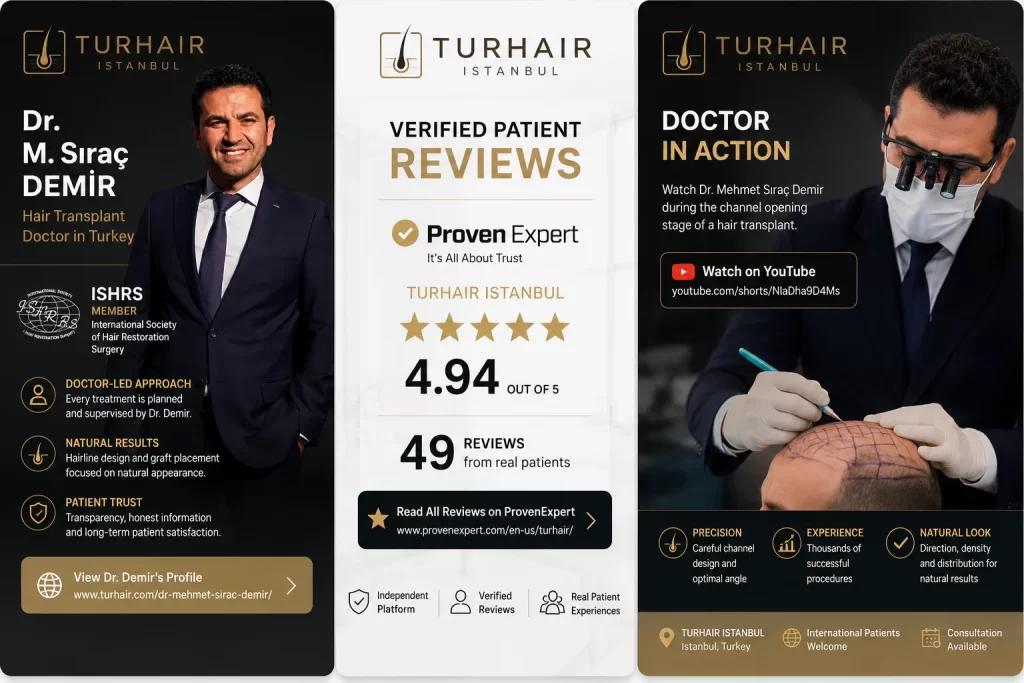
When comparing a hair transplant in Turkey, patients should look beyond the clinic name, hotel package, airport transfer or social-media presence. The most important question is who is medically responsible for the procedure. At TurHair, the physician is clearly identified: Dr. Mehmet Sıraç Demir. His professional background, medical experience and role in the treatment process are presented transparently rather than hidden behind generic expressions such as “our medical team” or “our specialists.”
| Comparison | TurHair & Dr.Demir | Many High-Volume / Technician-Driven Clinics |
|---|---|---|
| Doctor Identity | The responsible physician is clearly identified as Dr. Mehmet Sıraç Demir. | The doctor’s identity may be difficult to find, presented vaguely or revealed only shortly before treatment. |
| Medical Background | Patients can review the doctor’s professional background, experience and medical profile before booking. | Websites may focus heavily on marketing while providing little detailed information about the physician’s education or CV. |
| Hairline Design | In the appropriate TurHair package, the hairline is designed by Dr. Demir according to facial proportions, donor capacity and long-term hair-loss planning. | Hairline planning may sometimes be standardized or heavily delegated to technicians or coordinators. |
| Recipient Channels | With the relevant doctor-led package, Dr. Demir personally creates the recipient channels, one of the key stages influencing angle, direction and distribution. | In technician-driven models, critical stages may be delegated despite the clinic being advertised as doctor-supervised. |
| Donor Management | Planning emphasizes safe donor management, realistic graft numbers and preservation of donor reserves for the future. | Some high-volume clinics may market very large graft numbers because they are easier to sell commercially. |
| Patient Volume | The focus is on individualized planning and medical responsibility rather than an assembly-line concept. | Multiple patients may undergo procedures simultaneously under one brand, reducing direct physician involvement. |
| Doctor vs. Technician Model | Technicians work as part of the medical team, but the physician’s role and responsibility are clearly defined. | Technicians may effectively perform most of the procedure while the doctor has limited contact with the patient. |
| Transparency | Doctor identity, experience and treatment approach are presented openly so patients can investigate before traveling. | Marketing may emphasize luxury transport, hotel accommodation and package pricing more than medical responsibility. |
| Long-Term Planning | The objective is not simply maximum graft extraction. Age, future hair loss, donor capacity and possible future procedures are considered. | A short-term “maximum grafts” approach may be prioritized over preservation of the donor area. |
| Professional Verification | Patients are encouraged to research Dr. Mehmet Sıraç Demir, his CV and relevant professional credentials independently. | Some clinics rely mainly on reviews, influencers or marketing claims without making the operating physician easy to verify. |
TurHair’s core difference: patients are encouraged to choose a doctor, not merely a clinic brand. Dr. Mehmet Sıraç Demir is an identifiable Turkish physician with a transparent professional profile, and his direct medical involvement can be clearly explained before the patient travels to Istanbul.
Why This Matters When Trying to Avoid a Hair Mill
A clinic can claim that it is “not a hair mill,” but that statement alone proves nothing. Patients should verify who the doctor is, what stages the doctor personally performs, whether the doctor’s CV, diploma, qualifications and professional memberships can be checked, and whether important medical decisions are made by the physician rather than a sales coordinator. This transparency is one of the main differences between a genuinely doctor-led hair transplant in Turkey and a high-volume technician-driven business.
How to Know If a Hair Transplant Clinic Is Truly Doctor-Led
One of the biggest mistakes patients make when trying to avoid hair mills in Turkey is assuming that simply seeing one doctor’s name on a clinic website means the operation is doctor-led. Unfortunately, this is not always enough. A clinic can place a doctor’s photograph, biography and medical title prominently on its website while the actual hair transplant procedures are carried out largely by technicians.
For this reason, patients should not ask only “Is there a doctor?” The more important question is: “What does the doctor personally do during my operation?”
⚠️ Important: Having a doctor’s name on a website does not automatically prove that a clinic is not a hair mill. The doctor’s actual involvement, daily patient volume and responsibility for critical surgical stages are much more important.
🩺 1. The Doctor Should Be More Than a Name on the Website
Some high-volume clinics understand that international patients are becoming more cautious about technician-driven hair transplantation. As a result, they may prominently display the name of a single physician and describe the clinic as “doctor-led.”
But the existence of a named doctor should only be the beginning of your investigation. Patients should ask whether that physician actually examines them, evaluates the donor area, decides the graft strategy, designs the hairline and performs the most critical surgical stages.
If the doctor appears only for a short consultation while technicians perform practically the entire procedure, patients should be cautious about assuming that the clinic is genuinely doctor-led.
✍️ 2. The Doctor Should Personally Create the Recipient Channels
One of the most important questions to ask is who creates the recipient channels or incisions. These channels determine where the transplanted follicles will be placed and strongly influence the angle, direction and distribution of the final result.
In a genuinely physician-involved model, the doctor should personally perform the medically critical stages that define the surgical plan. For many patients seeking to distinguish a true doctor-led clinic from a hair mill, direct physician involvement in recipient-site creation is therefore a particularly important indicator.
“Will the doctor personally create my recipient channels, or will this stage be performed by technicians?”
👥 3. Ask How Many Patients the Doctor Treats Per Day
Daily patient volume is another major clue. Hair transplantation takes many hours and involves consultation, donor assessment, planning, hairline design, anesthesia, extraction, recipient-site creation and implantation.
If one doctor is supposedly responsible for a very large number of procedures every day, patients should ask how that level of direct medical involvement is physically possible.
As a practical screening guideline, a doctor personally involved in key surgical stages will generally have limited capacity. A clinic claiming that one physician meaningfully participates in six, eight or ten simultaneous hair transplants deserves much closer scrutiny.
For patients trying to avoid a hair mill, a more individualized model of roughly two to three patients per doctor per day at most can be a useful benchmark to investigate further. This is not a universal legal threshold, but rather a practical way to question whether the doctor’s claimed involvement is realistic.
⏱️ 4. Calculate Whether the Doctor Could Realistically Be Present
Do not accept marketing language automatically. Think about the mathematics.
If a physician needs to consult the patient, assess the donor, design the hairline, supervise anesthesia, create thousands of recipient sites and review the operation, that requires substantial time.
Now imagine that the same clinic advertises one doctor but performs ten operations in a single day. It becomes reasonable to ask whether that physician could genuinely participate in every procedure to the extent suggested by the clinic’s advertising.
| What to Check | Doctor-Led Model | Possible Hair Mill Warning |
|---|---|---|
| Doctor Name | Clearly identified and independently verifiable | Doctor used mainly for marketing |
| Hairline Design | Personally planned by physician | Standardized or delegated |
| Recipient Channels | Doctor personally performs this key stage | Technicians perform channels despite doctor-led marketing |
| Daily Volume | Limited enough for meaningful physician involvement | Large simultaneous patient volume |
| Doctor Contact | Direct and medically substantive | Doctor appears briefly or only on request |
📄 5. The Doctor’s CV Should Be Public and Detailed
A legitimate doctor-led clinic should make the physician’s professional background easy to investigate. Patients should look for a detailed medical CV, not simply a two-line promotional biography.
The website should ideally explain the physician’s medical education, graduation information, professional experience, hair-restoration background, relevant training and memberships.
If a clinic markets itself around a doctor but provides almost no verifiable information about that doctor’s career, patients should investigate further before booking.
🎓 6. Diplomas and Certificates Should Be Verifiable
Professional transparency matters. Where appropriate, a clinic should make it possible for patients to verify the physician’s diploma, qualifications and relevant certificates.
However, a logo or badge alone should never be treated as proof. If a doctor claims membership in a professional society, patients should search that organization’s official directory whenever possible.
A genuine medical career should be independently traceable beyond the clinic’s own website.
🧑⚕️ 7. Technicians Should Assist the Doctor, Not Replace the Doctor
Technicians can be an important part of a hair transplant team. The problem is not the existence of technicians. The problem arises when the physician’s role becomes largely symbolic while technicians independently perform the medically significant stages of multiple procedures.
Patients should therefore ask for a clear explanation of exactly which stages are performed by the physician and which stages are performed by assistants.
The clinic should answer this question before the patient pays a deposit—not after the patient arrives in Istanbul.
🚩 8. “We Are Not a Hair Mill” Is Not Evidence
Many clinics now understand that the term hair mill has a negative reputation. Consequently, simply stating “we are not a hair mill” has very little value on its own.
Patients should judge the clinic according to observable facts: doctor identity, physician involvement, patient volume, medical CV, diploma verification and transparency about the surgical team.
🔍 9. Ask These Questions Before Paying
- ✅ What is the full name of my doctor?
- ✅ Can I review the doctor’s CV before booking?
- ✅ Where did the doctor graduate?
- ✅ Are the doctor’s diploma and professional credentials verifiable?
- ✅ Who will design my hairline?
- ✅ Who will create the recipient channels?
- ✅ Which stages are performed by technicians?
- ✅ How many patients will the doctor be responsible for that day?
- ✅ Will several operations run simultaneously?
- ✅ Will the named doctor actually be present during my procedure?
🛡️ 10. A Real Doctor-Led Clinic Should Be Easy to Verify
The best protection against a hair transplant hair mill is transparency. Patients should not have to search through dozens of pages simply to discover the name of their doctor or what that doctor will actually do.
A genuinely physician-led hair transplant should make medical responsibility clear from the beginning. The doctor should be identifiable, professionally verifiable and meaningfully involved in the critical stages of treatment.
✅ The key rule: Do not judge a clinic by whether it has a doctor’s name. Judge it by whether the doctor genuinely performs the critical medical stages, whether the claimed daily workload is realistic, and whether the physician’s qualifications can be independently verified.
For international patients looking for a doctor-led hair transplant in Turkey, this distinction is essential. A clinic can purchase advertising, build a luxury website and publish a doctor’s photograph. What it cannot easily fake is consistent, verifiable physician involvement in every patient’s medical treatment.
“`html
More Warning Signs of a Hair Mill: What Patients Should Investigate Before Booking
Avoiding a hair mill in Turkey requires more than checking whether a clinic has a doctor, modern website or impressive patient photographs. As international patients have become more aware of technician-driven clinics, marketing strategies have also changed. Today, even a high-volume operation can present a physician prominently on its website and describe itself as a doctor-led hair transplant clinic.
The real question is therefore not whether a doctor’s photograph appears on the homepage. Patients need to determine whether the physician has enough time to evaluate each patient properly and whether the doctor genuinely performs the medically critical stages claimed by the clinic.
🔎 Remember: A named doctor is important, but a doctor’s name alone is not proof of a doctor-led operation. Real physician involvement must be measurable, realistic and verifiable.
🚩 11. One Doctor Cannot Realistically Perform Unlimited Operations
One useful way to evaluate a clinic is simply to consider time. Hair transplantation is not a five-minute medical procedure. Consultation, examination, donor assessment, hairline planning and recipient-site creation can require substantial physician involvement.
If one doctor is advertised as the medical figure behind a clinic while a very large number of patients undergo transplantation simultaneously, patients should ask how the doctor divides their time.
For example, imagine that eight patients are scheduled on the same day. Even if the physician spent only 45 minutes personally with each patient, that would already represent six hours of physician time. If the doctor is also expected to perform a technically demanding stage such as recipient-channel creation for thousands of grafts, the time requirement becomes considerably greater.
This is why daily patient volume matters when identifying a possible hair mill.
⏰ 12. Two or Three Patients Per Doctor Can Be a Useful Screening Benchmark
There is no universal rule stating that every doctor must treat a particular number of hair transplant patients per day. Different procedures, teams and techniques require different amounts of time.
Nevertheless, for a clinic claiming substantial direct physician participation, approximately two to three patients per physician per day can be used as a practical screening benchmark rather than an absolute legal or medical rule.
When the number becomes dramatically higher, ask more questions. If one physician is supposedly responsible for eight or ten procedures, how can that doctor personally evaluate every donor area, design every hairline, review every surgical plan and create every patient’s recipient sites?
The clinic should be able to provide a credible answer.
✍️ 13. Recipient-Site Creation Should Not Be Hidden Behind the Word “Supervision”
One phrase patients frequently encounter is “the procedure is performed under doctor supervision.” This sounds reassuring, but it does not explain what the physician actually does.
Does supervision mean that the doctor personally performs the recipient-site creation? Does the doctor enter the room occasionally? Does the physician only approve the hairline? Or is the doctor simply somewhere inside the clinic while technicians perform several procedures?
Patients should ask specifically who creates the recipient channels or incisions. These sites help determine the placement, direction, angle and distribution of transplanted follicles. For patients specifically seeking a strongly doctor-involved model, personal physician participation at this stage can be an important differentiator.
Do not ask only, “Will a doctor supervise my hair transplant?”Ask: “Will the named doctor personally create my recipient sites/channels, and approximately how long will the doctor be directly involved in my procedure?”
📸 14. A Doctor’s Photograph Does Not Prove Their Involvement
A common marketing technique is to build an entire clinic identity around one physician. The doctor’s photograph may appear on the homepage, advertisements, social-media videos and consultation materials.
That may be perfectly legitimate—but patients should verify that the marketing corresponds to reality.
Ask whether the physician shown on the website will actually be your doctor. Ask whether another physician may perform the procedure. Most importantly, ask which stages will be performed personally by the advertised doctor.
If the answer changes depending on the salesperson you speak with, consider that a warning sign.
🧑💼 15. Your Sales Representative Is Not Your Surgeon
Hair transplant tourism requires administrative support. Coordinators can arrange photographs, airport transfers, hotels, interpreters and scheduling. There is nothing inherently wrong with this structure.
The problem begins when medical decisions are effectively made during a sales conversation.
A coordinator may collect your photographs, but questions about donor capacity, medical suitability, previous surgery, scarring, future hair loss and safe graft extraction should ultimately involve appropriate medical evaluation.
Be cautious when a salesperson immediately promises an exact graft number without meaningful physician assessment.
💰 16. “Maximum Grafts” Should Not Be the Main Selling Point
Patients naturally want density, but donor hair is limited. Extracted donor follicles do not simply regenerate as a new unlimited supply.
For this reason, a responsible treatment plan should consider what happens not only this year but potentially five, ten or fifteen years later.
A clinic promising extremely high graft numbers to nearly every patient may deserve additional investigation. A doctor-led consultation should evaluate donor density, hair calibre, scalp characteristics, age, pattern of loss and the possibility of future progression.
| Question | More Reassuring Answer | Warning Sign |
|---|---|---|
| Who is my doctor? | Full name provided before booking | “Our medical team will decide” |
| Who creates the channels? | Named physician’s role clearly explained | Vague “doctor supervision” answer |
| How many patients? | Limited, realistic daily workload | Numerous simultaneous procedures |
| How many grafts? | Determined after donor evaluation | Maximum graft promise immediately |
| Can I verify the doctor? | CV, education and credentials available | Only marketing biography available |
🎓 17. Look Beyond “Hair Transplant Specialist”
Patients should pay attention to professional titles. The phrase “hair transplant specialist” can sound impressive in marketing, but patients should investigate the underlying medical qualification rather than relying on the wording alone.
Find the person’s full name. Check whether they are a physician. Review their medical education and professional history. Look for a detailed CV and relevant qualifications that can be independently verified.
A genuine doctor should not need an ambiguous title to establish medical credibility.
📋 18. Ask for the Surgical Team Structure Before You Travel
International patients should know the structure of their procedure before boarding a plane to Turkey.
Ask the clinic to explain in writing which person is responsible for each stage. Who performs the examination? Who designs the hairline? Who extracts grafts? Who creates recipient sites? Who implants the grafts? Who deals with a medical complication if one occurs?
A transparent provider should not have difficulty answering these questions.
🚐 19. Luxury Packages Do Not Measure Medical Quality
VIP airport transportation, premium hotels and interpreters can make medical travel more comfortable. They should be viewed as services—not evidence of surgical quality.
Patients sometimes spend more time comparing hotel stars than comparing physician credentials. This reverses the priorities.
Your hotel stay lasts a few nights. Your donor area and transplanted hair may affect your appearance for decades.
🌟 20. Reviews Are Helpful, but They Are Not Enough
Patient reviews can provide useful information about communication, organization and overall experience, but reviews should not replace medical verification.
A five-star rating does not tell you automatically who created the recipient sites or how many operations the physician managed simultaneously that day.
Use reviews as one component of your research, alongside the doctor’s identity, CV, qualifications, actual surgical involvement and daily patient volume.
🛡️ The 7-Point Anti-Hair-Mill Test
✅ 1. Is the responsible doctor identified before payment?
✅ 2. Can you independently verify the doctor’s medical CV?
✅ 3. Are qualifications, diploma information and memberships verifiable?
✅ 4. Does the doctor personally participate in critical medical stages?
✅ 5. Is the doctor’s daily patient volume realistic for the involvement being advertised?
✅ 6. Does the clinic clearly disclose what technicians perform?
✅ 7. Is donor preservation prioritized over simply advertising maximum graft numbers?
The Most Important Hair Mill Question: Who Actually Performs Your Surgery?
The difference between a doctor-led hair transplant clinic and a hair mill cannot be determined from one slogan. A clinic may have a doctor. It may publish the doctor’s photograph. It may even repeatedly advertise that it is “not a hair mill.” None of those facts alone answers the central question.
Patients need to investigate what the doctor actually does.
If a physician is genuinely involved, the clinic should be able to explain that involvement clearly. The daily number of patients should also make sense mathematically. A doctor cannot personally perform meaningful surgical stages for an unlimited number of simultaneous patients.
Therefore, before choosing a hair transplant clinic in Turkey, verify the doctor’s identity, CV, qualifications, daily workload and exact surgical role. Ask specifically about recipient-site creation and which stages are delegated to technicians.
The goal is not to find a clinic that simply says “we are not a hair mill.” The goal is to find a medical structure that can demonstrate why it is not one.
How Hair Mills Can Disguise Technician-Led Procedures: What Patients Should Check
The hair transplant industry has changed significantly. Years ago, identifying a hair mill in Turkey could sometimes be relatively easy: no recognizable doctor, extremely cheap packages and an obvious focus on high patient volume. Today, the distinction can be much more difficult. Patients have become more educated, so some high-volume providers have adapted their marketing.
A clinic may now display a doctor’s photograph, publish a short biography and repeatedly describe itself as a doctor-led hair transplant clinic. However, none of these elements alone proves how the procedure actually operates. A named physician can be associated with a clinic while technicians perform substantial parts of multiple procedures every day.
For patients researching how to avoid hair mills in Turkey, the objective should therefore be to investigate the operational reality behind the marketing.
⚠️ Golden Rule: Do not ask only whether the clinic has a doctor. Ask how many patients that doctor treats per day, which stages the doctor personally performs, and whether the numbers realistically match the claimed level of physician involvement.
🧑⚕️ 21. A “Face of the Clinic” Is Not Necessarily Your Operating Doctor
Patients frequently see one doctor appearing throughout a clinic’s marketing. The physician may appear in videos, photographs, advertisements and consultation pages. This can create the understandable impression that the same doctor personally performs or leads every procedure.
Do not assume this. Ask directly: “Will this exact doctor be medically responsible for my operation?”
Then go further. Ask what the doctor personally performs. A clinic should not use a physician’s image to create an impression of extensive surgical involvement if the doctor’s actual participation is limited.
🚪 22. Ask Whether the Doctor Moves Between Multiple Operating Rooms
This is one of the most revealing questions a patient can ask.
If several hair transplants take place simultaneously, the physician may need to move repeatedly between different treatment rooms. That does not automatically mean the clinic is unsafe, but it changes the meaning of the term doctor-led.
Ask how many procedures are running simultaneously and how much direct time the doctor will spend on your case. If five, eight or ten patients are being treated at the same time under one physician’s name, patients should investigate whether meaningful individual physician involvement is realistically possible.
“How many hair transplant patients will my doctor personally be responsible for on the day of my operation, and how many procedures will be taking place simultaneously?”
✍️ 23. Hairline Drawing Alone Does Not Automatically Make a Procedure Doctor-Led
Some clinics emphasize that a doctor designs the hairline. Physician involvement in hairline planning is certainly important, but patients should investigate what happens after the line is drawn.
If the doctor spends several minutes drawing a hairline and then technicians perform nearly every subsequent stage, describing the entire operation as physician-performed may give an incomplete picture.
Patients should ask about the complete procedure, particularly recipient-site or channel creation, because this stage helps establish the location, angle, direction and distribution of transplanted follicles.
For patients specifically seeking a strongly doctor-involved FUE procedure, having the physician personally create the recipient sites can provide a much clearer distinction than simply having the doctor approve a hairline.
🔬 24. Understand the Difference Between Assistance and Replacement
A professional hair transplant requires teamwork. Nurses, assistants and trained technicians may legitimately participate in appropriate stages according to local regulations and the physician’s treatment model.
Therefore, the objective should not be to find a clinic where a doctor literally performs every individual movement alone. That is not how most medical teams function.
The important distinction is whether technicians assist the physician or effectively replace the physician.
When medical planning and critical surgical decisions are physician-led and the doctor performs the key stages promised to the patient, technicians function as members of a medical team. When one physician’s name is primarily used for branding while multiple technician teams independently process large numbers of patients, the structure begins to resemble the model patients commonly describe as a hair mill.
📊 25. Patient Volume Should Match the Doctor’s Claimed Role
Daily patient numbers should always be interpreted together with the doctor’s claimed responsibilities.
A clinic treating four patients with several doctors is very different from a clinic treating twelve patients under one doctor’s name.
Similarly, if the physician only conducts consultations, a higher patient number may physically be possible. But if the clinic claims that one doctor personally designs every hairline, evaluates every donor area and creates every recipient channel, very high daily volume raises an obvious question of time.
| Scenario | What It May Indicate | What You Should Ask |
|---|---|---|
| 1 doctor / 2–3 patients | Potentially compatible with substantial physician involvement, depending on technique and case complexity | Which stages does the doctor personally perform? |
| 1 doctor / many simultaneous patients | Direct physician involvement may be limited | How much time does the doctor spend with each patient? |
| Doctor draws hairline only | Some physician involvement, but not necessarily a strongly doctor-led surgery | Who creates the recipient sites? |
| Doctor creates channels | Meaningful direct involvement in a key surgical stage | Will the named doctor personally do this in my case? |
| Technician teams rotate between patients | Possible high-volume model requiring closer investigation | Who is medically responsible for each team? |
📱 26. Social Media Popularity Is Not a Medical Qualification
Hair transplant marketing is highly visual. Instagram, TikTok, YouTube and other platforms can show dramatic transformations to millions of potential patients.
Social media can be useful for examining results, but follower numbers should never substitute for medical verification. A clinic with hundreds of thousands of followers is not automatically more medically qualified than a smaller physician-led practice.
Before being impressed by follower counts, search for the doctor’s medical education, CV, qualifications, professional memberships and exact surgical responsibilities.
📝 27. Get the Doctor’s Role Confirmed Before Arrival
Patients should ideally understand the treatment structure before sending a deposit or travelling internationally.
Ask the clinic to explain clearly which stages are performed by the doctor and which are performed by the medical team. This prevents misunderstandings after arrival.
If you selected a clinic specifically because you believed a particular physician would perform recipient-site creation, confirm that expectation before booking.
A transparent provider should be comfortable explaining its medical workflow.
🏥 28. Large Facilities Are Not Automatically Better
Large clinics can have excellent infrastructure, but physical size should not be confused with physician involvement.
Ten operating rooms may demonstrate capacity. It does not tell you how many doctors are present or who performs the procedures inside those rooms.
When evaluating a large hair transplant clinic in Istanbul, ask how many licensed physicians work during the day and how patients are distributed among them.
The ratio between physicians, operating rooms and daily patients can sometimes reveal more than the clinic’s advertising.
💬 29. Ask Previous Patients the Right Questions
When reading reviews or speaking to former patients, do not ask only, “Were you happy?” Ask operational questions.
🔹 Did you meet the doctor before surgery?
🔹 Who designed your hairline?
🔹 Who performed the recipient-site creation?
🔹 How long was the doctor physically involved?
🔹 How many other patients were treated that day?
🔹 Were technicians working independently for long periods?
These questions can provide much more useful information than a general five-star review.
🧠 30. Beware of Identical Treatment Plans for Every Patient
Hair transplantation should be individualized. A 25-year-old with aggressive hair loss should not necessarily receive the same strategy as a 45-year-old with a stable pattern. Likewise, donor capacity varies significantly between patients.
Be cautious when almost everybody seems to receive the same recommendation: the same graft number, the same density and a similar hairline regardless of age or future hair-loss risk.
A physician-led approach should consider long-term donor management, not merely how dramatic the immediate transformation can appear online.
🛑 31. Pressure to Pay Quickly Is a Warning Sign
Limited scheduling availability can be legitimate, but aggressive sales pressure should make patients cautious.
Statements such as “pay today to keep this price” or repeated pressure to send a deposit before the doctor has properly reviewed the case can shift the relationship from medical consultation toward high-pressure sales.
Hair transplantation is elective surgery. Patients should have sufficient information to make an informed decision.
🌍 32. International Branding Should Not Hide Local Medical Responsibility
Many clinics understandably employ international coordinators and multilingual staff because patients travel from around the world. This can make treatment easier and should not itself be considered a warning sign.
However, international branding should never make it difficult to identify the licensed physician medically responsible for treatment in Turkey.
Patients travelling to Turkey should be able to verify who their doctor is, the doctor’s medical background and the exact role that physician will perform during the procedure.
🔎 60-Second Hair Mill Reality Check
👨⚕️ Doctor: Do I know the full name of the physician responsible for me?
🎓 Credentials: Can I independently verify the doctor’s medical background?
✍️ Channels: Who personally creates my recipient sites?
👥 Volume: How many patients does this doctor handle that day?
🚪 Rooms: How many simultaneous procedures are running?
🧑⚕️ Technicians: Exactly which stages are delegated?
📋 Planning: Has my donor area and long-term hair loss been individually evaluated?
Doctor-Led Hair Transplant vs Hair Mill: Look at the Structure, Not the Slogan
The most sophisticated hair mills may no longer look like hair mills. They can have beautiful facilities, professional websites, recognizable doctors, excellent transportation and sophisticated international marketing.
That is why patients should examine the structure behind the brand.
A doctor displayed on the website is only the first step. Determine whether that physician actually treats you. Investigate the doctor’s CV and qualifications. Ask who creates the recipient channels. Determine the number of patients assigned to the physician and whether that workload is compatible with the direct involvement being promised.
Most importantly, remember that technicians being part of a medical team does not by itself define a hair mill. The key distinction is whether technicians assist an identifiable physician or effectively replace meaningful physician involvement.
When searching for the best hair transplant in Turkey, do not choose the clinic that makes the strongest claim about not being a hair mill. Choose the medical team that can clearly demonstrate its physician’s identity, qualifications, realistic workload, responsibilities and direct involvement.
A doctor’s photograph can be used for marketing. A doctor’s name can be placed on a website. But meaningful physician involvement must exist inside the operating room.
Frequently Asked Questions About Hair Mills in Turkey
These frequently asked questions explain how to avoid hair mills in Turkey, how to recognize a genuinely doctor-led hair transplant, and what patients should verify before booking a procedure.
1. What is a hair mill?
A hair mill generally refers to a high-volume hair transplant operation where numerous patients may be treated each day and substantial parts of the procedure are delegated to technicians, sometimes with limited direct physician involvement. Patient volume alone does not define a hair mill; the doctor’s actual role, medical responsibility and transparency are more important.
2. How can I avoid hair mills in Turkey?
Verify the doctor’s full name, medical background, CV and qualifications. Ask exactly which stages the doctor personally performs, how many patients are treated each day and how many operations take place simultaneously. Do not rely only on reviews, social media or statements such as “we are not a hair mill.”
3. Does having a doctor’s name on the website mean a clinic is not a hair mill?
No. A doctor’s name and photograph demonstrate that a physician is associated with the clinic, but they do not prove the extent of that doctor’s involvement. Patients should verify whether the named physician will actually be responsible for their procedure and what the doctor personally performs.
4. What should I ask the doctor before a hair transplant?
Ask who evaluates your donor area, who determines the graft plan, who designs your hairline, who creates the recipient sites or channels, which stages are delegated to the medical team and how many other patients the doctor will be responsible for that day.
5. Who should create the recipient channels in a doctor-led hair transplant?
Patients specifically seeking a strongly doctor-involved procedure should ask whether the physician personally creates the recipient sites or channels. This is an important stage because recipient-site planning influences the angle, direction, distribution and placement of transplanted follicles.
6. Is a clinic a hair mill if technicians participate in the operation?
Not necessarily. Hair transplantation is normally a team procedure. The important distinction is whether trained assistants support an identifiable physician within an appropriate medical structure or whether technicians effectively replace meaningful physician involvement.
7. How many hair transplants should one doctor perform per day?
There is no universal number that automatically determines quality. However, if a clinic claims substantial personal physician involvement, the daily workload must make that involvement realistically possible. Roughly two to three patients per physician can be used as a practical screening benchmark for further investigation, rather than as a universal medical or legal limit.
8. Can one doctor realistically manage eight or ten hair transplants per day?
A physician may supervise a larger team, but if the clinic claims that the same doctor personally evaluates, designs and performs important surgical stages for eight or ten simultaneous patients, patients should ask how much direct time the physician can realistically spend on each case.
9. What does “doctor-supervised hair transplant” actually mean?
The term can mean different things at different clinics. It may describe substantial physician involvement or simply indicate that a doctor is available somewhere in the facility. Ask for a precise explanation of which stages the physician personally performs.
10. Is doctor-designed hairline enough to call a procedure doctor-led?
Hairline design is important, but it is only one part of the procedure. Patients should also ask who performs donor assessment, recipient-site creation and other medically significant stages rather than assuming that a brief hairline consultation means the entire procedure is physician-led.
11. Should a hair transplant doctor’s CV be published online?
Transparent clinics should make it easy for prospective patients to understand the physician’s medical education, professional experience and relevant hair-restoration background. A detailed medical profile or CV allows patients to research the doctor independently before travelling.
12. Should I verify a hair transplant doctor’s diploma and certificates?
Yes. Patients should investigate medical qualifications and relevant professional credentials. When a clinic claims membership in a professional organization, check the organization’s own directory where possible instead of relying solely on a logo displayed on the clinic website.
13. Are very cheap hair transplants a warning sign?
Price alone cannot determine medical quality, but extremely low prices can justify additional investigation. Compare the doctor’s qualifications, physician involvement, daily patient volume, donor planning and aftercare rather than selecting a clinic purely because it offers the cheapest package.
14. Are high graft numbers a sign of a hair mill?
Not automatically. Some patients genuinely require large procedures and have sufficient donor capacity. However, promising extremely high graft numbers to nearly everyone without individualized donor assessment can be a warning sign. Donor hair is limited and should be planned for the long term.
15. Can I trust hair transplant clinic reviews?
Reviews can be useful but should form only one part of your research. A positive review does not necessarily explain who performed the surgical stages. Combine reviews with independent verification of the physician, qualifications, procedure structure and daily patient volume.
16. Does a luxury clinic mean better hair transplant quality?
No. Modern facilities, VIP transfers and premium hotels can improve the patient experience, but they do not prove surgical quality. Medical qualifications, donor management, physician involvement and treatment planning should carry more weight than luxury services.
17. What are the biggest hair mill red flags?
Important warning signs include an unclear doctor identity, an unverifiable medical background, vague answers about who performs the procedure, unusually high simultaneous patient volume, aggressive sales pressure, standardized treatment plans and marketing that focuses more heavily on hotels and discounts than medical responsibility.
18. Should I know who performs each stage before travelling to Turkey?
Yes. Before paying a deposit or travelling, ask who performs the consultation, donor assessment, hairline design, extraction, recipient-site creation and implantation. Understanding the division of responsibilities helps prevent surprises on the day of surgery.
19. How do I choose a doctor-led hair transplant clinic in Turkey?
Start with the doctor rather than the clinic brand. Research the physician’s full name, medical CV, education and professional credentials. Then verify the doctor’s exact role in your procedure and whether the clinic’s daily patient volume realistically allows the level of physician involvement being advertised.
20. What is the best way to avoid a hair mill in Turkey?
Do not rely on a clinic’s statement that it is “not a hair mill.” Verify the evidence yourself. Identify your doctor, research the doctor’s CV and qualifications, confirm who creates the recipient sites, ask how many patients the physician treats that day and make sure the promised level of physician involvement is realistically possible.
🛡️ Final Tip: The most important question is not simply, “Does this clinic have a doctor?” It is “What will this doctor personally do during my hair transplant?” A transparent provider should be able to answer that question clearly before you book.
Continue Your Hair Transplant Research
Choosing a safe hair transplant requires more than avoiding hair mills. Explore these detailed TurHair guides about doctors, techniques, safety, costs and hair transplant options in Turkey.
1. 💰 Can You Find an Affordable Hair Transplant in Turkey Without Choosing a Hair Mill?
2. 👩 How Should Women Choose a Safe Hair Transplant Clinic in Turkey?
3. 🧬 Is Stem Cell Hair Transplant or Hair Cloning Really Available?
4. 🧔 What Should You Check Before Getting a Beard Transplant in Turkey?
5. 💎 What Is Sapphire FUE and Who Should Perform the Channel Opening?
6. ⭐ Can Turkey Hair Transplant Reviews Help You Avoid Hair Mills?
7. 🏥 How Do You Choose the Best Hair Transplant Clinic in Istanbul?
8. ⚠️ Is a Cheap Hair Transplant in Turkey Worth the Risk?
9. 🔬 How Does DHI Hair Transplant in Turkey Work?
10. 🇹🇷 What Should You Know Before Having a Hair Transplant in Istanbul?
11. 👨⚕️ What Separates a Good Turkey Hair Transplant Clinic From a Hair Mill?
12. 🏆 How Can You Find the Best Hair Transplant in Turkey?
13. 💉 Does a Hair Transplant Hurt During or After the Procedure?
14. 🚨 What Are the Risks of Getting a Hair Transplant Abroad?
15. ✈️ Should You Travel to Turkey for a Hair Transplant?
16. 🌍 Which Is the Best Country for Hair Transplant in 2026?
17. 🇹🇷🇺🇸 How Do Turkey vs USA Hair Transplant Results Compare?
18. 🛡️ Is It Safe to Get a Hair Transplant in Turkey?
19. 💶 Why Is Hair Transplant Cheaper in Turkey?
20. 🏨 What Is Included in a Full-Package Hair Transplant in Turkey?
21. 🧔 What Should You Know About Beard and Mustache Transplantation?
22. 🗽 How Does a Hair Transplant in New York Compare With Turkey?
23. 🇬🇧 How Does a Hair Transplant in London Compare With Turkey?
24. 🤔 Is a Hair Transplant Really Worth It?
25. 💰 How Much Does a DHI Hair Transplant Cost in Turkey?
26. ⚖️ What Is the Difference Between a Cheap and Expensive Hair Transplant?
27. 🇪🇺 How Does Hair Transplant Cost in Europe Compare With Turkey?
28. 🔢 How Much Does a 3000-Graft Hair Transplant Cost in Turkey?
29. 📊 What Is the Hair Transplant Price Per Graft in Turkey?
30. 💶 How Much Does a Hair Transplant Cost in Turkey in 2026?