How to Choose a Hair Transplant Clinic ?
August 16, 2026
Female Hair Transplant in Turkey: Cost, Results & Recovery (2026)
August 16, 2026How Many Grafts Do I Need for a Hair Transplant? The Complete 2026 Guide
How many grafts do I need for a hair transplant? It is one of the first questions almost every patient asks, yet the correct answer cannot be calculated from baldness alone. A patient with a receding hairline may require approximately 1,500–2,500 grafts, while extensive frontal and mid-scalp thinning may require 3,000–4,500 grafts. Advanced hair loss involving the frontal area, mid-scalp and crown can sometimes require 4,500–6,000 or more grafts over one or multiple procedures.
The important question, however, is not simply how many grafts can be transplanted. It is how many grafts can be transplanted safely, strategically and aesthetically while preserving enough donor hair for the future.
A hair transplant is not a race to achieve the highest graft number. Successful surgery depends on distributing a limited donor supply across areas where those follicles will create the greatest visual improvement. Hairline design, native hair density, hair shaft thickness, scalp-to-hair color contrast, donor capacity, age, future hair loss and the size of the recipient area can all change the number of grafts required.
This comprehensive guide explains how surgeons estimate graft requirements, how many grafts may be required for different Norwood stages, what 1,000, 2,000, 3,000, 4,000 and 5,000 graft procedures can realistically cover, and why two patients with apparently similar hair loss may receive very different treatment plans.
Quick Answer: How Many Hair Transplant Grafts Do You Need?
Typical approximate ranges:
- Minor temple recession: 800–1,500 grafts
- Receding hairline: 1,500–2,500 grafts
- Hairline + frontal third: 2,000–3,000 grafts
- Front + mid-scalp: 3,000–4,500 grafts
- Crown only: 1,500–3,000+ grafts
- Front + mid-scalp + crown: approximately 4,000–6,000+ grafts, depending on donor supply and desired density
- Advanced Norwood VI–VII hair loss: often requires staged planning rather than attempting maximum coverage in a single session
These figures are guidelines rather than promises. A proper graft estimate should be made after assessing clear photographs or, preferably, examining the scalp and donor area directly.
Hair Transplant Graft Calculator by Hair Loss Area
| Hair Loss Area | Approximate Graft Range | Main Objective | Key Consideration |
|---|---|---|---|
| Small temple recession | 800–1,500 | Restore temporal corners | Hairline shape matters more than high density |
| Hairline only | 1,200–2,000 | Rebuild frontal frame | Single-hair grafts are important at the leading edge |
| Hairline + frontal area | 2,000–3,000 | Create strong frontal coverage | Density should gradually increase behind the hairline |
| Frontal third | 2,500–3,500 | Reconstruct the most visually important zone | Often prioritized when donor supply is limited |
| Front + mid-scalp | 3,000–4,500 | Provide continuous coverage | Native miniaturized hair must be considered |
| Crown only | 1,500–3,000+ | Reduce visible crown thinning | The crown can consume large numbers of grafts |
| Front + crown | 3,500–5,000+ | Improve two separate cosmetic zones | Prioritization may be necessary |
| Front + mid-scalp + crown | 4,500–6,000+ | Broad scalp restoration | May be safer as staged surgery |
The ranges above should not be interpreted as a universal graft calculator. Hair restoration planning is three-dimensional. Surgeons are not simply filling an empty surface with follicles. They must reproduce the appearance of density while respecting the patient’s existing anatomy and long-term donor limitations.
What Exactly Is a Hair Graft?
A graft is a naturally occurring follicular unit removed from a donor region and implanted into a recipient region. One graft does not automatically equal one hair.
A follicular unit may contain:
- one hair,
- two hairs,
- three hairs,
- four hairs,
- and occasionally more.
This distinction matters because a procedure involving 3,500 grafts could potentially relocate significantly more than 3,500 individual hairs. The average number of hairs per graft varies from patient to patient and even between different zones of the donor scalp.
Experienced surgical planning therefore considers both graft count and hair count. Single-hair grafts are particularly useful for creating a soft, natural-looking frontal hairline. Multi-hair follicular units can provide stronger visual density farther behind the hairline, where maximum coverage is more important than producing a delicate transition.
Why graft number alone can be misleading
Advertising often focuses on numbers such as “5,000 grafts” because large numbers sound impressive. But a larger graft count does not automatically create a better hair transplant. Extracting too aggressively from the donor area can produce visible depletion, patchiness or an unnatural donor appearance.
The ideal procedure is therefore not the largest procedure technically possible. It is the number of grafts necessary to achieve an appropriate aesthetic result without compromising donor integrity.
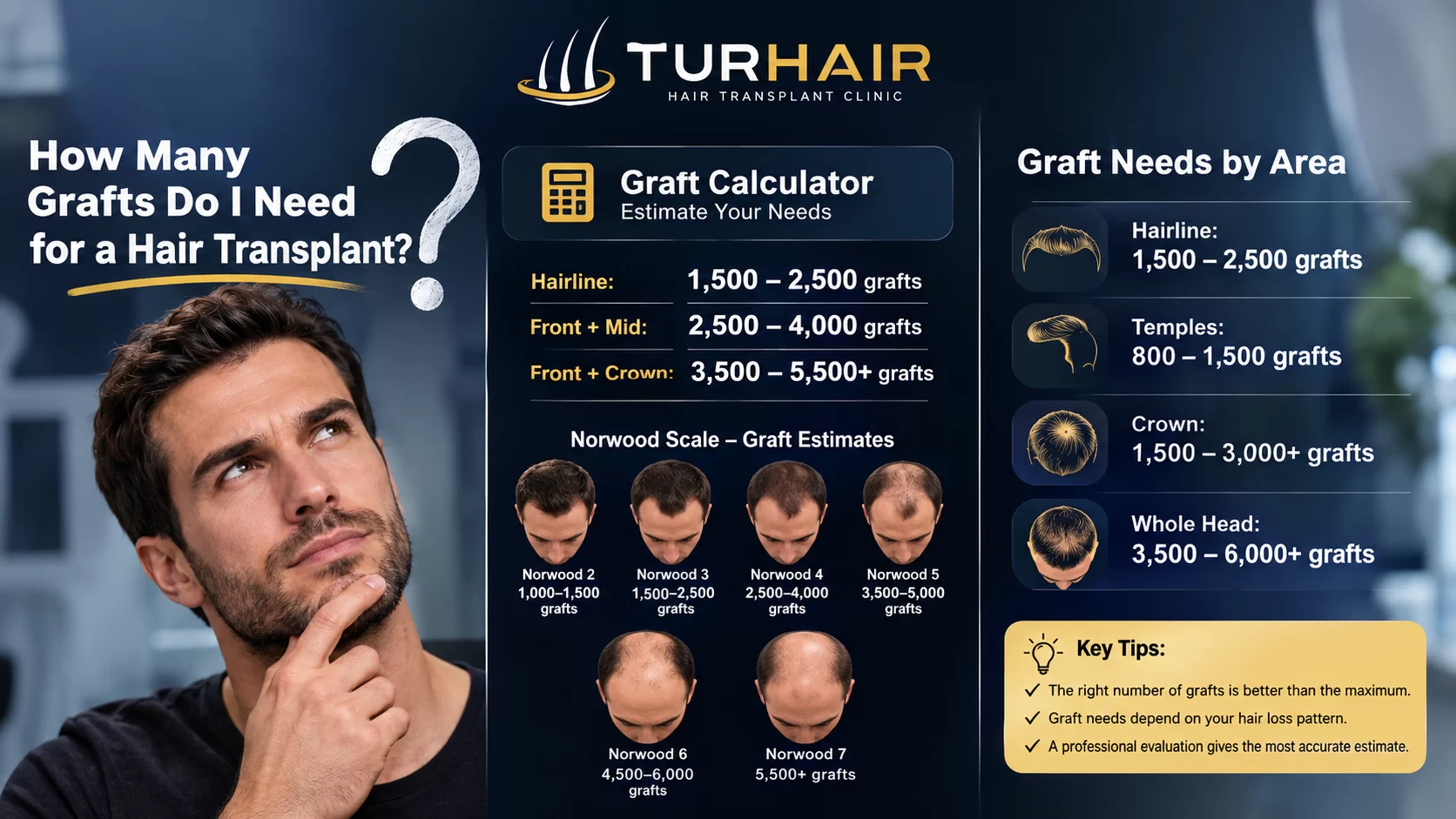
Hair transplant graft estimates by treatment area and Norwood stage
The 8 Factors That Determine How Many Grafts You Need
1. Size of the Bald or Thinning Area
The most obvious factor is the surface area requiring coverage. A small recession affecting only the temples requires fewer grafts than diffuse loss extending from the frontal hairline to the crown.
However, surface area alone does not determine the answer. Two bald areas of identical size can require different graft numbers because one patient may have coarse, wavy hair while another has thin, straight hair. The second patient may require a different distribution strategy to create comparable visual coverage.
2. Desired Hair Density
A natural scalp can contain considerably more follicular units per square centimeter than surgeons normally transplant into a completely bald recipient area. Attempting to duplicate original adolescent density is often unnecessary and may not be surgically appropriate.
Hair transplantation relies partly on an optical principle: carefully positioned follicles can create an impression of density without recreating every follicle that existed before hair loss.
Density requirements also vary by zone. The frontal hairline demands delicate placement and directional control. Slightly farther behind the hairline, denser placement may be used when donor supply and scalp characteristics permit.
3. Hair Shaft Thickness
Coarse hair generally provides more visual coverage per follicle than fine hair. Imagine covering the same background with thick brush strokes versus extremely thin pencil lines. The principle is similar.
Because thicker hairs occupy more visual space, a patient with coarse hair may achieve good cosmetic coverage with fewer grafts than a patient with very fine hair.
4. Straight, Wavy or Curly Hair
Hair texture affects perceived density. Curly and wavy hairs overlap and cover the scalp differently from completely straight hair. This can increase the cosmetic value of each transplanted follicular unit.
This does not mean curly-haired patients automatically require low graft counts. Donor density, curl type, follicular anatomy and recipient area still need individual evaluation.
5. Hair and Scalp Color Contrast
Contrast has a major effect on how easily the scalp can be seen through the hair. Dark hair against very light skin tends to produce greater visual contrast. When hair color and scalp tone are closer, the scalp may be less noticeable between individual hair shafts.
This is one reason photographs of two patients with identical graft numbers can look dramatically different.
6. Existing Native Hair
Patients with diffuse thinning may still have thousands of native follicles within the treatment area. A surgeon must determine which hairs are stable, which appear miniaturized and where transplanted grafts can be safely placed.
Native hair can reduce the number of grafts required to create visual coverage, but it also complicates planning because future loss may expose previously untreated areas.
7. Donor Area Capacity
The donor area is the biological budget of a hair transplant. A patient may want 6,000 grafts, but that does not mean the donor area can safely provide them.
Important donor characteristics include:
- follicular-unit density,
- hair diameter,
- number of hairs per follicular unit,
- size of the safe donor zone,
- previous extractions,
- scalp characteristics,
- future hair-loss risk,
- and whether beard or body hair could ever be appropriate as supplementary donor sources.
8. Future Hair Loss
A patient should not be planned only for how he looks today. Male pattern hair loss can continue for years. An aggressive low hairline that consumes a large percentage of donor follicles in a young patient can create major difficulties later if the mid-scalp and crown continue thinning.
Long-term planning is therefore central to deciding the correct graft count.
How Many Grafts Do I Need According to the Norwood Scale?
The Norwood scale is commonly used to describe patterns of male androgenetic alopecia. It can provide a useful framework for estimating graft requirements, although it should never replace direct assessment.
| Norwood Stage | Typical Pattern | Approximate Graft Requirement |
|---|---|---|
| Norwood I | Minimal or no significant recession | Usually no transplant or very limited correction |
| Norwood II | Mild frontal/temple recession | 800–1,800 grafts |
| Norwood III | More defined frontal recession | 1,500–2,500 grafts |
| Norwood III Vertex | Frontal recession with crown thinning | 2,000–3,500+ grafts |
| Norwood IV | Frontal loss and crown loss with separating bridge | 2,500–4,000 grafts |
| Norwood V | Broader front-to-crown loss | 3,500–5,000+ grafts |
| Norwood VI | Front, mid-scalp and crown largely connected | 4,500–6,000+ grafts, often staged |
| Norwood VII | Extensive loss with limited remaining horseshoe pattern | Highly individual; donor limitation becomes decisive |
These numbers are intentionally presented as ranges. A Norwood III patient with extremely dense donor hair and thick shafts may have a very different surgical plan from another Norwood III patient with low donor density and fine hair.
How Many Grafts Do I Need for a Receding Hairline?
A receding hairline is one of the most common reasons men consider hair transplantation. Depending on the degree of recession, approximately 1,200 to 2,500 grafts may be sufficient for many frontal cases.
But hairline restoration is particularly sensitive to design. Lowering a hairline by only a small distance can dramatically increase the recipient surface area and therefore increase graft demand.
A conservative hairline usually requires fewer grafts
A mature, age-appropriate hairline can provide strong facial framing while conserving follicles. By contrast, rebuilding the extremely low hairline a patient had at age eighteen may require hundreds or even thousands of additional grafts and may become difficult to maintain aesthetically if progressive hair loss occurs behind it.
For this reason, experienced planning considers:
- facial proportions,
- forehead height,
- temporal recession,
- future male pattern hair loss,
- donor reserve,
- hairline irregularity,
- direction and angle of implantation.
How Many Grafts Are Needed for the Temples?
Isolated temple recession can sometimes be corrected with approximately 800–1,500 grafts, although larger temporal recession can require more.
The temples may look like small areas on a photograph, but restoring them naturally is technically demanding. The angle of hair emergence must remain extremely acute in certain regions, and the transition between native and transplanted hair must appear soft rather than geometric.
Overfilling or creating unnaturally sharp temple points can make even a technically dense transplant look artificial.
How Many Grafts Are Needed for the Front of the Scalp?
For the frontal third, approximately 2,000–3,500 grafts is a common broad range, depending on the size of the area, presence of existing hair and planned density.
The frontal area deserves special attention because it dominates the way most people perceive a hair transplant. When donor supply is limited, prioritizing frontal coverage can often create a larger visual improvement than spreading the same grafts thinly over the entire scalp.
A strong frontal restoration can recreate the frame of the face even when the crown remains somewhat thin.
How Many Grafts Are Needed for the Crown?
Crown restoration can require approximately 1,500–3,000 grafts or more, depending on the diameter of the thinning area and desired coverage.
The crown is frequently underestimated. It is effectively a circular or oval region in which hairs change direction around a central whorl. Because the area can expand substantially as hair loss progresses, aggressively transplanting a young patient’s early crown thinning may consume donor follicles that later become more valuable in the frontal scalp.
Why does the crown use so many grafts?
Several characteristics increase crown graft demand:
- the recipient surface area may be larger than it appears in mirrors or photographs,
- the whorl requires radial directional changes,
- light frequently reflects directly from the crown, increasing scalp visibility,
- future crown expansion can occur,
- high density across a wide circular zone can consume a large donor reserve.
For patients with extensive hair loss, the crown may therefore receive a lower initial density or be deferred to a second procedure.
How Many Grafts Are Needed for the Hairline and Crown Together?
Treating the frontal region and crown simultaneously may require approximately 3,500–5,000 grafts or more. Whether this is advisable in one procedure depends heavily on donor capacity.
Patients sometimes request equal density across both areas. That may not be the best allocation of a limited donor supply. A common strategic principle is to prioritize the frontal third because it affects facial appearance from most viewing angles.
The crown can then receive moderate coverage or be treated during a later session if sufficient donor reserve remains.
How Many Grafts Can Safely Be Taken From the Donor Area?
There is no universal maximum number. Statements such as “everyone has 7,000 safe grafts” are oversimplifications.
A donor region contains a finite number of follicular units, and only a portion can be removed without creating excessive visible thinning. Safe extraction depends on individual anatomy.
Doctors must evaluate:
- donor density per square centimeter,
- hair shaft caliber,
- follicular grouping,
- safe donor boundaries,
- previous surgery,
- scalp visibility,
- hair length and styling habits,
- contrast between hair and skin,
- anticipated long-term loss.
More grafts are not automatically better
A clinic advertising extremely high graft counts should still be evaluated according to how those grafts are harvested and distributed. Once follicles are removed from the donor zone, they do not regenerate there. The donor area must therefore be treated as a limited lifetime resource.
What Does 1,000 Grafts Look Like?
One thousand grafts is considered a relatively small hair transplant. It may be appropriate for limited recession, small temporal defects, scar correction or modest density enhancement in a localized zone.
One thousand grafts will generally not be enough to densely reconstruct a large bald frontal area and crown.
The cosmetic effect depends on where those grafts are concentrated. One thousand grafts placed strategically within a narrow frontal zone can produce a meaningful change, while the same number spread over an extensive bald scalp may look sparse.
What Can 1,500 Grafts Cover?
Approximately 1,500 grafts can often provide noticeable improvement for mild to moderate hairline recession. It may also be sufficient for a relatively small crown or for localized density reinforcement.
For a hairline case, careful use of single-hair follicles along the front and multi-hair grafts immediately behind them can maximize cosmetic impact.
Again, the patient’s head dimensions matter. A 1,500-graft plan covering one person’s frontal region may cover only part of another person’s because head size and recession depth vary.
What Can 2,000 Grafts Cover?
A 2,000-graft hair transplant is commonly used for frontal restoration, moderate hairline recession and selected smaller crown cases.
For many Norwood II to III patterns, 2,000 grafts can make a substantial difference when concentrated in the front.
It may be possible to:
- reconstruct the hairline,
- fill temporal corners,
- strengthen the area immediately behind the hairline,
- or improve a relatively modest crown.
It would generally be unrealistic to expect 2,000 grafts to provide dense coverage across an extensively bald front, mid-scalp and crown simultaneously.
What Can 2,500 Grafts Cover?
Approximately 2,500 grafts provides more flexibility. It can often address a receded hairline plus a significant part of the frontal scalp.
For patients with remaining native hair, it may also help blend frontal and mid-scalp thinning. In other patients, all 2,500 grafts may be intentionally concentrated within the frontal third to maximize apparent density.
The best allocation depends on the long-term pattern rather than simply attempting to treat every visible thin spot.
What Can 3,000 Grafts Cover?
A 3,000 graft hair transplant is a common medium-to-large procedure. Depending on hair characteristics and recipient size, it may provide strong frontal coverage extending into the mid-scalp.
Three thousand grafts could also be distributed between a hairline and crown, although dividing the grafts into two distant areas may reduce the density achievable in either zone.
A surgeon may recommend using most or all 3,000 grafts in the front rather than spreading them across the entire scalp if that produces a more aesthetically powerful result.
What Can 3,500 Grafts Cover?
A 3,500-graft procedure can be suitable for moderate-to-advanced frontal and mid-scalp hair loss. It provides enough grafts for meaningful distribution across a larger recipient area while still requiring careful donor management.
For certain patients, 3,500 grafts may cover:
- the complete frontal hairline,
- temporal recessions,
- the frontal third,
- and part or much of the mid-scalp.
Whether it can also significantly treat the crown depends on the size of the crown and how much density is allocated elsewhere.
What Can 4,000 Grafts Cover?
A 4,000 graft hair transplant can create broad coverage in appropriately selected candidates. Many patients associate 4,000 grafts with a “full transplant,” but this description can be misleading.
A patient with moderate hair loss may achieve extensive coverage from 4,000 grafts. A patient with advanced Norwood VI loss may still require prioritization because the bald area is much larger.
Four thousand grafts are not four thousand identical building blocks. The number of hairs within those grafts, hair caliber and pattern of distribution significantly affect the visible result.
What Can 4,500 Grafts Cover?
Approximately 4,500 grafts represents a large FUE session for many patients. It may allow broad frontal and mid-scalp reconstruction and, in selected cases, some crown coverage.
However, the decision to harvest 4,500 grafts should begin with donor analysis rather than a patient’s requested number.
If harvesting 4,500 grafts creates excessive donor depletion, performing a smaller procedure is preferable to sacrificing long-term donor quality merely to advertise a higher number.
Is 5,000 Grafts a Lot?
Yes. 5,000 grafts is a substantial hair transplant procedure. It can potentially relocate a very large number of individual hairs and can provide extensive coverage in a suitable patient.
But 5,000 grafts should not be treated as a standard package target for every patient.
The surgeon needs to determine whether:
- the donor area genuinely contains enough safe extractable grafts,
- the patient’s scalp can tolerate the planned procedure,
- the recipient area requires that number,
- a one-session approach is preferable to staged treatment,
- sufficient follicles will remain for future hair loss.
Do you automatically get a better result with 5,000 grafts?
No. A natural 3,000-graft transplant performed with appropriate planning can be far better than an unnecessarily aggressive 5,000-graft procedure.
Hair transplant quality involves extraction pattern, graft handling, survival, hairline design, recipient-site creation, angulation, density distribution and long-term planning. The graft number is only one variable.
Can You Get 6,000 Grafts in One Hair Transplant?
Some selected patients may have sufficient donor characteristics for very large procedures, but 6,000 grafts should never be presented as an automatic one-session target.
Very large extraction sessions increase the importance of:
- accurate donor measurement,
- safe extraction spacing,
- procedure duration,
- graft storage and handling,
- recipient-site planning,
- medical suitability,
- and long-term donor conservation.
For extensive hair loss, dividing treatment into two carefully planned sessions may sometimes be more rational than attempting maximal extraction during a single visit.
Can 5,000 Grafts Cover a Full Head?
The phrase “full head” has no precise medical definition. Five thousand grafts may create broad coverage in some patients, but it cannot be assumed to recreate dense native hair across the front, mid-scalp and crown of every advanced-baldness patient.
An extensive bald scalp can represent a very large surface area. When 5,000 grafts are divided across that entire area, average transplanted density falls.
Surgeons therefore use strategic density. The frontal region may receive stronger density because it has greater cosmetic importance, while the mid-scalp transitions more gradually and the crown receives moderate coverage.
How Is Hair Transplant Density Calculated?
A simplified planning concept involves measuring the recipient area in square centimeters and considering how many follicular units per square centimeter are appropriate for each zone.
For example, imagine a treatment area measuring 80 cm². If an average of 35 grafts per cm² were considered appropriate, the theoretical calculation would be:
80 × 35 = 2,800 grafts.
Real surgical planning is more complicated.
Not every square centimeter should necessarily receive identical density. The frontal transition zone may use a different strategy from the central forelock, mid-scalp or crown. Existing hairs also affect placement.
Why surgeons do not simply multiply surface area by one density number
Uniform density would ignore the aesthetic architecture of the scalp. A natural-looking result often requires different follicular patterns in different zones.
For example:
- The first rows of a hairline should look soft rather than densely packed.
- Density can increase progressively behind the leading edge.
- The central frontal region may receive strong visual emphasis.
- The mid-scalp should provide continuity without wasting follicles.
- The crown needs radial orientation around the whorl.
How Many Grafts Per Square Centimeter Are Needed?
There is no single density number suitable for every patient. Transplanted densities frequently fall below natural native density while still creating strong cosmetic coverage.
The appropriate density depends on:
- hair caliber,
- existing native follicles,
- recipient blood supply,
- treatment zone,
- donor availability,
- hair style,
- degree of contrast between hair and skin.
Trying to maximize density indiscriminately is not always beneficial. Surgical design involves achieving the best cosmetic return for each available follicular unit.
Why Two People With the Same Norwood Level May Need Different Graft Numbers
Consider two patients who are both classified as Norwood III.
Patient A has thick, wavy hair, high donor density, a relatively small head and moderate contrast between scalp and hair.
Patient B has fine, straight hair, lower donor density, a broader forehead and high contrast between dark hair and pale skin.
Although both may share the same Norwood classification, the cosmetic requirements and donor strategy can be different.
This illustrates why online graft calculators can only provide preliminary estimates. A calculator cannot fully evaluate hair caliber, miniaturization, follicular grouping, scalp characteristics or future progression.
How Hair Thickness Changes the Number of Grafts You Need
Hair shaft diameter has an enormous effect on visual coverage. The difference between fine and coarse hair is not merely aesthetic; it changes how much scalp remains visible between hairs.
If two people receive the same number of grafts at the same numerical density, the patient with thicker hair shafts will often appear denser.
This is also why comparing your graft count with a friend’s transplant can be misleading. “He had 3,000 grafts and looks very dense, so I should only need 3,000” is not a reliable calculation.
Does Curly Hair Need Fewer Grafts?
Curly or wavy hair can provide excellent coverage because each hair travels across a larger visual space and overlaps neighboring hairs.
Nevertheless, extraction of strongly curved follicles may require additional technical care because the direction of the follicle beneath the skin may differ from what is visible above the scalp.
The advantage of curl should therefore be considered alongside donor quality and surgical technique rather than used as a simple reason to reduce graft numbers.
How Many Hairs Are in 3,000 Grafts?
There is no exact universal conversion between grafts and hairs because follicular units contain different numbers of hairs.
If a patient’s average graft contained approximately two hairs, 3,000 grafts might represent around 6,000 hairs. If the average were higher or lower, the total hair count would change accordingly.
Clinicians can estimate average hairs per follicular unit by examining the donor region. This information can be valuable when predicting potential visual density.
Grafts vs Hairs: Why Patients Should Know the Difference
| Term | Meaning | Why It Matters |
|---|---|---|
| Hair | An individual hair shaft | Contributes to visible coverage |
| Follicular unit | A naturally occurring group of hairs | The anatomical unit generally preserved during FUE |
| Graft | A transplanted tissue unit containing follicles | One graft may contain multiple hairs |
| Hair density | Number of hairs within a defined area | Affects visual fullness |
| Graft density | Number of grafts placed per area | Used in recipient-site planning |
How Many Grafts Do Women Need for a Hair Transplant?
Female hair loss often requires a different planning approach because diffuse thinning patterns are more common and the frontal hairline may remain relatively intact.
Depending on the pattern, women might require anywhere from approximately 1,000 to more than 3,000 grafts. However, determining candidacy is particularly important because transplanting into areas of unstable diffuse thinning may not always be appropriate.
Female patients should undergo evaluation of the cause and pattern of hair loss before deciding on surgery. Not every type of female hair loss is best treated with transplantation.
How Many Grafts Are Needed for Female Hairline Lowering?
Women seeking forehead reduction through hair transplantation may require roughly 1,500–3,000 grafts, depending primarily on how far the hairline is lowered and the width of the forehead.
Lowering the hairline even one additional centimeter increases the recipient surface area. Natural female hairline irregularity, direction and temporal transitions also require careful design.
Does FUE Require a Different Number of Grafts Than DHI?
FUE and DHI terminology often causes confusion. FUE fundamentally refers to the method used to extract follicular units individually. DHI generally describes implantation using an implanter device in a particular workflow.
The amount of hair loss—not the marketing name of the implantation method—is what primarily determines how many grafts the patient needs.
A person who needs approximately 3,000 grafts does not suddenly need 2,000 merely because an implanter pen is used.
Technique selection should therefore be based on clinical characteristics rather than assumptions that one method magically requires fewer grafts.
Does Sapphire FUE Change the Graft Number?
Sapphire blades are used by some clinics when creating recipient channels. Using sapphire instruments does not fundamentally change how many follicles are biologically required to cover a bald area.
The graft plan remains primarily determined by:
- surface area,
- density goals,
- donor capacity,
- hair characteristics,
- existing native hair,
- and long-term strategy.
Patients should therefore avoid choosing a graft count solely according to terms such as “Sapphire,” “DHI” or “FUE.”
Is It Better to Have More Grafts in One Session?
Not necessarily.
The objective is not to break a graft-count record. Large sessions should be performed only when medically appropriate and supported by the donor area.
There are situations where a staged approach can provide better control. For example, a patient with extensive hair loss may first restore the frontal and mid-scalp regions. After growth is assessed and donor recovery is evaluated, a second session can address the crown.
This approach can also help preserve flexibility if the patient’s pattern continues progressing.
When Is a Second Hair Transplant Needed?
A second hair transplant does not necessarily mean the first surgery failed. It may have been part of the original long-term strategy.
A second procedure may be considered when:
- hair loss progresses into untreated areas,
- the crown was deliberately deferred,
- a patient wants additional density after the first result matures,
- the original procedure focused on donor conservation,
- a previous transplant from another clinic requires repair or refinement.
The key question is how much safe donor reserve remains.
Should I Use All My Available Grafts in the First Hair Transplant?
Usually, long-term planning argues against automatically exhausting every available donor graft during the first procedure.
Imagine a 28-year-old patient with a Norwood III pattern who uses nearly his entire safe donor reserve to create an extremely low and dense frontal hairline. If he later develops Norwood VI loss, there may be insufficient donor hair to connect that frontal transplant naturally with the remaining scalp.
Preserving a donor reserve creates options.
How Age Affects Your Required Graft Number
Age does not directly determine graft number, but it changes how the surgeon interprets the hair-loss pattern.
Younger patients
In younger men, the final pattern of androgenetic alopecia may not yet be obvious. Conservative planning can therefore be particularly important.
A young patient requesting an aggressively low hairline may technically be transplantable, but the long-term aesthetic consequences require careful discussion.
Older patients
In an older patient whose hair-loss pattern has become more established, long-term planning may sometimes be more predictable. However, donor density and general medical suitability must still be assessed individually.
Can Minoxidil or Finasteride Reduce the Number of Grafts Needed?
Medical treatment may help preserve or strengthen existing hair in suitable patients, potentially changing how much transplantation is required. However, medication decisions should be discussed with an appropriate physician because benefits, risks and contraindications vary.
A transplant moves permanent or relatively resistant follicles into areas of loss; it does not automatically stop non-transplanted native hair from continuing to miniaturize.
This is another reason a long-term plan may include both surgical and non-surgical management.
What Is Donor Density?
Donor density describes how many follicular units and hairs exist within a defined area of the donor scalp. It is one of the most important factors in hair transplantation.
A high-density donor area provides more flexibility, but even high-density donors are not unlimited.
Density must also be interpreted together with:
- hair shaft diameter,
- percentage of multi-hair grafts,
- size of the safe donor area,
- hair-to-skin contrast,
- curl,
- previous extraction patterns.
What Is Donor Overharvesting?
Donor overharvesting occurs when too many follicular units are removed or when extraction is poorly distributed, leaving visible depletion.
Possible signs may include:
- patchy donor density,
- areas where scalp becomes excessively visible,
- irregular extraction patterns,
- difficulty wearing shorter hairstyles,
- insufficient donor reserve for future procedures.
Important: The donor area is finite. A promise of a very high graft count should not be interpreted as evidence that a clinic is better. Safe donor management is more important than an impressive number in an advertisement.
Can Beard Hair Increase the Number of Available Grafts?
Beard follicles can sometimes be considered as a supplementary donor source in selected patients, particularly when scalp donor supply is limited and additional coverage is needed.
However, beard hair behaves differently from scalp hair. It is usually thicker and may have different texture, growth characteristics and appearance.
For that reason, beard grafts are generally not interchangeable with scalp grafts in every zone. Scalp hair is usually preferred for the frontal hairline because it more closely matches natural scalp characteristics.
The suitability of beard extraction requires individual medical assessment.
Can Chest or Body Hair Be Used for Additional Grafts?
Body hair transplantation may be considered in selected advanced cases, but body hair should not be viewed as a simple replacement for scalp donor hair.
Body hairs can differ in:
- growth length,
- hair-cycle duration,
- caliber,
- texture,
- curl,
- survival characteristics.
Using non-scalp donor sources requires particularly careful patient selection and realistic expectations.
Can You Calculate Hair Transplant Grafts From a Photo?
Photographs can provide a useful preliminary estimate, especially when they clearly show the hairline, frontal scalp, mid-scalp, crown and donor region.
However, photographs have limitations.
Lighting can make hair appear much thinner or denser. Wet hair can exaggerate thinning. Hair fibers and styling products can hide areas of loss. A photograph also cannot accurately measure hair shaft diameter or donor density.
A photographic estimate should therefore be regarded as preliminary rather than definitive.
Which photos should I send for a graft estimate?
For a more informative preliminary assessment, patients should generally provide:
- straight frontal photograph,
- hairline from above,
- top of scalp,
- crown/vertex,
- left side,
- right side,
- back donor region,
- both donor sides if possible.
Photos should be taken in bright, neutral lighting without fibers, concealers or wet styling products.
Online Hair Transplant Graft Calculators: Are They Accurate?
Online graft calculators can be useful for education, but they should not be mistaken for a surgical assessment.
Most calculators use simplified inputs such as:
- Norwood stage,
- area requiring treatment,
- desired density.
They generally cannot evaluate donor miniaturization, follicular grouping, actual recipient size, hair caliber or future hair-loss risk.
A calculator might estimate 4,000 grafts, while an experienced surgeon may recommend 3,200 because the patient’s native hair provides useful density. Conversely, another patient may need more coverage than the calculator predicts because fine hair provides less visual volume.
How Hairline Position Changes Your Graft Requirement
Hairline height has one of the strongest effects on graft consumption.
A difference that appears small when drawn on the forehead can represent a substantial increase in transplant surface area once extended from temple to temple.
Low hairline
A very low hairline requires more grafts, uses donor reserve more aggressively and may look less age-appropriate later in life.
Conservative hairline
A slightly higher mature hairline can create strong cosmetic framing with fewer grafts, leaving more follicles available for mid-scalp or crown restoration.
The ideal design is not simply the lowest line physically possible. It should fit facial proportions and the patient’s probable future pattern.
How Many Grafts Are Needed to Lower a Hairline by 1 cm?
No exact number can be given without measuring forehead width and the shape of the proposed new hairline.
Lowering a broad hairline by one centimeter can create a surprisingly large new recipient zone. Depending on width and density, the additional requirement could involve several hundred grafts or more.
This is why hairline design should be completed before final graft allocation rather than after extraction has already begun.
Should the Hairline Be Packed With Maximum Density?
A natural frontal hairline should not look like a straight wall of identical follicles. Nature creates irregularity, micro-variations and gradual density.
Single-hair grafts are particularly valuable at the front. Behind them, larger follicular units can contribute density.
The objective is a transition that appears natural under different lighting and from close distances, not merely a high numerical density measurement.
How Many Grafts Are Needed for Diffuse Thinning?
Diffuse thinning is more complex than transplanting into a completely bald region because existing follicles remain throughout the recipient area.
Depending on the pattern, approximately 1,500–3,500+ grafts may be considered, but candidacy must first be established.
The surgeon should evaluate:
- degree of miniaturization,
- stability of native hairs,
- donor quality,
- underlying diagnosis,
- risk of continued loss,
- space available for safe recipient-site creation.
What Is Shock Loss and Does Graft Number Affect It?
Shock loss refers to shedding that can occur in or around a treated area following surgery. Some shedding may be temporary, but native miniaturized hairs can be more vulnerable.
Dense intervention among weak existing follicles therefore requires careful planning.
Simply inserting the maximum possible graft count into an area containing fragile native hair is not always the smartest strategy.
How Many Grafts Do I Need After a Previous Hair Transplant?
Revision cases require a completely different assessment.
The doctor must determine:
- how many grafts were previously harvested,
- whether the donor was evenly extracted,
- how much donor reserve remains,
- where previous grafts were placed,
- whether the old hairline requires repair,
- whether density or coverage is the primary objective.
A patient who had 3,000 grafts previously cannot simply assume another 3,000 can safely be removed.
How Many Grafts Are Needed to Repair a Bad Hair Transplant?
Repair cases can range from a few hundred grafts to several thousand, depending on the problem.
Small corrections may involve softening an unnatural hairline with carefully selected single-hair grafts. More complex repairs may require additional density, redistribution, extraction of poorly positioned grafts or reconstructive planning.
Because previous surgery may have reduced donor supply, repair patients particularly benefit from careful donor assessment.
Can You Transplant Between Existing Hairs?
Yes, in appropriate cases follicles can be placed between native hairs. But the technique requires attention to existing follicle direction and miniaturization.
The graft requirement may be lower than for a completely bald area because native hair contributes coverage. At the same time, dense placement must not be pursued blindly.
How Many Grafts Are Needed for a Hair Transplant Scar?
Scalp scars vary greatly in size, thickness, blood supply and location. Small linear scars may require only hundreds of grafts, while larger scars require more.
Scar tissue does not behave identically to healthy scalp tissue, so graft survival and density strategy may differ. Evaluation is essential before estimating the number required.
What Happens If Too Few Grafts Are Used?
If a recipient area receives insufficient grafts for its size and hair characteristics, the result may appear thin or unfinished.
Possible reasons for deliberately using a moderate density include limited donor supply, staged planning or preserving options for future procedures.
Low density is therefore not automatically evidence of poor surgery. Context matters.
However, a clinic should explain the expected coverage before surgery so the patient understands whether the goal is full reconstruction, moderate density or a first-stage treatment.
What Happens If Too Many Grafts Are Used?
The idea that more grafts always produce better results can create several problems.
Excessive graft use can:
- deplete the donor region,
- leave inadequate reserve for future loss,
- encourage unnecessarily low hairline design,
- increase procedure complexity,
- waste follicles in cosmetically low-priority areas.
The correct graft count should therefore balance present improvement with future flexibility.
Hair Transplant Graft Planning by Priority Zone
| Priority | Zone | Why It Matters |
|---|---|---|
| 1 | Frontal hairline | Frames the face and is visible in most interactions |
| 2 | Frontal third | Provides major visual density from front-facing angles |
| 3 | Mid-scalp | Connects front and crown and improves top coverage |
| 4 | Crown | Important aesthetically but can consume many grafts |
This does not mean every patient should follow exactly the same order. A patient with an intact front and isolated crown loss clearly has different priorities. The table primarily illustrates why advanced baldness often requires allocation decisions.
Why the Front Usually Gets More Attention Than the Crown
The frontal hairline is visible when talking face-to-face, looking in a mirror and appearing in photographs. It also defines facial proportions.
The crown, although important, is mainly visible from above or behind.
When donor supply is limited, surgeons may therefore intentionally allocate greater density to the front. This can produce a much stronger cosmetic transformation than spreading grafts equally over the entire scalp.
How Future Baldness Can Change Today’s Graft Plan
Suppose a patient currently needs 2,500 grafts to restore the frontal area. If he appears likely to develop extensive mid-scalp and crown loss later, the surgeon may choose a slightly more conservative hairline to conserve several hundred grafts.
Those saved follicles may become extremely valuable ten years later.
This long-term view separates hair restoration planning from simply filling today’s visible bald spot.
How Many Grafts Should a 25-Year-Old Get?
There is no graft count based solely on being 25 years old.
A young adult might require anywhere from zero grafts to several thousand depending on the pattern. What changes at younger ages is the uncertainty surrounding future progression.
Young patients may benefit from particularly conservative planning because aggressive restoration can become difficult to maintain if surrounding native hair disappears over subsequent years.
How Many Grafts Should a 40-Year-Old Get?
Again, age alone does not determine the number. A 40-year-old Norwood III patient could require approximately 2,000–3,000 grafts while a Norwood VI patient may need a much broader plan.
By this age, however, the progression pattern may be more established in some individuals, which can provide additional information for long-term design.
Is 3,000 Grafts Enough for Norwood 5?
Three thousand grafts may produce meaningful improvement in a Norwood V patient, particularly if concentrated in the frontal zone, but it would generally not create dense coverage across the entire front, middle and crown.
A surgeon might use approximately 3,000 grafts to rebuild the frontal frame and frontal third, deliberately leaving the crown for a later session.
This can sometimes look better than distributing 3,000 grafts thinly across the whole scalp.
Is 4,000 Grafts Enough for Norwood 6?
Four thousand grafts can substantially improve a Norwood VI pattern, but “enough” depends on the objective.
If the objective is strong frontal coverage with a transition into the mid-scalp, 4,000 grafts may create an impressive transformation in a suitable patient.
If the objective is to recreate high density from the forehead through a large crown, 4,000 grafts are unlikely to reproduce native density across the entire area.
Can Norwood 7 Be Restored With a Hair Transplant?
Some Norwood VII patients can benefit from surgery, but donor limitations become the central issue.
When the recipient area is extremely large and the permanent donor rim is relatively narrow, the surgeon must create the greatest possible visual improvement from a restricted follicular supply.
Potential strategies may include:
- conservative hairline placement,
- frontal prioritization,
- strategic lower density in less visible zones,
- multiple sessions when appropriate,
- supplementary beard grafts in selected candidates.
Realistic expectations are critical.
How Many Grafts Survive After a Hair Transplant?
Clinics sometimes advertise specific survival percentages, but real biological outcomes can vary according to surgical technique, graft handling, patient factors and postoperative events.
The objective should be meticulous follicle extraction, careful storage and implantation rather than relying on marketing guarantees.
Patients should also understand that final cosmetic density is affected not only by survival but by hair caliber, growth direction, hair length and styling.
Do All Transplanted Grafts Grow at the Same Time?
No. Early shedding of transplanted hair shafts is common after transplantation. New growth then develops gradually over subsequent months.
Because follicles enter growth phases at different times, density typically appears progressively rather than overnight.
Evaluating a transplant too early can therefore lead to inaccurate conclusions about graft survival or final density.
Can I Know My Final Density Before Surgery?
A surgeon can estimate the planned graft distribution and discuss realistic expectations, but no responsible clinic should promise an exact visual outcome with mathematical certainty.
Biology varies.
Two people receiving identical graft counts can show different apparent density due to:
- hair shaft thickness,
- curl,
- hair color,
- scalp tone,
- styling,
- growth characteristics.
Why Hair Transplant Before-and-After Photos Should Include Graft Counts
Before-and-after photographs are more informative when the graft count, treatment area and timing are explained.
However, even this information does not allow perfect comparison between patients.
A 3,500-graft result on coarse, curly hair cannot be directly used to predict a 3,500-graft result on fine, straight hair.
When evaluating photographs, look for comparable hair-loss patterns and similar hair characteristics rather than simply searching for the largest graft number.
Should I Choose a Clinic Based on Maximum Graft Count?
No.
A clinic promising the highest number should not automatically be considered superior. Patients should instead investigate who performs the critical surgical stages and how donor safety is assessed.
Useful questions include:
- Who examines and designs my hairline?
- Who determines the safe graft number?
- Who performs recipient-site creation?
- How many patients are treated per day?
- How is donor density assessed?
- What happens if my donor does not safely support the advertised number?
- Will the plan leave grafts for future hair loss?
Why Doctor Involvement Matters in Graft Planning
Graft planning is not simply a logistical calculation. It is part of the medical and aesthetic strategy of hair restoration.
The number of grafts interacts directly with hairline position, donor extraction, recipient-site distribution and long-term prognosis.
A qualified physician should therefore assess whether the requested procedure is medically and surgically appropriate and determine the role of the medical team according to applicable regulations and clinic protocols.
TurHair Approach: The Right Number, Not the Biggest Number
At TurHair, the objective of graft planning is not to advertise the largest possible extraction number. The goal is to determine how many grafts can provide the strongest aesthetic improvement while respecting donor capacity and future hair-loss risk.
Dr. Mehmet Sıraç Demir evaluates factors including recipient size, donor characteristics, hairline design, current hair loss and expected long-term needs before the surgical plan is finalized.
For patients considering treatment in Istanbul, photographs can be used for an initial evaluation, while the definitive strategy is confirmed following medical assessment.
TurHair principle: “A successful transplant is not measured by how many grafts are removed, but by how intelligently every available graft is used.”
How Many Grafts Do You Actually Need? A Practical Decision Framework
Rather than beginning with “I want 5,000 grafts,” begin with four questions.
Question 1: Which area bothers you most?
If the front is your main concern, concentrating grafts there may give greater cosmetic value than thinly distributing them across the crown.
Question 2: How large is the treatment area?
Measure the actual recipient zone rather than estimating from a single photograph.
Question 3: How strong is the donor?
The donor determines what is realistically possible.
Question 4: What happens if more hair is lost later?
A treatment plan should still make sense if the hair-loss pattern progresses.
Hair Transplant Graft Estimate Examples
Example 1: Mild receding hairline
A 35-year-old patient has moderate temple recession but good density behind the hairline. His donor region is strong and hair shafts are coarse.
Possible preliminary range: 1,500–2,000 grafts.
The primary objective would be rebuilding the temporal corners and creating a natural frontal transition.
Example 2: Norwood III frontal loss
A patient has a clearly receded hairline and substantial frontal thinning but an intact crown.
Possible preliminary range: 2,000–3,000 grafts.
Most follicles could be concentrated in the frontal third.
Example 3: Front and mid-scalp thinning
A patient shows significant recession with thinning extending toward the middle of the scalp.
Possible preliminary range: 3,000–4,000 grafts.
Distribution would depend on existing native density.
Example 4: Large crown
A patient has a stable frontal region but a broad thinning crown.
Possible preliminary range: 2,000–3,000 grafts.
Crown diameter and desired density would determine the final number.
Example 5: Advanced Norwood VI
A patient has continuous loss from the front to crown but strong donor characteristics.
Possible plan: 4,000–5,000+ grafts initially, potentially followed by a second session depending on donor capacity and desired coverage.
Frontal priority would generally be considered.
Why “Unlimited Grafts” Hair Transplant Packages Can Be Misleading
The phrase “unlimited grafts” sounds attractive, but anatomically no patient has unlimited donor hair.
A package may mean that the price does not increase according to graft count. It should never be interpreted as permission to remove unlimited follicles.
The actual extraction number must still be based on donor safety.
Patients should ask whether the clinic will reduce the planned number if the donor assessment shows that a large extraction is unsafe. The correct answer should be yes.
Should Hair Transplant Price Be Based on Graft Count?
Pricing models vary internationally. Some clinics charge per graft, while others use procedure packages.
Neither system automatically predicts quality.
A per-graft clinic can still recommend unnecessary grafts, while a fixed-price clinic can still perform excellent individualized planning. The important issue is whether the graft recommendation is clinically justified.
Patients should compare what is included in the surgical plan, who performs the critical steps and whether follow-up care is provided rather than evaluating price solely by dividing the total cost by the advertised graft count.
Is a Cheap 5,000-Graft Hair Transplant Better Value Than a 3,000-Graft Procedure?
Not necessarily.
Cost per graft is a poor standalone measure of hair transplant value.
Imagine Clinic A offers 5,000 grafts at a low package price but extracts aggressively and distributes follicles without a long-term strategy. Clinic B recommends 3,200 grafts because that number is sufficient for the frontal objective while preserving donor reserve.
The second plan may provide substantially better long-term value despite appearing to offer fewer grafts.
How to Compare Hair Transplant Graft Quotes From Different Clinics
It is common for one patient to receive estimates such as 2,500 grafts from one clinic, 3,500 from another and 4,500 from a third.
This does not automatically mean one clinic is wrong. Differences can arise from:
- different proposed hairlines,
- different recipient zones,
- different density targets,
- different donor assumptions,
- whether the crown is included,
- whether existing hair is counted as useful coverage.
When comparing quotes, ask each clinic to define exactly where the proposed grafts will be placed.
“4,000 grafts” without a zone-by-zone plan is far less informative than a clear explanation of the intended distribution.
Questions to Ask Before Agreeing to a Graft Number
- How was my graft estimate calculated?
- Which recipient zones will be treated?
- How many grafts will be allocated to the hairline?
- How much density is planned behind the hairline?
- Will my crown be treated?
- How strong is my donor area?
- How many grafts should remain for the future?
- What is my likely long-term Norwood pattern?
- Would lowering the hairline require additional grafts?
- Could the procedure be staged?
- Who will create the recipient sites?
- How will overharvesting be avoided?
- What happens if fewer grafts are safely available than expected?
Hair Transplant Graft Number Myths
Myth 1: Everyone needs at least 4,000 grafts
False. Many patients require substantially fewer.
Myth 2: More grafts always create more density
Not necessarily. Distribution, hair characteristics and survival are equally important.
Myth 3: 5,000 grafts guarantees a full head of hair
No. Recipient size and donor characteristics determine what 5,000 grafts can achieve.
Myth 4: One graft equals one hair
False. A follicular unit can contain multiple hairs.
Myth 5: Every person has the same donor capacity
False. Donor anatomy differs significantly.
Myth 6: A crown needs fewer grafts because it looks small
Often false. Large crowns can consume substantial graft numbers.
Myth 7: DHI automatically needs fewer grafts
No. The size of the recipient area does not disappear because a different implantation device is used.
Myth 8: Extracted donor grafts grow back in the donor area
No. Relocated follicular units do not regenerate at their original extraction point.
How Many Grafts Do I Need If I Wear My Hair Short?
Short hairstyles can make both recipient and donor density more visually demanding.
With longer hair, shafts overlap and create additional coverage. Very short hair provides less overlap, which can increase scalp visibility.
The extraction pattern also becomes particularly important for patients intending to maintain very short donor hair because uneven harvesting can be more noticeable.
How Many Grafts Do I Need If My Hair Is Fine?
Fine hair usually provides less visual coverage per shaft. A patient with very fine hair may therefore require a different density strategy from someone with thick, coarse hair.
But simply increasing the graft count is not always possible because donor supply remains finite.
The surgeon may instead optimize:
- hairline height,
- distribution,
- recipient priority,
- styling direction,
- future-session planning.
How Many Grafts Do I Need If My Donor Area Is Weak?
If donor density is limited, the number of grafts that would ideally cover the recipient area may exceed the number that can safely be harvested.
In this situation, the treatment plan must adapt to the donor—not the other way around.
Possible strategies include:
- raising the proposed hairline,
- reducing the treatment area,
- prioritizing the front,
- accepting lower crown density,
- considering staged treatment,
- evaluating supplementary donor sources in selected cases.
Can You Increase Density Later?
Yes, if the donor area remains adequate and the scalp is suitable, a later density-enhancement procedure may be possible.
This is one reason initial procedures do not always need to pursue the absolute maximum density technically possible.
A carefully staged plan can preserve flexibility.
Is One Large Hair Transplant Better Than Two Smaller Sessions?
Neither option is universally better.
A large single session may be convenient and efficient in appropriately selected patients. Staging may be preferable in cases involving extensive baldness, limited donor supply or uncertain future loss.
| One Large Session | Staged Sessions |
|---|---|
| Can treat a larger area at once | Allows reassessment after first growth |
| One primary recovery period | Can preserve flexibility |
| Requires strong donor capacity | May be useful for advanced patterns |
| Longer surgical day may be required | More than one procedure/recovery |
| Future donor planning remains essential | Second-stage allocation can be adjusted |
How Many Grafts Do I Need for Natural-Looking Results?
There is no minimum number that automatically makes a transplant natural.
Naturalness comes from matching follicular architecture to anatomy.
Important elements include:
- age-appropriate hairline height,
- subtle irregularity,
- single-hair grafts at the frontal edge,
- correct angulation,
- appropriate directional changes,
- density progression,
- strategic use of multi-hair grafts.
A 1,800-graft procedure can look completely natural if correctly designed. A 5,000-graft procedure can look unnatural if the hairline geometry or implantation direction is poor.
How Many Grafts Do I Need for Maximum Density?
The phrase “maximum density” should be approached carefully.
The goal of transplantation is typically cosmetically effective density, not necessarily mathematical duplication of original teenage density.
Trying to densely fill every centimeter of advanced baldness can exceed donor capacity. The more extensive the recipient area becomes, the more important strategic allocation becomes.
Does Head Size Affect Hair Transplant Graft Count?
Yes. Two patients with the same Norwood pattern can have different recipient surface areas because head width, forehead width and scalp dimensions vary.
A wider frontal zone requires more grafts at the same target density than a narrow one.
This is another limitation of estimating solely from a Norwood chart.
Can Hair Fibers Make Me Think I Need Fewer Grafts?
Hair fibers and scalp concealers can dramatically improve visual density but can also hide the true degree of thinning during photographic consultation.
For an accurate preliminary assessment, photographs should ideally be taken without camouflage products.
Should Wet or Dry Hair Be Used for Graft Assessment?
Dry hair photographs show how the patient normally looks, while separated or gently dampened hair can help reveal the underlying thinning pattern. In-person examination provides significantly more information than either method alone.
How Much of the Donor Area Should Be Saved?
There is no universal percentage suitable for everyone.
The amount preserved depends on donor density, age, hair-loss progression and whether additional procedures are likely.
What matters is avoiding a plan that assumes today’s surgery will definitely be the patient’s last.
What If the Clinic Extracts Fewer Grafts Than Promised?
If fewer grafts are removed because the donor cannot safely provide the initially estimated number, reducing extraction can be medically reasonable. Preliminary estimates are not always exact.
However, clinics should communicate transparently about the final number and why it changed.
What If the Clinic Says I Need Exactly 5,000 Grafts From One Photo?
A precise high-number recommendation based solely on limited photographs deserves further questioning.
Ask:
- How was donor density measured?
- Was the recipient area measured?
- Is the crown included?
- What happens if the donor is weaker in person?
- How many grafts will remain for the future?
A preliminary online estimate should normally remain subject to confirmation.
Hair Transplant Graft Calculator Summary
| Graft Count | What It May Commonly Address |
|---|---|
| 500–1,000 | Very small corrections, scars or limited temple refinement |
| 1,000–1,500 | Mild hairline/temple recession |
| 1,500–2,000 | Moderate hairline reconstruction |
| 2,000–2,500 | Hairline plus frontal reinforcement |
| 2,500–3,000 | Substantial frontal third |
| 3,000–3,500 | Front and selected mid-scalp coverage |
| 3,500–4,000 | Broad frontal/mid-scalp restoration |
| 4,000–4,500 | Advanced front and mid-scalp; selected crown coverage |
| 4,500–5,000+ | Extensive restoration in suitable donor candidates |
| 5,000–6,000+ | Advanced cases requiring very careful donor and staged planning |
The Most Important Rule: Treat the Donor Area as a Lifetime Resource
The most important concept in graft planning can be summarized in one sentence:
You do not have an unlimited supply of permanent donor follicles.
Every follicular unit extracted today is one less follicular unit available for a future procedure.
This is particularly important because androgenetic alopecia is progressive. A patient who restores the hairline today may develop mid-scalp loss years later. A patient who fills the crown aggressively may later need frontal reconstruction.
Hair transplantation therefore requires lifetime budgeting of a biological resource.
How to Get a More Accurate Personal Graft Estimate
A useful preliminary graft assessment should ideally include clear photos and basic medical and hair-loss information.
Patients can prepare:
- age,
- how long hair loss has been progressing,
- family history,
- previous hair transplant history,
- medications,
- medical conditions,
- clear frontal photographs,
- top view,
- crown view,
- left/right donor photographs,
- back donor photograph.
This information helps distinguish a casual estimate from a more meaningful preliminary plan.
There is no single graft number that is suitable for every patient. Two people with a similar level of hair loss may require different numbers of grafts because donor density, hair thickness, follicular characteristics, head size and the desired hairline can all influence the treatment plan. This is why an individual assessment is more useful than simply deciding that you need 3,000 or 4,000 grafts based on photographs found online.
For patients with moderate frontal and mid-scalp hair loss, around 3,000 grafts may sometimes provide substantial coverage. However, the result depends heavily on how those grafts are distributed. Our guide to a 3000 graft hair transplant explains the relationship between graft numbers, coverage and cost in more detail. Patients with a larger recipient area may require a higher number, which is why we also discuss the planning considerations for a 3000–4000 graft hair transplant.
The important point is that more grafts do not automatically mean a better hair transplant. The donor area contains a limited lifetime supply of suitable follicles, so extraction must be planned with both the current procedure and possible future hair loss in mind. A clinic offering a very high graft number should therefore be able to explain why that number is appropriate for your donor capacity rather than simply using it as a sales point.
Graft numbers are also closely connected to cost, but patients should be careful about comparing clinics purely by calculating the cheapest price for each follicular unit. Our guide to hair transplant price per graft in Turkey explains why the lowest cost per graft does not necessarily represent the best treatment plan. Differences in physician involvement, medical standards, the surgical team and what is included in the treatment can also explain why hair transplant prices vary between clinics in Turkey.
The technique selected for the procedure can also affect how the treatment is planned. FUE and DHI share many principles but differ in aspects of implantation and workflow. Patients who are unsure about the terminology can read our detailed DHI vs FUE comparison before deciding whether one technique is more appropriate for their situation. The technique itself, however, should never replace proper donor assessment and realistic graft planning.
Another common mistake is judging a procedure only by the number of grafts transplanted. A natural-looking result depends on where those grafts are placed, the direction and angle of implantation, hairline planning, existing native hair and the patient’s individual characteristics. Looking at realistic hair transplant before and after results can therefore be more informative than comparing graft numbers alone.
For international patients, graft requirements can also affect the overall treatment budget, particularly when comparing Turkey with other countries. The difference becomes clearer when looking at hair transplant costs in Turkey vs the UK or comparing the broader cost of hair transplantation in Europe and Turkey. Price comparisons are useful, but they should always be considered alongside donor safety, medical planning and who performs the critical stages of the procedure.
Ultimately, the right question is not “What is the maximum number of grafts I can get?” but “How many grafts can be used safely and effectively for my particular pattern of hair loss?” A personalised assessment should consider the donor area, recipient surface, hair characteristics and long-term hair-loss pattern before a final number is recommended.
Final Answer: How Many Grafts Do I Need?
For many patients, the answer falls somewhere between 1,500 and 4,500 grafts, but this range is intentionally broad.
A relatively small hairline correction may require around 1,000–1,500 grafts. A complete frontal reconstruction may require 2,000–3,000. Front plus mid-scalp restoration may require approximately 3,000–4,500. Extensive loss involving the front, middle and crown can require 4,500–6,000 or more follicles over one or multiple procedures.
But the best graft number is not the highest number.
The correct number is the amount that:
- provides meaningful cosmetic improvement,
- can be safely extracted,
- matches the patient’s hair characteristics,
- creates natural density distribution,
- preserves donor appearance,
- and leaves a sensible reserve for future hair loss.
That is why a personalized assessment is more valuable than any generic online hair transplant graft calculator.
Frequently Asked Questions About Hair Transplant Graft Numbers
How many grafts do I need for a hair transplant?
It depends on the size and location of your hair loss, donor capacity, hair thickness, density goals and future hair-loss pattern. Many procedures fall between approximately 1,500 and 4,500 grafts, while advanced cases may require more or multiple sessions.
Is 2,000 grafts enough for a hair transplant?
Two thousand grafts can be enough for many moderate hairline and frontal restoration cases. It is generally insufficient for dense restoration of an extensively bald front, mid-scalp and crown simultaneously.
Is 3,000 grafts a lot?
Three thousand grafts is a significant procedure and can often provide substantial frontal and mid-scalp improvement in a suitable candidate.
What area can 3,000 grafts cover?
Depending on hair characteristics and scalp size, 3,000 grafts may cover a complete frontal zone and extend into the mid-scalp. Coverage differs significantly between individuals.
Is 4,000 grafts enough for a full head?
Not necessarily. Four thousand grafts can create broad coverage but may not recreate dense hair across the complete front, mid-scalp and crown in advanced baldness.
Is 5,000 grafts too many?
Five thousand grafts is a large procedure. It may be appropriate for some patients with strong donor regions but excessive for others. Donor assessment should determine whether such a number is safe.
Can 5,000 grafts cover Norwood 6?
Five thousand grafts can significantly improve many Norwood VI cases but may still require strategic density allocation or staged crown treatment.
How many hairs are in 5,000 grafts?
The total number of hairs depends on the patient’s average hairs per follicular unit. Since many grafts contain more than one hair, 5,000 grafts can represent considerably more than 5,000 individual hairs.
Does one graft equal one hair?
No. A graft may contain one, two, three, four or occasionally more hairs.
How many grafts are needed for the crown?
Approximately 1,500–3,000+ grafts may be required depending on crown diameter, existing hair, desired density and donor availability.
How many grafts are needed for a receding hairline?
Many hairline cases require approximately 1,500–2,500 grafts, though minor recession may require fewer and extensive frontal loss may require more.
How many grafts are needed for temples?
Small temple restoration cases may require roughly 800–1,500 grafts, depending on the degree of recession and desired shape.
How many grafts are needed for Norwood 3?
Many Norwood III cases fall around 1,500–2,500 grafts, although recipient area and hairline design can move the requirement outside this range.
How many grafts are needed for Norwood 4?
Norwood IV cases may require approximately 2,500–4,000 grafts depending on whether the crown is included.
How many grafts are needed for Norwood 5?
Norwood V patients may require approximately 3,500–5,000 or more grafts depending on donor capacity and treatment objectives.
How many grafts are needed for Norwood 6?
Advanced Norwood VI loss can require approximately 4,500–6,000+ grafts and may benefit from staged treatment.
Can Norwood 7 receive a hair transplant?
Some Norwood VII patients can benefit, but donor limitation and realistic expectations become particularly important.
Can a graft calculator tell me exactly how many grafts I need?
No. Online calculators provide approximate figures. Accurate planning requires assessment of donor density, recipient area, hair caliber, follicular grouping and future hair-loss risk.
Can my graft number be estimated from photos?
Clear photographs can provide a useful preliminary estimate, but final planning should be confirmed through proper clinical assessment.
Does thick hair require fewer grafts?
Thick hair can create more visual coverage per shaft, which can improve apparent density. However, actual graft requirements still depend on recipient size and donor capacity.
Does curly hair need fewer grafts?
Curly hair often creates excellent coverage because hairs overlap, but graft requirements remain individual.
Does DHI require fewer grafts than FUE?
No. The amount of bald or thinning scalp primarily determines graft requirements. Implantation technique does not eliminate the underlying surface area.
Does Sapphire FUE require fewer grafts?
No. Sapphire instruments do not fundamentally alter how many follicles are required to cover a given recipient area.
Can all my donor grafts be used in one surgery?
Using the entire donor reserve is generally not a sensible default strategy because future hair loss may require additional treatment.
Do extracted donor grafts grow back?
No. Once a follicular unit is extracted and transplanted, that follicular unit no longer remains at its original donor location.
Can donor hair run out?
Yes. Donor hair is finite, which is why safe extraction and long-term planning are essential.
What is donor overharvesting?
Overharvesting refers to excessive or poorly distributed extraction that creates visible thinning or depletes the donor reserve.
Can beard hair be used when scalp grafts are insufficient?
Beard hair may be used as a supplementary donor source in selected patients, but it differs from scalp hair and is not appropriate for every recipient zone.
Can chest hair be transplanted to the scalp?
Body hair can be considered in selected advanced cases, but its growth characteristics differ from scalp hair and results can be less predictable.
Can I get 6,000 grafts in one session?
Some carefully selected patients may undergo very large sessions, but a 6,000-graft target should only be considered after detailed donor and medical assessment.
Is one large session better than two procedures?
Not always. Some patients benefit from a large single session, while others are better treated in stages to preserve donor flexibility and reassess coverage.
How many grafts should remain for the future?
There is no universal number. The appropriate reserve depends on age, donor capacity and the expected future pattern of hair loss.
Why did two clinics give me different graft estimates?
They may be proposing different hairline heights, densities or treatment zones. Ask each clinic exactly where the proposed grafts will be placed and how donor capacity was evaluated.
Is a clinic offering more grafts automatically better?
No. Higher numbers can sometimes indicate aggressive extraction rather than superior treatment. Surgical planning and donor preservation matter more.
Should I ask for 5,000 grafts to get maximum density?
No. The surgeon should determine the appropriate number according to your anatomy rather than working toward an arbitrary graft target.
Can I add density with another transplant later?
Potentially yes, provided sufficient safe donor reserve remains and the recipient area is appropriate for further surgery.
How many grafts are needed for frontal thinning?
Approximately 2,000–3,500 grafts is a common broad range for frontal restoration, but the final number depends on the treatment area and existing hair.
How many grafts are needed for front and mid-scalp?
Approximately 3,000–4,500 grafts may be considered in many cases, depending on scalp dimensions and donor quality.
How many grafts are needed for front, middle and crown?
Extensive loss across all three zones may require 4,500–6,000+ grafts and sometimes more than one procedure.
Will 1,500 grafts make a difference?
Yes. When concentrated strategically in a limited hairline or temple area, 1,500 grafts can create a substantial cosmetic improvement.
Will 2,500 grafts create good density?
It can create strong frontal density in many patients, but results depend on recipient area size and hair characteristics.
How many grafts do women need?
Female cases vary widely. Some may require approximately 1,000–3,000+ grafts, but diagnosis and candidacy are particularly important in diffuse female hair loss.
Does lowering the hairline increase graft requirements?
Yes. Lowering the hairline increases the recipient surface area and can significantly increase graft consumption.
Can hair transplant density equal natural density?
Transplantation usually aims for cosmetically effective density rather than reproducing every follicular unit originally present on the scalp.
What is the safest number of grafts?
There is no universal safest number. The safe extraction limit must be calculated individually from the donor area’s anatomy and long-term needs.
How do I know if 4,000 grafts is safe for me?
A proper donor examination is required. Density, donor dimensions, previous surgery, hair caliber and future loss should all be considered before confirming a 4,000-graft procedure.
Should I trust an unlimited-graft package?
Understand the wording carefully. A fixed-price package may have no price-based graft limit, but biologically your donor hair is never unlimited.
What is more important: graft number or surgeon planning?
Planning is more important. The best result comes from using an appropriate number of grafts intelligently, not simply transplanting the highest possible number.
Conclusion
How many grafts do you need for a hair transplant? The answer is ultimately determined by the relationship between two areas: the scalp that needs hair and the donor area that has to supply it.
Small hairline corrections may need approximately 1,000–1,500 grafts. Moderate frontal restoration commonly reaches 2,000–3,000 grafts. Larger front and mid-scalp cases may require approximately 3,000–4,500 grafts. Advanced front-to-crown loss may require 4,500–6,000+ grafts and sometimes staged surgery.
These figures should be treated as planning ranges rather than guarantees.
A responsible hair transplant strategy does not begin by asking, “What is the maximum number of grafts we can remove today?” It begins by asking, “How can we create the greatest long-term cosmetic benefit from this patient’s limited donor supply?”
That difference is crucial.
Hairlines change how the face appears. Donor follicles are limited. Male pattern hair loss may progress. Crown restoration can consume thousands of grafts. Hair caliber can dramatically affect apparent density. Every one of these variables needs to be considered together.
For that reason, use graft calculators and Norwood charts to understand the approximate scale of your hair loss—but use an individualized medical and donor assessment to determine the actual surgical plan.
The best hair transplant is not the one with the highest graft count. It is the one where the right grafts are placed in the right locations, at the right density, while protecting the patient’s future.
Not Sure How Many Grafts You Need?
Your graft requirement should be based on your donor capacity, recipient area, hair characteristics, Norwood stage and future hair-loss pattern — not on a generic number.
How TurHair Estimates Your Graft Requirement
| Assessment | Why It Matters |
|---|---|
| Norwood Stage | Helps estimate the size and pattern of the recipient area. |
| Donor Density | Shows how many grafts may be safely available without overharvesting. |
| Hair Thickness | Thicker hair may provide stronger visual coverage with fewer grafts. |
| Hairline Area | Hairline position and design directly affect the required graft count. |
| Crown Size | Large crown areas can require a significant number of additional grafts. |
| Future Hair Loss | Long-term planning helps protect the donor reserve for future needs. |
Get a Preliminary Graft Assessment
“`
Not sure whether you need 2,000, 3,000 or 4,000+ grafts? Send clear photos of your front, hairline, top, crown and donor area. Your case can be reviewed individually instead of relying on an online estimate.
“`
WhatsApp: +90 539 330 01 21
Your graft number should fit your donor area — not a sales target.