Hair Transplant Side Effects Explained 2026
July 20, 2026
Hair Transplant Turkey vs UK – Which Is Better?
July 22, 2026DHI vs FUE Hair Transplant – Which One Is Better? (2026)
DHI vs FUE hair transplant is one of the most frequently searched comparisons by patients considering hair restoration. Both techniques are modern, minimally invasive, and capable of producing natural-looking results when performed by experienced surgeons. However, they differ in surgical approach, implantation method, ideal candidates, recovery, and cost.
The truth is that there is no universal “best” technique. The right choice depends on your hair loss pattern, donor area, hair characteristics, desired density, and your surgeon’s experience.
This comprehensive guide compares DHI vs FUE in detail to help you make an informed decision in 2026.
What Is FUE Hair Transplant?
Follicular Unit Extraction (FUE) is currently the most widely performed hair transplant technique worldwide.
Individual follicular units are extracted from the donor area using specialized micro punches. After extraction, the surgeon creates tiny recipient sites (channels), and the grafts are carefully implanted into these openings.
Modern FUE offers:
- Minimal scarring
- Fast recovery
- Natural hairline design
- Excellent graft survival
- Suitable for both small and large sessions
What Is DHI Hair Transplant?
Direct Hair Implantation (DHI) is a variation of the FUE technique. The extraction process is similar, but implantation differs.
Instead of opening recipient channels first, grafts are inserted directly into the scalp using a specialized implantation pen (often called a Choi Implanter Pen).
This allows the surgeon to create and implant simultaneously.
DHI is commonly promoted for:
- Smaller treatment areas
- Hairline refinement
- Dense packing
- Patients who prefer partial shaving or no shaving (when appropriate)
“`
Personalized Hair Restoration
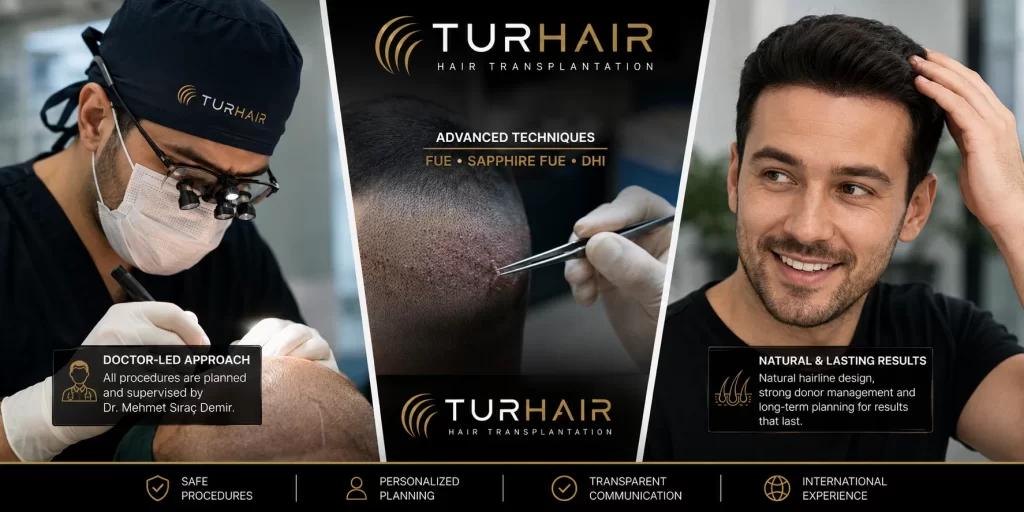
FUE and DHI Techniques at TurHair
TurHair does not recommend one technique for every patient. The choice between
FUE and DHI is based on the patient’s hair-loss pattern,
donor capacity, existing hair, required graft number and desired coverage.
“`
| Comparison | FUE at TurHair | DHI at TurHair |
|---|---|---|
| Extraction Method | Follicular units are extracted individually from the donor area using fine micro-punches. | Grafts are also extracted individually using the FUE extraction method. |
| Implantation Method | Recipient channels are created first, and the grafts are then placed into the planned openings. | Grafts are implanted using specialized implanter pens that create and place the graft in one controlled step. |
| Best Suited For | Patients requiring larger graft numbers, broader coverage or treatment of advanced hair loss. | Hairline refinement, smaller areas and selected cases where grafts must be placed between existing hairs. |
| Large Sessions | Often preferred for large sessions because it allows efficient implantation across wider treatment areas. | May be more suitable for targeted areas, although the final decision depends on the patient’s individual plan. |
| Shaving | Full or partial shaving is commonly recommended, especially for larger procedures. | Partial-shave or selected no-shave options may be possible in appropriate cases. |
| Density | Can provide excellent density when graft distribution and channel planning are performed correctly. | Allows controlled placement in selected areas, but does not automatically guarantee higher density than FUE. |
| Recovery | Usually includes temporary redness, scabbing and mild swelling during the first days. | Recovery is generally similar to FUE, with temporary redness, scabbing and possible swelling. |
| Main Advantage | Efficient coverage, flexibility and suitability for a wide range of hair-loss patterns. | Controlled implantation in targeted areas and around existing hair in carefully selected patients. |
“`
01
Individual Technique Selection
TurHair selects the technique after reviewing donor quality, recipient-area size, existing hair and long-term hair-loss expectations.
02
Doctor-Led Planning
Dr. Mehmet Sıraç Demir evaluates the scalp, designs the hairline and plans graft distribution according to facial proportions and donor capacity.
03
No Marketing-Based Recommendation
DHI is not automatically considered superior, and FUE is not treated as outdated. The recommendation is based on medical suitability.
“`
“`
Which Technique Does TurHair Recommend?
TurHair recommends the technique that best matches the patient’s individual needs.
FUE may be more suitable for larger areas and higher graft requirements, while DHI may be useful for targeted implantation and selected non-shaven cases.
The final result depends more on planning, donor management, hairline design and surgical execution than on the technique name alone.
Treatment suitability, graft numbers and technique selection can only be confirmed after an individual medical and donor-area assessment.
DHI vs FUE: The Main Differences
| Feature | FUE | DHI |
|---|---|---|
| Extraction | Micro punch extraction | Micro punch extraction |
| Implantation | Channels created first | Direct implantation pen |
| Large Sessions | Excellent | Usually smaller sessions |
| Recovery | Fast | Fast |
| Natural Results | Excellent | Excellent |
| Cost | Usually lower | Usually higher |
Which Technique Looks More Natural?
Many patients assume DHI automatically produces more natural results, but this is a misconception.
The natural appearance of a hair transplant depends far more on:
- Hairline design
- Channel angle
- Graft direction
- Surgeon’s experience
- Appropriate graft distribution
A well-performed FUE procedure can look just as natural as DHI.
Recovery: DHI vs FUE
Recovery is very similar with both techniques.
Patients can expect:
- Mild swelling
- Temporary redness
- Small scabs
- Shock loss
- New growth beginning after 3–4 months
Final results usually develop between 12 and 18 months regardless of the implantation technique.
Which Technique Is Better for Large Areas?
Patients with advanced hair loss often require thousands of grafts to achieve satisfactory coverage.
In these situations, FUE is generally preferred because it is highly efficient for larger transplant sessions while preserving excellent graft survival.
DHI may be more suitable for smaller areas, hairline refinement, or targeted density improvements, depending on the individual case.
Is DHI More Painful Than FUE?
No. Both procedures are performed under local anesthesia and are generally well tolerated. Most patients describe only mild discomfort during recovery rather than significant pain.
Does DHI Have Better Graft Survival?
Scientific evidence does not consistently show that DHI produces higher graft survival than a properly performed FUE procedure.
Graft survival depends primarily on:
- Proper graft handling
- Minimal follicle trauma
- Correct storage conditions
- Experienced surgical technique
- Good post-operative care
Who Is a Good Candidate for FUE?
- Patients requiring larger graft numbers
- Moderate to advanced hair loss
- Individuals seeking maximum coverage
- Most male pattern baldness patients
Who May Benefit from DHI?
- Hairline refinement
- Smaller treatment areas
- Patients wishing to preserve existing hair
- Select cases where minimal shaving is preferred
DHI vs FUE: Which Is Better?
Neither DHI nor FUE is universally superior.
The best technique depends on:
- Degree of hair loss
- Donor availability
- Hair characteristics
- Treatment goals
- Surgeon’s expertise
For many patients, surgeon experience and treatment planning have a far greater impact on the final outcome than the specific implantation method.
Final Thoughts
Both DHI and FUE are proven hair transplant techniques capable of delivering natural, permanent results. Rather than focusing solely on the name of the procedure, patients should choose a qualified surgeon who performs careful donor assessment, individualized hairline design, and meticulous graft placement.
A personalized treatment plan based on your unique hair characteristics will always be more important than choosing one technique over another.
DHI vs FUE: Which Technique Has Better Success Rates?
One of the most common questions patients ask is whether DHI has a higher success rate than FUE. In reality, scientific studies have not demonstrated a consistent advantage for either technique when both are performed correctly.
The overall success of a hair transplant depends far more on surgical expertise than on the implantation method itself.
Factors that influence success include:
- Accurate patient selection
- Healthy donor hair availability
- Proper graft harvesting
- Minimal follicle trauma
- Correct graft storage
- Natural hairline planning
- Precise graft placement
- Patient compliance with aftercare instructions
When these principles are followed, both DHI and FUE can achieve excellent long-term graft survival and natural-looking results.
Does DHI Produce Higher Hair Density?
Some clinics advertise DHI as a technique capable of producing significantly higher density than FUE. However, this claim can be misleading.
Hair density depends primarily on:
- The number of available grafts.
- Donor area quality.
- Recipient blood supply.
- Hair shaft thickness.
- Hair color and texture.
- The surgeon’s implantation strategy.
While DHI implantation pens allow controlled placement of follicles, an experienced surgeon can achieve similarly dense and natural results using modern FUE techniques.
Attempting to implant excessive grafts into a limited area may actually compromise blood circulation and reduce graft survival.
Scarring: DHI vs FUE
Both DHI and FUE are minimally invasive procedures that avoid the long linear scar associated with FUT (strip surgery).
Instead, both techniques leave tiny circular extraction sites that usually become almost invisible after healing.
Scarring depends more on:
- Punch size.
- Extraction technique.
- Skin characteristics.
- Healing response.
- Surgeon’s experience.
Patients who keep their hair extremely short may notice small donor scars regardless of whether DHI or FUE is used, although these are generally difficult to detect.
Procedure Duration
The duration of surgery varies according to the number of grafts transplanted.
| Procedure | Typical Duration |
|---|---|
| Small FUE Session | 4–6 Hours |
| Large FUE Session | 6–8 Hours |
| Small DHI Session | 5–7 Hours |
| Large DHI Session | Can Take Longer |
DHI procedures may require additional operating time because implantation is performed individually using implantation pens.
Cost Comparison: DHI vs FUE
DHI is often marketed as a premium procedure and may cost more than conventional FUE.
Higher pricing usually reflects:
- Additional implantation devices.
- Longer operating times.
- Greater technical demands.
- Smaller daily patient volumes in some clinics.
However, a higher price does not automatically guarantee better cosmetic results.
Patients should prioritize surgeon experience and clinical quality rather than selecting a technique based solely on marketing or cost.
Which Technique Is Better for Women?
Female hair transplant patients often have different goals than men. Many women seek to increase density without completely shaving their existing hair.
Depending on the patient’s hair characteristics and treatment area, DHI may offer advantages in carefully placing grafts between existing hairs.
Nevertheless, modern FUE can also be highly effective for female patients when performed by an experienced surgeon.
The treatment plan should always be individualized rather than determined solely by the name of the technique.
Common Misconceptions About DHI and FUE
Several myths continue circulating online regarding these procedures.
Myth 1: DHI Is a Completely Different Procedure
False. DHI is actually a variation of FUE. Both procedures involve extracting follicular units individually from the donor area.
Myth 2: DHI Always Produces Better Results
False. Natural-looking results depend primarily on the surgeon’s planning and execution rather than the implantation device.
Myth 3: FUE Is Outdated
False. FUE remains the worldwide standard for hair transplantation and continues to evolve with improved instruments and microsurgical techniques.
The Importance of Choosing the Right Surgeon
Patients often spend considerable time comparing DHI and FUE while overlooking the most important factor: the experience of the surgical team.
A skilled surgeon evaluates:
- Donor area quality.
- Future hair loss progression.
- Hairline proportions.
- Recipient blood supply.
- Long-term graft management.
These elements have a much greater impact on the final result than whether implantation is performed using traditional forceps or an implantation pen.
DHI vs FUE for Different Hair Loss Patterns
The best hair transplant technique depends heavily on the pattern and extent of hair loss. A method that works well for a patient with a receding hairline may not be the best choice for someone with extensive thinning across the frontal, mid-scalp, and crown areas.
At TurHair, treatment planning begins with identifying the patient’s Norwood stage, donor capacity, scalp condition, and likely future progression of hair loss. This allows the medical team to decide whether FUE, DHI, or a combined approach is more appropriate.
Receding Hairline
Patients with a receding hairline often require a carefully designed frontal zone rather than a very large transplant session. In these cases, both FUE and DHI can be effective.
DHI may be suitable when the treatment area is relatively small and detailed placement is required around the temples or frontal corners. FUE can also produce excellent results when the recipient channels are created at the correct angle and direction.
The most important factor is not the implantation tool but the quality of hairline design. A natural hairline should include slight irregularities, gradual density, and single-hair grafts in the first rows.
Diffuse Thinning
Diffuse thinning can be more challenging because many native hairs remain in the recipient area. Implantation must be carefully planned to reduce unnecessary trauma to existing follicles.
DHI may offer practical advantages in selected diffuse-thinning cases because implanter pens can place grafts between existing hairs. However, this does not mean DHI is always the safer option. The surgeon must first determine whether the native hairs are stable or already severely miniaturized.
If the existing hair is weak, temporary or permanent shock loss may occur regardless of the technique used.
Advanced Hair Loss
Patients with advanced hair loss usually require broad coverage and a higher number of grafts. FUE is often preferred in these cases because it is efficient for larger treatment areas and allows the surgeon to plan graft distribution across the frontal, mid-scalp, and crown zones.
For advanced cases, donor management is especially important. Attempting to cover every bald area with maximum density may exhaust the donor area and create an unnatural long-term result.
Hair Characteristics and Technique Selection
Hair texture, thickness, curl pattern, and color contrast all influence the visual result of a hair transplant. These factors are sometimes more important than the difference between FUE and DHI.
Thick Hair
Patients with thick hair shafts often achieve stronger visual coverage with fewer grafts because each hair contributes more volume.
Fine Hair
Fine hair may require more strategic graft placement to create the appearance of density. The surgeon must avoid overpromising because the same graft count can look very different depending on hair calibre.
Curly Hair
Curly hair can provide excellent coverage because the natural curl creates more volume. However, extraction may be technically more demanding because the follicles can curve beneath the skin.
Hair and Skin Color Contrast
Low contrast between hair and scalp often creates a denser appearance. High contrast, such as dark hair on a light scalp, may make thinning more visible.
Neither FUE nor DHI changes these biological characteristics. The surgeon must account for them during planning.
Is DHI Better for Unshaven Hair Transplants?
DHI is often associated with no-shave or partial-shave procedures. In selected patients, this can be a practical option, especially when the treatment area is small and the patient wants to conceal the procedure more easily.
However, unshaven transplantation has limitations:
- It may take longer.
- It can be more technically demanding.
- It may not be suitable for large graft sessions.
- Existing long hair can make implantation more difficult.
- Post-operative washing may require additional care.
For patients requiring extensive coverage, shaving often improves visibility, efficiency, hygiene, and graft placement accuracy. A no-shave option should be selected because it is medically suitable, not only because it is more convenient.
Are DHI Results Faster Than FUE Results?
No. The hair growth timeline is generally the same with both techniques because transplanted follicles follow the same biological growth cycle.
Typical growth stages include:
- First 10 days: scabbing and early healing
- Weeks 2–8: temporary shedding
- Months 3–4: early new growth
- Months 5–8: visible improvement
- Months 9–12: significant maturation
- Months 12–18: final thickening and texture development
Some patients may notice earlier growth, while others progress more slowly. This variation is usually related to individual biology rather than whether DHI or FUE was used.
Can DHI or FUE Prevent Future Hair Loss?
No hair transplant technique can stop the progression of androgenetic alopecia. Transplanted follicles are usually resistant to pattern hair loss, but the patient’s existing native hair may continue to thin over time.
This is why long-term planning is essential. A surgeon should consider:
- Current age
- Family history
- Rate of hair loss
- Miniaturization pattern
- Future donor requirements
- Potential medical treatment
In suitable patients, treatments such as minoxidil or finasteride may be discussed with a qualified doctor to help preserve native hair. These medications are not appropriate for everyone and should be considered individually.
DHI vs FUE for Second Hair Transplants
Patients who have already undergone one hair transplant require especially careful donor assessment before a second procedure.
The medical team must evaluate:
- Remaining donor density
- Previous extraction pattern
- Existing scars
- Current graft survival
- Hairline quality
- Areas still requiring coverage
FUE may be useful when a larger revision area requires additional grafts. DHI may be suitable for targeted density enhancement or hairline correction. In some cases, neither technique may be advisable if the donor area has been overharvested.
Why Technique Names Can Be Misleading
Many patients assume that a more modern-sounding name automatically means a better result. This is one of the most common misunderstandings in hair transplant marketing.
DHI is not a completely separate extraction technique. It uses FUE extraction and differs mainly in the implantation stage. Similarly, sapphire FUE is still FUE, with sapphire blades used for recipient-site creation.
The quality of the result depends on:
- Who designs the hairline
- Who creates the recipient sites
- Who extracts and handles the grafts
- How donor capacity is protected
- How many patients the clinic treats each day
- How closely recovery is monitored
Patients should ask these questions instead of focusing only on the technique name.
What Makes TurHair’s Approach Different?
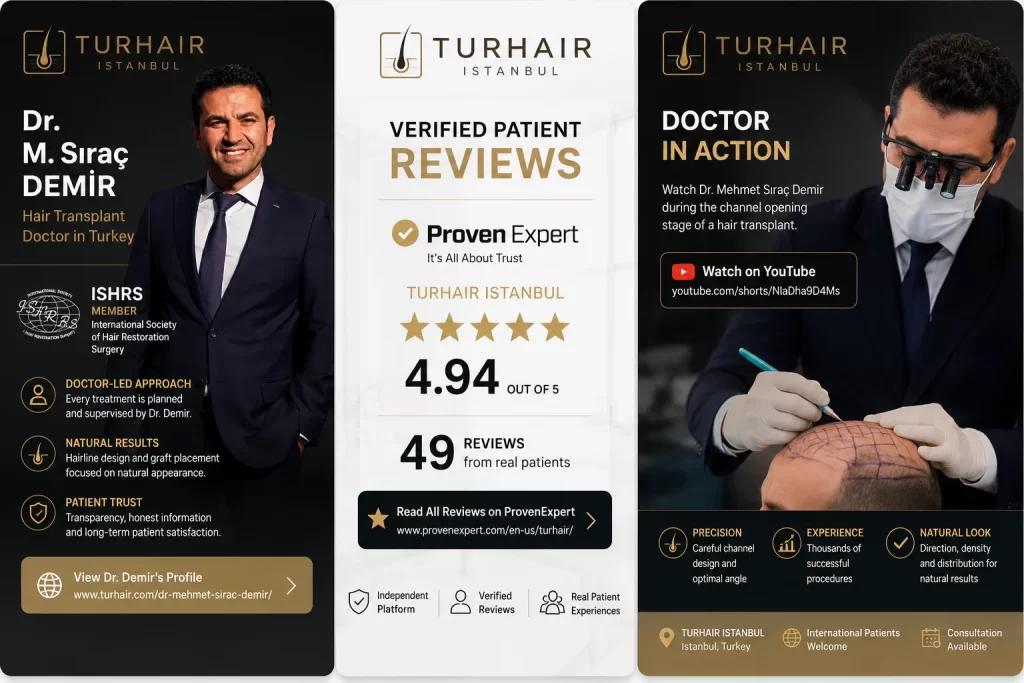
TurHair focuses on individualized planning rather than promoting one technique as universally superior. Dr. Mehmet Sıraç Demir evaluates the patient’s donor area, hair-loss pattern, facial proportions, and long-term needs before recommending FUE, DHI, or a combined strategy.
The aim is to use the technique that offers the best balance between natural density, donor preservation, safe healing, and long-term planning.
This approach helps avoid common problems such as:
- Overharvesting
- Unnaturally low hairlines
- Poor graft direction
- Uneven density
- Unnecessary procedure costs
- Technique selection based only on marketing
Final Conclusion
The question “DHI or FUE?” cannot be answered correctly without examining the individual patient. Both techniques can produce excellent results, and both can produce disappointing results if planning and execution are poor.
FUE may be more suitable for broad areas, larger graft numbers, and advanced hair loss. DHI may offer advantages in smaller areas, targeted density work, and selected cases involving existing hair.
The most important decision is not choosing between two technique names. It is choosing an experienced, doctor-led clinic that protects the donor area, creates a natural hairline, handles grafts carefully, and provides realistic long-term planning.
At TurHair, technique selection is based on medical suitability rather than trends. This personalized approach allows each patient to receive a treatment plan designed around their own hair characteristics, goals, and future needs.
DHI vs FUE: Questions You Should Ask Before Choosing a Technique
Many patients spend weeks researching the differences between DHI and FUE before scheduling a consultation. While comparing techniques is useful, asking the right questions during your consultation is even more important. A successful hair transplant depends on individualized planning rather than selecting the technique with the strongest marketing campaign.
Instead of asking only, “Which technique is better?” patients should also ask:
- Am I a suitable candidate for surgery?
- How many grafts do I actually need?
- Is my donor area strong enough?
- Will I need another procedure in the future?
- Who will design my hairline?
- Who will perform the critical stages of the surgery?
- How will my existing hair be protected?
- What can I realistically expect after one year?
These questions often have a greater impact on the final result than simply choosing between DHI and FUE.
Why Personalized Treatment Planning Matters
No two patients experience hair loss in exactly the same way. Even individuals with similar levels of baldness may have completely different donor density, hair characteristics, scalp elasticity, and long-term expectations.
This is why standardized treatment plans rarely produce the best outcomes.
At TurHair, treatment planning focuses on the patient’s unique characteristics rather than applying the same protocol to everyone. The medical team evaluates the entire scalp instead of concentrating only on the visibly bald areas.
Long-term planning is particularly important because androgenetic alopecia is progressive. Hair loss may continue after surgery, making donor preservation an essential part of responsible treatment.
The Importance of Hairline Design
One of the most noticeable features of any hair transplant is the frontal hairline. Even excellent graft survival cannot compensate for a poorly designed hairline.
A natural hairline should:
- Match the patient’s age.
- Respect facial proportions.
- Include natural irregularities.
- Avoid an unnaturally straight appearance.
- Use single-hair grafts in the leading edge.
- Transition gradually into higher density.
Whether FUE or DHI is used, artistic planning remains one of the defining factors of a successful cosmetic result.
Can Technique Alone Guarantee Better Results?
The simple answer is no.
Some advertisements suggest that changing the implantation device automatically produces denser or more natural results. In reality, no surgical instrument can replace careful planning and medical expertise.
Excellent outcomes depend on:
- Proper patient selection.
- Healthy donor follicles.
- Minimal graft trauma.
- Correct implantation angles.
- Balanced density.
- Comprehensive aftercare.
Patients should therefore evaluate the overall quality of the clinic rather than focusing exclusively on the technique name.
How Experience Influences Every Stage of Surgery
Hair transplantation is a sequence of many small technical steps. Every stage influences the final outcome.
An experienced surgical team understands how to:
- Harvest grafts without excessive trauma.
- Preserve graft hydration.
- Avoid prolonged out-of-body time.
- Create natural recipient sites.
- Distribute grafts according to density goals.
- Protect the donor area for possible future procedures.
These details often determine whether patients achieve a natural-looking result that ages well over time.
Choosing Quality Over Marketing
The popularity of a particular technique changes over time as clinics promote new technologies. However, the biological principles of successful hair transplantation remain remarkably consistent.
Patients should be cautious of claims such as:
- “Completely scar-free.”
- “Guaranteed 100% graft survival.”
- “No swelling at all.”
- “Instant results.”
- “Permanent density after one session for every patient.”
No responsible medical professional can guarantee these outcomes because healing depends on individual biology as well as surgical technique.
Instead, patients should look for transparent explanations, realistic expectations, and evidence-based recommendations.
Recovery Expectations After FUE and DHI
Although recovery differs slightly between individuals, both FUE and DHI generally follow a similar healing timeline.
During the first week, patients may notice:
- Mild swelling.
- Temporary redness.
- Small protective scabs.
- Minor tenderness.
By the second week, most visible signs of surgery have improved significantly. Temporary shedding usually occurs during the first month before new growth begins several months later.
Patience is essential because transplanted follicles require time to enter their normal growth cycle.
Long-Term Hair Planning
A hair transplant should never be viewed as an isolated procedure. It should be considered part of a long-term strategy for managing progressive hair loss.
During consultation, surgeons should consider:
- Expected future baldness.
- Available donor reserves.
- Possible future transplant sessions.
- Age-related changes.
- Medical treatment options.
This comprehensive approach helps avoid situations where all available donor hair is used during the first procedure, leaving few options for future correction if hair loss progresses.
Why Many Patients Choose a Doctor-Led Clinic
The difference between clinics is not always the equipment they use but how treatment is organized.
Doctor-led clinics generally emphasize:
- Comprehensive consultation.
- Individual treatment planning.
- Medical supervision.
- Natural hairline design.
- Structured aftercare.
Patients often value this approach because it provides greater continuity from consultation through long-term follow-up.
Final Recommendation
Both DHI and FUE are excellent modern hair transplant techniques when used appropriately. Neither should be viewed as universally superior. Instead, each technique has specific strengths that make it suitable for particular clinical situations.
The best results are achieved when the treatment plan is tailored to the individual patient rather than determined by marketing trends or package names. Careful donor assessment, realistic expectations, natural hairline design, and meticulous surgical execution remain the cornerstones of successful hair restoration.
Patients considering hair transplantation should focus on selecting an experienced, doctor-led clinic that provides personalized planning, transparent communication, and comprehensive post-operative care. With the right medical team, both FUE and DHI can deliver natural, long-lasting improvements in appearance and confidence.
The Future of Hair Transplantation: Is DHI Replacing FUE?
As hair restoration technology continues to evolve, many patients wonder whether DHI will eventually replace FUE. The simple answer is no. Instead of competing techniques, DHI and FUE should be viewed as complementary methods that can be selected according to the patient’s individual needs.
Modern hair transplantation is moving toward personalized treatment rather than promoting a single technique for every patient. Advances in surgical instruments, graft preservation, digital planning, and doctor-led procedures have improved outcomes regardless of the implantation method used.
Today, the most respected hair transplant clinics focus on choosing the right technique for the right patient rather than advertising one approach as universally superior.
Technology Continues to Improve Both Techniques
Both FUE and DHI have benefited from technological innovation over the past decade.
Modern improvements include:
- Smaller extraction punches.
- Improved graft storage solutions.
- Higher magnification during surgery.
- More refined implantation instruments.
- Better local anesthesia techniques.
- Improved post-operative care protocols.
These advancements have reduced tissue trauma, improved graft survival, and helped patients recover more comfortably than ever before.
Why Experience Still Matters More Than Equipment
Modern surgical instruments are valuable tools, but they cannot replace clinical judgment.
Two clinics using identical equipment may achieve very different results depending on:
- Hairline design.
- Donor management.
- Graft handling.
- Implantation technique.
- Patient selection.
- Aftercare quality.
The surgeon’s ability to make correct medical decisions remains one of the strongest predictors of long-term success.
Balancing Density and Donor Preservation
Many patients request the highest possible density after seeing dramatic before-and-after photographs online. While achieving good density is important, responsible treatment planning must also protect the donor area.
Overly aggressive extraction may leave visible thinning at the back of the scalp and reduce the number of grafts available for future procedures.
At TurHair, donor preservation is considered a long-term investment. Rather than using every available graft during one session, treatment planning aims to create natural-looking coverage while maintaining options for the future if additional hair loss occurs.
Hair Transplant Success Depends on More Than Technique
Whether a patient chooses FUE or DHI, successful outcomes depend on many variables working together.
Important factors include:
- Healthy donor follicles.
- Appropriate graft numbers.
- Balanced density planning.
- Natural hairline design.
- Careful implantation angles.
- Proper healing.
- Patient expectations.
A technically perfect procedure can still produce disappointing cosmetic results if the hairline is poorly designed or if donor management is inadequate.
Can Lifestyle Affect Your Hair Transplant Results?
Yes. Although surgery provides the foundation for successful hair restoration, patient lifestyle also influences recovery.
Healthy habits include:
- Following all aftercare instructions.
- Avoiding smoking during healing.
- Limiting alcohol immediately after surgery.
- Maintaining a balanced diet.
- Getting adequate sleep.
- Protecting the scalp from direct sunlight.
These measures support the body’s natural healing process and contribute to optimal graft survival.
Should You Choose DHI or FUE Based on Online Reviews?
Online reviews can provide useful insights into patient experiences, but they should never replace a professional consultation.
Every patient’s situation is different, and treatment that worked well for one individual may not be suitable for another.
Reliable decision-making should be based on:
- Medical examination.
- Donor assessment.
- Hair-loss pattern.
- Photographic evaluation.
- Realistic expectations.
A qualified surgeon can explain why one technique is recommended based on objective clinical findings rather than internet trends.
Why Consultation Is More Important Than Technique
The consultation is where the most important decisions are made.
During this stage, the surgeon evaluates whether surgery is appropriate, estimates graft requirements, plans the hairline, and discusses long-term expectations.
Patients should never feel pressured to choose one technique immediately. A thorough consultation should provide enough information to make an informed decision based on medical evidence rather than marketing language.
TurHair’s Treatment Philosophy
At TurHair, every patient receives an individualized assessment before any recommendation is made. Rather than promoting DHI or FUE as a superior technique, the medical team focuses on selecting the method that best matches the patient’s unique characteristics.
This philosophy is based on several principles:
- Protect the donor area.
- Create a natural hairline.
- Use grafts efficiently.
- Plan for future hair loss.
- Provide transparent medical advice.
- Support patients throughout recovery.
By prioritizing careful planning over marketing claims, TurHair aims to deliver results that remain natural for many years.
Conclusion: DHI vs FUE in 2026
In 2026, the discussion should no longer focus on whether DHI is better than FUE or vice versa. Both techniques are well-established, safe, and capable of producing outstanding results when performed correctly.
The real difference lies in how the procedure is planned, who performs the critical medical stages, how the donor area is protected, and how closely the patient’s long-term needs are considered.
Patients who choose an experienced, doctor-led clinic with personalized treatment planning are far more likely to achieve natural, balanced, and lasting hair restoration than those who choose a clinic based solely on technique names or promotional offers.
Ultimately, the best hair transplant is not defined by whether it is called DHI or FUE. It is defined by thoughtful planning, meticulous surgical execution, and a commitment to delivering results that look natural not only today but for many years to come.
Conclusion
Both DHI and FUE are highly effective hair transplant techniques capable of restoring natural hair growth with excellent long-term outcomes. Neither procedure is universally better, and both share similar success rates when performed by experienced surgeons using modern techniques.
The ideal choice depends on each patient’s degree of hair loss, donor capacity, treatment goals, and overall surgical plan. Rather than asking whether DHI or FUE is superior, patients should focus on selecting an experienced, doctor-led clinic that provides personalized treatment planning, meticulous graft handling, and comprehensive post-operative care.
Ultimately, the expertise of the surgeon—not the name of the technique—is the single most important factor influencing a successful hair transplant.
| Recommended Reading | Why Read It? |
|---|---|
FUE Hair Transplant Guide | Learn how the FUE technique works, who is the ideal candidate, recovery timeline, and expected results. |
DHI Hair Transplant Guide | Discover the advantages of Direct Hair Implantation (DHI), including higher precision and natural hairline design. |
How Many Grafts Do You Need? | Estimate the number of grafts required based on your level of hair loss. |
Hair Transplant Recovery Timeline | See what happens day by day and month by month after a hair transplant. |
Hair Transplant Cost in Turkey | Compare prices, packages, and understand what affects the total treatment cost. |
Before & After Results | View real patient transformations and realistic expectations after surgery. |
Hair Transplant Side Effects | Understand common side effects, healing stages, and how to reduce complications. |
Browse All Hair Transplant Articles | Explore our complete collection of expert guides, comparisons, patient advice, and the latest hair restoration techniques. |