FUE Hair Transplant Turkey (2026)
August 15, 2026
How Many Grafts Do I Need for a Hair Transplant? (2026)
August 16, 2026How to Choose a Hair Transplant Clinic: The Complete Guide for Natural Results
Hair transplantation has become one of the most popular cosmetic procedures worldwide. Every year, hundreds of thousands of patients travel abroad, especially to Turkey, searching for affordable prices and excellent results. However, while prices may vary significantly, the quality of the clinic and the experience of the surgeon make the biggest difference.
If you are considering a hair transplant, choosing the right clinic is the most important decision you will make. A successful hair transplant should look completely natural for the rest of your life. Unfortunately, a poor procedure can leave visible scars, unnatural hairlines, low density, and donor area damage that cannot easily be corrected.
This guide explains everything you should know before selecting a hair transplant clinic.
How to Choose a Hair Transplant Clinic?
- Choose a doctor-led clinic.
- Verify the surgeon’s experience.
- Review real before-and-after results.
- Check independent patient reviews.
- Ask who performs the surgery.
- Evaluate donor area preservation.
- Compare aftercare services.
- Don’t choose based on price alone.
1. Always Choose a Doctor-Led Hair Transplant Clinic
The biggest mistake many patients make is assuming that every clinic operates the same way.
In reality, there are two completely different models:
- Doctor-led clinics
- Technician-led clinics
Many low-cost clinics advertise famous doctors, but the doctor may only spend a few minutes with the patient while technicians perform almost the entire surgery.
A true doctor-led clinic means the surgeon personally:
- Examines your scalp
- Designs your hairline
- Calculates graft numbers
- Plans the extraction
- Creates recipient channels
- Supervises every stage of surgery
This significantly increases the chances of achieving natural density and long-lasting results.
Doctor-Led Hair Transplant
Why Choose TurHair & Dr. Demir?
The main difference is not only the technique used, but also who plans the surgery, who creates the recipient channels and how much medical attention each patient receives.
The Most Important Difference
At TurHair, Dr. Demir personally plans the hairline and opens the recipient channels. Channel direction, depth, angle and distribution are among the most important factors affecting naturalness, density and the final appearance of a hair transplant.
Treatment plans and results may vary depending on the patient’s donor capacity, hair characteristics and degree of hair loss.
2. Check the Doctor’s Experience
Experience matters more than marketing.
Ask questions such as:
- How many years has the doctor performed hair transplants?
- How many surgeries has the doctor completed?
- Does the doctor specialize only in hair restoration?
- Can you see long-term patient results?
A surgeon with thousands of successful procedures understands different hair types, ethnic characteristics, donor limitations, and future hair loss patterns.
3. Review Before and After Photos Carefully
Professional clinics always provide high-quality before and after photos.
Pay attention to:
- Hairline symmetry
- Natural appearance
- Hair density
- Temple design
- Crown coverage
- Donor healing
Look for photos taken under bright lighting without hair fibers or styling products.
Videos are even more reliable than photographs because they show the results from every angle.
4. Never Choose Based on Price Alone
Everyone likes to save money.
However, hair transplantation is not the place to choose the cheapest option.
Very low prices often indicate:
- High patient volume
- Technician-only surgeries
- Limited doctor involvement
- Lower quality instruments
- Less individualized treatment
A correction surgery is usually much more expensive than doing the procedure correctly the first time.
5. Understand Which Technique Is Used
Modern clinics generally offer:
- FUE Hair Transplant
- Sapphire FUE
- DHI Hair Transplant
Each technique has advantages depending on your hair type, donor area, and goals.
A reputable clinic recommends the most appropriate method rather than selling the most expensive package.
6. Hairline Design Is Everything
The hairline determines whether people notice you had surgery.
An experienced surgeon considers:
- Age
- Facial proportions
- Forehead size
- Future hair loss
- Natural asymmetry
- Ethnicity
An overly straight or low hairline may look artificial as you age.
The best hairline is one nobody notices.
7. Protecting the Donor Area Is Critical
Your donor area contains a limited number of permanent follicles.
Once overharvested, those grafts cannot be replaced.
A skilled surgeon carefully distributes extractions while preserving donor density for possible future procedures.
Ask whether donor preservation is part of the treatment plan.
8. Ask About the Number of Daily Patients
Some commercial clinics perform 15–30 surgeries every day.
Others treat only one or two patients daily.
Fewer patients generally allow:
- More doctor involvement
- Better planning
- Greater attention to detail
- Higher quality control
Hair transplantation is precision surgery—not factory production.
9. Read Independent Patient Reviews
Search for reviews on:
- Google Reviews
- Trustpilot
- RealSelf
- Hair restoration forums
- Reddit communities
Focus on detailed reviews explaining:
- The consultation
- The surgery
- Recovery
- Communication
- Final results after 12 months
Avoid relying only on testimonials published by the clinic itself.
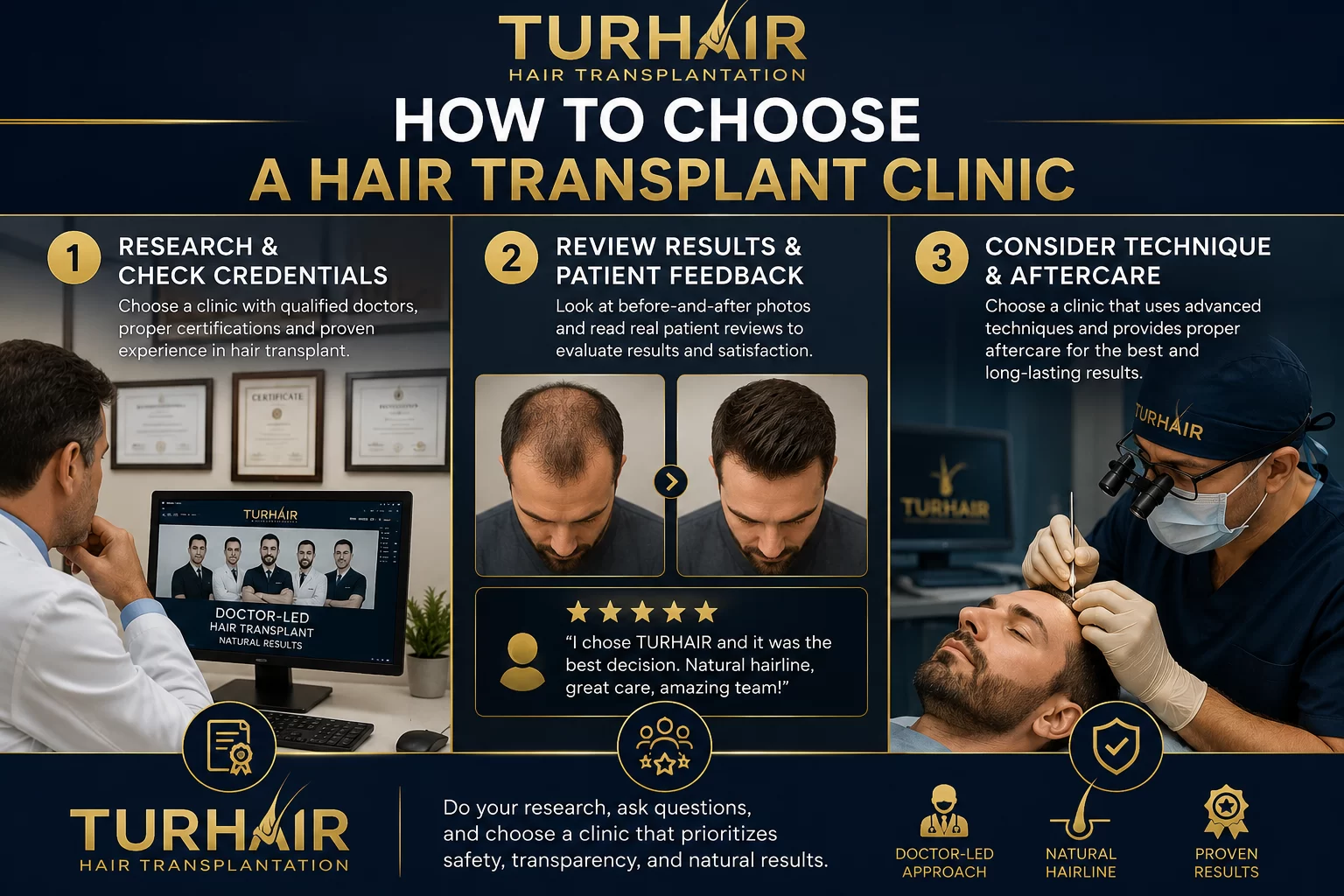
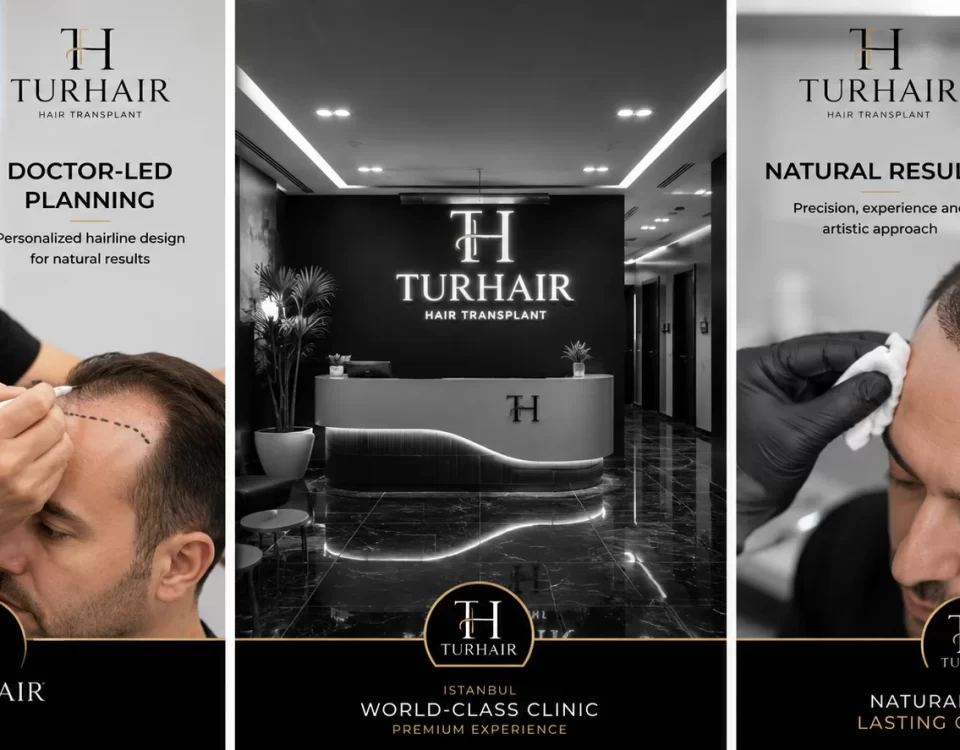
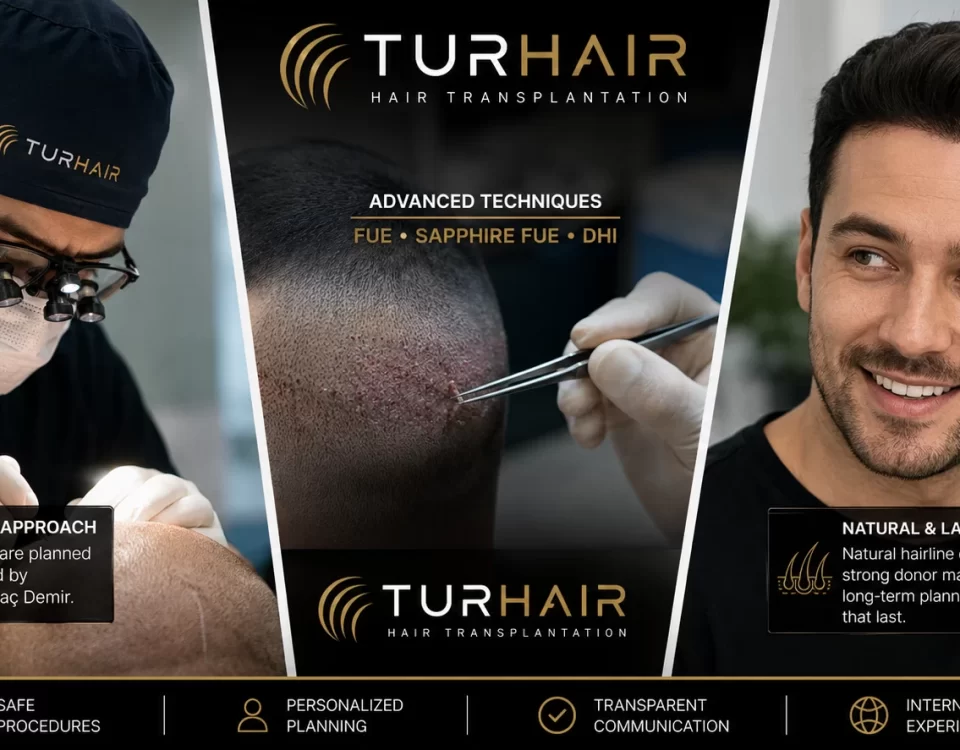
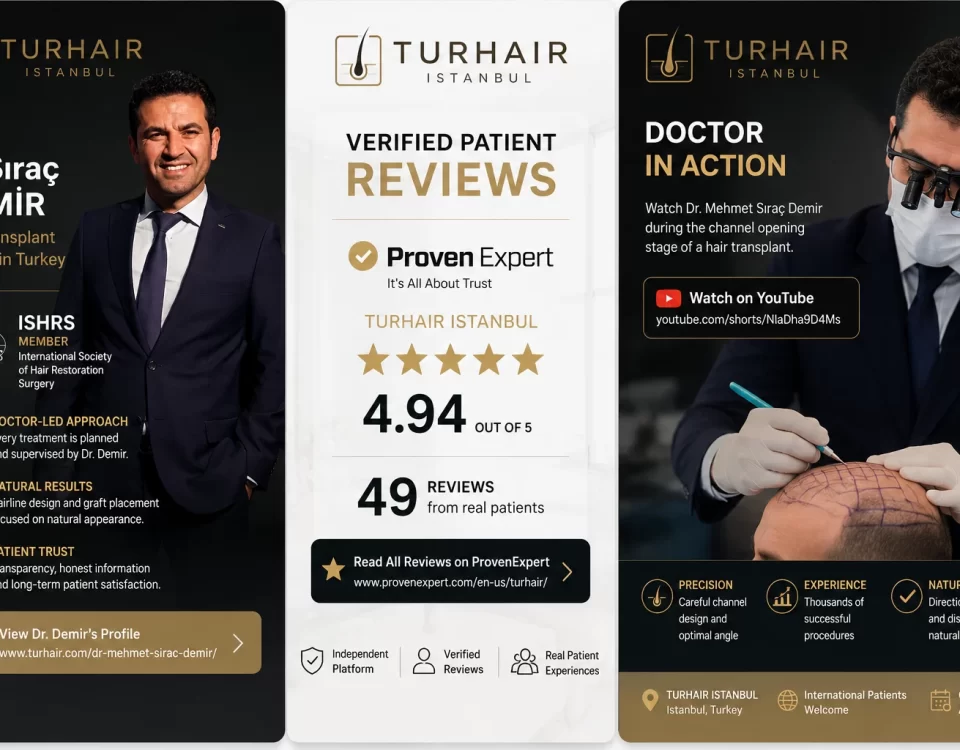
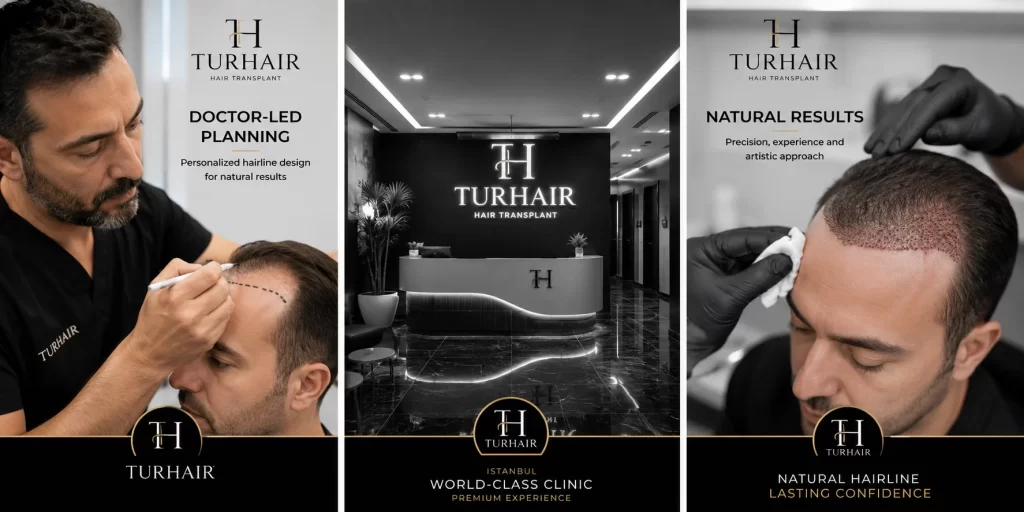
How to Choose a Hair Transplant Clinic infographic by TurHair showing doctor-led hair transplant, patient reviews, clinic credentials, and advanced FUE techniques in Turkey.
10. Communication Before Surgery Matters
Professional clinics answer questions honestly.
They should explain:
- Expected graft numbers
- Limitations
- Realistic density
- Future hair loss
- Recovery timeline
- Potential risks
If someone guarantees “perfect” results without examining you carefully, consider it a warning sign.
11. Ask About Aftercare
Hair transplantation does not end after surgery.
Proper aftercare influences the final outcome.
Good clinics provide:
- First wash
- Medication
- Detailed recovery instructions
- Regular follow-up
- Progress evaluations
Continuous support is one characteristic of high-quality clinics.
12. Verify Safety Standards
Your surgery should be performed in a sterile medical environment.
Ask whether the clinic follows:
- Sterile operating protocols
- Single-use instruments where appropriate
- Medical emergency procedures
- Proper patient monitoring
Safety should always come before cosmetic results.
13. Choose a Clinic That Plans for Your Future
Hair loss is progressive.
A responsible surgeon designs today’s transplant while considering how your hair may look 10 or even 20 years from now.
This long-term planning helps preserve donor reserves and maintain a natural appearance as you age.
14. Why Consultation Quality Matters
Your consultation is the first indication of how professional a hair transplant clinic truly is. A thorough consultation should never feel rushed or sales-driven. Instead, it should be an educational experience where the doctor carefully evaluates your hair loss and explains every available option.
During the consultation, an experienced surgeon will assess:
- Current stage of hair loss
- Donor area quality
- Hair thickness
- Hair caliber
- Scalp elasticity
- Family history of baldness
- Future progression of hair loss
The consultation should also include a discussion about realistic expectations. Ethical clinics never promise unrealistic density or guarantee perfect results. Instead, they explain what is achievable based on your available donor hair.
15. The Importance of Customized Treatment Planning
No two patients experience hair loss in exactly the same way. Age, genetics, ethnicity, donor quality, and the pattern of baldness all influence the treatment plan.
A reputable clinic creates a personalized surgical strategy rather than applying the same approach to every patient.
Individual treatment planning may include:
- Hairline reconstruction
- Frontal density improvement
- Mid-scalp reinforcement
- Crown restoration
- Future second-session planning
- Medical therapy recommendations
Customized planning significantly improves long-term patient satisfaction.
16. Why Natural Density Is More Important Than Maximum Grafts
Many patients focus only on graft numbers. While graft count is important, it is not the only factor that determines success.
Two clinics may transplant exactly 4,000 grafts, yet one result appears dramatically denser because of superior channel design, implantation angles, and strategic graft placement.
Natural density depends on:
- Recipient site planning
- Proper spacing
- Hair direction
- Hair angulation
- Single and multi-hair graft distribution
- Surgeon’s artistic experience
Quality always outweighs quantity.
17. Understanding Graft Survival Rates
The success of a hair transplant depends heavily on graft survival. Healthy follicles must remain viable throughout extraction, storage, and implantation.
Experienced medical teams use techniques that minimize trauma to the grafts while reducing the time they remain outside the body.
High graft survival generally leads to:
- Better density
- Faster growth
- Improved coverage
- Natural appearance
- Higher patient satisfaction
Ask the clinic about its graft handling protocols and storage methods.
18. Avoid Clinics That Promise Unlimited Grafts
One of the biggest warning signs is a clinic promising “unlimited grafts.”
The donor area contains a finite number of permanent follicles. Removing too many grafts can permanently damage the donor region, leaving visible thinning.
Responsible surgeons prioritize:
- Donor preservation
- Balanced extraction
- Future procedures if needed
- Long-term appearance
Hair transplantation is a lifetime strategy, not a one-day procedure.
19. Transparency Builds Trust
Professional clinics are transparent about every aspect of treatment.
They clearly explain:
- Who performs each stage
- Expected surgery duration
- Recovery timeline
- Medication requirements
- Possible side effects
- Expected growth phases
If a clinic avoids answering direct questions, this should be considered a warning sign.
20. International Patients Should Consider Logistics
If you are traveling abroad for surgery, the clinic should make your experience as smooth as possible.
Many high-quality clinics provide:
- Airport transfers
- Hotel accommodation
- Interpreter services
- Medication packages
- Post-operative washing
- Travel guidance
These services improve comfort and reduce stress throughout your medical journey.
21. Ask to See Results Similar to Your Hair Type
Not every patient’s hair behaves the same way. Straight, wavy, curly, thick, and fine hair all produce different visual density after transplantation.
When reviewing before-and-after photos, ask to see patients who resemble you in terms of:
- Hair color
- Hair texture
- Degree of baldness
- Age
- Ethnicity
This provides a more realistic expectation of your potential outcome.
22. Questions You Should Ask Before Booking Surgery
Before making your final decision, prepare a list of important questions.
- Who performs the recipient channel creation?
- How many patients are treated each day?
- How many grafts are recommended?
- Why is this number appropriate?
- Will I need another session later?
- What happens if additional hair loss occurs?
- How is the donor area protected?
- What follow-up care is included?
The answers to these questions often reveal far more than promotional advertisements.
23. Red Flags That Should Make You Walk Away
Not every clinic operates with the same medical standards. Be cautious if you notice any of the following warning signs:
- Guaranteed “perfect” results
- Pressure to book immediately
- No direct access to the doctor
- Unrealistically low prices
- No discussion of risks
- Refusal to show long-term results
- Unclear information about who performs the surgery
- Poor communication before treatment
Trustworthy clinics educate patients rather than pressure them.
24. A Simple Checklist Before Choosing Your Clinic
| Question | Yes / No |
|---|---|
| Does the doctor personally examine you? | ☐ |
| Can you verify who performs the surgery? | ☐ |
| Are long-term results available? | ☐ |
| Are patient reviews independently verified? | ☐ |
| Does the clinic discuss future hair loss? | ☐ |
| Is donor preservation explained? | ☐ |
| Are risks discussed openly? | ☐ |
| Is aftercare included? | ☐ |
| Do you feel informed rather than pressured? | ☐ |
If you can confidently answer “Yes” to most of these questions, you are likely evaluating a professional clinic.
Common Mistakes Patients Make When Choosing a Hair Transplant Clinic
- Choosing the lowest price
- Ignoring the doctor’s experience
- Focusing only on graft numbers
- Believing unrealistic marketing promises
- Not checking independent reviews
- Failing to ask who performs the surgery
- Ignoring donor area preservation
- Expecting unrealistic density in one session
Avoiding these common mistakes dramatically increases your chances of achieving a natural, permanent, and satisfying result.
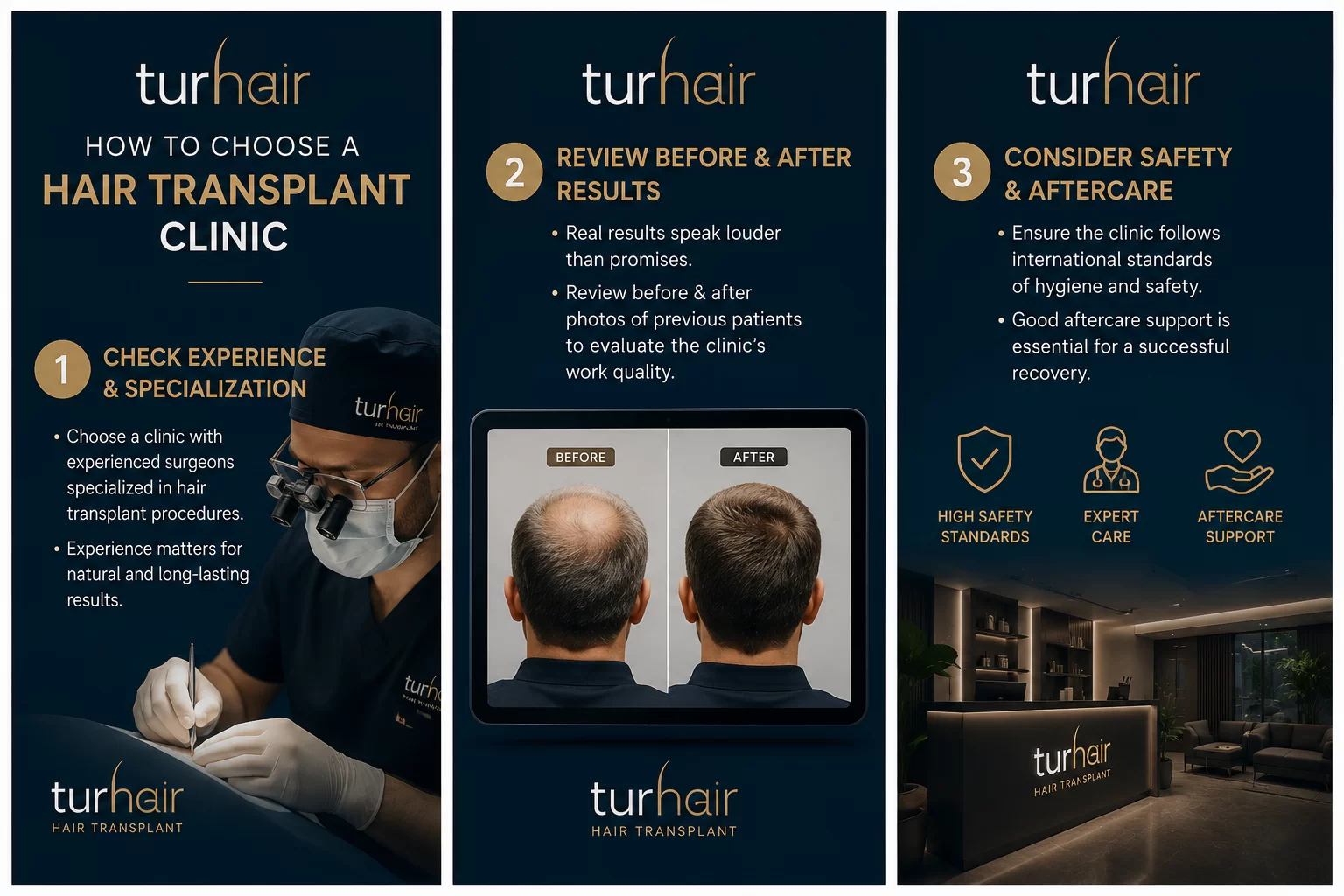
Learn how to choose the right hair transplant clinic with TurHair’s doctor-led approach, focusing on experience, credentials, patient results, and advanced FUE technology.
Conclusion
Choosing a hair transplant clinic is one of the most important decisions in your hair restoration journey. Excellent results depend on far more than price or marketing. They require experience, careful planning, ethical medical practice, artistic skill, and a commitment to patient care.
Take the time to research multiple clinics, compare their approach, ask detailed questions, and review authentic long-term results. Avoid rushing your decision, and remember that a successful hair transplant should continue to look natural not only next year but also ten or twenty years from now.
By prioritizing quality, transparency, and medical expertise, you give yourself the best opportunity to achieve a natural-looking hairline, balanced density, and long-lasting confidence.
Hair Transplant Clinic FAQ
How to Choose a Hair Transplant Clinic
Find clear answers to the most important questions about doctor involvement, clinic safety, donor protection, hairline design, costs, results and aftercare.
Frequently Asked Questions
At TurHair, Dr. Demir personally plans the hairline and creates the recipient channels according to each patient’s facial proportions, donor capacity and long-term hair loss pattern.
Recommended Hair Transplant Guides
Explore More Hair Transplant Resources
Learn more about choosing a hair transplant clinic, doctor-led procedures, FUE techniques, costs, success rates and real patient results.
Need More Hair Transplant Information?
Explore additional guides about hair transplant techniques, clinic selection, recovery, pricing and natural-looking results.