The Hidden Risks of Technician-Only Hair Transplant Clinics
July 22, 2026
Best Time for a Hair Transplant: Summer vs Winter
July 23, 2026Best Age for Hair Transplant: When Is the Right Time?
One of the most common questions asked by people experiencing hair loss is: What is the best age for a hair transplant? Although there is no single perfect age for every patient, timing is extremely important for achieving natural, permanent, and long-lasting results.
Hair loss develops differently in every person. Some men notice a receding hairline in their late teens, while others may not experience significant thinning until their thirties, forties, or later. For this reason, the decision should not be based only on age. Hair loss stability, donor area quality, family history, general health, and future hair loss progression must all be considered.
“`
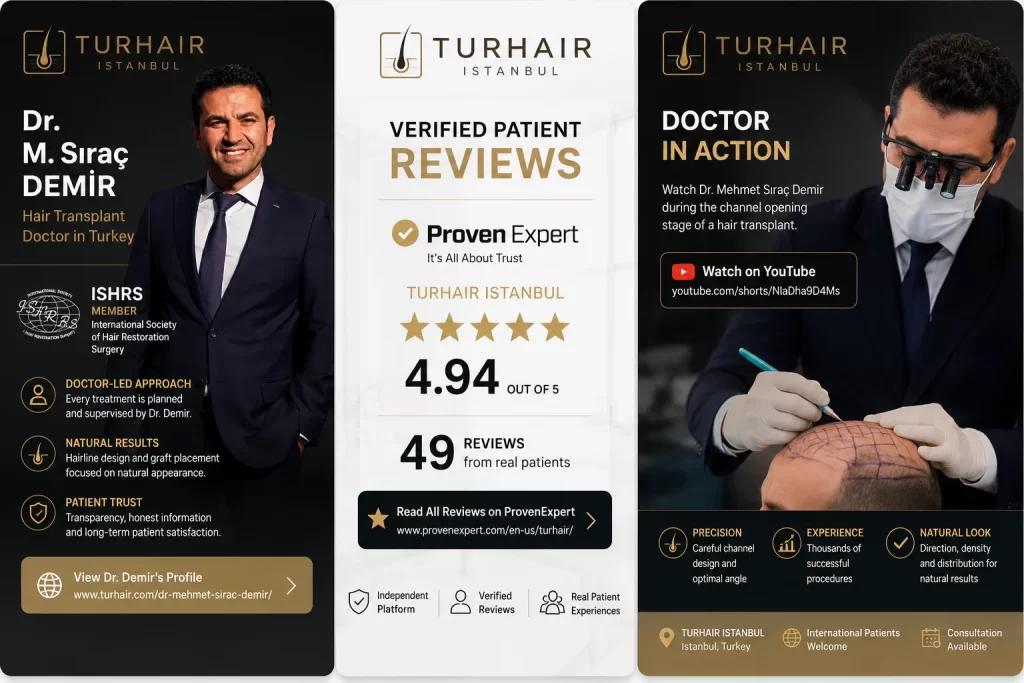
What Makes TurHair and Dr. Demir Different?
At TurHair, the treatment plan is not based on a standard graft package or a high-volume production model. Every patient is evaluated individually, and the most important surgical decisions are made under the leadership of
Dr. Demir.
“`
| Comparison Point | TurHair & Dr. Demir | High-Volume Clinic Model |
|---|---|---|
| Medical Planning | Each case is assessed individually according to the patient’s hair loss pattern, donor capacity, facial proportions, age, hair characteristics and possible future hair loss. | Treatment may be based mainly on a standard package, a general photograph review or a predetermined graft target. |
| Hairline Design | The hairline is designed according to facial structure, forehead proportions, age and long-term appearance. The goal is a natural result, not simply the lowest possible hairline. | Similar hairline templates may be used for many patients, sometimes without sufficient consideration of future aging or donor preservation. |
| Channel Opening | In the VIP treatment plan, Dr. Demir personally performs the channel-opening stage, which determines the direction, angle, distribution and visual density of the implanted grafts. | Important surgical stages may be delegated largely to technicians, depending on the clinic’s staffing and daily patient volume. |
| Daily Patient Volume | TurHair follows a limited-patient approach to support closer medical attention, careful planning and better communication throughout the treatment process. | Several procedures may be performed simultaneously, with different team members managing different patients during the same day. |
| Graft Strategy | The objective is not to extract the highest possible number of grafts. The plan focuses on safe extraction, visual coverage, donor-area protection and future surgical options. | Marketing may focus heavily on maximum graft numbers, even though more grafts do not automatically mean a more natural or safer result. |
| Donor Area Protection | Extraction is planned to maintain a balanced appearance in the donor zone and to reduce the risk of visibly depleted or overharvested areas. | Aggressive extraction may sometimes be used to reach a promised graft number, potentially compromising the appearance of the donor area. |
| Natural Density | Grafts are distributed strategically. Single-hair follicles are used in the front, while stronger grafts are placed behind them to create a gradual and natural density transition. | Density may be distributed according to a routine implantation pattern rather than the patient’s individual hair direction and facial anatomy. |
| Patient Communication | Patients receive direct guidance before arrival, during treatment and throughout the post-operative period, including instructions for washing, medication and recovery. | Communication may be handled mainly by sales coordinators, rotating assistants or different support representatives. |
| Long-Term Approach | The treatment plan considers how the result may appear years later. Donor reserves and future hair loss are taken into account before finalizing the hairline and graft distribution. | The immediate result may receive more attention than the patient’s possible hair loss progression over the following years. |
The comparison describes general differences between TurHair’s doctor-led approach and commonly used high-volume clinic models. Every clinic, medical team and patient case may differ.
A Hair Transplant Should Be Planned for Your Future, Not Only for Today
TurHair combines personalized medical planning, careful donor management and Dr. Demir’s involvement in the most important stages of the procedure. The objective is to create a natural, age-appropriate and sustainable result rather than applying the same treatment plan to every patient.
Why Does Age Matter in Hair Transplant Surgery?
Hair transplantation involves moving genetically resistant hair follicles from the donor area, usually located at the back and sides of the scalp, to thinning or bald areas. These transplanted follicles generally continue to grow permanently.
However, the patient’s existing non-transplanted hair may continue to become thinner after the procedure. If a hair transplant is performed too early without proper long-term planning, the transplanted hair may remain while the surrounding natural hair continues to disappear.
This may create an unnatural or uneven appearance and can make additional procedures necessary in the future.
Age helps the doctor evaluate:
- Whether the hair loss pattern is stable
- How aggressively hair loss may progress
- How much donor hair should be preserved
- Whether future procedures may be needed
- Which hairline design will remain natural with age
Can You Have a Hair Transplant at 18?
Technically, a hair transplant can be performed at 18. However, it is usually not recommended for patients this young unless there is a special medical reason.
Hair loss between the ages of 18 and 21 is often unpredictable. A patient may have only mild temple recession at the time of surgery but develop extensive baldness several years later.
Performing surgery too early may cause several problems:
- The natural hair may continue to fall rapidly.
- The transplanted hairline may look isolated in the future.
- Too many grafts may be used at a young age.
- The donor area may become insufficient for later procedures.
- An excessively low hairline may look unnatural as the patient gets older.
Young patients are often advised to monitor their hair loss and consider medical treatments before undergoing surgery.
What Is the Best Age for a Hair Transplant?
For many patients, the most suitable age for a hair transplant is between 25 and 40 years old.
By the mid-twenties, the pattern of male-pattern hair loss often becomes easier to predict. The doctor can more accurately assess the patient’s future hair loss, donor capacity, hairline position, and likely need for additional sessions.
This does not mean that everyone under 25 is unsuitable or that patients over 40 are too old. The best age depends on the individual rather than a fixed number.
Hair Transplant in Your Early 20s
Patients in their early twenties often seek hair transplantation because hair loss can strongly affect confidence, appearance, and social life.
A hair transplant may be considered in this age group when:
- Hair loss has remained stable for a reasonable period
- The donor area is strong and healthy
- The patient has realistic expectations
- The hairline is designed conservatively
- Future hair loss has been carefully considered
Doctors may recommend medical therapies such as minoxidil or finasteride, when medically suitable, to help preserve existing hair and slow further progression.
Hair Transplant Between 25 and 30
The late twenties are often considered a favorable period for hair transplant surgery. At this stage, the hair loss pattern is usually more visible and predictable than it was during the teenage years.
The surgeon can create a mature hairline that suits the patient’s facial proportions while preserving enough grafts for possible future needs.
Patients in this age group should still understand that hereditary hair loss may continue. A successful procedure therefore requires long-term planning rather than focusing only on immediate density.
Hair Transplant in Your 30s
Patients in their thirties are often excellent candidates for hair transplantation. By this age, the pattern and speed of hair loss are generally easier to evaluate.
Advantages of having a hair transplant in your thirties may include:
- More predictable hair loss progression
- A clearly defined receding or thinning area
- Better long-term graft planning
- More realistic expectations
- A lower risk of creating an age-inappropriate hairline
A carefully planned procedure in the thirties can provide a natural appearance that continues to suit the patient as they age.
Hair Transplant in Your 40s
The forties can also be an ideal time for hair restoration. In many patients, hair loss has become more stable, allowing the doctor to see the full extent of the thinning pattern.
At this age, the goal is usually not to recreate a teenage hairline. Instead, the surgeon aims to restore a mature, natural-looking hairline and improve coverage in the frontal, mid-scalp, or crown areas.
Because the future hair loss pattern is more predictable, planning may be easier than it is in younger patients.
Can You Have a Hair Transplant After 50?
There is no strict upper age limit for hair transplant surgery. Healthy patients in their fifties, sixties, and even older may achieve excellent results.
For older patients, the most important considerations are:
- General health
- Donor hair density
- Scalp condition
- Healing ability
- Blood pressure and chronic conditions
- Use of blood-thinning medications
- Realistic expectations
Older patients often want improved coverage and a fresher appearance rather than extremely high density. This realistic approach can lead to highly satisfying results.
Does Hair Loss Need to Stop Before a Hair Transplant?
Hair loss does not always need to stop completely before surgery. In hereditary hair loss, gradual thinning may continue throughout life.
The important question is whether the hair loss pattern is predictable enough to create a safe long-term plan.
A doctor may evaluate:
- How quickly the hair has been thinning
- Whether the hairline has recently changed
- The patient’s family history
- The extent of miniaturized hair
- The strength of the donor area
- The response to medical hair-loss treatments
Patients with rapidly progressing hair loss may be advised to delay surgery or stabilize the condition before proceeding.
Why a Conservative Hairline Is Important
Young patients often request a very low and straight hairline. However, using too many grafts to create a teenage-style hairline can be a serious long-term mistake.
A low hairline requires more grafts and reduces the donor reserve available for future hair loss. It may also look unnatural as the face matures.
A conservative, age-appropriate hairline can:
- Look natural for many years
- Preserve valuable donor grafts
- Reduce the risk of future correction surgery
- Match the patient’s facial proportions
- Allow future sessions if hair loss progresses
Factors More Important Than Age
Age is only one part of hair transplant candidacy. Several other factors may be even more important.
Donor Area Quality
The donor area must contain enough healthy and permanent hair follicles. A weak donor area can limit the number of grafts available, regardless of the patient’s age.
Hair Loss Pattern
A stable and clearly defined hair loss pattern is easier to treat than rapidly progressing diffuse thinning.
Hair Characteristics
Thick, curly, or wavy hair may provide stronger visual coverage than very fine and straight hair. Hair-to-scalp color contrast also affects the appearance of density.
General Health
The patient should be healthy enough to undergo a minor surgical procedure. Certain medical conditions, medications, or scalp diseases may affect eligibility.
Realistic Expectations
A hair transplant redistributes existing hair follicles. It cannot create an unlimited number of new follicles. Patients must understand the limits of their donor capacity.
How Is the Right Time Determined?
The right time for surgery should be determined through a detailed consultation. An experienced doctor will examine the scalp, donor area, hair thickness, hair loss pattern, medical history, and future risks.
The consultation may include:
- Hair and scalp examination
- Donor density measurement
- Norwood scale assessment
- Review of family hair loss history
- Evaluation of recent shedding
- Hairline design
- Calculation of the estimated graft requirement
- Discussion of future procedures
How Hair Loss Progression Affects the Best Age for Hair Transplant
One of the biggest mistakes patients make is assuming that hair loss will stop naturally after a certain age. In reality, androgenetic alopecia, commonly known as male pattern baldness, is a progressive condition. While the speed of hair loss varies from person to person, the process usually continues for many years.
This is why experienced hair transplant surgeons focus not only on your current appearance but also on how your hair is likely to change in the future. A successful procedure should continue to look natural even ten or twenty years after surgery.
For younger patients, predicting future hair loss is often more challenging. A conservative treatment plan helps preserve donor hair for possible future procedures if additional thinning occurs.
Understanding the Norwood Scale
Hair transplant specialists commonly use the Norwood Scale to evaluate the severity of male pattern baldness. The scale ranges from mild temple recession to advanced baldness involving the frontal scalp, mid-scalp, and crown.
Knowing your Norwood stage helps surgeons estimate:
- The approximate number of grafts required.
- The likely progression of future hair loss.
- Whether crown restoration should be performed.
- How conservative the hairline should be designed.
- How much donor hair should be reserved.
Patients with early Norwood stages may need fewer grafts, while advanced stages require careful planning to maximize coverage without exhausting the donor area.
Why Donor Hair Preservation Is Essential
Every person has a limited number of permanent donor follicles. Unlike hair products or medications, a hair transplant cannot create new follicles. It simply redistributes existing hair.
Because donor hair is limited, every graft should be used wisely.
Poor planning at a young age may consume thousands of grafts unnecessarily, leaving insufficient donor hair if more extensive baldness develops later.
Experienced surgeons often describe donor hair as a valuable resource that should be managed carefully throughout the patient’s lifetime.
Hair Transplant for Women: Does Age Matter?
Women can also benefit from hair transplantation, although female hair loss differs significantly from male pattern baldness.
Female patients often experience diffuse thinning rather than complete baldness. Before recommending surgery, doctors must identify the underlying cause of hair loss, which may include hormonal changes, nutritional deficiencies, thyroid disorders, pregnancy, menopause, or genetic factors.
There is no ideal age specifically for women. Instead, the decision depends on whether the hair loss has stabilized and whether enough healthy donor hair is available.
Can Medication Delay the Need for Surgery?
For many patients, medical treatment may delay the need for a hair transplant.
Depending on the individual’s medical suitability, doctors may recommend medications or topical treatments designed to slow hair loss and preserve existing follicles.
Medical therapy may:
- Reduce ongoing shedding.
- Strengthen miniaturized hairs.
- Slow future recession.
- Improve overall density.
- Delay surgery until hair loss becomes more stable.
Combining medical treatment with hair transplantation often produces better long-term outcomes than surgery alone.
Psychological Readiness Is Also Important
Hair loss can significantly affect self-confidence, especially in younger individuals. Many patients seek surgery because they feel older than their actual age or become uncomfortable in social situations.
However, psychological readiness is just as important as physical suitability.
Patients should understand that a hair transplant improves hair density but does not create perfection. Realistic expectations lead to higher satisfaction and better overall experiences.
Signs That You May Be Ready for a Hair Transplant
Although every patient is unique, several indicators suggest that the timing may be appropriate:
- Your hair loss has remained relatively stable.
- Your donor area has good density.
- You are in good overall health.
- You understand the limitations of surgery.
- You have realistic cosmetic expectations.
- Your surgeon has developed a long-term treatment plan.
Meeting these criteria is generally more important than reaching a specific birthday.
Common Mistakes Young Patients Make
Many younger patients are eager to restore the appearance they had at 18 years old. While understandable, this approach may not always produce the best long-term results.
Some of the most common mistakes include:
- Requesting an unnaturally low hairline.
- Ignoring future hair loss progression.
- Choosing clinics based only on price.
- Expecting immediate full density.
- Underestimating the importance of donor preservation.
Choosing a qualified surgeon who prioritizes long-term planning can help avoid these problems.
Questions to Ask During Your Consultation
Before deciding on surgery, patients should ask several important questions during their consultation:
- Is my hair loss stable enough for surgery?
- How many grafts will I likely need?
- Will I need another procedure in the future?
- How much donor hair will remain after surgery?
- Is my planned hairline appropriate for my age?
- Would medical treatment benefit me before surgery?
A reputable clinic will answer these questions honestly and focus on creating a personalized treatment plan rather than promising unrealistic results.
Conclusion
The best age for a hair transplant depends on much more than your birth date. Stable hair loss, strong donor density, good health, and careful long-term planning are the key factors that determine success.
While many patients achieve outstanding results between the ages of 25 and 40, younger and older individuals may also be excellent candidates when properly evaluated by an experienced surgeon.
Rather than rushing into surgery, choose a doctor who prioritizes natural hairline design, conservative graft management, and a treatment strategy that will continue to look natural for many years. A well-planned hair transplant is an investment not only in your appearance today but also in your confidence for the future.
How Genetics Influence the Best Age for a Hair Transplant
Genetics plays a major role in determining when hair loss begins, how quickly it progresses, and how extensive it may become. A patient whose father, brothers, or maternal relatives experienced advanced baldness at a young age may also have a higher risk of aggressive future hair loss.
This family history is especially important when evaluating younger patients. A 23-year-old with mild temple recession but a strong family history of Norwood 6 or Norwood 7 baldness may need a much more conservative treatment plan than someone of the same age with stable and limited hair loss.
During consultation, an experienced doctor should ask about the hair loss patterns of close family members. This information can help estimate how the patient’s own hair loss may develop over time.
Is 25 Always the Minimum Age for Hair Transplant?
The age of 25 is often mentioned as a general guideline, but it should not be treated as an absolute rule. Some patients younger than 25 may be suitable candidates, while some patients older than 30 may still need to postpone surgery.
A younger patient may be considered for a hair transplant if:
- The hair loss pattern is clearly defined.
- The donor area has strong and stable density.
- The hairline design is mature and conservative.
- The patient understands that future procedures may be needed.
- The doctor can create a realistic long-term plan.
On the other hand, surgery may be delayed even after the age of 25 if the patient is experiencing rapid shedding, diffuse thinning, unstable medical conditions, or unrealistic expectations.
How Long Should Hair Loss Be Stable Before Surgery?
There is no universal period that applies to every patient, but many surgeons prefer to see a relatively stable pattern for at least 12 months. Stability does not mean that no hair is lost at all. It means that the overall pattern and speed of progression are predictable enough to support responsible surgical planning.
Signs of relative stability may include:
- No major change in the hairline during the past year
- No sudden increase in daily shedding
- Similar density in recent photographs
- A consistent Norwood pattern
- A stable response to medical treatment
Patients can support this assessment by bringing clear photographs taken under similar lighting conditions over several months or years.
The Role of Scalp Examination Before Hair Transplant
A detailed scalp examination is essential before deciding whether the timing is right. The doctor should evaluate not only the visibly bald areas but also the condition of the remaining native hair.
Miniaturized hair may appear present but can be weak and likely to disappear in the future. If these areas are not identified, the initial result may look satisfactory, but density may decrease as the surrounding native hair continues to thin.
A proper evaluation may include donor density measurement, scalp photography, hair caliber analysis, and examination for inflammation or scalp disease.
Why Crown Hair Transplants Require Extra Caution
The crown is one of the most demanding areas in hair restoration. It can consume a large number of grafts because of its circular growth pattern and broad surface area.
For younger patients, aggressive crown transplantation may not always be the best first step. If the frontal hairline and mid-scalp continue to recede, the patient may later need more grafts in areas that have a greater visual impact.
For this reason, doctors often prioritize the frontal zone and mid-scalp before the crown, especially when donor supply is limited.
A balanced plan should consider:
- The patient’s current Norwood stage
- The size of the crown area
- The available donor reserve
- The likelihood of future frontal recession
- The patient’s preferred cosmetic priorities
Hair Transplant Density and Age
Younger patients often request maximum density because they remember having thick hair during their teenage years. However, attempting to recreate teenage-level density may not be realistic or strategically wise.
A natural result depends on the intelligent placement of grafts, correct angulation, hairline irregularity, and the use of thicker grafts in appropriate zones. Visual density can often be improved without using an excessive number of follicles.
For long-term success, the doctor should balance immediate cosmetic improvement with future donor preservation.
Can a Hair Transplant Prevent Future Hair Loss?
No. A hair transplant does not stop the progression of hereditary hair loss. Transplanted follicles are usually resistant to the hormone-related process that causes male pattern baldness, but the patient’s original hair may still become thinner.
This is an important point for patients of every age. Surgery restores selected areas, but it does not cure the underlying genetic condition.
Long-term management may include regular medical follow-up, scalp care, and doctor-approved treatment to protect existing hair.
How Age Affects Recovery After Hair Transplant
Most healthy patients recover well after modern FUE or DHI procedures regardless of age. However, healing speed may vary according to general health, smoking habits, circulation, medication use, and skin quality.
Younger patients may sometimes heal slightly faster, but age alone is not the main factor. A healthy 55-year-old may recover better than a younger patient who smokes heavily, sleeps poorly, or has uncontrolled medical conditions.
Typical recovery involves:
- Mild swelling during the first few days
- Small crusts in the transplanted area
- Temporary redness
- Initial shedding of transplanted hairs
- Gradual regrowth beginning after several months
Patients should follow all post-operative instructions carefully to support healthy healing and graft survival.
When Is It Too Late for a Hair Transplant?
There is no fixed age at which a hair transplant becomes impossible. The main limitation is usually the donor area rather than the patient’s age.
A patient may not be suitable if the donor area is too weak, if hair loss is extremely diffuse, or if the available grafts cannot provide meaningful cosmetic improvement.
In advanced baldness, the goal may need to shift from full coverage to strategic restoration. For example, improving the frontal frame of the face may create a more noticeable result than spreading grafts thinly across the entire scalp.
Why Doctor-Led Planning Matters
The success of a hair transplant depends heavily on diagnosis, hairline design, graft distribution, and long-term strategy. These decisions should be made by an experienced doctor rather than based only on a sales consultation or a standard package.
A doctor-led approach is especially important for younger patients because future hair loss must be anticipated carefully. The surgical team should not simply fill the current bald areas without considering how the surrounding hair may change.
A responsible clinic may even recommend delaying surgery if waiting is likely to produce a safer and more natural result.
How to Know Whether a Clinic Is Planning for the Future
During consultation, pay attention to whether the clinic discusses future hair loss, donor preservation, and the possibility of additional procedures.
Positive signs include:
- A conservative and age-appropriate hairline proposal
- A clear explanation of donor limitations
- Discussion of future hair loss progression
- Realistic graft estimates
- No guarantee of impossible density
- A personalized rather than standardized plan
Be cautious of clinics that promise a very low hairline, unlimited grafts, or complete permanent coverage without examining the donor area carefully.
Best Age for FUE and DHI Hair Transplant
The ideal age does not change significantly between FUE and DHI. Both methods rely on the same fundamental principle: healthy follicles are extracted from the donor area and implanted into thinning regions.
The choice between FUE and DHI should depend on the patient’s hair loss pattern, graft requirement, scalp condition, and the clinic’s treatment strategy rather than age alone.
The most important factor is not the name of the technique, but how carefully the donor area is managed and how naturally the grafts are placed.
Final Recommendation
The best age for a hair transplant is the age at which your hair loss can be evaluated accurately and treated with a realistic long-term plan. For many patients, this is between 25 and 40, but each case must be assessed individually.
A successful hair transplant should improve the current appearance without compromising future options. This requires a stable or predictable hair loss pattern, a healthy donor area, an age-appropriate hairline, and responsible graft management.
Rather than choosing surgery based only on age, focus on medical suitability, donor strength, future progression, and the experience of the doctor performing the procedure. Careful timing and conservative planning are the foundations of natural, long-lasting hair transplant results.
Can Teenagers Have a Hair Transplant?
Teenage hair loss can be emotionally difficult, especially when it affects confidence at school, university, or during important social years. However, hair transplantation is rarely the first treatment recommended for teenagers.
At this age, hair loss is usually still developing. A receding hairline at 18 or 19 may progress into much more advanced baldness during the twenties. If surgery is performed before the pattern becomes clear, the transplanted hair may remain while the surrounding natural hair continues to disappear.
This can create an unnatural appearance and increase the need for repeated procedures. In most cases, younger patients should first receive a proper diagnosis, monitor progression, and discuss non-surgical options with a qualified doctor.
Is 21 Too Young for a Hair Transplant?
The age of 21 is not automatically too young, but patients at this age require especially careful evaluation. Some may have a stable frontal recession, while others may be at the beginning of aggressive hereditary hair loss.
A responsible surgeon should evaluate:
- How long the patient has been losing hair
- Whether the hairline has changed recently
- The degree of miniaturization in surrounding hair
- The family history of advanced baldness
- The strength and density of the donor area
- Whether medical treatment has been considered
When surgery is appropriate, the hairline should usually be mature, conservative, and designed with future progression in mind.
Hair Transplant at 25: Is It a Good Age?
For many people, 25 can be a suitable age for hair transplantation. By this stage, the general pattern of hair loss may be more visible than it was during the late teenage years or early twenties.
However, the number 25 should not be treated as a guarantee of eligibility. A patient who is still losing hair rapidly may need to postpone surgery, while another patient of the same age with stable recession and a strong donor area may be an excellent candidate.
A personalized consultation is therefore more important than following a strict age rule.
Hair Transplant at 30: Why It Is Often Ideal
The early thirties are often considered one of the most favorable periods for hair transplant surgery. At this age, hair loss patterns are generally easier to identify, and the surgeon can make more reliable predictions about future thinning.
Patients in their thirties may also have more realistic expectations. Instead of requesting a teenage hairline, they are often more open to a mature design that fits their facial structure and preserves donor grafts.
This balance between cosmetic improvement and long-term planning can lead to highly natural results.
Hair Transplant at 40: Is It Too Late?
Forty is not too late for a hair transplant. In fact, many patients in their forties are excellent candidates because their hair loss pattern has become more predictable.
At this stage, the surgeon can often see which areas are permanently bald, which hairs are miniaturized, and how much donor hair is available for restoration.
Treatment may focus on:
- Rebuilding the frontal hairline
- Increasing density in the mid-scalp
- Improving crown coverage
- Creating a younger but age-appropriate appearance
The result should complement the patient’s age rather than attempt to recreate the exact appearance of adolescence.
Hair Transplant at 50 and Older
Patients over 50 often ask whether their age may prevent them from undergoing surgery. In most cases, age alone is not a barrier.
Many older patients have stable hair loss and realistic expectations, both of which are favorable for treatment. The main concerns are donor quality, medical health, scalp condition, and the ability to heal properly.
Before surgery, the medical team may review:
- Blood pressure
- Heart and circulation problems
- Diabetes or blood sugar control
- Blood-thinning medication use
- Previous scalp surgery
- Smoking and alcohol habits
When health conditions are well managed, older adults can achieve natural and satisfying improvements.
Does Hair Texture Affect the Right Time for Surgery?
Hair texture does not usually determine the best age, but it does influence the expected visual result. Curly, wavy, or thick hair often provides stronger scalp coverage than very fine, straight hair.
Patients with favorable hair characteristics may achieve the appearance of greater density using fewer grafts. In contrast, patients with thin hair may require more careful placement and realistic density expectations.
The surgeon should consider hair caliber, curl, color contrast, and growth direction when developing the treatment plan.
What Happens If You Have Surgery Too Early?
Having a hair transplant too early does not always cause immediate problems. The initial result may look good for several years. The difficulty appears when untreated native hair continues to thin behind or around the transplanted area.
Possible long-term consequences include:
- An isolated strip of transplanted hair
- Visible gaps behind the new hairline
- An unnatural contrast between thick and thin areas
- The need for several additional sessions
- Insufficient donor hair for advanced future baldness
This is why long-term planning is essential, particularly for patients under 25.
What Happens If You Wait Too Long?
Waiting is not always harmful. In many cases, waiting allows the hair loss pattern to become clearer and makes surgical planning more accurate.
However, patients with advanced hair loss may eventually have a larger area requiring treatment. Since donor hair is limited, complete coverage may not always be possible.
The decision should therefore balance patience with realistic timing. A qualified doctor can explain whether delaying surgery is beneficial or whether the current stage is suitable for treatment.
Can Hair Transplant Results Change as You Age?
Transplanted follicles are generally selected from areas that are resistant to hereditary hair loss. These follicles usually continue growing after transplantation.
Nevertheless, the overall appearance can change as the patient ages. Natural hair may thin, hair color may turn grey, and scalp characteristics may change. A well-designed transplant should continue to blend naturally with these changes.
This is another reason why excessively low or perfectly straight hairlines should be avoided. A softer and more mature design often ages better.
The Importance of Hairline Design by Age
The ideal hairline for a 22-year-old is not necessarily the ideal hairline for a 42-year-old. Hairline design should take facial proportions, forehead shape, ethnicity, existing hair, and future aging into account.
A natural hairline often includes:
- Small irregularities rather than a perfectly straight line
- Single-hair grafts in the front row
- A gradual increase in density behind the hairline
- Correct angle and direction of follicle placement
- A position that remains suitable with age
Good design is more important than simply lowering the forehead.
Can a Second Hair Transplant Be Needed Later?
Some patients may need a second procedure in the future, especially if natural hair loss continues. This does not necessarily mean that the first surgery failed.
A second session may be used to:
- Increase density
- Treat newly developed thinning
- Restore the crown
- Improve a previous hairline
- Extend coverage into the mid-scalp
Patients who undergo surgery at a younger age should be particularly aware of this possibility. Proper donor management during the first procedure is therefore crucial.
How Many Grafts Are Needed at Different Ages?
Age alone does not determine the number of grafts. The requirement depends on the size of the thinning area, the desired density, donor capacity, hair characteristics, and treatment priorities.
A younger patient with limited temple recession may require relatively few grafts, while an older patient with frontal and crown baldness may need a larger session. However, using the maximum possible number of grafts is not always the best strategy.
The goal should be natural coverage with responsible preservation of the donor area.
Red Flags When Choosing a Hair Transplant Clinic
Patients of every age should be cautious when selecting a clinic. Some providers focus on selling the largest graft package rather than creating a medically responsible plan.
Warning signs may include:
- No doctor-led examination
- No discussion of future hair loss
- A guaranteed graft number without donor analysis
- Promises of unlimited density
- An extremely low hairline recommendation
- No explanation of who performs each surgical step
- Pressure to book immediately
A professional clinic should be willing to explain both the benefits and limitations of the procedure.
Preparing for a Hair Transplant at Any Age
Once a patient is considered suitable, preparation can help support a safer procedure and smoother recovery. Instructions vary, but patients may be advised to avoid certain medications or supplements, reduce smoking, avoid alcohol, and inform the clinic about all medical conditions.
Patients should never stop prescribed medication without approval from the doctor who manages their health.
Clear communication about medical history is especially important for older patients or anyone using blood thinners, blood pressure medication, or diabetes treatment.
Best Age for Hair Transplant: Frequently Asked Summary
Under 21: Surgery is usually postponed because hair loss may be unpredictable.
Ages 21 to 24: Selected patients may qualify, but conservative planning is essential.
Ages 25 to 40: Often considered the most suitable range because hair loss is generally easier to predict.
Ages 40 to 50: Frequently an excellent period for natural and stable restoration.
Over 50: Surgery may still be successful when the donor area and general health are suitable.
Final Conclusion
There is no universal perfect age for hair transplant surgery. The best time is when the patient has a predictable hair loss pattern, sufficient donor hair, realistic expectations, and a carefully designed long-term strategy.
For many individuals, the ideal period is between 25 and 40 years old. However, younger patients may qualify in selected cases, and older patients can also achieve excellent results.
The final decision should always be based on a detailed medical and donor-area assessment rather than age alone. Responsible timing, conservative hairline design, and doctor-led planning are the most important elements of a natural hair transplant result that continues to look appropriate over time.
Final Answer: What Is the Best Age for Hair Transplant?
For most patients, the best age for a hair transplant is generally between 25 and 40. During this period, the hair loss pattern is usually easier to predict and long-term planning becomes more reliable.
However, age alone should never determine eligibility. Some patients under 25 may be suitable candidates, while others may need to wait. Patients over 50 may also achieve excellent results if their donor area is strong and their overall health is suitable.
The most important factors are hair loss stability, donor hair quality, realistic expectations, and a carefully designed long-term treatment plan.
Choosing an experienced, doctor-led hair transplant clinic is essential. A properly planned procedure should not only improve your appearance today but should also continue to look natural as you grow older.