Is a Cheap Hair Transplant Worth the Risk?
June 11, 2026
Hair Transplant Side Effects Explained 2026
July 20, 2026Can a Bad Hair Transplant Be Repaired? A Complete Guide to Hair Transplant Repair Surgery
Can a Bad Hair Transplant Be Repaired?
Yes, a bad hair transplant can often be repaired. Corrective hair transplant surgery may remove poorly positioned grafts, redesign an unnatural hairline, improve low density, correct hair direction, camouflage scars and repair donor-area damage. The treatment plan depends on the remaining donor supply, scar tissue and the severity of the previous procedure.
Can a bad hair transplant be repaired? Yes. Modern corrective hair transplant surgery can repair unnatural hairlines, low density, poorly angled grafts, visible scars and some donor-area damage. Techniques may include FUE graft removal, hairline redesign, density enhancement, scar camouflage and beard-hair transplantation.
A bad hair transplant can be emotionally devastating. An unnatural hairline, patchy density, visible scars, or poorly placed grafts can affect your appearance and self-confidence. Fortunately, modern hair restoration techniques make it possible to repair most unsuccessful procedures.
If you are wondering “Can a bad hair transplant be repaired?”, the answer is yes—in most cases. However, successful repair requires an experienced hair transplant doctor who understands donor management, hairline design, graft extraction, and natural density planning.
This comprehensive guide explains why hair transplants fail, what can be repaired, and how experienced surgeons achieve natural-looking corrective results.
How Can a Bad Hair Transplant Be Repaired?
- Remove incorrectly positioned grafts with FUE.
- Redesign an unnatural or excessively low hairline.
- Add single-hair grafts to create a softer frontal transition.
- Increase density in patchy or thin areas.
- Correct grafts growing in the wrong direction.
- Camouflage FUT scars or visible donor damage.
- Use beard hair when scalp donor supply is limited.
How TurHair and Dr. Demir Repair a Bad Hair Transplant
A failed hair transplant may involve an unnatural hairline, incorrect graft direction,
low density, visible scarring, plug-like grafts or an overharvested donor area.
At TurHair, Dr. Demir evaluates each problem individually and creates a personalized
correction plan based on the remaining donor capacity, scalp condition and previous surgical damage.
Why Repair Surgery Is Different from a First Hair Transplant
Corrective hair transplantation is usually more complex than a first procedure.
The surgeon must work around existing grafts, scar tissue, depleted donor zones and
previously created channels. The objective is not simply to implant more hair.
The real goal is to identify the cause of the poor result and correct the hairline,
density, direction and overall visual balance without causing unnecessary additional damage.
Dr. Demir focuses particularly on hairline planning, graft distribution and recipient-site
creation. These stages strongly influence how natural the final result may appear.
Every case is assessed individually, and no correction procedure should be presented as a guaranteed result.
1. Correcting an Unnatural Hairline
When the original hairline is too low, too straight or contains thick grafts,
the repair plan may involve removing selected grafts, changing the visible transition
and adding finer single-hair follicular units to create a softer appearance.
2. Improving Direction and Angle
Poorly angled grafts can make the hair stand upright or grow against the natural pattern.
Dr. Demir plans new recipient sites to visually harmonize the corrected area with the patient’s native hair.
3. Repairing Low Density
In low-density cases, the objective is not to place grafts randomly.
Available grafts are concentrated in visually important areas to improve coverage
and create a more balanced transition between transplanted and native hair.
4. Protecting the Remaining Donor Area
A patient who has already undergone one or more procedures may have limited donor reserves.
For this reason, TurHair evaluates the usable donor zone carefully and avoids promising
graft numbers that may compromise the donor area.
What Makes the TurHair Repair Approach Different?
TurHair does not treat repair surgery as a standard second transplant.
The clinic first determines whether the previous grafts should be preserved,
removed, softened or supported with additional implantation.
The strategy is based on realistic donor capacity and the visible priorities of the case.
In some patients, one corrective session may significantly improve the appearance.
In more complex cases, staged treatment, graft removal, scar camouflage or more than one procedure may be necessary.
Important: Not Every Failed Hair Transplant Can Be Fully Corrected
The degree of improvement depends on the remaining donor supply, the severity of scarring,
the number and position of existing grafts, scalp circulation, hair characteristics and the patient’s expectations.
A detailed medical assessment is therefore essential before recommending a repair procedure.
Request a Personalized Hair Transplant Repair Assessment
Send clear photos of your hairline, frontal area, crown and donor region.
TurHair and Dr. Demir can provide a preliminary evaluation of whether your previous hair transplant may be improved.
Can a Bad Hair Transplant Really Be Fixed?
Yes. Advances in modern FUE hair transplant techniques allow surgeons to correct many previous mistakes.
Depending on your condition, repair surgery may involve:
- Removing incorrectly placed grafts
- Lowering or redesigning the hairline
- Increasing hair density
- Camouflaging scars
- Repairing donor damage
- Correcting unnatural hair direction
- Using beard hair when donor supply is limited
Every repair case is unique, requiring a personalized treatment plan rather than a standard hair transplant.
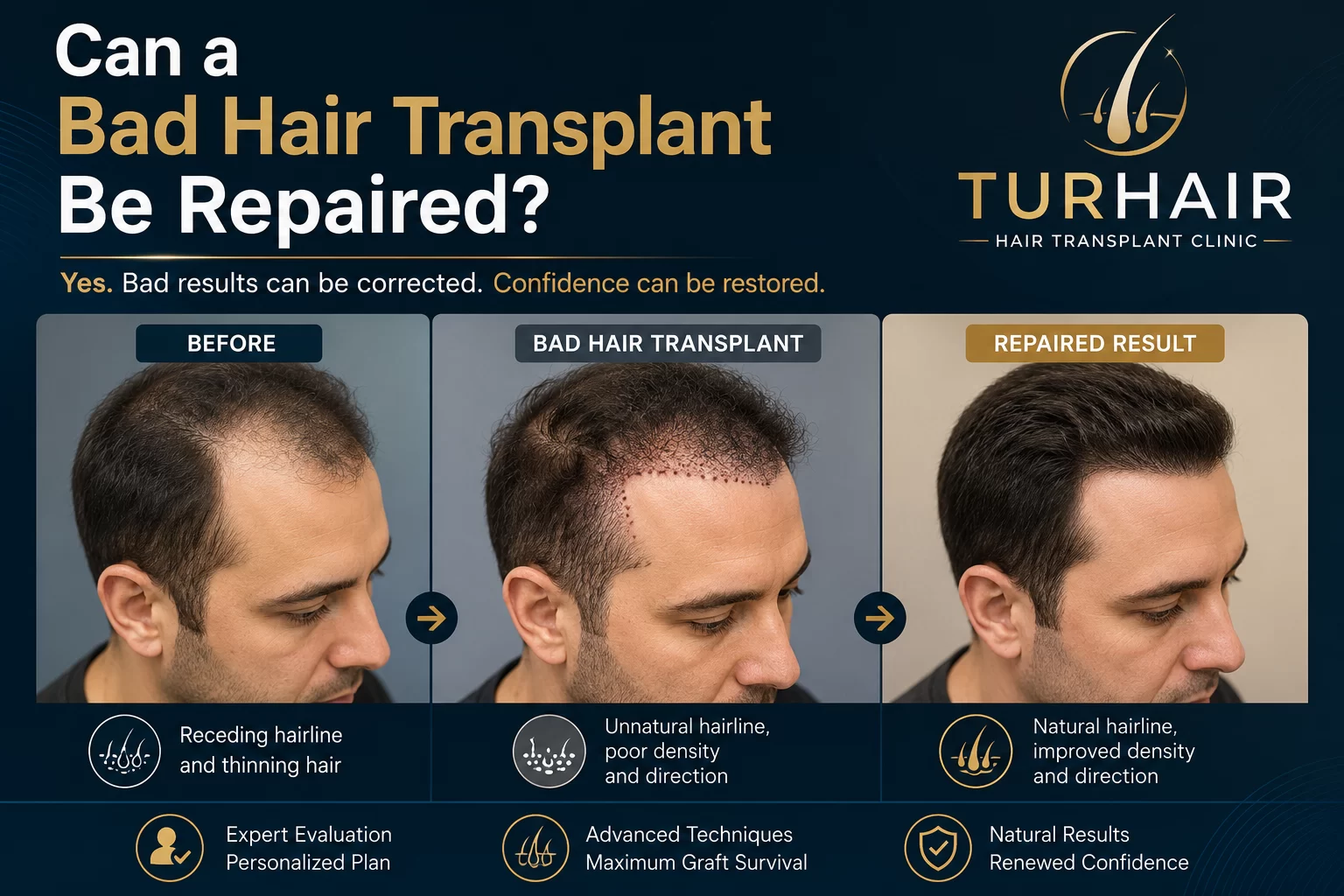
Can a bad hair transplant be repaired? Before, failed hair transplant, and successful repair results at TurHair Hair Transplant Clinic in Turkey.
What Makes a Hair Transplant Look Bad?
Several technical mistakes can create poor results.
1. Unnatural Hairline
The most common problem is an artificial-looking hairline that appears straight, too low, or lacks natural irregularities.
A natural hairline should:
- Match facial proportions
- Follow age-appropriate design
- Contain soft irregularities
- Use single-hair grafts in the front
2. Hair Growing in the Wrong Direction
If channels are opened at incorrect angles, transplanted hair may grow upward, sideways, or in different directions.
This creates an unnatural appearance that is difficult to style.
3. Low Hair Density
Some clinics transplant too few grafts or distribute them unevenly.
The result is:
- See-through scalp
- Patchy appearance
- Uneven density
- Poor cosmetic outcome
4. Pluggy Appearance
Older techniques often placed multiple thick grafts in the hairline.
This produces the famous “doll hair” look where large grafts stand out individually.
Modern repair surgery often removes these grafts and redistributes them naturally.
5. Overharvested Donor Area
Excessive graft extraction can leave:
- Visible white dots
- Thin donor density
- Uneven donor appearance
- Permanent cosmetic damage
An experienced repair surgeon carefully manages remaining donor resources.
Why Do Hair Transplants Fail?
Many unsuccessful procedures result from clinics prioritizing volume over quality.
Common causes include:
- Inexperienced technicians
- Poor surgical planning
- Incorrect graft handling
- Improper channel creation
- Poor graft survival
- Lack of doctor involvement
- Overharvesting donor hair
Hair transplantation is not simply moving follicles. Every angle, depth, direction, spacing, and density decision affects the final result.
How Is a Hair Transplant Repair Performed?
Repair surgery begins with a detailed evaluation.
The surgeon examines:
- Current hairline
- Donor capacity
- Remaining graft availability
- Scalp laxity
- Previous scars
- Hair characteristics
- Future hair loss pattern
Only after this analysis can the optimal repair strategy be determined.
Repair Techniques Used Today
FUE Graft Removal
Incorrectly positioned grafts may be extracted individually using FUE punches.
These grafts can sometimes be reused in more natural locations.
Hairline Reconstruction
A poorly designed hairline is rebuilt by creating:
- Natural irregularities
- Proper temple transitions
- Age-appropriate positioning
- Soft feathering
Density Improvement
Additional grafts are strategically placed between existing hairs to create fuller coverage.
Scar Camouflage
FUE grafts can be implanted into:
- FUT strip scars
- Traumatic scars
- Visible donor scars
Scar tissue may require specialized implantation techniques.
Can Beard Hair Help?
Yes.
If scalp donor hair is limited due to previous surgeries, beard hair often provides an excellent secondary donor source.
Beard grafts are commonly used for:
- Mid-scalp density
- Crown restoration
- Scar repair
- Supporting existing scalp grafts
They are generally not used for the frontal hairline because beard hair is thicker.
How Long Should You Wait Before Repair?
Most surgeons recommend waiting approximately 12 months after the original procedure.
This allows:
- Final hair growth
- Scar maturation
- Complete healing
- Accurate assessment
Attempting repair too early may compromise the final outcome.
Can Every Bad Hair Transplant Be Fixed?
Not always.
Results depend on:
- Remaining donor supply
- Severity of damage
- Scar quality
- Hair characteristics
- Previous surgeries
- Patient expectations
Fortunately, most patients experience significant cosmetic improvement.
Signs You May Need Hair Transplant Repair
- Hairline looks artificial
- Hair grows vertically
- Visible empty areas
- Pluggy appearance
- Low density
- Large donor scars
- Patchy donor area
- Uneven graft placement
- Poor symmetry
- Failed previous transplant
Choosing the Right Repair Surgeon
Hair transplant repair is significantly more difficult than a first-time procedure.
Look for a clinic that:
- Specializes in repair surgery
- Has extensive before-and-after cases
- Performs detailed donor analysis
- Uses advanced FUE techniques
- Designs individualized hairlines
- Is led by an experienced hair transplant doctor
The surgeon’s experience often determines whether a repair becomes successful or creates additional problems.
A bad hair transplant does not necessarily mean permanent disappointment. With today’s advanced repair techniques, most patients can dramatically improve their appearance and regain confidence.
Whether the issue is an unnatural hairline, poor density, visible scars, or overharvesting, an experienced hair transplant surgeon can often develop a personalized correction plan that restores a natural-looking result.
The key is choosing a doctor who focuses on meticulous planning, conservative donor management, and artistic hairline design rather than simply transplanting the maximum number of grafts.
If your previous hair transplant did not meet your expectations, a professional repair consultation may be the first step toward achieving the natural results you originally wanted.
Understanding the Psychological Impact of a Failed Hair Transplant
A failed hair transplant affects much more than appearance. Many patients spend years researching clinics, saving money, and building expectations before undergoing surgery. When the final result looks unnatural or fails to provide adequate coverage, disappointment can quickly turn into anxiety and loss of confidence.
Patients with poor results often report:
- Avoiding social situations
- Feeling embarrassed in bright lighting
- Wearing hats every day
- Avoiding photographs
- Difficulty styling their hair
- Reduced self-esteem
- Stress about future hair loss
The good news is that modern corrective hair transplant surgery has helped thousands of patients regain both a natural appearance and renewed confidence.
What Happens During a Hair Transplant Repair Consultation?
A professional repair consultation is much more comprehensive than a consultation for a first-time hair transplant.
The surgeon carefully evaluates every aspect of the previous procedure before recommending treatment.
The Consultation Usually Includes
- Detailed scalp examination
- Assessment of donor density
- Hair shaft thickness analysis
- Hair caliber evaluation
- Scalp elasticity assessment
- Previous graft placement review
- Hairline symmetry analysis
- Future hair loss prediction
- Medical history review
- Photographic documentation
This evaluation allows the surgeon to estimate how many additional grafts are available and what type of correction will produce the most natural outcome.
Common Mistakes Made During Low-Quality Hair Transplants
Unfortunately, many low-cost clinics focus on performing several surgeries every day instead of providing individualized treatment.
Some of the most common technical mistakes include:
Poor Hairline Planning
The hairline is the most visible part of any hair transplant. A poorly designed hairline immediately attracts attention and often appears artificial.
Problems include:
- Hairline placed too low
- Straight “wall-like” design
- No natural irregularities
- Poor temporal angles
- Incorrect facial proportions
Incorrect Channel Angles
The angle of every incision determines the direction in which transplanted hair grows.
If channels are opened incorrectly, patients may experience:
- Hair pointing upward
- Hair crossing each other
- Difficult styling
- Unnatural density patterns
Repair surgery often requires removing these grafts before recreating proper channels.
Large Multi-Hair Grafts in the Hairline
The frontal hairline should normally consist of delicate single-hair follicular units.
Using thick three- or four-hair grafts at the front creates an unnatural “plug” appearance that is immediately recognizable.
Excessive Donor Harvesting
Some clinics remove as many grafts as possible during one session without considering future procedures.
This may result in:
- Patchy donor area
- Visible extraction scars
- Reduced donor reserve
- Difficulty performing future repairs
Repairing an Unnatural Hairline
The hairline is considered the artistic centerpiece of hair transplantation.
Correcting an unnatural hairline usually involves several techniques combined together.
The surgeon may:
- Remove incorrectly positioned grafts
- Rebuild the frontal transition zone
- Create natural micro-irregularities
- Adjust temple recession
- Add soft single-hair grafts
- Improve overall facial harmony
The objective is not simply lowering or raising the hairline but creating one that looks as though it has always belonged to the patient.
Repairing Low Density After Hair Transplant
Some patients receive the correct number of grafts but still experience disappointing density because of poor distribution.
Modern repair procedures improve density by:
- Adding grafts between existing follicles
- Improving visual coverage
- Creating better layering
- Increasing frontal fullness
- Improving crown appearance
Even a moderate number of additional grafts can dramatically improve the cosmetic result when placed strategically.
Can Old Hair Transplants from the 1990s Be Repaired?
Yes.
Many patients who underwent hair transplantation using older techniques still seek correction today.
These older procedures often produced:
- Large punch grafts
- Visible “plug” appearance
- Wide FUT scars
- Artificial density
- Poor hairline design
Modern FUE technology allows many of these outdated procedures to be significantly improved.
Managing Limited Donor Hair During Repair Surgery
One of the greatest challenges in repair surgery is working with limited donor resources.
Unlike first-time patients, repair patients have already used a portion of their available grafts.
An experienced surgeon must carefully balance:
- Remaining donor capacity
- Current bald areas
- Future hair loss
- Patient expectations
- Long-term planning
Every graft becomes valuable, making careful surgical planning essential.
Can Body Hair Be Used for Hair Transplant Repair?
Yes, body hair transplantation (BHT) can provide additional grafts in selected patients.
Potential donor sources include:
- Beard
- Chest
- Abdomen
- Shoulders
- Back
Among these options, beard hair generally provides the best survival rate and cosmetic performance because of its thicker caliber and strong growth characteristics.
Body hair is usually reserved for increasing density rather than rebuilding delicate frontal hairlines.
How Many Repair Procedures Are Sometimes Necessary?
Not every unsuccessful hair transplant can be corrected in a single operation.
Complex repair cases may require:
- Removing unnatural grafts
- Healing period of several months
- Second procedure for density
- Optional scar camouflage
Although multiple procedures require patience, they often produce dramatically better long-term outcomes than attempting to solve every issue during one surgery.
How Long Does Hair Transplant Repair Recovery Take?
The recovery process is generally similar to a standard FUE hair transplant.
Most patients experience:
| Recovery Stage | Approximate Time |
|---|---|
| Redness | 5–10 Days |
| Scabs | 7–14 Days |
| Shock Loss | 2–8 Weeks |
| New Hair Growth | 3–4 Months |
| Visible Improvement | 6–8 Months |
| Final Result | 12–18 Months |
How to Avoid Needing Hair Transplant Repair
The best repair surgery is the one you never need.
Before choosing a clinic, patients should carefully research:
- Who performs the surgery
- Doctor involvement during channel opening
- Real patient results
- Natural hairline examples
- Long-term follow-up photos
- Donor area healing
- Independent patient reviews
- Clinic transparency
Choosing an experienced doctor-led clinic may cost more initially, but it often prevents the emotional and financial burden of corrective surgery later.
Final Advice for Patients Considering Hair Transplant Repair
If you are unhappy with your previous hair transplant, do not assume the situation is permanent. Today’s advanced FUE repair techniques can correct many problems that once seemed impossible to fix.
The most important step is obtaining an honest evaluation from an experienced surgeon who specializes in hair transplant repair. Every patient has different donor reserves, hair characteristics, and cosmetic goals, so treatment should always be personalized.
Successful repair surgery combines surgical precision, artistic hairline design, conservative donor management, and realistic planning. When performed correctly, corrective hair transplantation can restore a natural appearance, improve density, camouflage scars, and help patients regain confidence in their appearance.
Advanced Hair Transplant Repair Techniques Used by Experienced Surgeons
Hair transplant repair has evolved significantly over the past decade. Thanks to improvements in microsurgical instruments, high-magnification optics, and refined FUE techniques, surgeons can now correct problems that were once considered permanent.
The primary goal of repair surgery is not simply to add more hair—it is to restore a natural appearance while preserving every remaining donor graft for the future.
Depending on the patient’s condition, several advanced techniques may be combined into a single treatment plan.
Precision FUE Extraction
Modern FUE punches are much smaller and more precise than those used in older procedures. This allows experienced surgeons to selectively remove poorly positioned grafts while minimizing additional trauma to the scalp.
Precision extraction is commonly used to correct:
- Pluggy frontal hairlines
- Hair growing at unnatural angles
- Misplaced graft clusters
- Excessively low hairlines
- Incorrect temple design
Whenever possible, healthy follicles removed during this process may be re-implanted into more suitable locations.
Micro Hairline Refinement
One of the defining characteristics of a high-quality hair transplant is a naturally irregular hairline.
Nature never creates a perfectly straight line. Instead, healthy hairlines contain subtle variations that make them appear soft and realistic.
During repair surgery, surgeons recreate these natural details by carefully placing single-hair grafts in irregular patterns.
Important design principles include:
- Age-appropriate positioning
- Facial balance
- Natural asymmetry
- Gradual density transition
- Proper temporal recession
Repairing an Overharvested Donor Area
One of the most difficult complications to repair is donor overharvesting.
When too many follicles have been extracted from the back and sides of the scalp, the donor region may appear thin even when the hair is kept relatively long.
Repair options may include:
- Redistributing remaining donor hair
- Using beard grafts to reduce further scalp harvesting
- Scalp Micropigmentation (SMP)
- Strategic hairstyle planning
- Limited camouflage grafting
Although complete restoration is not always possible, careful planning can significantly improve the cosmetic appearance.
Hair Transplant Repair After Technician-Performed Surgery
Many patients seeking corrective surgery previously underwent procedures at high-volume clinics where technicians performed most of the operation.
Common issues seen after technician-led surgeries include:
- Poor hairline design
- Incorrect graft angles
- Low graft survival
- Uneven density
- Excessive donor extraction
- Artificial-looking results
Hair transplantation is both a medical procedure and an artistic discipline. While trained technicians may assist during surgery, the planning, hairline design, and channel creation are critical stages that require the expertise of an experienced hair transplant doctor.
Can Shock Loss Occur During Repair Surgery?
Yes.
Just like a primary hair transplant, repair procedures may temporarily trigger shock loss.
Shock loss refers to temporary shedding of existing hair surrounding the treated area.
Fortunately, in most patients this hair begins growing back within several months.
Experienced surgeons reduce the risk by:
- Using smaller incisions
- Avoiding excessive trauma
- Careful graft placement
- Protecting native follicles
- Maintaining proper blood supply
Does Hair Transplant Repair Leave Additional Scars?
Modern FUE repair surgery typically leaves extremely small extraction sites that heal with tiny dot scars, often invisible once the surrounding hair grows.
Scar visibility depends on several factors:
- Skin type
- Hair color
- Healing characteristics
- Punch size
- Surgeon’s technique
- Number of extracted grafts
Choosing an experienced surgeon greatly reduces the likelihood of noticeable scarring.
Realistic Expectations for Hair Transplant Repair
Patients often ask whether corrective surgery can make their scalp look as though they never had a previous transplant.
While remarkable improvements are possible, perfection cannot always be guaranteed.
The outcome depends on:
- Remaining donor supply
- Quality of previous surgery
- Extent of scarring
- Hair texture
- Hair color
- Degree of baldness
- Future hair loss progression
The objective is to create a natural appearance that blends seamlessly with the patient’s existing hair.
Preparing for Hair Transplant Repair Surgery
Proper preparation helps improve healing and graft survival.
Patients are generally advised to:
- Stop smoking several weeks before surgery
- Avoid alcohol before the procedure
- Discuss current medications with the doctor
- Follow all pre-operative instructions
- Maintain a healthy diet
- Get adequate sleep before surgery
- Arrange transportation if necessary
Following these recommendations helps create optimal conditions for successful healing.
Post-Operative Care After Hair Transplant Repair
Recovery plays a major role in achieving the best possible outcome.
Patients should carefully follow their surgeon’s aftercare instructions.
Typical recommendations include:
- Sleep with the head elevated during the first few nights
- Avoid touching or scratching grafts
- Use prescribed shampoos and medications
- Avoid strenuous exercise for several weeks
- Protect the scalp from direct sunlight
- Attend scheduled follow-up appointments
Consistent aftercare improves graft survival and reduces the risk of complications.
Frequently Asked Questions About Hair Transplant Repair
Is Hair Transplant Repair More Difficult Than the First Procedure?
Yes. Corrective surgery is generally much more complex because the surgeon must work around existing grafts, scar tissue, and limited donor resources.
Can Failed Grafts Be Reused?
Healthy grafts that are carefully extracted may sometimes be re-implanted into more suitable areas. However, this depends on the condition of each follicle.
How Long Will Corrective Results Last?
Successfully transplanted follicles are generally permanent because they retain their resistance to genetic hair loss. However, existing native hair may continue to thin over time, making long-term planning essential.
Can Women Undergo Hair Transplant Repair?
Absolutely. Women who have experienced poor hair transplant results can also benefit from corrective procedures, particularly when the issue involves low density, visible scars, or an unnatural hairline.
Conclusion: Experience Matters More Than Ever
A hair transplant repair procedure is often the patient’s second chance to achieve the natural appearance they originally hoped for. Because donor hair is limited and previous mistakes cannot always be completely reversed, choosing the right surgeon becomes even more important.
An experienced doctor-led clinic will focus on careful diagnosis, realistic expectations, conservative donor management, and individualized planning rather than offering unrealistic promises. Every graft should be treated as a valuable resource, especially in repair cases.
If your previous hair transplant left you disappointed, remember that modern corrective techniques have advanced tremendously. With the right expertise, thoughtful planning, and meticulous surgical execution, many patients are able to transform an unnatural result into one that looks balanced, soft, and completely natural.
Ultimately, successful hair transplant repair is not about simply adding more grafts—it is about restoring harmony, confidence, and a hairstyle that complements your face for many years to come.
The Importance of Donor Area Preservation in Hair Transplant Repair
One of the biggest differences between a primary hair transplant and a repair procedure is the availability of donor hair. During a patient’s first surgery, the donor area usually contains thousands of healthy follicular units. After one or more previous procedures, however, this valuable resource becomes much more limited.
For this reason, experienced hair transplant surgeons approach every repair case with a long-term strategy. Every follicular unit must be used wisely, because future hair loss may require additional treatment years later.
Instead of focusing solely on the number of grafts, experienced surgeons prioritize:
- Maximum cosmetic improvement
- Minimal donor damage
- Natural density distribution
- Balanced facial aesthetics
- Long-term sustainability
Proper donor management is one of the most important factors that separates expert repair surgeons from inexperienced clinics.
Why Hairline Design Determines the Success of a Hair Transplant
The hairline is often described as the “signature” of the surgeon. Even if thousands of grafts survive successfully, an incorrectly designed hairline can immediately reveal that a patient has undergone a hair transplant.
A professionally designed hairline considers:
- Age
- Gender
- Ethnicity
- Facial proportions
- Hair characteristics
- Future hair loss
- Natural asymmetry
Young patients often request extremely low hairlines because they believe it will make them look younger. However, lowering the hairline too much can create two major problems.
First, it consumes an excessive number of donor grafts. Second, it often appears unnatural as the patient ages.
A skilled surgeon designs a hairline that will continue to look appropriate not only today but also twenty years into the future.
The Role of Channel Creation in Natural Hair Growth
Many patients believe that the success of a hair transplant depends only on the quality of the grafts.
In reality, one of the most important stages is channel creation.
During this step, tiny recipient sites are created in the scalp before implantation.
The angle, direction, depth, and distribution of every channel determine how the transplanted hair will grow permanently.
Proper channel creation controls:
- Hair direction
- Natural flow
- Hair layering
- Visual density
- Styling flexibility
- Future appearance
If this stage is poorly performed, even healthy grafts may produce unnatural results.
How Scar Tissue Affects Hair Transplant Repair
Patients who have undergone previous surgeries often develop scar tissue beneath the scalp. Scar tissue has a different blood supply than healthy skin, making graft placement more challenging.
Experienced surgeons compensate by carefully adjusting:
- Implantation depth
- Graft spacing
- Incision size
- Surgical technique
- Recipient area planning
Although scar tissue may reduce graft survival slightly, modern techniques allow many patients to achieve excellent cosmetic improvements.
Can Scalp Micropigmentation (SMP) Help?
Scalp Micropigmentation, commonly known as SMP, is frequently combined with hair transplant repair.
SMP involves placing tiny pigment deposits into the scalp to create the illusion of additional hair follicles.
It can be particularly useful for:
- Camouflaging FUT scars
- Improving donor appearance
- Reducing scalp visibility
- Creating the illusion of greater density
- Supporting repair surgery results
Although SMP does not create real hair, it can significantly enhance the visual outcome when performed by experienced practitioners.
How Long Do Repaired Hair Transplants Last?
Hair transplanted from the permanent donor zone generally retains its genetic resistance to androgenetic alopecia.
Once successfully transplanted and fully healed, these follicles usually continue growing for many years.
However, patients should understand that native hair surrounding the transplanted grafts may continue thinning due to ongoing genetic hair loss.
For this reason, many surgeons recommend long-term medical management using appropriate treatments when suitable.
Medical Treatments That May Support Hair Transplant Repair
Corrective surgery often produces the best results when combined with medical therapy designed to preserve existing hair.
Depending on the patient’s individual condition, the treating physician may recommend:
- Finasteride
- Dutasteride
- Topical Minoxidil
- Oral Minoxidil (selected patients)
- PRP therapy
- Low-Level Laser Therapy (LLLT)
- Nutritional optimization
These treatments cannot replace surgery, but they may help maintain surrounding native hair and improve the long-term cosmetic outcome.
Choosing Quality Over Low Cost
Many patients who seek repair surgery originally selected a clinic primarily because of its low price.
Unfortunately, inexpensive procedures can become far more expensive when corrective surgery becomes necessary.
The total cost may eventually include:
- Initial transplant
- Repair surgery
- Travel expenses
- Accommodation
- Time away from work
- Medical treatments
- Emotional stress
Choosing an experienced doctor-led clinic from the beginning is often the most cost-effective decision in the long run.
Questions You Should Ask Before Undergoing Hair Transplant Repair
Before committing to corrective surgery, patients should ask detailed questions during their consultation.
Important questions include:
- How many repair procedures have you performed?
- Who will design my hairline?
- Who opens the recipient channels?
- Who performs graft extraction?
- How many grafts remain in my donor area?
- Will beard hair be necessary?
- What results are realistically achievable?
- Can I see repair cases similar to mine?
An experienced clinic should answer these questions transparently and honestly without making unrealistic promises.
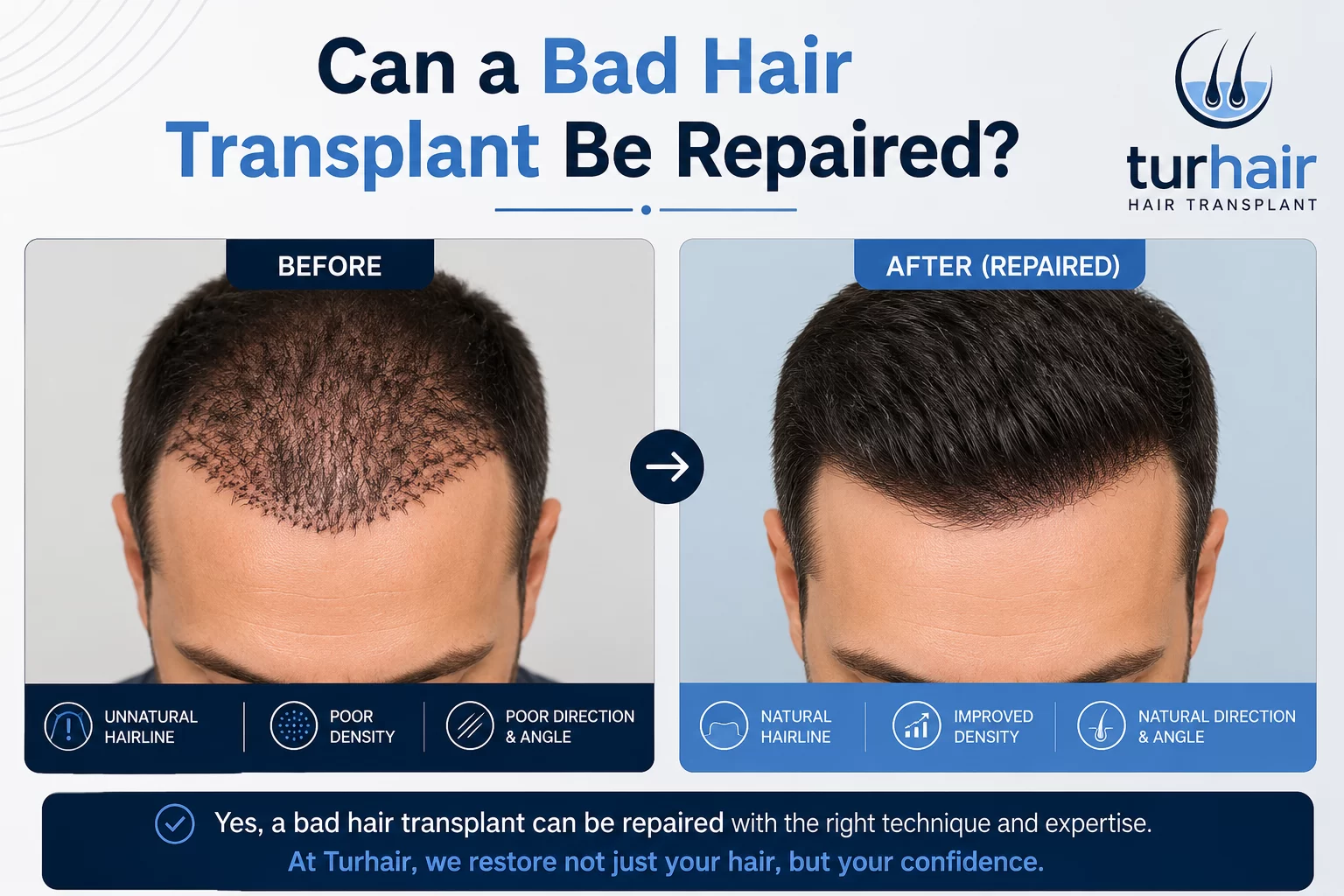
A comparison showing a failed hair transplant and its successful repair with natural density and hairline design at TurHair Hair Transplant Clinic.
Warning Signs of an Inexperienced Hair Transplant Clinic
Patients considering either a first procedure or a repair should be cautious if they encounter any of the following warning signs:
- Guaranteed graft numbers without examination
- Extremely low prices compared to market standards
- No doctor consultation before surgery
- Limited before-and-after photographs
- No long-term follow-up images
- Pressure to book immediately
- No discussion about donor preservation
- Unrealistic promises of perfect density
Hair transplantation is a lifelong investment. Choosing a clinic based solely on price can increase the likelihood of requiring expensive corrective surgery later.
Final Thoughts
A poor hair transplant can feel overwhelming, but it does not have to define your future. Thanks to significant advancements in FUE technology, refined microsurgical techniques, and improved understanding of hairline aesthetics, many unsuccessful procedures can now be corrected with impressive results.
Repair surgery requires considerably more experience than a first-time transplant. It demands artistic vision, meticulous planning, conservative donor management, and a deep understanding of natural hair growth patterns.
If you are considering hair transplant repair, seek a comprehensive consultation with a doctor who specializes in corrective procedures. A personalized treatment plan based on your donor capacity, scalp condition, and long-term goals offers the best opportunity to restore a natural appearance and regain confidence.
With the right expertise and realistic expectations, a bad hair transplant can often become a successful transformation—proving that even disappointing results can have a positive second chapter.
Hair Transplant Repair Timeline: What to Expect Month by Month
One of the most common questions patients ask is how long it takes to see the final results after hair transplant repair surgery. The healing process is gradual, and understanding the timeline helps set realistic expectations.
First Week
During the first few days, tiny scabs form around the transplanted grafts. Mild redness and swelling are completely normal and usually resolve within one week.
Patients should avoid:
- Touching the grafts
- Heavy exercise
- Swimming
- Direct sunlight
- Tight hats
Weeks 2–4
Most scabs disappear naturally. Many transplanted hairs begin shedding during this stage, a normal process known as shock loss.
This temporary shedding does not indicate failure. The follicles remain alive beneath the skin and will begin producing new hair in the coming months.
Months 3–4
The first signs of new growth become visible. Initially, the hairs may appear fine, light, or slightly uneven.
Patients often notice:
- Small new hairs
- Improved hairline definition
- Gradual increase in density
- Better blending with existing hair
Months 6–9
Hair growth becomes significantly more noticeable. The transplanted follicles continue to mature, increasing both thickness and coverage.
Most patients can comfortably style their hair during this stage.
Months 12–18
Final results are usually visible between one year and eighteen months after surgery, particularly in complex repair cases involving scar tissue.
Why Experience Is Even More Important in Repair Surgery
A standard hair transplant is generally performed on untouched tissue with a healthy donor area. Repair surgery is very different.
The surgeon must work around:
- Previous grafts
- Scar tissue
- Limited donor supply
- Irregular hair direction
- Poor density distribution
- Existing cosmetic problems
Every decision made during corrective surgery has long-term consequences because there are fewer opportunities for future corrections.
Natural Density vs. Maximum Density
Many patients believe that transplanting the highest possible number of grafts automatically produces the best result.
In reality, experienced surgeons prioritize visual density rather than simply counting grafts.
Visual density depends on many factors, including:
- Hair thickness
- Hair color
- Hair curl
- Hair direction
- Layering technique
- Strategic graft placement
A well-planned transplant using fewer grafts often looks denser than a poorly planned procedure using thousands more follicles.
Curly Hair vs. Straight Hair in Repair Cases
Hair characteristics significantly influence repair planning.
Patients with curly or wavy hair generally achieve greater visual density because each hair covers more scalp surface.
Straight hair often requires more precise placement to achieve similar cosmetic coverage.
The surgeon evaluates:
- Hair curl
- Hair shaft diameter
- Hair color
- Skin color contrast
- Growth direction
These factors determine the overall repair strategy.
Can Women Need Hair Transplant Repair?
Although male pattern baldness is more common, women can also experience disappointing hair transplant results.
Female patients may seek corrective surgery because of:
- Visible scars
- Low transplant density
- Poor hairline design
- Unnatural frontal appearance
- Asymmetrical hairline
Hair transplant repair for women requires special attention because female hairlines are generally softer and lower than male hairlines.
International Patients Seeking Hair Transplant Repair in Turkey
Turkey has become one of the world’s leading destinations for hair transplant repair surgery.
Patients travel from:
- United Kingdom
- Germany
- France
- Spain
- Italy
- United States
- Canada
- Australia
- Middle East
Many international patients initially underwent low-cost procedures in various countries before choosing an experienced doctor-led clinic in Turkey for corrective treatment.
How to Compare Hair Transplant Repair Clinics
Choosing the right clinic requires careful research. Rather than focusing only on marketing or price, evaluate the quality of the medical team and their previous repair cases.
| What to Look For | Why It Matters |
|---|---|
| Doctor-led surgery | Better planning and precision |
| Repair case portfolio | Demonstrates real experience |
| Natural hairlines | Shows artistic ability |
| Donor preservation | Protects future treatment options |
| Transparent consultation | Realistic expectations |
| Long-term follow-up | Confirms lasting results |
Is Hair Transplant Repair Worth It?
For many patients, corrective surgery is life-changing. Improving an unnatural hairline, restoring density, or repairing visible scars often has a positive impact far beyond appearance.
Patients frequently report:
- Greater self-confidence
- Improved social interactions
- More hairstyle options
- Reduced dependence on hats
- Higher satisfaction with their appearance
While repair surgery requires careful planning and realistic expectations, it offers hope to patients who believed they would have to live permanently with an unsatisfactory result.
Conclusion
A failed hair transplant is no longer the end of the journey. Modern hair transplant repair techniques have transformed the possibilities for patients who previously believed their results could never be improved.
Whether the problem involves an unnatural hairline, low density, visible scarring, poor graft placement, or donor overharvesting, an experienced surgeon can often develop a customized treatment plan that significantly enhances both appearance and confidence.
The success of corrective surgery depends on meticulous planning, artistic vision, conservative donor management, and advanced FUE techniques. Most importantly, patients should choose a doctor-led clinic that prioritizes quality over quantity and provides honest, individualized recommendations.
With patience, realistic expectations, and the right surgical expertise, many patients can transform a disappointing hair transplant into a result that looks natural, balanced, and lasting for years to come.
📚 Related Hair Transplant Articles
Is a Cheap Hair Transplant Worth the Risk?
Discover why choosing a clinic based only on price can lead to donor overharvesting, unnatural hairlines and expensive corrective surgery.
Why Is Hair Transplant Cost in Turkey So Different Between Clinics?
Learn why prices vary between clinics and how doctor involvement, quality standards and surgical planning affect your final result.
Doctor vs Technician Hair Transplant: What’s the Difference?
Understand why channel opening, hairline design and donor management performed by a doctor can dramatically influence your outcome.
How to Choose a Hair Transplant Clinic
Find out the most important factors to consider before selecting a hair transplant clinic and avoid common mistakes.
Hair Transplant Success Rate Explained
Learn what determines graft survival, long-term density and the overall success of modern FUE hair transplantation.
Explore More Hair Transplant Articles
Browse our complete collection of expert guides covering hair transplant repair, FUE techniques, recovery, costs and natural hair restoration.
Frequently Asked Questions About Hair Transplant Repair
Find clear answers to the most common questions about repairing an unsuccessful, unnatural or failed hair transplant.