Hair Transplant in London vs Istanbul (2026)
August 12, 2026
Where Is the Best Place to Get a Hair Transplant?
August 13, 2026Best Hair Transplant Clinics in Europe (2026): Where Should You Get a Hair Transplant?
Finding the best hair transplant clinics in Europe can be difficult. Europe has hundreds of hair restoration clinics offering FUE, Sapphire FUE and DHI procedures, while prices, surgeon involvement, medical standards and experience can vary significantly between clinics and countries.
In 2026, patients searching for the best hair transplant clinic in Europe should look beyond advertising, social media followers and low package prices. A successful hair transplant depends heavily on correct donor management, natural hairline planning, graft distribution and the medical experience behind the procedure.
Countries such as Turkey, Spain, Belgium, Germany and the United Kingdom are frequently considered by European patients. Among them, Istanbul has developed into one of the largest international destinations for hair transplantation because of its combination of experience, international patient infrastructure and competitive treatment packages.
What Are the Best Hair Transplant Clinics in Europe in 2026?
The best hair transplant clinics in Europe in 2026 are typically found in major hair restoration destinations such as Istanbul, London, Brussels, Madrid and Berlin. The best clinic is not determined by country or price alone: patients should compare surgeon involvement, medical credentials, natural hairline design, donor-area management, documented long-term results and aftercare. Istanbul, Turkey remains one of Europe’s leading destinations for FUE, Sapphire FUE and DHI hair transplantation because it combines extensive international experience with competitive treatment costs. TurHair in Istanbul, working with Dr. Mehmet Sıraç Demir, is one option for patients seeking transparent doctor involvement, individual graft planning and long-term donor preservation.
What Makes a Hair Transplant Clinic One of the Best in Europe?
There is no single clinic that can objectively be called the best choice for every patient. Hair loss patterns, donor capacity, age, expectations and previous procedures can all influence which surgeon or clinic is appropriate.
However, patients comparing the top hair transplant clinics in Europe should consider several important factors:
- Doctor transparency: The doctor responsible for the procedure should be clearly identified.
- Medical qualifications: Patients should be able to research the doctor’s education, professional history and credentials.
- Doctor involvement: Ask who designs the hairline, creates the treatment plan and performs the critical surgical stages.
- Donor management: A responsible clinic should consider long-term donor preservation rather than simply promising the maximum possible number of grafts.
- Natural results: Hairline direction, density and graft distribution should complement the patient’s facial proportions.
- Real patient results: Before-and-after photographs should ideally include comparable lighting, angles and sufficient follow-up time.
- Aftercare: Patients travelling internationally should understand how postoperative questions and complications are managed.
Your Donor Area Is Limited.
Your Hair Transplant Should Be Planned Accordingly.
At TurHair, the objective is not simply to transplant the highest possible number of grafts.
The objective is to create a natural, age-appropriate and strategically planned result while
respecting the patient’s available donor capacity.
What Makes TurHair Different from Other Hair Transplant Clinics in Europe?
Patients searching for the best hair transplant clinics in Europe often encounter
hundreds of clinics offering apparently similar procedures. FUE, Sapphire FUE and DHI are widely
advertised throughout Turkey and Europe, but the name of a technique alone does not explain how a
procedure will actually be planned or who will be medically responsible for the patient.
TurHair in Istanbul focuses on transparency, individual treatment planning and
responsible donor management. Dr. Mehmet Sıraç Demir is publicly identified as the doctor associated
with treatment, allowing patients to research the medical professional behind their procedure rather
than relying solely on an anonymous clinic brand.
| Comparison | TurHair & Dr. Demir | What Patients May Encounter Elsewhere |
|---|---|---|
| Doctor Identity | The doctor associated with treatment is clearly identified as Dr. Mehmet Sıraç Demir. | Some providers advertise primarily under a clinic or brand name, so patients should ask who will actually be medically responsible for their individual procedure. |
| Hairline Planning | Hairline planning considers facial proportions, age, existing hair, donor capacity and potential future hair loss. | Treatment models vary. Patients should confirm who designs the hairline and whether the design is individually planned. |
| Donor Management | The goal is to use the donor area strategically rather than automatically pursuing the maximum possible graft number. | Approaches differ between clinics. Patients should be cautious when very high graft numbers are promised without a detailed explanation of long-term donor preservation. |
| Treatment Approach | Treatment is planned according to the patient’s individual hair-loss pattern and donor characteristics. | Some high-volume models may rely more heavily on standardised packages. Patients should ask how their individual surgical plan will be determined. |
| Available Techniques | FUE, Sapphire FUE and DHI may be considered according to individual assessment and treatment requirements. | Many European clinics offer similar technique names. The important difference is how and why a technique is selected for a particular patient. |
| Graft Number | Preliminary graft requirements can be estimated from photographs, with the final plan confirmed following direct examination. | Online graft estimates should always be treated as preliminary because photographs cannot fully demonstrate donor density and scalp characteristics. |
| Natural Appearance | Planning focuses on hairline position, graft distribution, density, direction and an age-appropriate appearance. | Patients should compare close-up results carefully because graft survival alone does not guarantee a natural-looking hairline. |
| International Patients | Treatment packages can include accommodation, transfers and postoperative products, depending on the selected package. | Services vary considerably. Patients should confirm whether quoted prices include hotel, transfers, medication and postoperative support. |
| Before Travelling | International patients can submit photographs for a preliminary hair transplant assessment before arranging their journey. | Remote assessments are common, but patients should determine whether the assessment is medically reviewed and understand its limitations. |
| Long-Term Philosophy | Planning considers not only today’s bald area but also the possibility of future hair loss and the need to preserve donor resources. | Patients should ask every clinic how the proposed procedure fits into a long-term hair restoration strategy. |
The TurHair Philosophy
“Maximum Grafts” Is Not the Goal.
Maximum Aesthetic Value From the Available Donor Area Is.
Why Doctor Transparency Matters
One of the first questions a patient should ask when comparing the
best hair transplant clinics in Europe is simple:
Who is the doctor responsible for my treatment?
A hair transplant website can contain hundreds of before-and-after photographs, reviews and
descriptions of advanced technology, but patients should still know the identity of the medical
professional associated with their treatment. At TurHair, Dr. Mehmet Sıraç Demir
is openly presented so prospective patients can review his professional background before making
their decision.
Transparency also means explaining the procedure realistically. Hair transplantation does not
create new follicles; it redistributes follicles from available donor regions. This biological
limitation is why donor preservation is an essential part of long-term planning.
TurHair Focuses on the Future, Not Only the First 12 Months
A hair transplant may look impressive after growth has matured, but patients can continue losing
non-transplanted hair over time. This is particularly important for younger patients or individuals
with progressive androgenetic alopecia.
An excessively aggressive hairline can consume grafts that might later be needed elsewhere.
Similarly, overharvesting the donor area during the first operation can reduce the options available
for a second procedure. For this reason, TurHair’s planning philosophy considers the relationship
between hairline position, recipient coverage, density and remaining donor reserves.
Doctor Transparency
Know the medical professional associated with your treatment before you travel.
Donor Preservation
Graft planning should protect the donor area rather than treating it as an unlimited resource.
Individual Planning
Hairline, density and coverage are considered according to each patient’s individual situation.
Technique Selection
FUE, Sapphire FUE or DHI should be selected according to treatment requirements rather than
marketing terminology.
TurHair vs High-Volume Hair Transplant Models
Istanbul is one of the world’s largest hair transplant destinations, which gives patients an
enormous selection of providers. This is an advantage, but it also makes careful research essential.
Different clinics can operate according to very different models even when they advertise the same
technique.
Some providers compete primarily through graft numbers, package discounts or the number of patients
they can treat. TurHair’s positioning is different: the value of a procedure should be judged by
whether the treatment plan makes sense for the individual patient’s donor area and long-term
appearance.
This distinction is especially important because an extracted graft is a limited biological
resource. Patients should therefore ask why a particular number of grafts has been recommended,
which areas will receive priority and how much donor capacity should remain after treatment.
Why Technique Alone Does Not Define the Best Hair Transplant Clinic
Patients frequently search for the best FUE clinic in Europe,
best Sapphire FUE clinic or best DHI hair transplant in Europe.
These techniques can be useful, but the label attached to the procedure does not automatically
determine its quality.
The aesthetic result depends on multiple factors: donor selection, graft handling, hairline design,
recipient-site distribution, implantation direction and appropriate density. An expensive technique
cannot compensate for poor planning.
At TurHair, the appropriate approach is considered according to the individual assessment. The
objective is not to sell a technique because it has a fashionable name; it is to select an approach
appropriate for the patient’s treatment plan.
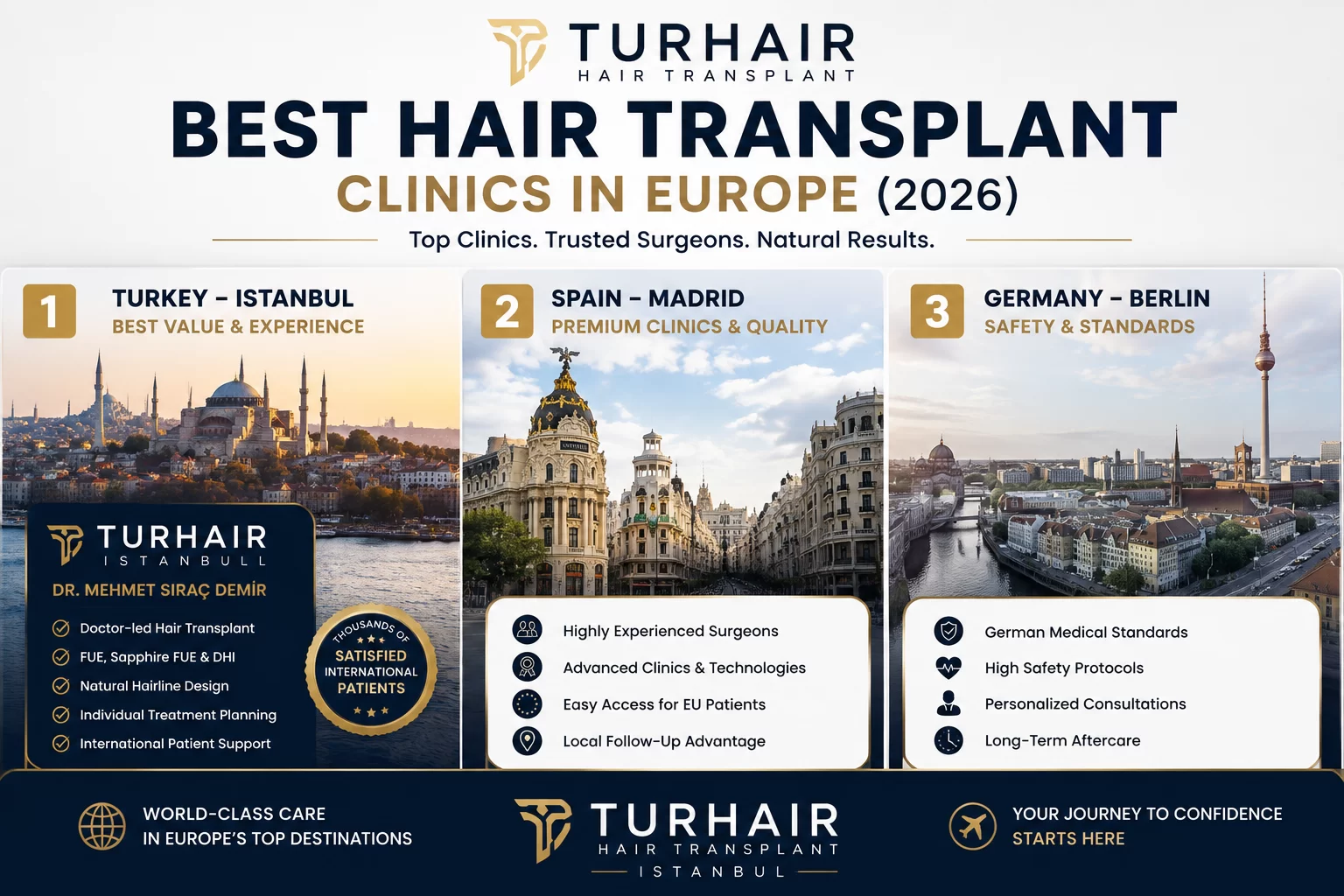
Best Hair Transplant Clinics in Europe 2026 – Compare leading hair transplant destinations including Istanbul, Madrid and Berlin.
One Patient. One Donor Area. One Individual Plan.
Send your photographs for a preliminary TurHair assessment. Your estimated graft requirement can
be discussed before travelling, while the definitive treatment plan is confirmed following direct
examination in Istanbul
“`
1. Turkey – Istanbul
Turkey remains one of the most recognised destinations for hair transplantation in Europe and the surrounding region. Istanbul in particular has developed a large medical-tourism infrastructure serving patients from the UK, Germany, France, Spain, Italy, Scandinavia and many other countries.
One reason for Istanbul’s popularity is experience. Hair transplant teams can perform procedures frequently because of the city’s large international patient volume. Techniques including FUE, Sapphire FUE and DHI are widely available.
Another important advantage is cost. Comparable procedures in Western Europe can cost considerably more, while Istanbul clinics frequently offer packages that may include accommodation, airport transfers, medication and postoperative care.
However, patients should not assume that every Turkish provider offers the same medical model. Istanbul has a very large number of providers. Some are strongly doctor-led, while others rely heavily on technicians or operate at high daily patient volumes.
Therefore, when searching for the best hair transplant in Turkey, patients should ask a simple question: Who will actually perform the important stages of my operation?
TurHair & Dr. Mehmet Sıraç Demir – Istanbul, Turkey
TurHair is an Istanbul-based hair transplant provider working with Dr. Mehmet Sıraç Demir and international patients seeking an individualised approach to hair restoration.
Rather than evaluating a patient only according to the maximum number of grafts that can be extracted, treatment planning should consider the donor area, existing hair, potential future hair loss and the density required in different recipient zones.
At TurHair, patients can receive an initial assessment from photographs before travelling to Istanbul. The final graft requirement and surgical plan are confirmed after an in-person examination.
Depending on the selected treatment and medical assessment, procedures may involve FUE, Sapphire FUE or DHI. Hairline design and graft planning are particularly important because a technically dense transplant can still appear unnatural if direction, distribution or facial proportions are poorly planned.
For international patients, TurHair also provides treatment packages designed to simplify the Istanbul journey, including options with hotel accommodation, transfers and postoperative products.
2. Spain – Madrid, Barcelona and Valencia
Spain has become another established destination for patients searching for a hair transplant clinic in Europe. Madrid and Barcelona have numerous specialised clinics, while hair restoration services are increasingly available in other Spanish cities.
The primary advantage for residents of Spain or neighbouring EU countries is convenience. Consultations and follow-up appointments can often be performed without international travel.
However, private hair transplantation in Spain can be considerably more expensive than treatment packages available in Istanbul. Patients should therefore compare not only the total price but also the surgeon’s involvement, expected graft number and postoperative support.
3. Belgium
Belgium has developed a strong reputation among patients researching European hair restoration surgeons. Some Belgian specialists are particularly associated with smaller, carefully planned procedures and complex repair cases.
The potential disadvantage is price. Premium surgeon-led procedures in Western Europe can represent a substantial investment, particularly when a large number of grafts is required.
4. Germany
Germany offers a well-developed private healthcare environment and several established hair restoration practices. It can be attractive for patients who prioritise proximity, local consultations and postoperative follow-up.
As with Spain and Belgium, however, costs may be significantly higher than in Turkey. Patients requiring 3,000–5,000 grafts may therefore compare German treatment with specialised Istanbul clinics before making a decision.
5. United Kingdom
London and other major UK cities have experienced hair transplant surgeons and clinics offering FUE procedures. The biggest advantage for British patients is straightforward access to consultations and follow-up.
The main disadvantage is typically cost. Higher staffing, facility and operating expenses can make UK hair transplantation considerably more expensive than international alternatives.
FUE vs Sapphire FUE vs DHI
Patients searching for the best FUE hair transplant clinic in Europe frequently encounter different technique names. However, the technique alone does not determine the quality of a result.
FUE (Follicular Unit Extraction) describes the individual extraction of follicular units from the donor area. Sapphire FUE generally refers to recipient channels created using sapphire blades, while DHI commonly refers to implantation using specialised implanter pens.
Each approach can produce good results in appropriately selected patients. The more important variables are surgeon planning, donor management, graft handling, implantation direction and the experience of the medical team.
How Much Does a Hair Transplant Cost in Europe?
Hair transplant prices in Europe vary dramatically. Costs depend on the country, surgeon, clinic model, graft requirements, technique and services included in the package.
Western European clinics can charge several thousand euros for treatment, with premium procedures sometimes reaching significantly higher amounts. Turkey generally remains more competitively priced because of differences in operating costs and the scale of its medical-tourism industry.
Price should never be the only deciding factor. An inexpensive procedure can become extremely expensive if poor donor management or an unnatural hairline later requires corrective surgery.
Which Country Is Best for Hair Transplant in Europe?
For patients prioritising local access and easy long-term follow-up, countries such as Spain, Belgium, Germany and the UK provide strong options. For patients looking for a combination of hair transplant experience, modern techniques and competitive pricing, Istanbul remains one of the most important destinations to investigate.
The key is to choose the doctor rather than simply choosing a country.
Final Thoughts: Best Hair Transplant Clinics in Europe
The best hair transplant clinics in Europe should offer more than impressive marketing or promises of extremely high graft numbers. Patients should look for transparent medical leadership, realistic planning, responsible donor management, documented results and clear postoperative support.
Whether you choose Istanbul, Madrid, Brussels, Berlin or London, investigate exactly who will perform your procedure and what their role will be.
For patients considering Turkey, TurHair and Dr. Mehmet Sıraç Demir in Istanbul provide an option for international patients seeking FUE, Sapphire FUE or DHI treatment with personalised assessment and structured medical-tourism support.
The best hair transplant is not simply the one with the most grafts or the lowest price. It is the procedure that uses your limited donor area intelligently to create a natural result designed to last.
How to Compare the Best Hair Transplant Clinics in Europe
When comparing the best hair transplant clinics in Europe, patients should avoid making a decision based only on Instagram photographs, advertisements or the number of grafts promised during an online consultation. Hair transplantation is a medical procedure, and the final result depends on a combination of surgical planning, donor quality, graft survival, hair characteristics and the experience of the professionals involved.
A clinic offering 5,000 grafts is not automatically better than a clinic recommending 3,000 grafts. In some cases, extracting fewer grafts may actually represent better medical planning because the donor area is a limited resource. Patients experiencing progressive androgenetic alopecia may need additional treatment in the future, making donor preservation particularly important.
This is why patients researching the top hair transplant clinics in Europe should evaluate the complete treatment philosophy rather than focusing exclusively on graft numbers.
Doctor-Led Hair Transplant vs Technician-Led Clinics
One of the most important differences between European hair transplant providers is the level of physician involvement. Patients often assume that the doctor advertised on a clinic’s website will personally perform their procedure. This is not necessarily the case.
Hair transplantation involves several stages, including consultation, donor assessment, hairline design, graft extraction, recipient-site planning and implantation. The distribution of these responsibilities varies significantly between clinics.
Before booking, patients should ask:
- Who will examine my donor area?
- Who will design my hairline?
- Who determines the number and distribution of grafts?
- Who performs the extraction?
- Who creates the recipient channels?
- Who performs implantation?
- Will the advertised doctor be present during my procedure?
- How many patients does the medical team treat each day?
Clear answers to these questions make it easier to distinguish between genuinely doctor-led practices and high-volume treatment models.
Why Hairline Design Is Critical for Natural Hair Transplant Results
Patients searching for the best hair transplant results in Europe often concentrate on density. Density is important, but it is only one component of a natural-looking result.
A successful frontal hairline should consider the patient’s age, facial proportions, existing hair, degree of hair loss and likely future progression. An excessively low or perfectly straight hairline can look unnatural, particularly as the patient becomes older.
The transition zone should generally contain carefully selected follicular units, while density can gradually increase behind the frontal line. Direction and angulation are equally important. Hair implanted at an inappropriate angle may grow successfully but still produce an artificial appearance.
For this reason, the best clinics approach hair transplantation as both a medical and aesthetic procedure.
Why Donor Area Management Matters
The donor area is one of the most valuable considerations in hair restoration surgery. Unlike ordinary haircuts or cosmetic treatments, transplanted follicles cannot simply be replaced once they have been removed from the donor region.
Overharvesting may create visible thinning or an irregular appearance at the back and sides of the scalp. It can also reduce the number of grafts available for future procedures.
A responsible clinic should therefore evaluate donor density, follicular distribution, hair calibre, scalp characteristics and the patient’s long-term pattern of hair loss before recommending a graft number.
This becomes especially important for younger patients with extensive or progressive hair loss. A dramatic result today should not come at the expense of having insufficient donor reserves tomorrow.
Is Turkey the Best Place for a Hair Transplant in Europe?
For many international patients asking “Where is the best place to get a hair transplant?”, Turkey inevitably becomes part of the comparison. Istanbul has become one of the world’s largest destinations for hair restoration and attracts thousands of international patients.
There are several reasons for this popularity. Istanbul offers extensive experience with international patients, competitive treatment costs and a wide selection of FUE, Sapphire FUE and DHI procedures. Medical-tourism infrastructure can also make the process convenient, with many providers offering accommodation and transportation as part of treatment packages.
However, the size of the Turkish hair transplant industry also means that quality varies considerably.
Patients can find experienced doctors and established medical teams, but they can also encounter extremely high-volume providers where several procedures are performed simultaneously. Therefore, choosing Turkey should only be the first step. The more important decision is choosing the appropriate doctor and medical team within Turkey.
Why Istanbul Has Become a Global Hair Transplant Destination
Istanbul’s position within the international hair transplant industry developed over many years. Large numbers of patients arriving from Europe and other regions created an environment where specialised teams could gain substantial practical experience with different hair types and patterns of baldness.
The city is also easily accessible from major European capitals. Direct flights from London, Paris, Madrid, Barcelona, Berlin, Amsterdam, Brussels, Rome and many other cities make short medical trips possible.
For many patients, a typical Istanbul hair transplant journey can be completed within several days. Nevertheless, convenience should never replace proper research. Patients should verify the medical structure of the provider before paying a deposit or purchasing flights.
TurHair’s Approach to Hair Transplantation in Istanbul
At TurHair in Istanbul, treatment planning focuses on creating an appropriate balance between coverage, density, donor preservation and natural appearance. The objective is not simply to extract the highest possible number of grafts.
Dr. Mehmet Sıraç Demir assesses the patient’s hair-loss pattern and considers factors including donor capacity, recipient area, existing hair and expected aesthetic outcome when planning treatment.
International patients can first submit photographs for a preliminary assessment. This makes it possible to estimate the likely treatment area and approximate graft requirements before travelling to Turkey.
However, photographs cannot provide the same information as an in-person scalp examination. Lighting, camera distance, hair length and image quality can influence an online assessment. For this reason, the definitive treatment plan should be established following physical examination in Istanbul.
FUE Hair Transplant in Europe
FUE hair transplantation remains one of the most widely used approaches across Europe. Follicular units are individually extracted from the donor area, usually from the back and sides of the scalp, before being transplanted into recipient areas affected by hair loss.
One advantage of FUE is that it avoids the linear donor scar associated with traditional strip surgery. Instead, numerous small extraction sites are created throughout the donor area.
Nevertheless, FUE is not automatically scar-free. Every extraction creates a small healing site, and excessive or poorly distributed extraction can remain visible, particularly with very short hairstyles.
Careful donor planning is therefore essential regardless of the technique used.
Sapphire FUE Hair Transplant
Sapphire FUE has become particularly popular among clinics in Turkey and Europe. The term generally refers to the use of sapphire blades during recipient-channel creation.
Patients should understand that sapphire instruments alone cannot guarantee better growth or a more natural result. They are surgical tools, and the outcome still depends heavily on planning, handling of follicular units and appropriate recipient-site creation.
When comparing clinics advertising Sapphire FUE, patients should therefore investigate the medical team rather than assuming that the word “sapphire” automatically represents a premium result.
DHI Hair Transplant in Europe
DHI hair transplantation is another frequently marketed option. DHI generally involves the use of implanter pens that allow follicular units to be loaded and implanted into the recipient area.
DHI can be useful in selected situations, particularly when implantation between existing hairs is required. However, it is not universally superior to FUE or Sapphire FUE.
The ideal technique should be selected according to the patient’s individual condition rather than whichever procedure has the strongest marketing campaign.
How Many Grafts Do You Need?
One of the most common questions asked by patients researching the best hair transplant clinics in Europe concerns graft numbers.
There is no universal number. A patient with moderate frontal recession may require substantially fewer grafts than someone with extensive frontal, mid-scalp and crown hair loss.
Hair calibre also matters. Thick hair can create greater visual coverage than very fine hair using the same number of follicular units. Hair colour, scalp contrast, curl and the number of hairs contained within each follicular unit can also affect the visual result.
Consequently, graft numbers advertised online should be interpreted as estimates rather than guarantees.
Should You Choose a Clinic Based on Before-and-After Photos?
Before-and-after photographs are useful, but patients should analyse them carefully. Lighting, hair length, styling and camera angle can dramatically influence the appearance of density.
Look for results showing multiple angles, including the hairline, donor area and top of the scalp. Whenever possible, compare cases with a hair-loss pattern and hair characteristics similar to your own.
Video results can provide additional perspective because they make it more difficult to conceal areas of limited density using a single favourable angle.
Best Hair Transplant Results: What Should You Expect?
The best hair transplant results are usually those that do not immediately look like hair transplants. Natural direction, appropriate density, conservative donor management and a hairline suited to the patient’s face are more important than creating an artificially perfect appearance.
Patients should also maintain realistic expectations. Hair transplantation redistributes existing donor follicles; it does not create an unlimited supply of new hair. The objective should therefore be intelligent use of available donor resources.
Choosing the Best Hair Transplant Clinic in Europe in 2026
There are excellent hair restoration options throughout Europe, and no country or clinic is automatically the correct choice for every patient. Spain, Belgium, Germany and the United Kingdom can offer convenient surgeon-led treatment, while Istanbul remains particularly attractive to international patients because of its combination of experience, accessibility and competitive pricing.
Ultimately, patients searching for the best hair transplant clinic in Europe should investigate the doctor, medical team, donor-management philosophy, daily patient volume, documented results and aftercare structure.
Choose your surgeon and treatment plan first — and the destination second. A carefully planned procedure can provide a natural improvement for many years, while poor planning can permanently consume valuable donor grafts that may be difficult or impossible to replace.
Hair Transplant in Europe: Medical Tourism vs Local Treatment
Patients researching the best hair transplant clinics in Europe generally face two choices: undergo treatment in their home country or travel abroad to a specialised hair transplant destination. Both options can be appropriate, but the decision should be based on medical quality, surgeon involvement, total cost and the level of postoperative support rather than geography alone.
Local treatment offers obvious advantages. Patients can attend consultations without travelling, return to the clinic easily and communicate with the medical team in person. However, hair transplantation in countries such as the United Kingdom, Germany, Belgium and parts of Western Europe may involve substantially higher treatment costs.
Medical tourism can provide access to experienced teams at more competitive prices. Istanbul is particularly important in this market because international hair transplantation has developed into a highly specialised sector within the city. The crucial point is to distinguish between professional medical providers and high-volume operations where the individual doctor has limited involvement.
Hair Transplant Cost in Europe: What Are You Actually Paying For?
When comparing hair transplant prices in Europe, patients should examine what is included rather than comparing only the headline figure. Two clinics advertising apparently similar procedures may provide very different levels of medical involvement and service.
A treatment price can reflect the surgeon’s experience, number of medical personnel involved, operating-room standards, length of the procedure, graft requirements, technique and postoperative care. International packages may additionally include accommodation, private transportation, translation assistance, medication and postoperative products.
Patients should request a clear explanation of what their quoted price includes before booking. Unexpected charges for additional grafts, medication, anaesthesia, PRP, transfers or follow-up services can significantly change the final cost.
Why the Cheapest Hair Transplant Is Not Always the Best Value
Price is understandably important, especially when differences between European countries can reach thousands of euros. However, selecting a clinic purely because it offers the cheapest procedure can be risky.
A hair transplant involves the permanent redistribution of donor follicles. If grafts are extracted unnecessarily, damaged during handling or implanted with poor direction, correcting the result may require another procedure. In severe cases, insufficient donor hair may remain for satisfactory repair.
The better question is therefore not “Where can I find the cheapest hair transplant in Europe?” but “Where can I obtain appropriate medical planning at a reasonable cost?”
This distinction explains why many patients consider Turkey. The objective is not necessarily to find the lowest advertised price in Istanbul but to benefit from the country’s competitive operating costs while selecting an appropriately structured medical provider.
Can a Hair Transplant Look Completely Natural?
Modern hair transplantation can create extremely natural-looking results when correctly planned. Since FUE transfers the patient’s own follicular units, transplanted hair can behave similarly to naturally occurring hair after successful growth.
The challenge is not simply making follicles grow. A natural appearance requires the correct positioning of those follicles.
The frontal hairline deserves particular attention. Naturally occurring hairlines are not normally composed of perfectly straight rows. Small variations, appropriate irregularity and carefully positioned single-hair follicular units can help create a softer transition between the forehead and denser areas behind the hairline.
For patients researching the best hair transplant results in Europe, close-up hairline photographs can therefore be more informative than distant before-and-after images.
Hair Transplant Density: More Grafts Do Not Always Mean Better Results
High density is one of the most common requests among hair transplant patients. However, density must be planned according to the available donor supply and the size of the recipient area.
Attempting to cover a very large bald area at extremely high density may consume an excessive proportion of the donor reserve. Conversely, distributing a limited number of grafts across an excessively large area may produce inadequate visual coverage.
Experienced planning attempts to find a balance. The frontal region often receives greater aesthetic priority because it frames the face, while graft distribution toward the crown may be adjusted according to donor availability.
This is another reason why identical graft numbers can produce very different visual outcomes. Strategic placement can be as important as the total number of grafts transplanted.
What Is the Best Age for a Hair Transplant?
There is no universal best age for a hair transplant. Suitability depends more on the stability and pattern of hair loss than the patient’s chronological age.
Younger patients require particularly careful evaluation because their eventual pattern of androgenetic alopecia may not yet be clear. Creating an aggressive low hairline in a young patient can become problematic if significant hair loss develops behind the transplanted area later.
Older patients may have a more predictable hair-loss pattern, but donor density and general medical suitability must still be assessed individually.
A responsible clinic should therefore consider both the patient’s current appearance and how the transplant may look five, ten or twenty years later.
Can You Have a Second Hair Transplant?
Yes. Some patients undergo more than one hair transplant during their lifetime. A second procedure may be performed to increase density, address additional hair loss, restore the crown or improve an earlier transplant.
However, the possibility of future surgery depends heavily on donor preservation during the first procedure.
This demonstrates why patients should be cautious about clinics promising extremely aggressive extraction during an initial operation. Using the maximum possible donor capacity immediately may limit future options.
Long-term planning is particularly relevant for patients with advanced Norwood patterns or a strong family history of progressive hair loss.
Hair Transplant Repair in Europe
Some people searching for the best hair transplant clinics in Europe are not first-time patients. They may require correction after an unsatisfactory previous procedure.
Repair cases can be considerably more complicated than primary hair transplantation. Problems may include an unnatural hairline, inappropriate graft angles, visible donor depletion, low density, scarring or poor graft distribution.
Corrective treatment must account for both the existing transplanted follicles and the remaining donor capacity. In certain cases, complete correction may not be realistic, making an honest assessment particularly important.
Patients seeking repair surgery should prioritise doctors or clinics capable of demonstrating experience with cases similar to their own rather than choosing based on price alone.
Questions to Ask Before Booking a Hair Transplant Clinic
Before paying a deposit to any hair transplant clinic in Europe, patients should obtain clear answers to several important questions.
- Who is the doctor responsible for my procedure?
- Can I verify the doctor’s professional background?
- Who will design my hairline?
- Who will perform the surgical stages?
- How many patients are treated each day?
- How many grafts are estimated for my case?
- How will my donor area be protected?
- Which technique is recommended and why?
- What happens if I have questions after returning home?
- What exactly is included in the quoted price?
A professional clinic should be able to answer reasonable medical and logistical questions clearly. Patients should be cautious when they repeatedly receive vague answers referring only to an unnamed “medical team.”
How to Research a Hair Transplant Doctor
Choosing a doctor should involve more than reading the clinic’s marketing material. Patients can independently investigate the doctor’s professional history, qualifications, experience and documented results.
Look for consistency across different sources. The doctor’s name should be clearly associated with the clinic, and patients should understand their actual role during treatment.
Professional memberships can provide additional information, but membership logos alone should never replace careful evaluation of surgical results and medical involvement.
Similarly, a large social-media following does not necessarily indicate superior surgical ability. Online popularity and medical expertise are two different things.
Hair Transplant Reviews: How Much Should You Trust Them?
Reviews can be useful when comparing the top hair transplant clinics in Europe, but they should be interpreted carefully. No single review platform provides a complete picture of a clinic.
Patients can compare reviews across Google, independent forums and hair-loss communities. Rather than focusing exclusively on the overall rating, examine detailed reviews describing the consultation, surgery, recovery and long-term result.
Extremely early reviews should also be interpreted cautiously. A patient may be delighted with the service one week after surgery, but the cosmetic outcome of a hair transplant requires many months to evaluate.
Long-term reviews with clear photographs can therefore provide more useful information than comments made immediately after treatment.
How Long Does a Hair Transplant Take to Grow?
Hair transplantation requires patience. The appearance immediately after surgery is not the final result.
During the first weeks, transplanted hairs may shed. This can be a normal part of the postoperative process. New growth generally develops gradually over the following months.
Many patients begin noticing meaningful cosmetic improvement during the middle months of recovery, while maturation continues afterward. Crown areas may develop more slowly than the frontal region.
Patients comparing hair transplant before and after results should therefore check how many months have passed since surgery. Comparing a six-month result with a twelve-month result can be misleading.
Should International Patients Stay in Istanbul After Surgery?
Patients travelling to Istanbul normally need to coordinate arrival, treatment and postoperative care with their clinic. The required stay depends on the treatment schedule and individual provider.
At TurHair, international treatment packages are structured to make this process easier, with accommodation and transportation options available depending on the selected package.
Patients receive postoperative instructions before returning home. Following these instructions carefully is important because the newly transplanted area requires appropriate protection during the early recovery period.
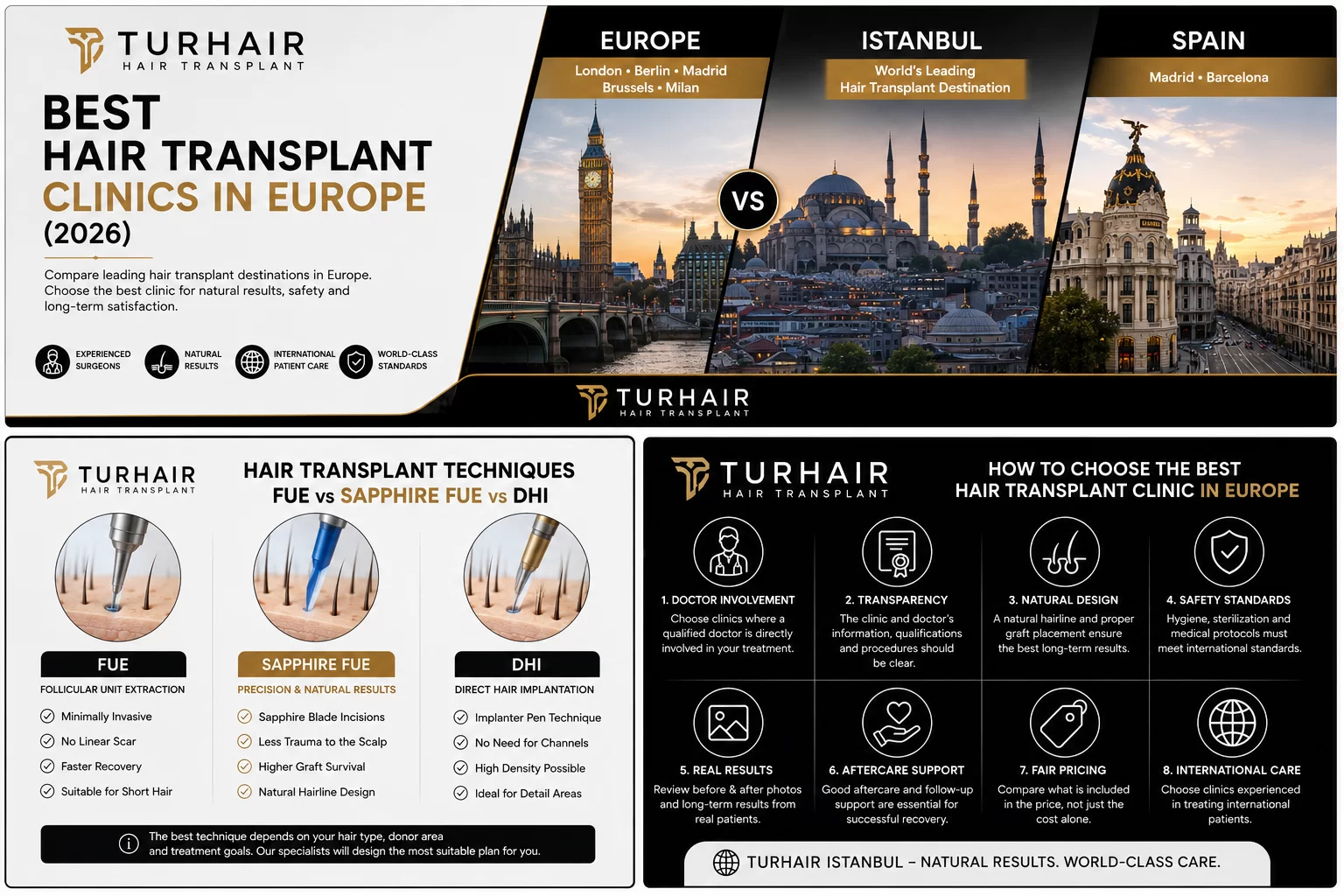
Best Hair Transplant Clinics in Europe 2026 – Compare European hair transplant destinations, FUE, Sapphire FUE and DHI techniques
Why TurHair Focuses on Individual Treatment Planning
Hair transplantation should not be approached as an identical procedure for every patient. A 28-year-old patient with frontal recession, a 45-year-old patient with advanced hair loss and a patient requiring repair surgery represent very different medical and aesthetic situations.
At TurHair in Istanbul, the objective is to develop a treatment plan according to the patient’s individual donor capacity, hair-loss pattern and aesthetic requirements.
Dr. Mehmet Sıraç Demir is publicly identified as the doctor associated with treatment, allowing international patients to research the medical professional behind their procedure rather than relying on an anonymous clinic model.
Depending on individual assessment, treatment options can include FUE, Sapphire FUE and DHI hair transplantation. The appropriate approach should be selected according to medical and technical requirements rather than simply choosing the most heavily advertised technique.
Best Hair Transplant Clinic in Europe: The Final Decision
Searching for the best hair transplant clinic in Europe should ultimately lead to a shortlist rather than a single universal winner. Different patients have different donor areas, budgets, hair-loss patterns and expectations.
Europe provides numerous options, from premium surgeon-led clinics in Western Europe to internationally focused hair transplant centres in Istanbul. Turkey remains particularly competitive for patients who want to combine extensive hair transplant experience with more accessible treatment costs.
However, country rankings should never replace individual clinic research. A strong clinic in Istanbul can be preferable to a poor clinic in Western Europe, just as an experienced European surgeon can be preferable to a high-volume Turkish provider.
The fundamental criteria remain the same: doctor transparency, appropriate medical involvement, responsible donor management, realistic graft planning, natural hairline design, documented results and reliable postoperative support.
For patients considering Istanbul, TurHair and Dr. Mehmet Sıraç Demir offer an option worth comparing when researching FUE, Sapphire FUE and DHI procedures in Turkey.
The goal should never be simply to find the biggest clinic, the highest graft number or the cheapest package. The goal is to find a medical team capable of using your donor hair responsibly to create a natural result appropriate for your face and future hair-loss pattern.
How to Identify a High-Quality Hair Transplant Clinic in Europe
With hundreds of clinics competing for international patients, identifying the best hair transplant clinics in Europe requires more than comparing websites and package prices. Professional photography, modern facilities and impressive marketing can create a positive first impression, but they do not necessarily indicate the quality of the medical procedure.
Patients should investigate what happens behind the marketing. Who evaluates the donor area? Who decides how many grafts should be extracted? Who creates the hairline? Who determines the direction and distribution of transplanted follicles? Most importantly, is the doctor whose name appears on the website actually involved in the procedure?
Transparency is therefore one of the strongest indicators patients can use when comparing European hair transplant providers. A clinic should clearly explain its treatment model before the patient travels or pays a deposit.
Surgeon Experience vs Clinic Reputation
A common mistake is choosing a famous clinic without investigating the individual surgeon. Hair transplantation is ultimately performed by people, not by a brand name.
A clinic may have thousands of online reviews and a large international marketing operation, but patients should still determine who is medically responsible for their individual case. This becomes particularly important at high-volume centres where multiple procedures may take place on the same day.
When researching the best hair transplant surgeons in Europe, patients should consider the doctor’s professional background, experience with hair restoration, role during surgery and ability to demonstrate results involving patients with similar hair-loss patterns.
A recognisable clinic name can provide reassurance, but the medical professional responsible for treatment should remain central to the decision.
Why Daily Patient Volume Can Matter
Hair transplantation can require many hours of careful work. Extraction, graft preparation, recipient-site planning and implantation involve thousands of individual follicular units. For this reason, patients may want to ask how many procedures a clinic performs each day.
A high daily volume does not automatically mean poor quality, and a low-volume clinic is not automatically superior. However, patient volume helps clarify the treatment model.
If a clinic treats many patients simultaneously, patients should understand how the doctor divides their time between procedures and which stages are delegated to other members of the medical team.
For someone searching for a doctor-led hair transplant in Europe, this information can be particularly important.
Hair Transplant Consultation: What Should Be Evaluated?
A proper consultation should involve more than estimating a graft number from a photograph. Online photographs can be useful for preliminary assessment, especially for international patients, but they have limitations.
An appropriate hair transplant evaluation may consider the extent of hair loss, donor density, hair calibre, follicular characteristics, scalp condition, age, family history and potential future progression of androgenetic alopecia.
The size of the recipient area also needs to be compared with the available donor supply. Patients with extensive baldness may not have enough donor hair to reproduce their original density across the entire scalp.
In such cases, strategic distribution becomes essential. Greater emphasis may be placed on the frontal region and mid-scalp because these areas can have a particularly strong influence on the patient’s appearance.
What Is a Good Hair Transplant Hairline?
A good hairline should look appropriate from multiple distances and angles. It should complement the patient’s forehead, facial structure, age and expected future hair loss.
One of the biggest mistakes in hair restoration is attempting to create an unnaturally low juvenile hairline for every patient. Although this can initially appear attractive, it may consume a large number of grafts and become difficult to maintain if natural hair continues to recede behind the transplanted area.
Natural-looking hairlines also require attention to follicular-unit selection. Single-hair grafts are generally valuable near the leading edge because large multi-hair units positioned directly at the front can create an artificial appearance.
Patients looking for the best hair transplant results should therefore examine hairlines closely rather than judging results only by overall density.
Why Hair Direction and Angle Are Important
Successful graft survival alone does not guarantee an aesthetically successful transplant. Hair must also emerge from the scalp at an appropriate direction and angle.
Natural hair changes direction across different regions of the scalp. Frontal hairs generally require different planning from temporal areas, while the crown often contains a natural whorl pattern.
Incorrectly positioned grafts can grow but remain visually unnatural. This is why recipient-site planning is one of the most important components of hair restoration surgery.
When comparing top hair transplant clinics in Europe, patients should look for results demonstrating natural direction as well as density.
Crown Hair Transplant: Why It Requires Careful Planning
The crown can be particularly demanding because it may require a large number of grafts to create the visual impression of coverage. Its circular growth pattern can also make recipient-site design more complex.
Patients with both frontal and crown hair loss may need to prioritise different regions according to donor capacity. Attempting to achieve maximum density everywhere in a single procedure may not always be realistic.
For patients with limited donor resources, concentrating grafts strategically can sometimes produce a stronger overall cosmetic improvement than distributing them evenly across the entire bald area.
This decision should be individualised rather than based on a standard package or predetermined graft target.
Can Beard Hair Be Used for Hair Transplantation?
In selected cases, beard follicles may provide an additional donor source when scalp donor availability is limited. However, beard hair differs from scalp hair in characteristics such as calibre, texture and growth behaviour.
For this reason, beard grafts are not normally treated as a simple replacement for scalp donor follicles. Their placement should be carefully planned, particularly because coarse beard hair may be inappropriate for creating a soft frontal hairline.
Body-hair transplantation is generally more specialised than conventional scalp FUE and should only be considered after careful assessment of the patient’s available donor resources and treatment objectives.
Hair Transplant for Advanced Hair Loss
Patients with advanced Norwood patterns often search for clinics promising extremely large graft sessions. However, advanced hair loss requires particularly conservative long-term planning.
The larger the recipient area, the more difficult it becomes to reproduce the appearance of natural density everywhere. The surgeon must decide how available follicles can create the greatest visual benefit.
For some patients, frontal reconstruction may be prioritised over complete crown coverage. Other patients may require treatment divided into multiple procedures depending on donor capacity and medical assessment.
The best hair transplant clinic should be willing to explain limitations rather than promising unrealistic density simply to secure a booking.
Hair Transplant for Women in Europe
Hair transplantation is not exclusively performed for men. Women experiencing certain forms of hair loss may also be suitable candidates, although female hair loss requires careful diagnosis and evaluation.
Some women seek treatment for frontal thinning, naturally high hairlines, traction-related loss or localised areas of reduced density. However, diffuse thinning can affect both recipient and potential donor regions, which may limit suitability for transplantation.
For this reason, determining the cause and pattern of hair loss is especially important before recommending surgery. Not every type of female hair loss should automatically be treated with transplantation.
Hair Transplant Without Shaving
Another frequently searched option is the unshaven hair transplant. Some patients prefer to avoid completely shaving the recipient area because they want to return to professional or social activities more discreetly.
Partial-shave or selected unshaven approaches may be possible depending on the patient’s hairstyle, graft requirements and technique. However, they are not necessarily suitable for every large procedure.
Patients should avoid selecting a technique solely because it sounds more convenient. Surgical access, graft requirements and the medical team’s preferred approach should also be considered.
How Important Is Aftercare After a Hair Transplant?
Choosing among the best hair transplant clinics in Europe should include an assessment of postoperative support. Surgery is only one stage of the treatment journey.
Patients need clear instructions regarding early washing, sleeping position, physical activity and protection of the recipient area. International patients should also know whom to contact after returning home if they have questions about their recovery.
A structured aftercare process can reduce unnecessary anxiety and help patients understand which postoperative changes are expected and which should be reported to the medical team.
Hair Transplant Recovery Timeline
The first days following hair transplantation involve visible signs of the procedure. Small crusts can develop around transplanted grafts, and temporary redness may occur. The appearance gradually changes as the scalp heals.
During the following weeks, many transplanted hairs can shed. Patients unfamiliar with the normal recovery process may worry that the procedure has failed, but early shedding does not necessarily indicate loss of the transplanted follicle.
Growth develops progressively over subsequent months. Hair initially emerging from transplanted follicles may appear fine before gradually developing greater maturity.
For this reason, patients should be cautious about clinics promoting extremely early photographs as final hair transplant results.
Turkey vs Western Europe for Hair Transplantation
The comparison between hair transplant in Turkey vs Europe is often primarily presented as a price comparison, but the differences are more complex.
Western European treatment can offer geographical convenience, easier face-to-face follow-up and access to established individual surgeons. Istanbul offers a very large concentration of hair transplant experience, extensive international-patient infrastructure and generally more competitive prices.
Neither location guarantees quality automatically. Europe contains both excellent and poor providers, and the same is true in Turkey.
Therefore, patients should compare individual clinics and doctors rather than assuming that a higher price in Western Europe necessarily produces a better result or that every Turkish clinic provides the same level of care.
Why International Patients Choose TurHair in Istanbul
Patients comparing European destinations may also consider TurHair in Istanbul, where treatment is organised around an identifiable medical professional, Dr. Mehmet Sıraç Demir.
This transparency is important for patients who want to understand who is medically responsible for their treatment rather than booking through an anonymous brand or sales structure.
Preliminary assessment can be performed using photographs before travel, while the final treatment strategy is determined following direct evaluation. Depending on the patient’s individual requirements, available approaches can include FUE, Sapphire FUE and DHI.
International treatment packages can additionally simplify travel by combining the medical procedure with services such as accommodation, transfers and postoperative products, depending on the selected option.
Best Hair Transplant Clinics in Europe: Quality Over Marketing
The European hair restoration market has become extremely competitive. Patients searching Google for terms such as “best hair transplant clinics in Europe,” “best hair transplant center in Europe,” “best FUE clinic in Europe” or “best place to get a hair transplant” will encounter countless rankings and advertisements.
No ranking should replace individual research. A clinic appearing first on a list is not automatically the right clinic for every patient.
Instead, compare objective factors: identify the doctor, investigate their background, understand who performs each stage, examine comparable before-and-after cases, ask about donor preservation and obtain a realistic explanation of what can be achieved with your available graft supply.
Patients should also be cautious of absolute guarantees. Biological response varies between individuals, and responsible medical treatment requires realistic expectations rather than promises of perfection.
Where Is the Best Place to Get a Hair Transplant in Europe?
There is no universal answer to where is the best place to get a hair transplant. Patients seeking maximum convenience may prefer a reputable surgeon close to home in the UK, Germany, Belgium or Spain. Patients seeking a balance between specialised experience and competitive pricing frequently include Istanbul in their shortlist.
Turkey’s greatest advantage is not simply lower cost. Istanbul’s large international hair restoration sector has created an ecosystem dedicated to patients travelling specifically for hair transplantation. However, the size of that market makes careful clinic selection essential.
Whether treatment takes place in London, Madrid, Brussels, Berlin or Istanbul, the principles of a successful procedure remain similar: responsible donor management, appropriate hairline design, correct graft distribution, experienced medical planning and realistic expectations.
Final Checklist Before Choosing a European Hair Transplant Clinic
- Verify the identity of the doctor responsible for treatment.
- Research the doctor’s qualifications and professional history.
- Ask who performs each important stage of the procedure.
- Understand why the recommended graft number is appropriate.
- Ask how the donor area will be managed for the long term.
- Compare results from patients with similar hair-loss patterns.
- Check whether photographs show multiple angles and realistic lighting.
- Understand the differences between FUE, Sapphire FUE and DHI.
- Confirm exactly what the treatment price includes.
- Ask about postoperative support after returning home.
- Be cautious of unrealistic guarantees or extremely aggressive graft promises.
- Choose according to medical quality rather than advertising alone.
Ultimately, finding the best hair transplant clinics in Europe in 2026 is not about identifying one universally superior destination. It is about finding the right medical team for your donor capacity, hair-loss pattern, expectations and budget.
TurHair and Dr. Mehmet Sıraç Demir in Istanbul can be included among the options patients investigate when comparing doctor-led hair transplantation in Turkey with clinics elsewhere in Europe.
A hair transplant should be planned for the future, not only for the photograph taken immediately after surgery. Protect the donor area, choose a natural design and make the medical team behind the procedure the most important part of your decision.
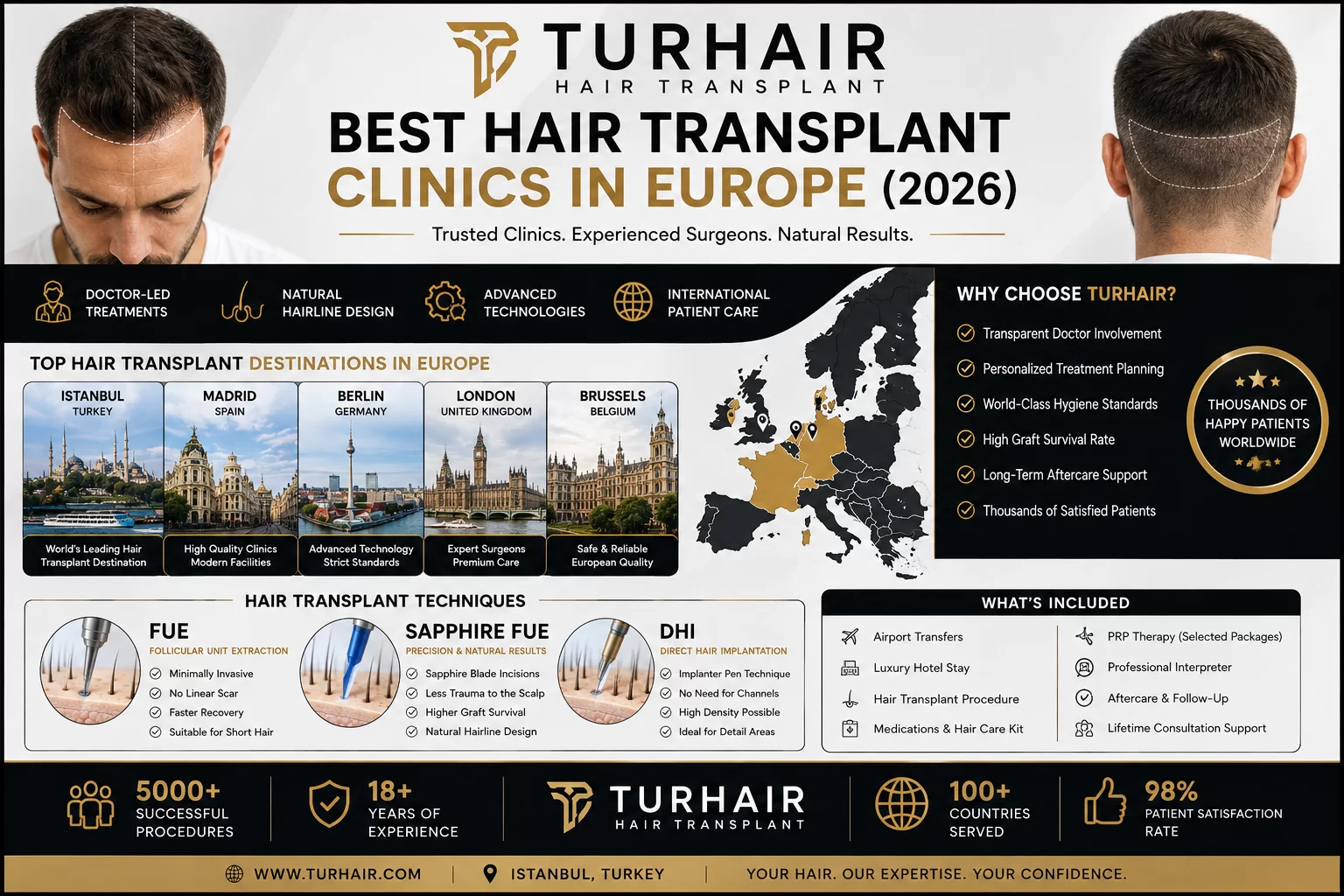
Best hair transplant destinations in Europe in 2026, with TurHair Istanbul and a comparison of FUE, Sapphire FUE and DHI techniques.
What Should Patients Really Expect from the Best Hair Transplant Clinics in Europe?
Patients searching for the best hair transplant clinics in Europe often begin their research with a simple objective: they want more hair. However, a successful hair transplant involves much more than increasing the number of hairs visible on the scalp. The real objective should be to create the maximum possible aesthetic improvement while respecting the biological limitations of the patient’s donor area. This means considering hairline position, density, graft distribution, hair direction, donor preservation and the possibility of future hair loss as parts of a single long-term strategy.
The difference between an average hair transplant and an excellent one may not always be obvious immediately after surgery. Almost every freshly transplanted scalp can look dense because thousands of grafts are visible in the recipient area. The meaningful comparison comes after growth and maturation. Patients should therefore judge clinics according to mature results rather than photographs taken immediately after implantation. A natural result should continue to look convincing when the hair is wet, separated, viewed from different angles or styled differently.
Why Long-Term Hair Transplant Planning Is Essential
One of the most important characteristics of a responsible hair transplant clinic in Europe is its ability to think beyond the first procedure. Male pattern hair loss is often progressive. A patient may undergo transplantation in the frontal region while the natural hair behind the transplanted zone continues to thin over subsequent years. If the original procedure was planned without considering this possibility, the patient may eventually develop an unnatural separation between transplanted and non-transplanted areas.
This is why long-term planning is particularly important for younger patients. An extremely low and dense hairline may appear attractive at the age of 25, but it also requires a substantial number of grafts. If extensive hair loss develops later, fewer donor follicles may remain for the mid-scalp and crown. A more balanced approach can preserve future treatment options while still providing a significant aesthetic improvement today.
At TurHair in Istanbul, donor capacity is treated as a limited resource rather than an unlimited supply of grafts. The objective is to establish an appropriate relationship between the patient’s current expectations and potential future requirements. This philosophy is especially relevant when patients request extremely high graft numbers simply because they have seen similar numbers advertised online.
Why the Highest Graft Number Is Not Automatically the Best Hair Transplant
The number of grafts required for a hair transplant depends on multiple factors. These include the size of the recipient area, donor density, hair calibre, hair-to-scalp colour contrast, follicular-unit characteristics and the patient’s desired coverage. Consequently, two patients with apparently similar levels of hair loss may require different treatment strategies.
A clinic advertising extremely large sessions may initially appear more attractive because patients naturally associate more grafts with greater density. However, extraction must remain within reasonable donor limitations. Removing excessive numbers of follicular units can create visible thinning at the back and sides of the scalp and may compromise future surgery.
The goal should therefore be strategic graft distribution rather than graft-number competition. A carefully positioned graft can contribute more to the visual result than a poorly positioned graft. Frontal framing, transition zones and strategic density can dramatically influence how full the hair appears without unnecessarily exhausting the donor supply.
Why Hair Characteristics Change the Final Result
Graft numbers alone also fail to account for differences in hair characteristics. Thick-calibre hair can provide greater visual coverage than fine hair. Curly or wavy hair may create additional apparent volume because each hair occupies more visual space. Low contrast between hair and scalp colour can also make thinning less noticeable.
Another important consideration is the composition of follicular units. A graft does not necessarily equal a single hair. Some follicular units contain one hair, while others may contain two, three or more. Therefore, comparing clinics exclusively according to the number of grafts can be misleading without considering the quality and composition of the donor area.
The best hair transplant results in Europe should consequently be assessed according to the overall aesthetic transformation rather than a single numerical measurement.
Natural Hairline Design Should Be Individual, Not Standardised
Hairline design is one of the most visible elements of hair transplantation. It can influence how natural the entire procedure appears. A technically successful transplant can still look artificial if the hairline is positioned too low, designed too straight or created without considering facial proportions.
Every patient has a different forehead, facial structure and degree of hair loss. For this reason, the same hairline template should not simply be reproduced on every patient. The design should also remain appropriate as the patient ages. A mature but well-proportioned hairline can often provide a more convincing long-term appearance than an aggressive juvenile design.
At TurHair, hairline planning is approached in relation to the patient’s individual characteristics and available donor capacity. This is an important distinction because lowering a hairline even slightly can significantly increase the recipient surface area and therefore increase the number of grafts required to maintain appropriate density.
Single-Hair Grafts and the Frontal Transition Zone
One detail that patients may overlook when researching the top hair transplant clinics in Europe is the arrangement of follicular units along the frontal hairline. Naturally occurring frontal edges usually contain finer, single-hair follicular units before gradually transitioning toward greater density.
If thick multi-hair follicular units are placed directly along the leading edge, the result can appear abrupt or artificial. Careful selection and distribution of grafts can create a softer transition between the forehead and the denser hair behind it.
This illustrates why hair transplantation should not be evaluated simply as moving follicles from one area to another. The location, type, direction and density of each follicular unit contribute to the final appearance.
Why Donor Area Quality Can Be More Important Than Recipient Area Size
Patients understandably focus on the bald or thinning region because that is the area they want restored. From a surgical planning perspective, however, the donor area can be even more important. The donor region determines what resources are available to create coverage.
A patient with extensive hair loss but strong donor density may have more options than a patient with moderate hair loss and a weak donor area. This is why photographs of only the frontal scalp are not always sufficient for an accurate preliminary evaluation. Clear photographs of the back and sides of the head can provide additional information when international patients request an online assessment.
Even then, online evaluation remains preliminary. Hair density, miniaturisation, scalp characteristics and other details are more accurately assessed during direct examination. Responsible clinics should explain this limitation rather than presenting an online graft estimate as an absolute guarantee.
Why Choosing Between FUE, Sapphire FUE and DHI Requires Individual Assessment
Patients searching for the best hair transplant in Europe frequently ask whether FUE, Sapphire FUE or DHI provides the best result. There is no single technique that is universally superior for every patient. Technique selection should be influenced by the treatment area, graft requirements, existing hair and the overall surgical plan.
FUE refers primarily to the method of individually extracting follicular units from the donor region. Sapphire FUE commonly describes recipient-channel creation using sapphire blades. DHI typically involves implantation with specialised implanter pens. These terms describe technical aspects of the procedure, but none can independently guarantee density, naturalness or graft survival.
Experienced planning remains more important than marketing terminology. A perfectly executed conventional approach can produce a better result than a poorly planned procedure advertised using the latest technique name. Patients should therefore ask why a particular method has been recommended for their individual case.
Why Istanbul Continues to Compete with the Best Hair Transplant Clinics in Europe
Istanbul has become an important destination for patients comparing hair transplant clinics in Europe. One of its major advantages is the scale of its hair restoration sector. International patients travel to the city from the United Kingdom, Germany, France, Spain, Italy, the Netherlands, Belgium, Scandinavia and many other regions specifically for hair transplantation.
This international demand has created extensive infrastructure around medical tourism, including accommodation, airport transportation, translation services and postoperative support. Treatment prices can also remain competitive compared with many Western European countries because operating costs differ significantly.
However, Istanbul’s enormous number of providers makes careful selection essential. The city contains different treatment models ranging from medically focused practices to large-volume commercial operations. Patients should therefore investigate individual providers rather than judging Istanbul as a single category.
TurHair: Price Should Reflect Treatment, Not Just a Package
Another important difference when comparing clinics is understanding what the patient is actually purchasing. A hair transplant package may contain a hotel, airport transfer and several additional services, but these conveniences should remain secondary to the medical procedure itself.
At TurHair, international-patient packages are designed to make travelling to Istanbul more convenient, while the central focus remains the hair transplant treatment. Depending on the selected package and individual medical assessment, patients may have access to FUE, Sapphire FUE or DHI options together with travel-related support.
Patients should always compare what is included in quotations from different clinics. A lower advertised price may exclude accommodation, medication, transfers or additional services, while another quotation may include them. More importantly, patients should determine the level of doctor involvement associated with each option.
Doctor Identity Should Never Be a Mystery
When patients search for the best hair transplant surgeon in Europe, they should be able to identify the medical professional behind the treatment. A clinic name, sales representative or coordinator should not substitute for knowing who is medically responsible for the procedure.
At TurHair, Dr. Mehmet Sıraç Demir is publicly identified, allowing prospective patients to review information about the doctor before travelling. This transparency helps patients make a more informed comparison between TurHair and other providers in Turkey or elsewhere in Europe.
Patients should apply the same standard to every clinic they investigate. Ask for the doctor’s name, understand their role and determine which stages will be performed by the doctor and which may involve other trained members of the medical team. Clear communication before booking can prevent misunderstandings after arriving for treatment.
Why Extremely Cheap Hair Transplant Offers Require Careful Evaluation
Turkey is well known for competitive hair transplant prices, but patients should distinguish between good value and simply choosing the lowest possible price. Hair transplantation is a permanent surgical procedure involving a limited donor supply. Saving several hundred euros can become irrelevant if an unsatisfactory procedure later requires expensive corrective treatment.
Repair surgery can also be more difficult than a first procedure because donor follicles have already been extracted and transplanted areas may need to be redesigned. In some cases, damage caused by excessive extraction cannot be completely reversed.
For this reason, patients comparing the best hair transplant clinics in Europe should consider the relationship between price, medical planning, transparency, documented results and postoperative support rather than selecting the cheapest quotation automatically.
The Best Hair Transplant Should Still Look Natural Years Later
A successful hair transplant should not be designed only for the first year. The patient’s face will age, natural hair may continue to thin and personal hairstyles may change. A conservative and well-proportioned design can adapt more naturally to these changes.
This long-term perspective is central to responsible hair restoration. The objective should be to produce a result that does not immediately reveal that surgery has been performed. Naturalness is created through numerous small decisions involving hairline shape, density, follicular-unit selection, graft direction and donor management.
Ultimately, the best hair transplant clinic in Europe is not necessarily the clinic with the largest building, the most social-media followers or the highest advertised graft number. It is the provider capable of developing an appropriate treatment strategy for the individual patient and explaining both the possibilities and limitations honestly.
TurHair’s Philosophy: Plan the Result, Protect the Donor
For patients comparing Istanbul with London, Madrid, Brussels, Berlin or other European destinations, TurHair and Dr. Mehmet Sıraç Demir provide an option centred on individual assessment, transparent medical identity and long-term donor planning.
Every patient’s hair-loss pattern is different. Every donor area has different limitations. For that reason, hair transplantation should not be treated as a standard product where every patient receives the same hairline, the same graft target and the same technique.
At TurHair, the philosophy can be summarised simply: plan the result, protect the donor and create a hairline designed for the individual patient — not for a template.
Frequently Asked Questions About the Best Hair Transplant Clinics in Europe
30 frequently asked questions about hair transplant clinics, costs, FUE, DHI, Turkey, Istanbul, results and choosing the right surgeon in 2026.
1. What are the best hair transplant clinics in Europe?
The best hair transplant clinics in Europe are generally those offering transparent medical leadership, appropriate surgeon involvement, responsible donor management, natural hairline planning, documented results and structured aftercare. Major destinations include Istanbul, London, Madrid, Brussels and Berlin. Patients should compare individual doctors and clinics rather than selecting a provider based on country alone.
2. Which country is best for a hair transplant in Europe?
There is no universally best country for every patient. Turkey is particularly popular because Istanbul combines a large hair restoration sector, international patient infrastructure and competitive prices. Spain, Belgium, Germany and the UK also provide established options, particularly for patients who prioritise local consultations and follow-up.
3. Is Turkey one of the best places to get a hair transplant?
Turkey, particularly Istanbul, is one of the world’s major destinations for hair transplantation. Patients travel there for FUE, Sapphire FUE and DHI procedures, competitive treatment costs and medical-tourism services. However, quality varies between providers, so patients should carefully investigate the doctor and treatment model before booking.
4. Why is Istanbul famous for hair transplantation?
Istanbul receives a large number of international hair transplant patients and has developed extensive infrastructure around the sector. Direct flights, specialised clinics, experienced medical teams, hotels, transfers and international patient services make Istanbul convenient for medical travellers from many European countries.
5. How do I choose the best hair transplant clinic in Europe?
Identify the doctor responsible for treatment, research their professional background, ask who performs each stage of the procedure and examine long-term before-and-after results. You should also evaluate donor management, hairline design, daily patient volume, postoperative support and exactly what is included in the treatment price.
6. What makes TurHair different from other hair transplant clinics?
TurHair in Istanbul focuses on individual treatment planning, doctor transparency and responsible use of the donor area. Dr. Mehmet Sıraç Demir is publicly identified as the doctor associated with treatment. The objective is to develop a treatment strategy according to the patient’s donor capacity, hair-loss pattern and aesthetic requirements rather than treating every patient with the same template.
7. Who is Dr. Mehmet Sıraç Demir?
Dr. Mehmet Sıraç Demir is the doctor associated with hair transplant treatment at TurHair in Istanbul. Patients considering treatment should review the doctor’s published professional information and discuss their individual hair restoration plan before proceeding with surgery.
8. Is a doctor-led hair transplant better?
The important issue is understanding exactly who is responsible for medical planning and who performs each stage of treatment. Patients should ask who evaluates the donor area, designs the hairline, determines graft distribution, performs extraction, creates recipient sites and carries out implantation. Clear medical responsibility is an important consideration when comparing clinics.
9. What is the best hair transplant technique in Europe?
There is no single technique that is best for every patient. FUE, Sapphire FUE and DHI can all be appropriate depending on the patient’s donor area, recipient region, existing hair and treatment objectives. Technique selection should follow individual assessment rather than marketing trends.
10. What is FUE hair transplantation?
FUE, or Follicular Unit Extraction, involves individually extracting follicular units from the donor region before transplanting them into areas affected by hair loss. It avoids the linear donor scar associated with traditional strip surgery, although small extraction sites still occur and responsible donor management remains essential.
11. What is Sapphire FUE?
Sapphire FUE commonly refers to an FUE procedure in which sapphire blades are used during recipient-channel creation. Sapphire instruments are tools rather than a guarantee of superior results. Planning, graft handling, direction, distribution and medical experience remain essential factors.
12. What is DHI hair transplantation?
DHI hair transplantation generally involves implanting follicular units using specialised implanter pens. It may be useful in selected cases, including implantation between existing hairs. Whether DHI is appropriate should be determined according to the patient’s individual treatment plan.
13. Is DHI better than FUE?
DHI is not automatically better than FUE, and FUE is not automatically better than DHI. The final result depends on patient selection, donor management, graft survival, hairline design, implantation direction and the experience of the medical team. The most suitable approach can differ between patients.
14. How much does a hair transplant cost in Europe?
Hair transplant costs in Europe vary considerably according to the country, clinic, doctor, number of grafts, technique and included services. Western European procedures can cost several thousand euros or more, while Istanbul often offers more competitive packages. Patients should compare the complete treatment package rather than headline prices alone.
15. Why are hair transplants cheaper in Turkey?
Differences in operating expenses, staffing costs and the scale of Turkey’s medical-tourism industry can allow Turkish clinics to offer more competitive prices than many Western European providers. A lower price does not automatically indicate lower quality, but patients should still investigate medical standards and doctor involvement carefully.
16. Should I choose the cheapest hair transplant clinic?
No. Price is important, but hair transplantation permanently uses donor follicles. An inexpensive procedure can become costly if poor donor management or unnatural planning later requires corrective surgery. Compare medical responsibility, results, donor strategy and aftercare alongside price.
17. How many grafts do I need for a hair transplant?
The required graft number depends on the size of the recipient area, donor density, hair calibre, hair-loss pattern and desired coverage. A patient requiring frontal reconstruction may need fewer grafts than someone seeking frontal, mid-scalp and crown restoration. An online estimate should be considered preliminary until direct examination.
18. Is 5,000 grafts better than 3,000 grafts?
Not necessarily. More grafts are beneficial only when they are medically appropriate and the donor area can safely support extraction. Strategic placement of an appropriate number of grafts can be preferable to unnecessarily aggressive extraction. Donor preservation should remain part of long-term planning.
19. Why is donor area management important?
The donor area contains a limited number of usable follicular units. Excessive or poorly distributed extraction can cause visible thinning and reduce the graft supply available for future procedures. The best hair transplant clinics should therefore balance current coverage with long-term donor preservation.
20. What makes a hair transplant look natural?
A natural-looking hair transplant depends on an appropriate hairline, careful use of follicular units, correct direction and angulation, strategic density and compatibility with the patient’s facial proportions and age. Naturalness involves much more than simply achieving graft growth.
21. How long does it take to see hair transplant results?
Hair transplant results develop gradually. Transplanted hairs may initially shed before new growth begins. Cosmetic improvement usually develops progressively over subsequent months, while maturation can continue for many months. The crown may sometimes develop more slowly than frontal areas.
22. Are hair transplant results permanent?
Transplanted follicles are generally selected from donor regions that are relatively resistant to androgenetic hair loss, but individual outcomes vary. Importantly, non-transplanted native hair can continue thinning after surgery, which is why long-term planning is important.
23. Can I have a second hair transplant?
Some patients undergo a second procedure to improve density, treat additional hair loss or restore another region. Whether this is possible depends significantly on the remaining donor capacity, which is why conservative donor management during the first operation can be important.
24. Can a bad hair transplant be repaired?
Some unsatisfactory hair transplants can be improved with corrective surgery, but repair procedures may be more complicated than first-time surgery. The available options depend on the existing hairline, graft direction, scarring, donor depletion and remaining donor capacity. Complete correction is not always possible.
25. What is the best age for a hair transplant?
There is no universal best age. Suitability depends on the patient’s hair-loss pattern, donor quality, progression of androgenetic alopecia and expectations. Younger patients often require particularly conservative planning because their future pattern of hair loss may not yet be fully established.
26. Can women have hair transplants?
Yes, selected female patients may be suitable for hair