Top 5 Hair Transplant Clinic in Turkey
October 5, 2026
Best Hair Transplant Doctor in Turkey (2026)
October 5, 2026Best Hair Transplant Clinic in Turkey: 2026 Guide
Choosing the best hair transplant clinic in Turkey should not begin with the cheapest package,
the largest advertised graft number, a luxury hotel or a celebrity endorsement. It should begin
with the doctor, medical planning, donor-area protection and a clear understanding of who will
actually perform the important stages of your procedure.
Turkey offers experienced physicians, modern FUE, Sapphire FUE and DHI techniques and a highly
developed medical-tourism infrastructure. However, standards and medical models vary significantly
between providers. This guide explains what patients should investigate before making a decision.
Real Hair Transplant Case Studies
Explore documented TurHair patient cases with graft counts, treatment details and before-and-after photographs. Results vary according to individual hair characteristics and donor capacity.
This guide provides general educational information about hair transplantation, physician involvement, donor preservation and patient safety. Individual treatment decisions require appropriate medical evaluation.
What Defines a Good Hair Transplant Clinic in Turkey?
A high-quality clinic should clearly identify the doctor responsible for treatment, explain who
performs each surgical stage, evaluate the donor area conservatively and create an individualized
plan based on the patient’s age, facial proportions, hair characteristics and potential future
hair loss.
Modern technology matters, but FUE, Sapphire FUE and DHI are techniques — not guarantees
of a good result. Surgical judgment, natural hairline design, recipient-site planning,
graft handling and responsible donor management remain fundamental.
Why Turkey Is a Leading Destination for Hair Transplants
Turkey, and particularly Istanbul, has developed one of the world’s largest medical-tourism
ecosystems for hair restoration. International patients can find clinics experienced in treating
people from Europe, the United Kingdom, North America and the Middle East, while accommodation,
airport transfers, multilingual coordination and postoperative support can often be organized
within the same treatment journey.
Another reason for Turkey’s popularity is the relationship between cost and available medical
expertise. Treatment is often considerably less expensive than comparable private treatment in
Western Europe or North America. However, a lower national price level should never encourage
patients to choose solely on price.
Istanbul has extensive experience treating international hair-restoration patients.
FUE, Sapphire FUE and DHI are widely available for suitable patients.
Hotels, transfers and multilingual coordination can simplify treatment abroad.
Treatment can cost less than in many Western countries, but medical quality must remain the priority.
How to Choose the Best Hair Transplant Clinic in Turkey
1. Find Out Which Doctor Is Actually Responsible
Do not assume that seeing a doctor’s photograph on a website means that physician will personally
participate in your procedure. Before booking, ask for the doctor’s full name and investigate their
medical background, professional experience and actual role in your surgery.
Patients should know who evaluates the donor area, who designs the hairline, who establishes the
graft strategy, who performs or supervises extraction, who creates the recipient sites and who is
medically responsible during the procedure. A doctor’s name should represent real medical
responsibility rather than simply branding.
2. Hairline Design Should Be Individual
A natural hairline is not simply a straight line drawn across the forehead. Planning should consider
age, facial proportions, forehead shape, existing hair, hair calibre, density, donor capacity and
the possibility of future hair loss. An aggressive low hairline can look attractive immediately
after surgery but become difficult to maintain if native hair continues to recede.
3. Ask Who Creates the Recipient Channels
Recipient-site creation is an important stage because the position, angle, direction and distribution
of transplanted follicles influence the visual pattern of the final result. Healthy grafts alone
cannot compensate for poor aesthetic planning.
Do not ask only how many grafts will be extracted. Ask how those grafts will be distributed and
who is responsible for determining their direction and placement. The answer should be clear
before you travel.
4. Protect the Donor Area
The donor area is a limited resource. Once follicular units are removed and transplanted, they
cannot simply be replaced in the donor zone. Responsible planning therefore considers not only
today’s cosmetic objective but also what may happen if hair loss progresses in the future.
A clinic should not automatically treat the largest possible graft number as the best plan.
5. Do Not Confuse Marketing With Medicine
Google visibility, Instagram followers, professional videos, luxury vehicles, celebrity photographs
and influencer campaigns can demonstrate marketing strength. They do not independently demonstrate
surgical quality.
The same applies to accommodation. A comfortable hotel and airport transfer can improve the travel
experience, but neither determines whether the hairline will look natural or whether the donor area
will be managed responsibly.
6. Read Reviews — But Read Them Properly
Online reviews are useful supporting evidence, not a replacement for medical due diligence.
Look for detailed descriptions of the procedure, communication, healing, long-term growth and donor
appearance. Distinguish reviews of hospitality from reviews of the actual medical outcome.
Doctor First. Clinic Second. Marketing Last.
A clinic is a brand and an organization. A hair transplant is a medical procedure performed by
people. Before travelling, you should be able to say not only
“I chose this clinic”, but also
“I know which doctor is responsible for me and exactly what that doctor will do during my procedure.”

Dr. Mehmet Sıraç Demir
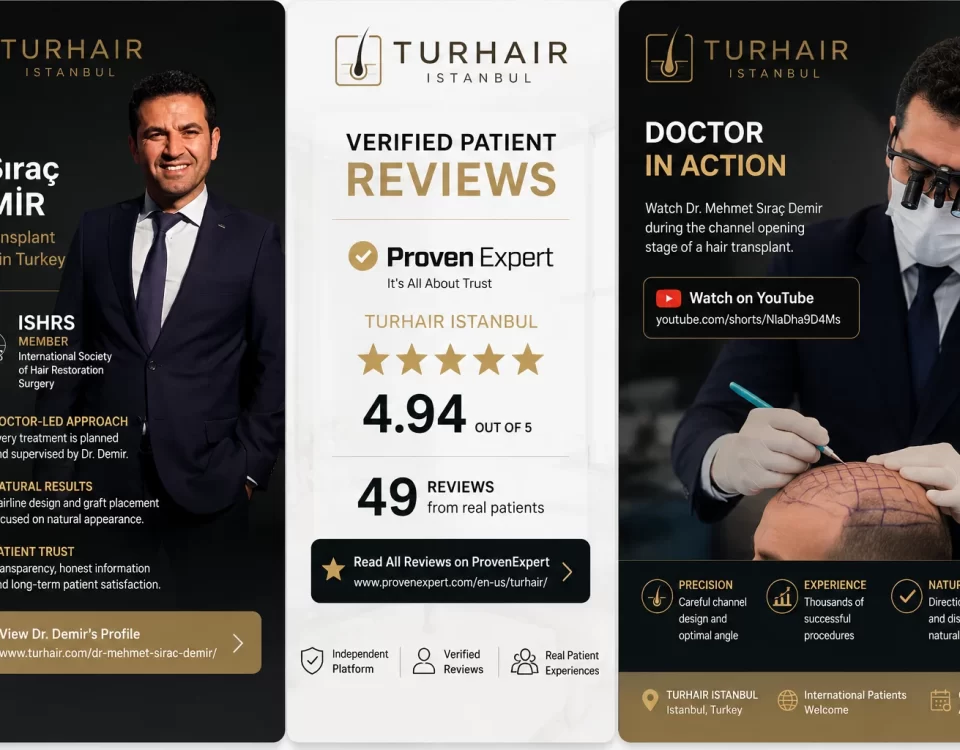
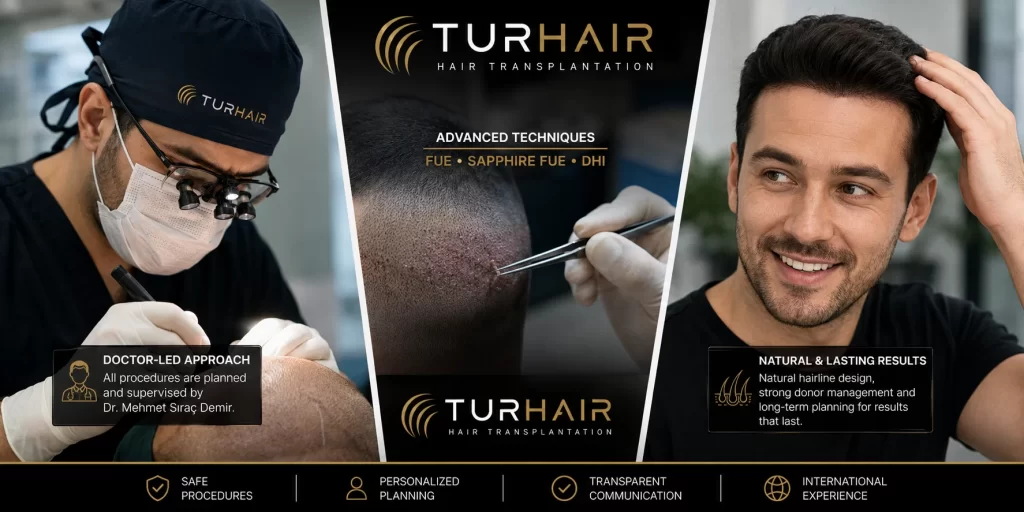
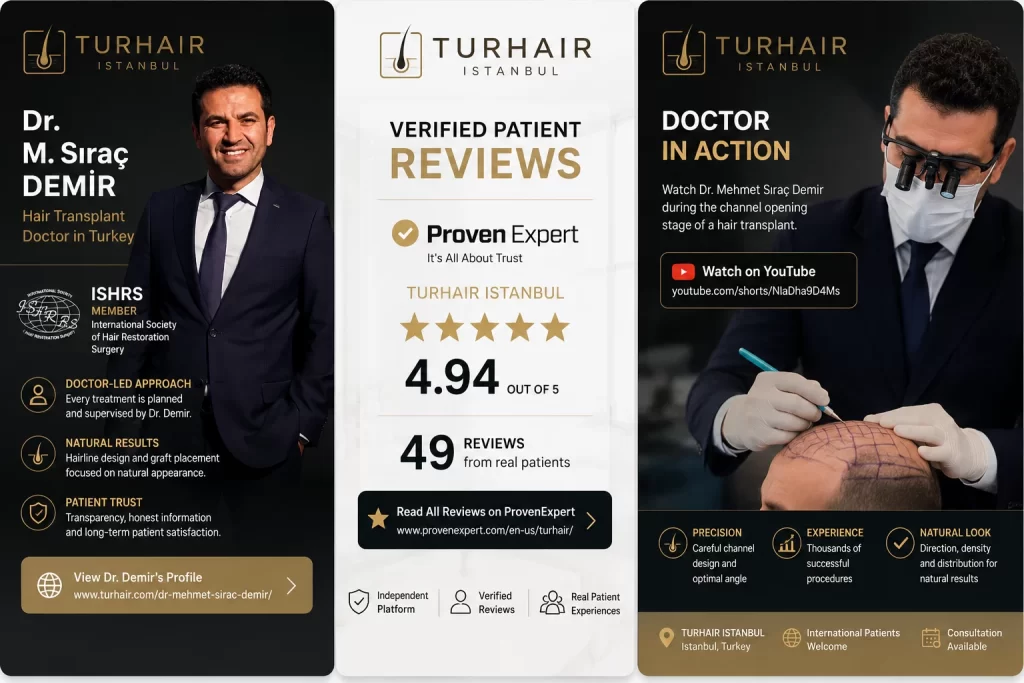
TurHair’s medical approach is centered on Dr. Mehmet Sıraç Demir. His professional
profile states that he has worked in medical aesthetics and hair transplantation since 2008.
He is also listed as a full member of the International Society of Hair Restoration Surgery (ISHRS).
Treatment planning focuses on the patient’s facial proportions, hair-loss pattern, donor capacity,
hair characteristics and possible future progression. In TurHair’s applicable doctor-led packages,
Dr. Demir’s role includes personalized hairline planning and recipient-channel creation.
Medical DoctorHair RestorationSince 2008ISHRS Full Member
Hair Transplant Reviews: What Should You Look For?
Reviews can help evaluate a clinic, but the headline score is only the beginning. Patients should
read detailed experiences and compare them with medical credentials, before-and-after cases and
the clinic’s explanation of who performs each surgical stage.
Google Reviews
ProvenExpert
Review scores may change over time and platforms use different review and verification systems.
Why Consider TurHair When Comparing Hair Transplant Clinics?
For patients researching the best hair transplant clinic in Turkey, TurHair follows a model focused
on identifiable medical responsibility, individualized planning and long-term donor preservation.
The objective is not simply to transplant the maximum number of grafts possible. The treatment
strategy should make aesthetic and medical sense for the individual patient.
👨⚕️ Doctor-Led Planning
Patients are informed about the physician responsible for treatment and the doctor’s role in the selected package.
✍️ Personalized Hairline
Planning considers facial structure, age, existing hair, donor capacity and future hair-loss patterns.
🎯 Recipient-Site Planning
Doctor involvement in recipient-channel creation is available within TurHair’s applicable doctor-led treatment packages.
🛡️ Donor Preservation
The donor area is considered a limited resource and the treatment strategy is planned accordingly.
💎 Modern Techniques
FUE, Sapphire FUE and DHI options can be considered according to the individual case and selected treatment plan.
🌍 International Support
Accommodation, airport transfers, medication guidance, translation and postoperative coordination can be organized for international patients.
Doctor-Led Hair Transplant vs High-Volume Model
Not every clinic operates in the same way. Patients should understand the treatment model rather
than assuming that every provider advertising FUE or DHI offers the same level of physician involvement.
| Criteria | Doctor-Led Model | Possible High-Volume Model |
|---|---|---|
| Doctor Identity | Clearly identified before treatment | Doctor’s exact role may be less clear |
| Hairline Planning | Individualized to the patient | May rely more heavily on standardized designs |
| Recipient Sites | Physician role clearly defined | May be delegated depending on provider |
| Donor Strategy | Long-term donor preservation emphasized | Large graft numbers may receive greater emphasis |
| Treatment Planning | Individual medical and aesthetic assessment | Workflow may be more standardized |
| Patient Volume | Limited volume can allow closer oversight | Multiple simultaneous procedures may occur |
Why Donor Area Management Matters
Many patients arrive at consultations focused on a specific graft number. But a larger number is
not automatically a better result. The safe and useful number depends on donor density, follicular
distribution, hair characteristics, recipient requirements and the possibility that further
treatment may be necessary in the future.
Overharvesting can leave visible thinning or an irregular appearance in the donor area. Conversely,
an excessively conservative procedure may fail to provide adequate coverage. The objective is a
balanced plan that uses available grafts efficiently while maintaining donor appearance.
The right graft number is more important than the biggest graft number.
FUE, Sapphire FUE and DHI: Which Is Best?
Patients frequently search for the “best technique,” but there is no single method that is ideal
for every case. Technique selection should follow diagnosis and planning rather than marketing.
FUE
Follicular Unit Extraction removes follicular units individually from the donor area. It is widely
used and can be suitable for many different patterns of hair loss.
Sapphire FUE
Sapphire FUE refers to the use of sapphire blades during recipient-site creation. The instrument
does not replace the importance of correct angle, direction, distribution and medical planning.
DHI
DHI uses an implanter device during graft placement and can be useful in selected cases, including
situations where transplantation is performed among existing hair.
Do not choose a clinic simply because it advertises Sapphire or DHI as a premium technology.
The person planning and performing the treatment remains more important than the branding of the instrument.
What Creates a Natural Hair Transplant Result?
A successful transplant should not immediately reveal that a transplant was performed. Naturalness
comes from the relationship between hairline shape, follicular direction, density distribution,
hair calibre and the patient’s existing pattern.
The frontal hairline usually requires particularly careful planning because it frames the face.
Natural hairlines are not perfectly straight or mechanically symmetrical. Appropriate use of
individual follicular units in the frontal zone and gradual transitions in density can contribute
to a softer appearance.
When evaluating before-and-after photographs, look for:
- Natural frontal hairline shape
- Correct direction of growth
- Realistic density for the donor capacity
- Appearance of the donor area after healing
- Comparable lighting and camera angles
- Long-term results rather than only immediate postoperative photographs
Hair Transplant Planning for Different Types of Hair Loss
Receding Hairline and Temples
Frontal recession is one of the most common reasons patients seek treatment. The objective is not
simply to lower the hairline. The new design should frame the face while remaining appropriate for
the patient’s age, donor capacity and possible future recession.
Mid-Scalp Hair Loss
Diffuse or mid-scalp loss requires strategic distribution of available grafts. Existing native
hair should be evaluated carefully and the long-term pattern considered before determining density.
Crown / Vertex
The crown has a characteristic whorl pattern and can require a significant number of grafts.
Correct direction is especially important. In patients with extensive loss, the physician may
prioritize the frontal region rather than consuming excessive donor capacity in the crown.
Advanced Hair Loss
Patients with advanced hair loss require realistic expectations. Complete high-density restoration
of every bald area may not be possible from a limited donor supply. Strategic coverage and the
possibility of more than one session may need to be discussed.
Female Hair Transplant
Women may seek treatment for hairline lowering, temple recession or selected areas of reduced
density. Because female hair loss can have different underlying patterns, appropriate medical
evaluation is important before surgical planning.
Curly and Afro-Textured Hair
Curved follicles can make extraction technically more demanding. The clinic should assess hair
and follicular characteristics carefully and have an appropriate strategy for minimizing graft damage.
Hair Transplant Cost in Turkey: What Are You Actually Paying For?
Hair transplant prices in Turkey vary according to the clinic, physician involvement, technique,
case complexity and included services. Comparing two prices without comparing the medical structure
behind them can therefore be misleading.
A package may include the procedure, accommodation, airport transfers, medication, translation and
aftercare. Other services may be optional. Before paying a deposit, request a clear explanation of
what is included and whether any additional charges can apply.
What exactly will the physician personally perform?
Is the recommendation based on your donor capacity?
How many hotel nights are included?
Are airport and clinic transfers included?
What postoperative support will you receive?
Are PRP or other optional services included or additional?
What Should Happen During a Hair Transplant Consultation?
A consultation should be more than receiving a graft estimate from a few photographs. Photographs
can provide useful preliminary information, but final planning requires a proper assessment of the
donor and recipient areas.
- Hair-loss pattern should be evaluated.
- Donor density and donor limitations should be considered.
- The proposed hairline should be discussed.
- A realistic graft strategy should be established.
- The appropriate technique should be selected for the individual case.
- Relevant medical history and medication should be reviewed.
- Patients should understand the doctor’s and surgical team’s respective roles.
Hair Transplant Process: Step by Step
01 — Medical Assessment
Hair loss, donor capacity, expectations and suitability are evaluated.
02 — Hairline & Strategy
Hairline position and distribution of available grafts are planned.
03 — Donor Extraction
Follicular units are extracted according to the treatment plan.
04 — Recipient Sites
Direction, angle and distribution are established in the recipient area.
05 — Implantation
Prepared grafts are placed according to the surgical plan.
06 — Aftercare
Washing, medication and postoperative instructions are provided.
Hair Transplant Recovery and Growth
Recovery is gradual. Mild redness, sensitivity or swelling can occur during the early postoperative
period. Patients should follow the clinic’s instructions carefully and avoid scratching or
traumatizing newly implanted grafts.
Crusts gradually clear during the early healing period. Temporary shedding of transplanted hair can
occur before new growth becomes visible. This should not automatically be interpreted as loss of
the transplanted follicles.
Hair growth and maturation continue over many months. Different scalp areas may mature at different
rates, and the crown can take longer than the frontal area. Final timing varies from patient to patient.
Red Flags When Choosing a Hair Transplant Clinic
Know Who Is Performing Your Hair Transplant
The International Society of Hair Restoration Surgery has published consumer information warning
patients about risks associated with unlicensed personnel performing aspects of hair-restoration
surgery. Patients should verify the physician’s qualifications and understand who is responsible
for the different stages of treatment.
This is particularly relevant when comparing providers primarily through advertisements or social
media. A clinic’s online visibility does not replace verification of medical responsibility.
Travelling to Istanbul for a Hair Transplant
International treatment involves more than the surgery itself. Patients should understand the
arrival schedule, hotel arrangements, transfer organization, procedure date, postoperative washing
and departure timing before purchasing flights.
Comfortable clothing that does not need to be pulled tightly over the head can make the
postoperative period easier. Patients should also follow their clinic’s instructions concerning
alcohol, medication, exercise, sun exposure and washing rather than relying on generic online advice.
Before travelling, confirm:
- Arrival and departure dates
- Hotel nights
- Airport and clinic transfers
- Preoperative assessment
- Procedure schedule
- First wash / postoperative check
- Emergency and follow-up contact information
Who Is a Good Candidate for a Hair Transplant?
Not everyone experiencing hair loss is automatically a good surgical candidate. The availability
and quality of donor hair, the type and progression of hair loss, general health and realistic
expectations all influence suitability.
Some patients may benefit from postponing surgery, considering medical management first or choosing
a more conservative hairline. In extensive hair loss, the available donor supply may not be
sufficient to recreate the density the patient remembers from youth.
A responsible clinic should be willing to recommend against surgery when transplantation is unlikely
to provide an appropriate result. Sometimes the correct medical answer is not the answer that
produces an immediate booking.
Will You Need a Second Hair Transplant?
Some patients may eventually require or choose a second session. This can occur because hair loss
continues, because an extensive area could not safely be treated in one session or because additional
density is desired later.
This is another reason donor preservation matters. A treatment plan should not consume donor
resources without considering the patient’s possible future needs.
Frequently Asked Questions
Is Turkey good for hair transplantation?
Turkey has a large and experienced hair-transplant sector, particularly in Istanbul. However,
quality varies between providers, so patients should evaluate the individual doctor and treatment
model rather than judging the entire country as one standard.
How do I find the best hair transplant clinic in Turkey?
Start by identifying the physician responsible for your treatment. Check credentials, experience,
doctor involvement, hairline planning, donor strategy, real patient results, reviews, aftercare
and exactly who performs each stage.
How many grafts do I need?
There is no universal graft number. Requirements depend on the size of the recipient area, donor
density, hair calibre, hair-loss pattern, desired coverage and long-term strategy. Final planning
should follow an individual assessment.
Is DHI better than FUE?
Not automatically. DHI refers to an implantation approach, while FUE describes follicular-unit
extraction. The appropriate method depends on the patient’s characteristics and treatment plan.
Is Sapphire FUE better than regular FUE?
Sapphire blades are one tool used for recipient-site creation. The quality of the result still
depends heavily on planning, angle, direction, distribution, graft handling and the surgical team.
Why is doctor involvement important?
Hair transplantation involves medical and aesthetic decisions including donor management,
hairline planning and recipient-site strategy. Patients should know which physician is responsible
for those decisions and what the physician personally performs.
Can I choose a clinic based on Google reviews?
Reviews are helpful, but they should be one part of the decision. A large number of positive reviews
does not replace medical credentials, long-term before-and-after results, donor assessment or
clarity about who performs the surgery.
Are very cheap hair transplants risky?
Price alone does not prove quality or lack of quality. However, patients should understand how a
very low price is achieved and whether it affects physician involvement, patient volume, staffing,
aftercare or other aspects of treatment.
Are transplanted hairs permanent?
Hair transplanted from suitable donor areas is generally selected for its resistance to the
miniaturization pattern affecting androgenetic hair loss. However, surrounding native hair can
continue to thin, which is why long-term planning remains important.
When can I expect the final result?
Hair-transplant growth develops gradually over many months. Individual timing varies, and different
areas of the scalp can mature at different rates. Your clinic should explain the expected timeline
for your specific treatment.
So, What Is the Best Hair Transplant Clinic in Turkey?
There is no single clinic that can objectively be called the best choice for every patient.
Hair-loss patterns, donor capacity, expectations, medical history and aesthetic objectives differ.
The right provider is therefore the one whose medical approach is appropriate for your individual case.
Instead of asking only which clinic has the largest Instagram account, the most reviews, the
cheapest package or the most luxurious hotel, investigate the doctor responsible for the operation,
the physician’s actual surgical role, donor strategy, hairline philosophy and long-term planning.
Choose the doctor first. Evaluate the clinic second. Treat advertising, rankings and luxury services
as secondary information.
Why TurHair May Be a Suitable Choice
TurHair is positioned for patients seeking a doctor-led approach in Istanbul with identifiable
medical responsibility, individualized hairline planning, donor preservation and access to modern
hair-restoration techniques.
Rather than selecting a clinic from a ranking alone, prospective patients are encouraged to review
Dr. Mehmet Sıraç Demir’s professional background, understand the exact treatment package being
offered and obtain an individual assessment before making a final decision.
Request a Personal Hair Transplant Assessment
A preliminary assessment can help evaluate your hair-loss pattern and donor area. Final graft
planning and medical suitability are determined following appropriate evaluation.
October 5, 2026
October 5, 2026
Dr. Mehmet Sıraç Demir