Sapphire FUE Turkey
August 25, 2026
Stem Cell Hair Transplant Turkey & Cost
August 25, 2026Hair Transplant Reviews: Are They Real or Fake? How to Spot Genuine vs Fake Reviews
Hair transplant reviews are one of the first things patients check before choosing a clinic, surgeon, or country for their procedure. Search for almost any popular hair transplant clinic and you may find hundreds—or even thousands—of Google reviews, testimonials, before-and-after photographs, Reddit discussions, forum posts, YouTube videos, and social media comments.
But this creates an important question: are hair transplant reviews real or fake?
The answer is not as simple as assuming that every five-star review is genuine or that every negative comment is trustworthy. Hair transplantation is a highly competitive international industry. Reviews can come from real patients, disappointed patients, competitors, marketing agencies, anonymous forum members, employees, influencers, and—in some cases—people who may never have undergone a hair transplant at all.
For prospective patients, therefore, the objective should not simply be to find the clinic with the highest rating. A much safer approach is to learn how to verify hair transplant reviews, identify suspicious patterns, compare reviews across independent sources, examine real patient results, and understand exactly who performed the medical stages of the procedure.
This comprehensive guide explains how to distinguish genuine hair transplant reviews from potentially misleading ones and how to research a hair transplant clinic more intelligently before making a decision.
Why Hair Transplant Reviews Can Be Misleading
Unfortunately, online reviews in the hair transplant industry can be heavily manipulated, which makes it increasingly difficult for prospective patients to distinguish genuine medical quality from aggressive digital marketing. In particular, some technician-led or so-called “black market” hair transplant operations may use substantial advertising budgets, paid or incentivized reviews, promotional accounts, agents, affiliates, and sophisticated SEO campaigns to create the impression of overwhelming patient satisfaction and online authority.
The problem can extend beyond individual reviews, as commercially motivated “best clinic,” “top hair transplant clinic,” or “best surgeon” lists may also influence visibility on search engines such as Google or Yandex, while smaller, ethically operating doctor-led practices can struggle to achieve the same level of exposure.
This is particularly important because online popularity should never be confused with medical quality, surgical responsibility, or genuine physician involvement. The International Society of Hair Restoration Surgery (ISHRS) has repeatedly raised awareness of the risks associated with illicit or improperly supervised hair restoration practices, including through its “Fight the FIGHT” initiative addressing fraudulent and illicit hair transplant activity.
Patients therefore have an important responsibility to look beyond the clinic’s brand name, advertising budget, social-media presence, and number of five-star reviews; they should identify the actual doctor responsible for their treatment, research that doctor’s medical background and CV, determine who will personally perform or supervise the critical stages of surgery, and understand whether the physician whose name appears in the marketing is genuinely involved in the operation.
The same caution should be applied to forums, Reddit discussions, and other anonymous online communities, because neither positive nor negative comments should automatically be treated as verified medical evidence simply because they appear on an apparently independent platform.
Forums can contain extremely useful genuine patient journeys, but they can also include anonymous users, promoters, agents, highly active supporters of particular clinics, competitors, or individuals who repeatedly attack doctors and clinics without providing verifiable evidence that they were ever patients.
Ultimately, choosing a hair transplant surgeon requires much deeper investigation than comparing Google ratings or following a “Top 10” list: patients should verify the physician, examine the doctor’s CV and experience, establish exactly who performs the operation, review genuine long-term before-and-after cases, assess donor-area outcomes, compare multiple independent sources, and distinguish documented patient experiences from anonymous opinions, because in a highly competitive industry the clinic with the loudest online presence is not necessarily the clinic providing the highest level of medical care.
Can You Trust Hair Transplant Reviews on Reddit?
Reddit can be a useful place to read personal experiences, but patients should remember that Reddit is not a medical authority, healthcare platform, licensing body, or independent certification organization for hair transplant clinics and surgeons. One of the biggest mistakes prospective patients can make is choosing or rejecting a doctor solely because of recommendations, rankings, criticism, or apparent “community consensus” on Reddit. Anonymous opinions may provide additional information for research, but they should never replace verification of a doctor’s medical qualifications, professional experience, surgical involvement, and documented patient results.
Another important concern is that commercial promotion on Reddit does not always look like traditional advertising. Promotional activity can be designed to appear completely natural: an established-looking account may participate in ordinary discussions, answer general hair-loss questions, recommend particular clinics repeatedly, criticize competing clinics, or gradually direct patients toward certain providers without openly disclosing a commercial relationship. The opposite form of manipulation is also possible, where anonymous accounts repeatedly publish negative comments or anti-advertising against particular doctors or clinics; unless the identity, patient status, evidence, and possible commercial relationships of the person can be verified, patients should be cautious about treating such statements as established medical facts.
This is especially important in the highly competitive hair transplant and medical-tourism market, where clinics—including technician-led or so-called “black market” hair transplant operations—may have significant digital marketing resources. A clinic that appears to be naturally popular within an online community is not automatically medically superior, just as a doctor who receives repeated criticism from anonymous accounts is not automatically a poor surgeon. Patients should therefore use Reddit only as one additional research source and cross-check what they read against the doctor’s CV, medical credentials, professional memberships where relevant, independently documented long-term before-and-after results, donor-area outcomes, and—most importantly—clear information about who actually performs the critical stages of the hair transplant procedure.
Remember: Reddit popularity is not medical accreditation. The number of recommendations, upvotes, positive comments, or negative posts does not establish the medical quality of a hair transplant surgeon. Before trusting any Reddit account that repeatedly recommends or attacks particular clinics or doctors, examine the account’s history, posting patterns, evidence, whether the person can demonstrate a genuine patient journey, and whether the same account consistently promotes certain providers while criticizing their competitors. Reddit can help you discover questions worth asking, but the final decision about a medical procedure should be based on verifiable medical information—not anonymous online popularity.
Why Hair Transplant Reviews Matter
A hair transplant is fundamentally different from purchasing an ordinary product. The outcome can affect a patient’s appearance for many years, and the donor area contains a limited supply of transplantable follicles. Poor planning, inappropriate graft extraction, unnatural hairline design, excessive harvesting, or inadequate medical supervision can therefore have consequences that are difficult to reverse.
This is why prospective patients naturally search terms such as:
- hair transplant reviews
- hair transplant Turkey reviews
- best hair transplant clinic reviews
- hair transplant Istanbul reviews
- hair transplant reviews real or fake
- fake hair transplant reviews
- best hair transplant surgeon reviews
- Turkey hair transplant reviews Reddit
- hair transplant before and after reviews
Reviews can provide useful information that is difficult to obtain from a clinic’s advertising material. A real patient may describe airport transfers, hotel quality, communication, consultation, hairline planning, anesthesia, the procedure itself, postoperative support, healing, shedding, donor recovery, and final growth.
However, reviews should be considered one source of evidence rather than definitive proof of medical quality.
A clinic can have excellent customer-service reviews while providing only limited information about who actually performs the surgery. Conversely, an experienced surgeon may have fewer reviews because the practice operates on a smaller scale.
Therefore, review analysis should always be combined with investigation of the surgeon, medical team, treatment plan, donor management, patient results, and transparency of the clinic.
Can Hair Transplant Reviews Be Fake?
Yes. Reviews in virtually any commercial industry can potentially be manipulated, and medical tourism is not immune.
However, patients should avoid the opposite mistake of assuming that positive reviews are automatically fake. Many clinics legitimately treat large numbers of satisfied patients and naturally accumulate positive feedback over time.
The correct question is therefore not:
“Does this clinic have positive reviews?”
A better question is:
“Does the overall review history look consistent with genuine patient experiences?”
That distinction is important.
Authenticity is usually evaluated through patterns rather than a single review. Review dates, reviewer profiles, photographs, writing style, treatment details, follow-up updates, negative feedback, clinic responses, and consistency with independently documented results can collectively provide a much clearer picture.
Regulators have also increased scrutiny of deceptive online review practices. In the United States, for example, the Federal Trade Commission has established rules addressing fake and false consumer reviews and testimonials, including practices involving purchased reviews and incentives conditioned on particular sentiments.
This reflects a broader reality: online reviews have become commercially powerful enough that patients should evaluate them critically.
Different Types of Fake or Misleading Hair Transplant Reviews
Not every misleading review looks like an obviously fabricated five-star comment. Review manipulation can take several forms.
1. Completely Fabricated Reviews
The clearest example is a review written by someone who never received treatment from the clinic.
These reviews may contain vague statements such as:
“Amazing clinic, best doctors, perfect service, highly recommended!”
A short review is not automatically fake—many genuine patients write only one sentence—but large numbers of nearly identical generic reviews deserve closer inspection.
2. Incentivized Reviews
A patient may actually have visited the clinic but could have been offered some form of benefit for leaving a review.
This creates an important distinction between a fabricated reviewer and a real patient whose review may have been influenced by an incentive.
Patients researching clinics should therefore consider whether reviews appear to represent spontaneous experiences or structured promotional activity.
3. Reviews Written Too Early
This issue is particularly relevant to hair transplantation.
A patient can genuinely be very happy on the day after surgery. The transfer may have been excellent, the hotel comfortable, the staff friendly, and the hairline visually attractive.
But that patient does not yet know the final hair transplant result.
Hair transplant growth normally requires many months of development. Early postoperative reviews are therefore mainly reviews of the experience, not the final surgical outcome.
This doesn’t make them fake. It simply means patients should interpret them correctly.
| Review Timing | What It Can Tell You | What It Cannot Reliably Tell You |
|---|---|---|
| Surgery Day | Service, communication, clinic experience | Final hair growth |
| 10 Days | Early healing and postoperative care | Density and mature result |
| 3 Months | Early recovery and beginning growth | Final density |
| 6 Months | Meaningful growth progress | Fully mature result in many patients |
| 12+ Months | Much stronger evidence of final outcome | Long-term future hair-loss progression |
4. Employee or Insider Reviews
Another potential problem occurs when people connected to a business present themselves as ordinary independent customers without clearly identifying that relationship.
This is why reviewer context matters.
If a profile appears repeatedly connected to a clinic, marketing company, employee network, or related business, prospective patients may want to investigate further.
5. Competitor-Generated Negative Reviews
Review manipulation is not limited to positive feedback.
In highly competitive industries, fake negative reviews can also exist.
A one-star review from an anonymous account that provides no treatment date, no photographs, no details, and no evidence should not automatically be considered definitive proof against a clinic.
Again, this does not mean negative reviews should be ignored.
Detailed criticism from a verifiable patient can be extremely valuable. The objective is to evaluate the credibility of the evidence rather than simply the star rating.
6. Review Suppression
A review profile can also become misleading when negative experiences are systematically hidden, discouraged, or removed without legitimate reason.
A trustworthy review ecosystem should allow patients to describe both positive and negative experiences.
In fact, a clinic with a realistic mixture of overwhelmingly positive reviews plus occasional reasonable criticism can sometimes appear more credible than a profile containing hundreds of flawless, repetitive five-star comments.
How Can You Tell If a Hair Transplant Review Is Real?
No single technique can guarantee authenticity. However, genuine reviews often contain several characteristics that are difficult to reproduce consistently across hundreds of fabricated profiles.
1. Specific Details About the Patient Journey
Real patients frequently remember practical details.
For example:
- where they travelled from;
- how they communicated with the clinic;
- whether they had an online assessment;
- who designed their hairline;
- who performed the extraction;
- who opened the recipient channels;
- approximately how many grafts were transplanted;
- how anesthesia felt;
- how long the procedure lasted;
- how the donor area healed;
- what happened during the shedding phase;
- when new growth became noticeable;
- how the clinic handled follow-up communication.
The presence of these details does not prove authenticity, but detailed experiences are generally more useful than generic praise.
2. A Natural Mix of Positive and Negative Observations
Real medical experiences are rarely perfect in every imaginable way.
A genuine patient might say:
“The procedure was longer than I expected and the first night was uncomfortable, but the staff answered my questions quickly and I am happy with the progress at eight months.”
This type of balanced description often provides more information than exaggerated statements claiming that absolutely everything was perfect.
3. Patient Photographs
Reviews containing photographs may provide additional evidence, especially when images document several stages:
- before surgery;
- immediately after implantation;
- donor area;
- 10-day recovery;
- 3-month stage;
- 6-month stage;
- 9–12 month result.
However, photographs themselves should also be evaluated critically.
Different lighting, hair length, styling, fibers, wet versus dry hair, camera angle, and image editing can dramatically affect the apparent density of a result.
4. Long-Term Updates
One of the strongest forms of patient-generated evidence is a documented journey that develops over time.
For example, a forum thread where a patient posts:
Day 0 → Day 10 → Month 3 → Month 6 → Month 9 → Month 12
can provide substantially more information than a review written immediately after leaving the clinic.
Longitudinal documentation allows prospective patients to observe shedding, redness, donor healing, growth progression, density development, and the final appearance of the hairline.
5. An Established Reviewer Profile
When examining Google reviews or other platforms, look at the reviewer’s broader activity.
Questions worth asking include:
- Does the account have a history?
- Has the person reviewed other businesses?
- Are the locations geographically plausible?
- Are photographs attached?
- Were all reviews posted within a few days?
- Does every review give five stars?
A reviewer with years of ordinary activity can potentially provide more contextual credibility than a newly created account containing only one promotional-looking review.
But this is only a clue—not proof. Many genuine patients rarely write reviews and may create or use an account specifically to review their medical experience.
10 Red Flags That May Indicate Fake Hair Transplant Reviews
The following warning signs should encourage deeper investigation. None should be used alone to accuse a clinic or reviewer of dishonesty.
Red Flag #1: Hundreds of Extremely Similar Reviews
If large numbers of reviews repeatedly use almost identical wording, investigate further.
Examples might include repeated combinations such as:
“best clinic in Turkey,” “amazing doctor,” “perfect experience,” “highly recommend,”
particularly when they appear in nearly identical sentence structures.
Red Flag #2: Sudden Review Bursts
A clinic might naturally receive multiple reviews after a busy week, so clusters are not automatically suspicious.
However, an unusually large increase within a very short period—particularly after months of minimal activity—can justify closer analysis.
Red Flag #3: Reviewer Accounts With Unusual Patterns
Imagine an account that has reviewed:
- a hair transplant clinic in Istanbul;
- a dentist in another country;
- a cosmetic surgery center elsewhere;
- several unrelated businesses;
all within a few days and all with promotional language.
That pattern may deserve additional scrutiny.
Red Flag #4: No Medical Details
A review stating only:
“Best hair transplant clinic. Amazing experience. Five stars.”
provides almost no evidence about the procedure.
A more useful review might mention that the patient received approximately 3,500 grafts, explain the area treated, describe the consultation, identify who performed key surgical stages, and provide an update months later.
Red Flag #5: Every Review Sounds Like Advertising Copy
Patients generally speak differently from professional marketers.
Repeated use of commercial keyphrases, package descriptions, slogans, or unusually polished sales language can be worth examining.
Red Flag #6: Results Are Never Shown
If a clinic has thousands of supposedly satisfied patients but very little independently documented long-term evidence, ask why.
Privacy naturally limits how many patients permit their photographs to be published. Therefore, lack of public images does not prove anything improper.
But ideally, a clinic’s reputation should be supported by more than star ratings alone.
Red Flag #7: Reviews Focus Only on Hospitality
Statements about drivers, hotels, translators, food, and friendly staff can be genuine and useful.
But a hair transplant is ultimately a medical procedure.
The most important questions include:
- Was the donor area managed appropriately?
- Was the hairline suitable for the patient’s age and future hair loss?
- Who performed the medical stages?
- Was the graft count appropriate?
- Did the transplanted hair grow?
- Does the result look natural?
Red Flag #8: No Critical Reviews Exist
No business can satisfy every person indefinitely.
Even excellent hotels, hospitals, restaurants, surgeons, and clinics receive occasional complaints.
A completely flawless profile should not automatically be considered fake, particularly for a small practice, but patients should look at how the review history developed and whether independent platforms show the same pattern.
Red Flag #9: The Clinic Cannot Explain Who Performed the Surgery
This issue is more important than review authenticity itself.
A clinic might have excellent reviews while prospective patients still do not know:
- the doctor’s full name;
- who designs the hairline;
- who performs extraction;
- who creates recipient sites/channels;
- who implants the grafts;
- how many patients are treated simultaneously.
Reviews should never replace these questions.
Red Flag #10: Pressure to Book Based on Ratings
Statements such as:
“We have thousands of five-star reviews, so you don’t need to research anything else”
should not replace informed decision-making.
A responsible clinic should be comfortable with patients researching the surgeon, treatment method, risks, alternatives, and independent patient experiences.
Are Five-Star Hair Transplant Reviews Trustworthy?
They can be.
A high rating is not evidence of manipulation by itself.
A clinic that treats many international patients successfully may genuinely accumulate hundreds of positive reviews.
The important factor is the quality and consistency of the underlying evidence.
Instead of looking only at:
★★★★★ 4.9/5
look deeper.
| Weak Review Analysis | Better Review Analysis |
|---|---|
| Check average stars | Read detailed reviews across several years |
| Count total reviews | Examine how review volume developed over time |
| Read newest five-star comments | Read 5-, 4-, 3-, 2- and 1-star reviews |
| Trust testimonials alone | Compare testimonials with documented results |
| Choose the highest-rated clinic | Research surgeon involvement and medical planning |
Are Negative Hair Transplant Reviews Always Reliable?
No.
Negative reviews deserve attention, but they require the same critical evaluation as positive reviews.
There are several possibilities.
A Genuine Poor Outcome
The patient may have experienced low growth, poor density, an unnatural hairline, excessive donor extraction, communication problems, or another legitimate concern.
These reviews are particularly important when supported by clear photographs and a timeline.
Unrealistic Expectations
Some patients expect a hair transplant to recreate the density they had as teenagers despite advanced hair loss and limited donor capacity.
A medically reasonable result can therefore still receive criticism when expectations were unrealistic or inadequately discussed before surgery.
Early Panic During the Shedding Phase
Hair transplantation involves a recovery process. Patients unfamiliar with postoperative shedding may become concerned when transplanted hairs temporarily shed.
A negative review posted very early should therefore be interpreted in the context of the treatment timeline.
Service Complaint Rather Than Surgical Complaint
A one-star rating might relate to:
- hotel expectations;
- airport transfer delays;
- communication;
- appointment scheduling;
- pricing disagreement.
These issues matter, but they should be distinguished from poor surgical outcomes.
Potentially Malicious Reviews
Businesses can also receive reviews from individuals they cannot identify as patients.
Prospective patients should therefore examine whether a serious accusation includes verifiable context rather than automatically treating every anonymous statement as established fact.
How to Check Google Hair Transplant Reviews Properly
Google reviews are often one of the first resources patients encounter.
Instead of reading only the first few reviews, conduct a structured analysis.
Step 1: Sort by Newest
This helps determine whether the clinic is currently receiving patient feedback.
Step 2: Read Older Reviews
A long review history can be useful because it allows you to see whether feedback has remained consistent over several years.
Step 3: Read the Lowest Ratings
This is one of the most useful research techniques.
Do not simply count one-star reviews. Read them.
Ask:
- What exactly happened?
- Was the reviewer actually a patient?
- Are photographs included?
- How long after surgery was the complaint posted?
- Did the clinic respond?
- Was the response professional?
- Was a medical outcome being criticized or only logistics?
Step 4: Inspect Reviewer Profiles
Look for natural activity patterns.
Do not assume that an account with only one review is fake. Many genuine patients simply do not use Google reviews frequently.
Instead, consider reviewer history as one part of a broader authenticity assessment.
Step 5: Search for Repeated Language
If the same unusual sentence appears repeatedly, copy a portion of it and search for it online.
You may occasionally discover duplicated language across unrelated businesses.
Step 6: Compare Google With Other Platforms
A clinic’s reputation should not be evaluated in isolation.
Search:
[Clinic Name] + reviews
[Doctor Name] + reviews
[Clinic Name] + Reddit
[Doctor Name] + forum
[Clinic Name] + before after
[Clinic Name] + bad review
[Clinic Name] + patient experience
The objective is not to search only for criticism. It is to deliberately expose yourself to different sources rather than relying on a single platform.
Is a Hair Transplant Clinic With 5,000 Reviews Better Than One With 500?
Not necessarily.
Review count primarily demonstrates review volume. It does not independently establish surgical quality.
Consider two hypothetical clinics.
| Factor | Clinic A | Clinic B |
|---|---|---|
| Google Reviews | 5,000 | 500 |
| Patients Per Day | High volume | 1–2 |
| Surgeon Clearly Identified | Unclear | Yes |
| Doctor Performs Key Medical Stage | Unclear | Clearly explained |
| Long-Term Results | Mixed documentation | Documented cases |
Which clinic is better?
The number of reviews alone cannot answer that question.
A high-volume clinic naturally has more opportunities to collect reviews. A smaller surgeon-led practice may treat far fewer patients and consequently accumulate reviews more slowly.
Review volume should therefore be interpreted relative to treatment volume and clinic structure.
Hair Transplant Reviews vs Before-and-After Photos: Which Is More Important?
Both provide different information.
Reviews tell you about the patient’s experience.
Before-and-after photographs can provide evidence about visual outcomes.
Neither should be used alone.
A strong research process combines:
- patient reviews;
- before-and-after results;
- video results;
- donor-area photographs;
- long-term patient journeys;
- surgeon credentials;
- clear explanation of who performs the surgery;
- consultation quality;
- realistic graft planning.
Look at the Donor Area, Not Only the Hairline
This is frequently overlooked.
A dramatic frontal result may look impressive while photographs of the donor area are absent.
Hair transplantation redistributes follicles; it does not create an unlimited new donor supply.
Therefore, responsible evaluation should include both:
Recipient result + donor preservation.
Compare Similar Hair-Loss Patterns
If you have advanced Norwood-pattern hair loss, a result from someone with mild temple recession may not be particularly relevant to your case.
Try to find patients with similar:
- hair-loss stage;
- age;
- hair caliber;
- hair texture;
- donor density;
- skin-to-hair contrast;
- treatment goals.
Why the Doctor’s Identity Matters More Than the Clinic’s Star Rating
One of the most important questions in hair transplant research is surprisingly simple:
Who is actually performing my procedure?
A clinic name is a brand.
A medical procedure is performed by people.
Before booking, patients should request clear answers regarding:
- the doctor’s full name;
- medical qualifications;
- hair transplant experience;
- who performs the consultation;
- who designs the hairline;
- who administers anesthesia;
- who extracts grafts;
- who creates recipient sites or channels;
- who implants grafts;
- how many patients are treated simultaneously.
A five-star review does not answer these questions.
How TurHair Approaches Transparency
At TurHair, patients are encouraged to understand the treatment plan before making a booking decision. Hair transplantation should not be selected solely according to advertisements, star ratings, package names, or promises of very high graft numbers.
Cases are individually assessed because donor capacity, hair-loss pattern, hair characteristics, age, previous surgery, and future hair-loss risk vary from patient to patient.
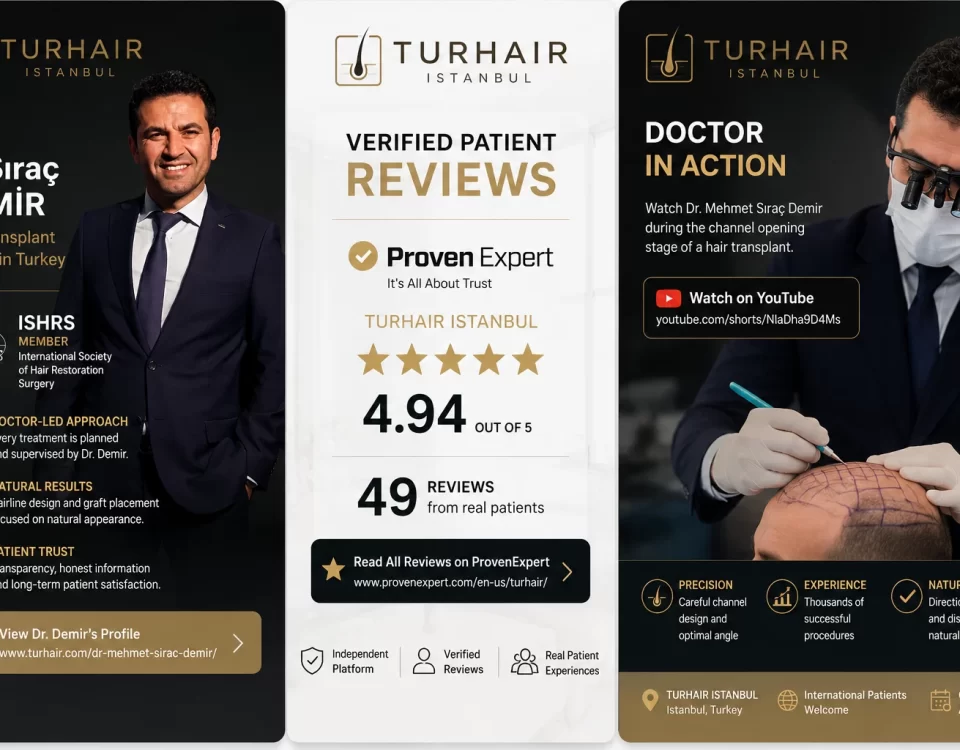
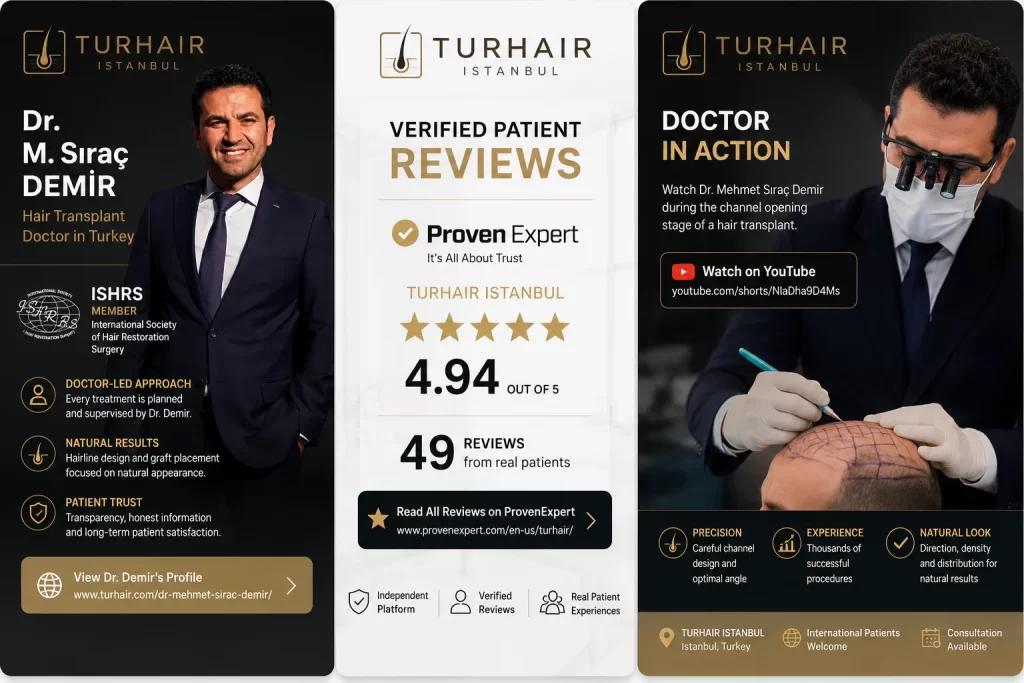
TurHair works with Dr. Mehmet Sıraç Demir, whose identity is disclosed to patients rather than presenting the procedure under an anonymous clinic brand alone.
The purpose of this approach is straightforward: a prospective patient should know who is responsible for medical planning and should be able to ask questions about the procedure before travelling to Istanbul.
Patients researching TurHair—or any other clinic—should still conduct independent research, compare alternatives, review available patient results, and make a decision based on the overall evidence rather than one review platform.
Questions to Ask Any Hair Transplant Clinic
- What is the full name of the doctor responsible for my procedure?
- Who will design my hairline?
- Who performs graft extraction?
- Who opens the recipient channels/sites?
- Who implants the grafts?
- How many patients are treated each day?
- How is my graft estimate calculated?
- Can I see results from patients with hair loss similar to mine?
- Can I see donor-area results?
- What happens if my donor area is insufficient?
- What postoperative support is provided?
- How long should I expect before evaluating the final result?
Hair Transplant Review Verification Checklist
Before trusting a clinic’s online reputation, use the following checklist.
✓ Check review history
Do reviews appear naturally distributed over time?
✓ Read detailed reviews
Do patients explain what actually happened?
✓ Read negative reviews
What are the recurring complaints?
✓ Check reviewer profiles
Do the profiles show plausible activity?
✓ Look for patient photographs
Are multiple recovery stages documented?
✓ Check long-term outcomes
Are there results at approximately 9–12 months or later?
✓ Examine donor areas
Do published results show responsible extraction?
✓ Search independently
Check Google, forums, Reddit, social platforms, and search engines.
✓ Research the surgeon
Can you identify the doctor responsible for the medical procedure?
✓ Ask who performs each stage
Never assume that a famous doctor personally performs every step.
Can AI Be Used to Create Fake Hair Transplant Reviews?
Artificial intelligence has made it easier to generate natural-sounding text at scale. This means that writing style alone is becoming a weaker method of determining whether an online review is genuine.
A sophisticated fabricated review can include spelling mistakes, personal details, emotions, and realistic medical terminology.
For this reason, patients should increasingly focus on verifiable evidence rather than writing style alone.
Useful evidence can include:
- consistent patient photographs;
- long-term updates;
- video testimonials;
- reviewer history;
- independent forum documentation;
- matching surgery timelines;
- consistent information about the surgeon and clinic.
The central principle is simple:
The more independent pieces of evidence that tell the same story, the stronger the case for credibility.
Should You Trust Hair Transplant Reviews on a Clinic’s Own Website?
Testimonials published on a clinic’s own website can be useful, but they should naturally be considered curated content.
A clinic chooses which cases and testimonials appear on its website.
That does not mean the testimonials are false.
It means they should be supplemented with independent research.
A good research sequence might therefore be:
Clinic website → Google → patient results → surgeon search → forums → Reddit → social media → consultation.
When information remains consistent across multiple independent channels, confidence can increase.
What Is More Important Than Hair Transplant Reviews?
Reviews matter, but several factors may be even more important.
1. Donor Management
The donor area is limited. A responsible treatment plan should consider not only today’s procedure but also the patient’s possible future hair loss.
2. Hairline Design
A hairline should complement age, facial proportions, donor capacity, and future hair-loss risk.
3. Surgeon Involvement
Patients should know who performs the medical stages of their procedure.
4. Realistic Graft Planning
More grafts do not automatically mean a better result.
Extremely aggressive extraction can compromise the donor area.
5. Documented Outcomes
Long-term patient results are more informative than marketing claims.
6. Communication and Follow-Up
Patients should understand postoperative instructions and have a clear method for contacting the clinic during recovery.
Final Verdict: Are Hair Transplant Reviews Real or Fake?
Some are genuine, some may be misleading, and individual reviews cannot always be independently verified.
The safest strategy is therefore not to blindly trust or automatically dismiss online reviews.
Instead, investigate patterns.
A credible clinic should ideally demonstrate consistency between:
- patient reviews;
- documented before-and-after results;
- surgeon identity;
- medical planning;
- donor management;
- independent discussions;
- long-term patient outcomes.
Think of online reviews as the beginning of your research—not the end.
A patient considering a hair transplant in Turkey, Istanbul, or anywhere else should ask one fundamental question:
“Can I independently verify enough of what this clinic is telling me to feel comfortable trusting them with my donor area?”
That question is considerably more useful than simply asking which clinic has the most five-star reviews.
Continue reading: Part 2 examines Google Reviews, Reddit, hair transplant forums, Trustpilot, YouTube testimonials, before-and-after manipulation, review farms, AI-generated reviews, negative-review analysis, and a complete step-by-step system for verifying a hair transplant clinic before booking.
“`html
Hair Transplant Reviews: Advanced Verification Guide
Once you understand the basic differences between genuine and potentially misleading hair transplant reviews, the next step is learning how to investigate them more deeply.
Today, prospective patients do not depend on a single website. A clinic may appear on Google, Reddit, Trustpilot, YouTube, Instagram, TikTok, hair-loss forums, Facebook groups, medical directories, and independent review platforms.
This creates more information—but also more noise.
The challenge is no longer simply finding reviews. The challenge is determining which reviews provide meaningful evidence and which ones should be treated cautiously.
In this second part of our guide, we examine how to investigate hair transplant reviews across Google, Reddit, forums, social media, Trustpilot, YouTube, and before-and-after galleries. We also explain how to identify potential review manipulation, AI-generated testimonials, misleading photography, suspicious review patterns, and exaggerated marketing claims.
The objective is not to create distrust toward every clinic. Instead, it is to help patients make better-informed decisions using multiple independent signals.
How to Analyse Google Hair Transplant Reviews Like an Investigator
Google is often the first place patients search for hair transplant reviews. The average star rating is highly visible and may influence a patient’s impression within seconds.
But a rating such as 4.9 stars from 1,500 reviews should be treated as a starting point rather than a final conclusion.
To properly evaluate Google reviews, look beyond the headline score.
Check the Age of the Google Business Profile
If a clinic has been operating for many years, it is reasonable to expect a review history extending across a meaningful period.
A clinic with thousands of reviews accumulated over eight years tells a different story from a clinic that suddenly received a very large number of reviews within several months.
This does not automatically prove manipulation. A clinic may have recently launched a structured feedback program or significantly increased treatment volume.
However, review velocity is still worth investigating.
Look at Reviews Month by Month
One useful method is to scroll through older reviews and mentally estimate the frequency.
For example:
- January: 12 reviews
- February: 15 reviews
- March: 14 reviews
- April: 11 reviews
- May: 13 reviews
This appears relatively organic.
Compare that with:
- January: 4 reviews
- February: 3 reviews
- March: 5 reviews
- April: 180 reviews
- May: 220 reviews
A sudden increase does not prove wrongdoing, but it should encourage you to ask what changed.
Compare Review Volume With Patient Volume
This is extremely important.
A high-volume clinic treating many patients per day should naturally receive more reviews than a surgeon-led practice treating one or two patients daily.
Therefore, review count should be interpreted relative to the clinic’s operational model.
| Clinic Type | Possible Daily Volume | Expected Review Growth |
|---|---|---|
| Small surgeon-led clinic | 1–2 patients | Usually slower |
| Medium clinic | Several patients | Moderate |
| High-volume medical tourism centre | Potentially many patients | Potentially rapid |
Read Reviews From Different Ratings
Do not only read five-star reviews.
Read:
- 5-star reviews;
- 4-star reviews;
- 3-star reviews;
- 2-star reviews;
- 1-star reviews.
Four-star and three-star reviews can be especially informative because they often include both positive and negative observations.
These balanced reviews may provide realistic information about the treatment journey.
Are Reddit Hair Transplant Reviews Reliable?
Reddit has become an important source for people researching hair restoration.
Patients frequently search terms such as:
- hair transplant Turkey Reddit;
- best hair transplant Turkey Reddit;
- hair transplant Istanbul Reddit;
- hair transplant reviews Reddit;
- Turkey hair transplant experience Reddit;
- hair transplant clinic recommendation Reddit.
Reddit can provide useful perspectives because users may post detailed discussions, photographs, progress updates, and personal experiences.
However, Reddit should not automatically be considered completely independent or unbiased.
Anonymous Users Can Be Genuine—or Not
Reddit’s anonymity allows people to speak openly, which can be valuable.
But anonymity also means that you may not always know:
- whether the person was actually a patient;
- whether they have a relationship with a clinic;
- whether they are a competitor;
- whether they are promoting a surgeon;
- whether they are participating in affiliate marketing;
- whether the account was created specifically to praise or criticize someone.
Check the Account’s History
Before giving significant weight to a Reddit recommendation, click the user’s profile.
Look for:
- account age;
- post history;
- comment history;
- whether they discuss unrelated topics;
- whether every comment promotes the same clinic;
- whether every comment attacks competing clinics.
A person who has participated naturally in various discussions over several years may appear more credible than an account created recently that posts exclusively about one clinic.
Look for Full Patient Journeys
The most useful Reddit posts are often those documenting progress.
For example:
- preoperative photographs;
- surgery-day images;
- one-week update;
- one-month update;
- three-month update;
- six-month update;
- one-year result.
This allows other users to evaluate development rather than relying on one isolated statement.
Be Careful With Reddit Consensus
Repeated recommendations can create the impression that one surgeon or clinic is objectively the best.
But online communities can develop strong preferences.
A small number of highly active members may influence discussion significantly.
Therefore, Reddit should be used as one source among several—not as a substitute for direct medical research.
How Reliable Are Hair Transplant Forums?
Hair transplant forums existed long before many current social media platforms and can contain valuable archives of patient journeys.
Some forums include thousands of detailed cases showing growth over many months.
This can be extremely useful.
However, forum content also requires critical analysis.
Advantages of Hair Transplant Forums
- Long-term case documentation
- Patient photographs
- Detailed technical discussions
- Surgeon comparisons
- Donor area discussions
- Repair cases
- Medication discussions
- Multi-year archives
Possible Limitations
- Anonymous members
- Strong community biases
- Sponsored clinic relationships
- Recommended-clinic lists
- Affiliate relationships
- Competitor conflicts
- Non-medical members presenting opinions as medical conclusions
A forum moderator or experienced member may have seen thousands of cases, but this does not automatically make that person a licensed physician.
Patients should distinguish between:
experienced community opinion
and
professional medical assessment.
Ask Whether the Forum Has Financial Relationships
Some forums may have advertising, sponsorships, recommended surgeon programs, affiliate relationships, or paid listings.
This does not automatically invalidate the entire platform.
However, transparency matters.
If a forum recommends certain clinics, investigate how clinics become recommended.
Can You Trust Trustpilot Hair Transplant Reviews?
Trustpilot is another popular consumer review platform.
Like Google reviews, it can be useful for identifying patterns in customer experiences.
However, patients should again avoid relying exclusively on the average score.
What to Check on Trustpilot
- Total number of reviews
- Review distribution
- How frequently reviews are posted
- Detailed versus generic reviews
- Whether reviewers have other activity
- How the clinic responds to criticism
- Whether disputed reviews are clearly addressed
Trustpilot Reviews Often Focus on Service
Many reviews may focus heavily on:
- booking;
- airport transfers;
- hotel;
- staff friendliness;
- WhatsApp communication;
- overall experience.
These are valuable but should not be confused with long-term medical outcome data.
A patient can have an excellent service experience while still being too early to judge final hair growth.
Are YouTube Hair Transplant Reviews Reliable?
YouTube can be particularly useful because video makes it more difficult to hide certain aspects of a result.
Viewers can see movement, lighting changes, hairline angles, donor areas, and overall appearance.
But YouTube testimonials should still be interpreted carefully.
Clinic-Produced Videos
A clinic may professionally record patient testimonials.
These can be genuine, but they are naturally selected by the clinic.
Therefore, they represent curated evidence.
Independent Patient Videos
Independent YouTube channels documenting a full hair transplant journey may provide stronger contextual evidence.
Look for videos showing:
- before surgery;
- immediately after;
- first wash;
- shedding phase;
- ugly-duckling phase;
- early regrowth;
- six-month progress;
- one-year result.
Check for Sponsorship Disclosure
Some creators receive:
- free treatment;
- discounted treatment;
- travel support;
- affiliate commissions;
- content sponsorship.
Sponsored content is not automatically dishonest.
But viewers should know whether a financial or commercial relationship exists.
Instagram and TikTok Hair Transplant Reviews
Instagram and TikTok have transformed hair transplant marketing.
Short-form video allows clinics to show dramatic transformations quickly.
However, these platforms can also make misleading presentation easier.
Why Social Media Results Can Look Impressive
Appearance can change dramatically depending on:
- lighting;
- camera exposure;
- hair fibers;
- hair spray;
- hair length;
- wet versus dry hair;
- combing direction;
- camera angle;
- contrast;
- video editing.
Watch the Hairline From Multiple Angles
A strong result should ideally look natural:
- from the front;
- from the side;
- from above;
- under normal lighting;
- with the hair moving.
One carefully selected frontal photograph is much easier to optimize than a full video.
Can Hair Transplant Before-and-After Photos Be Misleading?
Yes.
Before-and-after images are among the most important forms of evidence in hair transplantation, but presentation differences can dramatically affect how a result appears.
Different Lighting
A preoperative photograph taken under harsh overhead light may make thinning look significantly worse.
A postoperative photograph taken under soft frontal light can make hair appear much denser.
Different Hair Length
Longer hair provides significantly more coverage.
If the before image shows 5 mm hair and the after image shows 7 cm hair, direct density comparison becomes difficult.
Different Hair Styling
Combing hair forward can conceal thinning.
Combing hair backward can expose it.
Wet vs Dry Hair
Wet hair clumps together and often makes scalp visibility substantially higher.
Comparing wet preoperative hair with dry postoperative hair can create an exaggerated impression of improvement.
Hair Fibers
Cosmetic fibers can temporarily increase the appearance of density.
Patients should ideally view results without concealers when possible.
Image Retouching
Modern image editing software can change:
- brightness;
- contrast;
- sharpness;
- skin tone;
- scalp visibility;
- hair darkness.
For this reason, consistent photography is important.
How to Verify Hair Transplant Before-and-After Photos
If a result looks unusually impressive, you can perform basic verification.
Search the Image Online
Reverse image search tools can sometimes identify whether a photograph appears on multiple websites.
If the same patient result is presented by several unrelated clinics as their own work, this is a serious warning sign.
Check for Cropping
Look for versions of the same image with different logos or watermarks.
Look at Background Details
Clinic rooms, walls, uniforms, equipment, mirrors, and furniture can sometimes help determine whether images were actually created at the claimed facility.
Look for Video Evidence
When possible, compare photographs with videos of the same patient.
Can AI Generate Fake Hair Transplant Reviews?
Yes.
Modern AI systems can produce highly realistic testimonials using natural language.
They can imitate:
- casual writing;
- minor spelling mistakes;
- personal storytelling;
- emotional language;
- medical terminology;
- specific graft numbers;
- travel experiences.
This means that judging reviews purely by writing quality is becoming increasingly unreliable.
AI Detection Is Not a Perfect Solution
Online AI detectors are not definitive proof.
They can incorrectly classify both human-written and AI-generated text.
Therefore, authenticity should be evaluated using external evidence.
Evidence Beats Style
Ask whether the reviewer can be connected to:
- progress photographs;
- older posts;
- consistent timeline;
- video updates;
- other social activity;
- independent discussions.
What Are Review Farms?
A review farm is an organized system where large numbers of reviews are generated for commercial purposes.
These may involve:
- paid reviewers;
- multiple accounts;
- outsourced marketing agencies;
- incentive systems;
- fake customer profiles.
Possible Signs of Review Farm Activity
- Many reviews posted within a short period
- Similar sentence structure
- Similar vocabulary
- Reviewer profiles with unusual geographic patterns
- Very little detail about treatment
- Highly promotional language
- Sudden rating increases
Again, none of these signs independently prove that reviews were purchased.
They simply justify further investigation.
Can Clinics Receive Fake Negative Reviews?
Absolutely.
Online reputation manipulation can work in both directions.
A business may theoretically receive negative reviews from:
- competitors;
- people involved in commercial disputes;
- former employees;
- individuals who were never patients;
- anonymous accounts.
How to Evaluate a Severe Negative Review
When a review makes serious claims, check whether it contains:
- date of treatment;
- doctor’s name;
- number of grafts;
- photographs;
- timeline;
- specific description of the issue;
- communication with the clinic.
Do Not Dismiss Negative Reviews Automatically
A clinic should not simply label every dissatisfied patient as fake.
Patterns matter.
If multiple verifiable patients independently report the same medical issue over time, prospective patients should take that seriously.
How a Hair Transplant Clinic Responds to Negative Reviews Matters
A clinic’s response can reveal a great deal about professionalism.
A Professional Response Might:
- acknowledge the patient’s concern;
- avoid disclosing private medical information publicly;
- invite the patient to contact the clinic;
- clarify factual misunderstandings politely;
- offer further medical evaluation where appropriate.
A Concerning Response Might:
- insult the reviewer;
- threaten the patient;
- publish confidential medical information;
- aggressively deny every concern;
- attack the patient’s personality.
How a clinic behaves under criticism can sometimes be as informative as the original review.
Hair Transplant Turkey Reviews: Why There Are So Many
Turkey has become one of the world’s most visible destinations for hair transplantation.
Thousands of international patients travel to the country for procedures every year.
This means that searches such as:
- hair transplant Turkey reviews;
- Turkey hair transplant reviews;
- best hair transplant Turkey reviews;
- hair transplant Turkey before and after;
- Turkey hair transplant Reddit;
produce enormous amounts of content.
High Competition Creates More Marketing
Because many clinics compete for international patients, review profiles become commercially important.
This makes careful verification particularly valuable.
Do Not Compare Clinics Only by Price and Stars
Two clinics may both advertise:
FUE + hotel + transfer + medication.
But the actual medical structure may differ substantially.
Ask:
- Who performs the procedure?
- Who designs the hairline?
- Who extracts grafts?
- Who opens channels?
- How many cases does the team perform per day?
- Is the doctor clearly identified?
Hair Transplant Istanbul Reviews: What to Look For
Istanbul is one of the major global centres for hair transplantation.
The city contains many different treatment models.
These range from smaller doctor-led practices to larger medical tourism centres.
Therefore, a search for hair transplant Istanbul reviews should be followed by deeper questions.
Do Not Assume Every Istanbul Clinic Operates the Same Way
Differences can include:
- doctor involvement;
- patient volume;
- technician involvement;
- hairline planning;
- graft extraction strategy;
- recipient-site creation;
- follow-up systems;
- pricing;
- hotel and transfer services.
Clinic Brand vs Surgeon Identity
Some patients remember the clinic name but do not know who performed their medical procedure.
This should be clarified before booking.
How Much Should Hair Transplant Review Scores Matter?
Reviews are useful—but they should not dominate the entire decision.
A simple way to think about clinic evaluation is to use multiple categories.
| Evaluation Area | Importance |
|---|---|
| Surgeon identity | Very High |
| Doctor involvement | Very High |
| Donor management | Very High |
| Before-and-after results | Very High |
| Long-term results | Very High |
| Patient reviews | High |
| Hotel quality | Moderate |
| Airport transfer | Moderate |
| Lowest price | Should not be the main factor |
The 10-Step Hair Transplant Clinic Verification System
Before choosing a clinic, use this complete verification process.
Step 1: Identify the Doctor
Ask for the full name of the doctor responsible for the medical procedure.
Step 2: Research the Doctor Independently
Search the doctor’s name separately from the clinic.
Look for:
- professional profile;
- medical background;
- experience;
- patient cases;
- conference activity;
- professional memberships where applicable.
Step 3: Review Multiple Platforms
Do not rely on one website.
Check several of the following:
- Google;
- Reddit;
- forums;
- YouTube;
- Trustpilot;
- Instagram;
- medical directories.
Step 4: Read the Worst Reviews
Search deliberately for criticism.
The purpose is not negativity—it is risk assessment.
Step 5: Look for Recurring Complaints
One complaint may be an isolated incident.
Repeated complaints about the same issue deserve greater attention.
Step 6: Study Before-and-After Results
Evaluate:
- hairline;
- density;
- donor area;
- temples;
- crown;
- natural direction;
- photographic consistency.
Step 7: Find Patients Similar to You
Look for similar:
- Norwood pattern;
- hair type;
- age;
- donor density;
- ethnicity;
- previous surgery history.
Step 8: Ask Who Performs Each Surgical Stage
Get explicit answers.
Step 9: Ask About Daily Patient Volume
This helps you understand the clinic’s operating model.
Step 10: Compare the Consultation With the Marketing
A responsible medical assessment should discuss limitations.
Be cautious if every patient appears to receive the same recommendation regardless of donor quality or hair-loss stage.
20 Questions to Ask Before Booking a Hair Transplant
- What is the full name of my surgeon?
- How long has the doctor been performing hair transplantation?
- Who will design my hairline?
- Who will perform graft extraction?
- Who will create the recipient sites or channels?
- Who will implant the grafts?
- How many patients will be treated on my surgery day?
- How many grafts do you estimate for my case?
- Why is that graft number appropriate?
- What is my donor-area capacity?
- What happens if my donor is weaker than expected?
- Can I see patients with similar hair loss?
- Can I see donor-area photographs?
- Can I see 12-month results?
- What are the main risks in my case?
- What happens if growth is lower than expected?
- How long is postoperative support available?
- Who should I contact after returning home?
- What is included in the price?
- Can I take time to research before paying a deposit?
How to Compare Two Hair Transplant Clinics
If you are choosing between two clinics, create a simple comparison rather than relying on intuition.
| Question | Clinic A | Clinic B |
|---|---|---|
| Doctor clearly identified? | Yes / No | Yes / No |
| Doctor involvement explained? | Yes / No | Yes / No |
| Long-term results? | Strong / Limited | Strong / Limited |
| Donor areas shown? | Yes / No | Yes / No |
| Independent reviews? | Strong / Limited | Strong / Limited |
| Similar cases available? | Yes / No | Yes / No |
| Daily volume clear? | Yes / No | Yes / No |
Why a Perfect Review Score Should Never Replace a Medical Consultation
A review score reflects other people’s experiences.
Your hair transplant depends on your own anatomy.
Your result may be influenced by:
- donor density;
- hair caliber;
- hair texture;
- degree of hair loss;
- future hair-loss progression;
- scalp characteristics;
- previous procedures;
- medical suitability.
This means even the world’s best-reviewed clinic cannot promise identical results for every patient.
Can a Clinic With Negative Reviews Still Be Good?
Yes.
Every established business may eventually receive criticism.
The better question is:
What percentage of the criticism appears credible, and what issues are repeatedly mentioned?
A clinic with 1,000 reviews and several detailed complaints should be assessed differently from a clinic with 50 reviews and 15 similar complaints about the same issue.
Can a Clinic With Perfect Reviews Still Be Bad?
Potentially.
A strong online reputation does not guarantee medical quality.
Reviews may heavily reflect:
- friendly communication;
- luxury transport;
- hotel quality;
- low price;
- first-day satisfaction.
These factors do not necessarily tell you how the final result looks at 12 months.
What Makes a Hair Transplant Review Truly Valuable?
The most valuable reviews usually combine several elements.
- A clear treatment date
- Clinic and doctor identified
- Approximate graft number
- Preoperative photographs
- Surgery-day photographs
- Donor photographs
- Recovery updates
- Long-term progress
- Balanced description
- Final result photographs
Hair Transplant Review Example: Weak vs Strong
Weak Review
“Best clinic ever. Amazing staff. Perfect hair transplant. Highly recommend.”
This review may be genuine, but it provides little useful information.
Stronger Review
“I travelled for my procedure in October and received approximately 3,200 grafts to the frontal area. The doctor designed the hairline before surgery, and the clinic explained which team members would perform each stage. The first week was uncomfortable but manageable. I experienced shedding during the first two months. Growth became noticeable around month four and improved substantially between months six and ten. I am satisfied with the hairline and donor recovery.”
This review provides significantly more context.
Final Hair Transplant Reviews Checklist
Before trusting a clinic’s online reputation, confirm as many of these points as possible:
☑ Reviews exist across more than one platform.
☑ Reviews are distributed naturally over time.
☑ Reviewer profiles appear plausible.
☑ Both positive and negative reviews have been examined.
☑ Serious complaints have been investigated individually.
☑ Long-term results are available.
☑ Before-and-after photography appears consistent.
☑ Donor areas are visible in at least some cases.
☑ The surgeon is clearly identified.
☑ Doctor involvement is clearly explained.
☑ The clinic explains who performs each surgical stage.
☑ Daily patient volume is reasonably transparent.
☑ The clinic discusses limitations rather than only benefits.
☑ You have compared multiple clinics.
☑ Your decision is not based only on price or star rating.
Hair Transplant Reviews: Frequently Asked Questions
Are hair transplant reviews fake?
Some online reviews may be fabricated or misleading, while many others come from genuine patients. Review authenticity should be evaluated using reviewer history, treatment details, photographs, timelines, and consistency across independent platforms.
Can Google hair transplant reviews be trusted?
Google reviews can provide useful information, but patients should not rely solely on the average rating. Reading detailed positive and negative reviews and checking review patterns over time provides more useful context.
Are Turkey hair transplant reviews reliable?
Many are genuine, but Turkey’s highly competitive hair transplant market means patients should independently verify clinic claims, surgeon identity, before-and-after results, and treatment structure.
Are Reddit hair transplant reviews trustworthy?
Reddit can contain highly detailed patient experiences, but anonymous accounts can also be difficult to verify. Check account history and look for long-term case documentation.
Can hair transplant clinics buy reviews?
Fake or purchased reviews can occur in many commercial industries. Patients should therefore assess patterns rather than assuming every review is genuine.
How can I spot fake hair transplant reviews?
Potential warning signs include repetitive wording, unusually rapid review growth, vague testimonials, suspicious reviewer histories, and a lack of verifiable treatment details.
Are video testimonials more reliable?
Video can provide additional evidence because viewers can see hair from multiple angles, but clinic-produced videos are still curated and may involve sponsorship or selection.
Should I choose the clinic with the highest Google rating?
No. Ratings should be considered alongside surgeon experience, donor management, documented outcomes, treatment planning, patient volume, and doctor involvement.
How many hair transplant reviews should a good clinic have?
There is no ideal number. Review count depends on how long the clinic has operated and how many patients it treats.
Are one-star hair transplant reviews always genuine?
No. Negative reviews can also be inaccurate, exaggerated, malicious, or unrelated to final medical outcomes. Serious criticism should be evaluated using supporting evidence.
What is the best way to verify a hair transplant clinic?
Research the surgeon, compare independent platforms, evaluate long-term patient results, check donor-area photographs, ask who performs each surgical stage, and compare several clinics before making a decision.
Conclusion: Do Not Trust Reviews Blindly—Verify Them
Hair transplant reviews can be an extremely useful part of your research, but they should never become the only basis for choosing a surgeon or clinic.
The online reputation of a clinic can tell you about previous patient experiences, communication quality, service, and sometimes medical outcomes. However, star ratings alone cannot tell you whether a treatment plan is appropriate for your individual donor area or whether the surgeon’s approach is suitable for your long-term hair-loss pattern.
The safest approach is to combine multiple forms of evidence.
Research:
- Google reviews;
- Reddit discussions;
- hair transplant forums;
- video testimonials;
- before-and-after results;
- donor-area results;
- doctor credentials;
- clinic transparency;
- patient volume;
- long-term outcomes.
Most importantly, identify the medical professional responsible for your procedure.
A beautiful website, thousands of followers, luxury transport, attractive package prices, and a high star rating may all contribute to the patient experience—but none of them can replace appropriate medical planning.
When researching a hair transplant in Turkey or Istanbul, ask for evidence, compare multiple clinics, study cases similar to your own, and avoid making a decision based on a single review platform.
The best hair transplant review is not necessarily the most positive one. It is the one that provides enough verifiable information to help you make a better decision.
Considering a Hair Transplant in Istanbul?
At TurHair, patients can request an individual assessment before deciding whether to proceed with treatment.
The assessment considers factors such as:
- hair-loss pattern;
- donor condition;
- previous hair transplant history;
- estimated graft requirements;
- hairline planning;
- future hair-loss considerations.
Patients are encouraged to research the clinic, review available patient results, ask questions about the procedure, and understand the role of the doctor and medical team before booking.
A hair transplant should be a medical decision first and a travel decision second.
Hair Transplant Reviews: Frequently Asked Questions
1. Are hair transplant reviews real or fake?
Hair transplant reviews can be both genuine and potentially misleading. Many reviews come from real patients, while others may be incentivized, commercially influenced, promotional, or impossible to independently verify. Instead of trusting a single review, compare multiple platforms, examine reviewer histories, look for long-term patient photographs, and verify the surgeon and clinic independently.
2. How can I spot fake hair transplant reviews?
Potential warning signs include repetitive wording, unusually generic praise, sudden bursts of five-star ratings, suspicious reviewer profiles, repeated promotion of the same clinic, and reviews containing very little information about the actual procedure. None of these signs proves that a review is fake, but several occurring together should encourage further investigation.
3. Can hair transplant clinics buy fake reviews?
Fake and purchased reviews are a broader problem across many commercial industries, including healthcare-related services. Patients should therefore avoid assuming that a high review count automatically represents medical quality. Review history, patient evidence, surgeon credentials, long-term results, and transparency about who performs the procedure are more meaningful when considered together.
4. Can I trust Google hair transplant reviews?
Google reviews can be useful, but they should be treated as one part of your research rather than definitive proof that a clinic is good or bad. Read reviews from different time periods and star ratings, inspect detailed patient experiences, examine reviewer profiles, and compare the information with independent patient results and the doctor’s professional background.
5. Are Reddit hair transplant reviews reliable?
Reddit can contain valuable patient experiences and long-term hair transplant journeys, but Reddit is not a medical authority, healthcare regulator, licensing organization, or accreditation body. Users can also be anonymous, making their identities, patient status, qualifications, and possible commercial relationships difficult to verify. Reddit should therefore be used as an additional research source rather than the sole basis for choosing a surgeon.
6. Can clinics advertise themselves indirectly on Reddit?
Commercial promotion on community platforms does not necessarily look like traditional advertising. Accounts may participate naturally in discussions while repeatedly recommending particular providers, although repeated recommendations alone do not prove a commercial relationship. Check account history, disclosure of affiliations, patient evidence, posting patterns, and whether recommendations appear balanced before giving them significant weight.
7. Can negative hair transplant reviews be fake?
Yes, negative reviews can also be inaccurate, exaggerated, commercially motivated, or posted by people whose patient status cannot be verified. At the same time, genuine negative reviews can reveal important problems and should never automatically be dismissed. Look for treatment dates, photographs, timelines, specific medical concerns, and recurring patterns across multiple independent patients.
8. Are hair transplant forums trustworthy?
Hair transplant forums can be valuable because some contain detailed patient journeys extending over 6, 12, or more months. However, forum members and moderators are not automatically medical professionals, and online communities can develop preferences for particular surgeons or clinics. Consider forum opinions alongside verifiable medical credentials and documented patient outcomes.
9. Are Turkey hair transplant reviews trustworthy?
Many Turkey hair transplant reviews are genuine, but Turkey is also one of the world’s most competitive hair restoration markets. Patients should compare reviews across different platforms, identify the doctor responsible for the procedure, examine long-term results, investigate donor management, and ask exactly who performs each important stage of surgery.
10. Are Istanbul hair transplant reviews reliable?
Istanbul has many different hair transplant models, ranging from smaller doctor-led practices to larger high-volume medical tourism operations. Reviews can provide useful information, but a high rating does not tell you how a particular clinic operates medically. Verify the surgeon’s identity, daily patient volume, doctor involvement, treatment plan, and long-term results before booking.
11. Does a 5-star Google rating mean a hair transplant clinic is good?
No rating can guarantee medical quality or an individual patient’s outcome. Five-star reviews may reflect genuine satisfaction, but they can also focus heavily on communication, transfers, hotels, staff friendliness, and the immediate postoperative experience. Hair transplant quality should additionally be assessed through surgeon involvement, donor management, hairline planning, and long-term growth results.
12. Is a clinic with 5,000 reviews better than one with 500?
Not necessarily. Review volume can be strongly influenced by how many patients a clinic treats and how long it has been operating. A high-volume clinic may naturally accumulate thousands of reviews, while a doctor-led practice treating one or two patients per day may accumulate them much more slowly. Quality should not be measured by review count alone.
13. How do I verify a real hair transplant patient review?
Look for a consistent patient journey including preoperative photographs, surgery-day images, graft information, donor-area photographs, recovery updates, and results several months later. Reviewer history and consistency across different platforms can provide additional context. No single factor guarantees authenticity, so verification works best when several independent pieces of evidence agree.
14. Can hair transplant before-and-after photos be manipulated?
Before-and-after photographs can appear dramatically different because of lighting, camera angle, hair length, styling, wet versus dry hair, cosmetic fibers, contrast, or image editing. For a fair comparison, look for consistent photography, multiple angles, donor-area images, close-ups, and preferably video footage showing the hair under normal conditions.
15. Can AI generate fake hair transplant reviews?
AI can generate realistic testimonials containing personal stories, medical terminology, graft numbers, emotions, and natural-sounding language. This makes writing style alone increasingly unreliable for determining authenticity. Focus instead on evidence such as patient timelines, photographs, videos, reviewer history, treatment details, and consistency across independent sources.
16. What is more important than hair transplant reviews?
The identity and experience of the doctor, appropriate donor management, realistic graft planning, natural hairline design, long-term before-and-after results, and clarity about who performs the procedure can be more important than the number of online reviews. Reviews should support your medical research rather than replace it.
17. How do I know who actually performs my hair transplant?
Ask the clinic directly who will design the hairline, perform or supervise graft extraction, create recipient sites or channels, and perform implantation. Request the full name and professional background of the responsible physician before paying a deposit. Do not assume that a doctor shown prominently on a clinic’s website personally performs every stage of every procedure.
18. Should I choose a hair transplant clinic from a “Top 10” list?
Top clinic and best surgeon lists can be useful for discovering providers, but their methodology should always be examined. Some lists may be editorial, while others may involve advertising, sponsorships, affiliate relationships, or commercial criteria. Never treat placement on a ranking page as medical accreditation; independently research every surgeon you are considering.
19. What should I check before choosing a hair transplant surgeon?
Verify the doctor’s identity, medical background, hair transplant experience, role during surgery, daily patient volume, treatment approach, donor management strategy, and documented long-term results. Compare patients with hair-loss patterns and donor characteristics similar to your own, and investigate both positive and negative experiences before making a decision.
20. What is the safest way to use hair transplant reviews?
Use reviews to identify questions and patterns rather than allowing them to make the decision for you. Compare Google, Reddit, forums, videos, before-and-after cases, and other independent sources, then verify the doctor’s qualifications and actual involvement in the procedure. Online popularity is not medical accreditation, and the clinic with the most reviews is not automatically the clinic with the best medical care.