Hair Transplant in New York vs Turkey
April 23, 2026
Eyebrow Transplant✨
April 23, 2026Beard and Mustache Transplant: Complete Guide (2026)
A beard and mustache transplant is becoming one of the most popular cosmetic procedures for men who want a fuller, thicker, and more defined facial hair appearance. Whether due to genetics, patchiness, scars, or uneven growth, modern hair restoration techniques now provide a permanent and natural-looking solution.
In this complete guide, we will cover how the procedure works, costs, results, and why Turkey has become a global leader in beard transplantation.
What is a Beard and Mustache Transplant?
A beard transplant is a specialized procedure where hair follicles are extracted from a donor area—usually the back of the scalp—and implanted into the beard or mustache region. The most commonly used method is FUE (Follicular Unit Extraction), which ensures minimal scarring and natural results.
The transplanted hair behaves like natural facial hair, meaning it will grow, shed, and regrow permanently.
Who is a Good Candidate?
- Men with patchy or uneven beard growth
- Individuals with facial scars or burns
- Those unable to grow a mustache or beard due to genetics
- People wanting a denser or more defined beard shape
If you already have a strong donor area, you are likely a good candidate for this procedure.
How the Procedure Works
1. Consultation and Design
The process begins with a personalized consultation. The doctor designs your beard line based on your face shape and desired density.
2. Donor Extraction
Hair follicles are extracted one by one using the FUE technique from the donor area.
3. Channel Opening
This is the most critical stage. The direction and angle of hair growth are carefully created to ensure a natural look.
4. Implantation
The follicles are implanted into the beard or mustache area with precision.
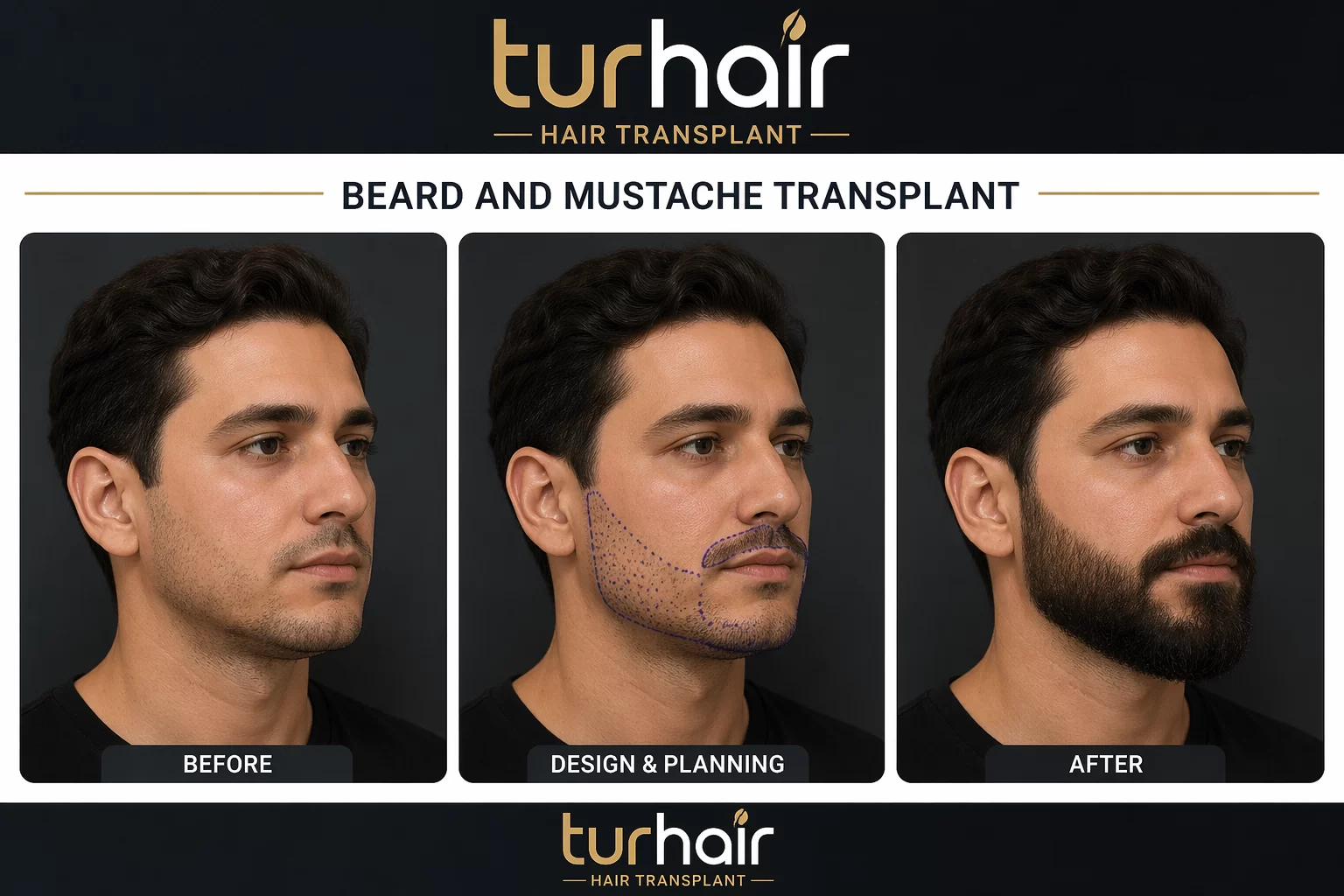
Real beard and mustache transplant results – natural density and design by Turhair
Beard Transplant Results
Results are permanent and natural. The timeline typically looks like this:
- First 2–3 weeks: Transplanted hairs shed (normal phase)
- 3–4 months: New hair growth begins
- 6–9 months: Visible density improvement
- 12 months: Full results achieved
Once fully grown, you can shave, trim, and style your beard as you wish.
Beard Transplant Cost (2026)
The cost varies significantly depending on location:
| Location | Average Cost |
|---|---|
| USA / UK | $5,000 – $15,000 |
| Europe | €4,000 – €10,000 |
| Turkey | €1,500 – €3,500 |
Turkey offers world-class quality at significantly lower prices due to lower operational costs and high patient volume.
Why Choose Turkey for Beard Transplant?
- Highly experienced surgeons
- Affordable all-inclusive packages
- Advanced medical technology
- VIP services (hotel, transfers, translator)
Many international patients combine their procedure with a comfortable medical tourism experience.
👉 Learn more about overall costs here:
Hair Transplant Turkey Cost 2026
👉 Detailed pricing guide:
How Much Does a Hair Transplant Cost in Turkey
Does It Look Natural?
Yes—when performed correctly, a beard transplant is virtually indistinguishable from natural facial hair. The key factor is the angle and direction of implantation.
This is why choosing a clinic where the doctor performs the channel opening is crucial.
Recovery and Aftercare
- Redness and small scabs disappear within 7–10 days
- Avoid shaving for 2 weeks
- Follow post-op washing instructions carefully
- Avoid heavy exercise for 5–7 days
After the healing phase, your beard will start growing naturally.
Risks and Considerations
Although beard transplant is generally safe, choosing an inexperienced clinic may lead to:
- Unnatural hair direction
- Low density
- Poor design
Always choose a clinic with proven experience and real patient results.
Beard Transplant vs Natural Growth
| Factor | Natural Beard | Transplant |
|---|---|---|
| Density | Genetic | Controlled |
| Shape | Unpredictable | Custom Design |
| Permanence | Natural | Permanent |
Final Thoughts
A beard and mustache transplant is one of the most effective solutions for achieving a full and well-defined facial hair appearance. With modern techniques like FUE, the results are natural, permanent, and life-changing.
If performed by an experienced doctor, especially in leading destinations like Turkey, the procedure offers high quality at an affordable price.
How Many Grafts Are Needed for a Beard and Mustache Transplant?
The number of grafts required for a beard and mustache transplant depends on the desired density, facial structure, and current hair coverage. Each graft typically contains 1–3 hair follicles, and precise planning is essential for achieving a natural appearance.
- Light beard fill: 1,000 – 1,500 grafts
- Moderate density: 1,500 – 2,500 grafts
- Full beard transplant: 2,500 – 4,000+ grafts
- Mustache only: 300 – 800 grafts
The most important factor is not just the number of grafts, but how they are distributed. Strategic placement ensures a realistic density without overharvesting the donor area.
Beard Design: Why It Matters More Than You Think
One of the biggest mistakes in beard transplantation is focusing only on density instead of design. A natural beard follows specific growth patterns, including:
- Directional flow of hair (downward, sideways, or angled)
- Gradual density transitions (cheeks vs jawline)
- Symmetry aligned with facial proportions
A professional doctor will create a beard that complements your face shape rather than simply filling empty areas. This is what separates average results from premium outcomes.
FUE vs DHI for Beard Transplant
Two main techniques are used in facial hair transplantation:
| Technique | Advantages | Best For |
|---|---|---|
| FUE | High graft survival, natural results | Full beard restoration |
| DHI | Direct implantation, precise control | Smaller areas like mustache |
Most clinics prefer FUE for beard transplants because it allows better control over angle and direction—critical for natural-looking facial hair.
Beard Transplant Before and After Expectations
Understanding realistic expectations is essential before undergoing the procedure:
- Initial redness and scabbing are completely normal
- Shock shedding occurs in the first few weeks
- Final density takes up to 12 months
Unlike scalp hair, beard hair is more visible and requires precise placement, so patience during the growth phase is key.
Common Mistakes to Avoid
Choosing the wrong clinic can lead to disappointing results. Here are the most common mistakes:
- Going for the cheapest option instead of quality
- Ignoring doctor involvement in the procedure
- Not reviewing real patient results
- Overharvesting the donor area
Always prioritize experience and medical expertise over price alone.
Is Beard Transplant Permanent?
Yes, a beard transplant is permanent. The transplanted hair follicles are taken from areas genetically resistant to hair loss, meaning they will continue to grow for a lifetime.
Once fully healed, the transplanted beard behaves exactly like natural facial hair—you can shave, trim, or style it without limitations.
Does Beard Transplant Leave Scars?
Modern FUE techniques are minimally invasive and do not leave visible scars. Tiny extraction points heal quickly and become virtually undetectable.
This makes the procedure ideal for individuals who prefer short hairstyles.
Beard Transplant for Scars and Patchy Areas
One of the most powerful benefits of beard transplantation is its ability to cover scars. Whether caused by:
- Acne scars
- Burns
- Injuries
- Surgical marks
Transplanted hair can effectively camouflage these areas, restoring confidence and a natural appearance.
Turkey vs Europe for Beard Transplant
Turkey has become the leading destination for beard transplantation, offering a strong combination of quality and affordability.
| Factor | Turkey | Europe |
|---|---|---|
| Price | Affordable | High |
| Experience | Very High | Moderate |
| Packages | All-inclusive | Limited |
Many patients prefer Turkey not only for cost advantages but also for the high number of procedures performed annually.
Aftercare Tips for Best Results
Following proper aftercare is crucial for achieving optimal results:
- Avoid touching or scratching the transplanted area
- Use recommended shampoos and lotions
- Stay away from smoking and alcohol temporarily
- Follow your clinic’s instructions strictly
Good aftercare significantly improves graft survival and final density.
Psychological Benefits of Beard Transplant
A beard is often associated with masculinity, maturity, and confidence. For many men, achieving a full beard can have a significant psychological impact:
- Improved self-confidence
- Better facial symmetry
- Enhanced personal image
This is why beard transplantation is not just a cosmetic procedure—it’s also a confidence transformation.
Combining Beard Transplant with Hair Transplant
Some patients choose to combine beard and scalp hair transplantation in one session. This approach can:
- Save time and travel costs
- Provide a complete aesthetic transformation
- Optimize donor area usage
To understand full procedures and pricing, you can explore:
Hair Transplant Turkey Cost Guide
Final Expert Insight
The success of a beard and mustache transplant depends on three key factors:
- Doctor’s experience
- Natural design planning
- Correct angle and direction implantation
When these elements are combined, the results are virtually indistinguishable from natural beard growth.
Choosing the right clinic—especially one that prioritizes doctor-led procedures—makes all the difference in achieving a premium outcome.
Beard Transplant Healing Process: Week-by-Week
Understanding the healing timeline of a beard and mustache transplant helps patients stay confident and patient throughout the process. While results are permanent, the journey requires several stages of healing and regrowth.
Days 1–3
Immediately after the procedure, mild redness, swelling, and tiny scabs appear in both donor and recipient areas. This is completely normal and part of the natural healing process.
Days 4–10
Scabs begin to fall off gradually. Patients are advised to follow a gentle washing routine as instructed by the clinic.
Weeks 2–4
This phase is known as shock loss, where transplanted hairs shed. It may look like the procedure didn’t work, but this is a temporary and expected stage.
Months 3–4
New hair growth begins. The hairs may initially appear thin or soft, but they will gradually thicken over time.
Months 6–9
Significant density improvement becomes visible. The beard starts to take its final shape.
Month 12+
Full results are achieved, with thick, natural, and fully functional facial hair.
Can You Shave After a Beard Transplant?
Yes, but timing is crucial. Most doctors recommend waiting at least 10–14 days before shaving the transplanted area. After this period, you can gradually resume trimming and shaving.
Once the healing process is complete, the transplanted beard can be shaved, styled, and groomed just like natural facial hair.
Beard Density: What Is Considered Natural?
A natural beard does not have uniform density across the entire face. Instead, it follows specific patterns:
- Higher density along the jawline
- Softer and lighter density on the cheeks
- Defined but not overly dense mustache area
Experienced doctors replicate these patterns to avoid an artificial or “pluggy” appearance.
Does Age Matter for Beard Transplant?
Age can play a role in beard transplantation, but it is not a strict limitation. Ideal candidates are typically:
- Over 21 years old
- Have stable hair growth patterns
- Possess a healthy donor area
Younger patients may still experience natural beard development, so doctors often recommend waiting until growth stabilizes.
Beard Transplant for Different Face Shapes
A customized beard design enhances facial aesthetics. Here’s how beard styles can complement different face shapes:
| Face Shape | Recommended Beard Style |
|---|---|
| Round | Longer beard to elongate the face |
| Square | Soft edges to balance strong jawline |
| Oval | Most styles work well |
| Thin/Long | Fuller sides to add width |
This level of personalization is what defines high-quality beard transplant results.
How to Choose the Right Clinic
Selecting the right clinic is the most important decision in your beard transplant journey. Consider the following factors:
- Doctor’s direct involvement in the procedure
- Before & after results of real patients
- Transparent pricing and consultation
- Clear communication and aftercare support
Clinics that prioritize quality over volume typically deliver the most natural and satisfying outcomes.
Medical Tourism Experience in Turkey
One of the biggest advantages of choosing Turkey is the complete medical tourism experience. Many clinics offer all-inclusive packages that include:
- Airport VIP transfers
- 4–5 star hotel accommodation
- Translator services
- Post-operation care kits
This makes the entire process seamless and stress-free for international patients.
👉 For a detailed breakdown of costs and packages:
Hair Transplant Cost in Turkey
Beard Transplant vs Beard Growth Products
Many people compare beard transplant with products like oils, serums, or medications. Here’s the reality:
| Method | Effectiveness | Permanence |
|---|---|---|
| Beard Oils | Low | No |
| Minoxidil | Moderate | Temporary |
| Transplant | High | Permanent |
While products may help slightly, only transplantation provides a guaranteed and permanent solution.
Does Beard Transplant Hurt?
The procedure is performed under local anesthesia, meaning patients feel minimal discomfort. During the operation, you may feel slight pressure, but no significant pain.
After the procedure, mild soreness or sensitivity can occur, but it usually subsides within a few days.
How Long Does the Procedure Take?
A typical beard transplant session lasts between 4 to 8 hours, depending on the number of grafts required. Larger sessions may take a full day, but patients can usually return to their hotel the same day.
Long-Term Maintenance
Once the beard has fully grown, maintenance is simple:
- Regular trimming and grooming
- Healthy skincare routine
- No special medical treatments required
The transplanted hair continues to grow naturally for life.
Is It Worth It?
For many men, the answer is yes. A beard and mustache transplant offers:
- Permanent results
- Natural appearance
- Improved confidence
- Customizable style
Compared to temporary solutions, it provides long-term value and satisfaction.
Final Conclusion
A beard transplant is more than just a cosmetic enhancement—it’s a long-term investment in your appearance and confidence. With advanced techniques, experienced doctors, and affordable options in Turkey, achieving a full and natural beard is now more accessible than ever.
If you are considering this procedure, make sure to choose a reputable clinic and focus on quality results rather than short-term savings.
Advanced Beard Transplant Techniques (2026 Trends)
The field of beard and mustache transplant continues to evolve with new technologies and refined surgical methods. In 2026, clinics are focusing more on precision, naturalness, and patient comfort than ever before.
Some of the latest advancements include:
- Sapphire blades: Allow for smaller, more precise incisions
- Micromotor extraction: Minimizes trauma to donor follicles
- High-density implantation: Achieves fuller results in fewer sessions
- Customized angle mapping: Replicates natural beard growth patterns
These innovations significantly improve graft survival rates and overall aesthetic outcomes.
Single Session vs Multiple Sessions
Most beard transplants are completed in a single session. However, in cases where very high density is desired, a second session may be recommended.
| Approach | Advantages | Best For |
|---|---|---|
| Single Session | Faster results, lower cost | Moderate density goals |
| Multiple Sessions | Maximum density, refined results | Full thick beard transformation |
Your doctor will recommend the best approach based on your expectations and donor capacity.
Donor Area Management
The donor area is one of the most critical aspects of a successful beard transplant. Overharvesting can lead to visible thinning, while underutilization may limit results.
Key principles include:
- Balanced extraction across the donor area
- Preserving natural density
- Avoiding over-extraction in one zone
A skilled surgeon ensures that the donor area remains natural and undetectable after healing.
Beard Line Customization
The beard line is what defines the overall look of the face. A well-designed beard line enhances masculinity and facial harmony.
Customization factors include:
- Face symmetry
- Jawline structure
- Personal style preference
Natural beard lines are slightly irregular—not perfectly straight—which adds realism to the final result.
Beard Transplant for Ethnic Hair Types
Hair characteristics vary across different ethnicities, and beard transplantation must be adapted accordingly:
- Straight hair: Easier to implant, requires careful angle control
- Wavy hair: Offers natural volume and density
- Curly hair: Requires advanced expertise due to follicle curvature
Clinics experienced with diverse hair types achieve significantly better outcomes.
How Lifestyle Affects Results
Your lifestyle choices can directly impact the success of your beard transplant. For optimal results:
- Avoid smoking during the healing phase
- Maintain a healthy diet rich in vitamins
- Stay hydrated
- Follow post-op care strictly
Healthy habits support faster healing and stronger hair growth.
Beard Transplant for Professional Image
In many industries, appearance plays a role in personal branding. A well-defined beard can:
- Enhance a professional image
- Create a more mature appearance
- Improve overall facial balance
This is one reason why beard transplants are increasingly popular among professionals and entrepreneurs.
Cost vs Value: What Are You Really Paying For?
When evaluating the cost of a beard transplant, it’s important to understand what influences pricing:
- Doctor’s expertise
- Clinic reputation
- Technology used
- Number of grafts
Lower prices may seem attractive, but they often compromise quality. Investing in an experienced clinic ensures better long-term results.
👉 Explore detailed pricing here:
Hair Transplant Turkey Cost 2026
How to Prepare Before the Procedure
Preparation plays a key role in achieving successful results. Before your procedure:
- Avoid alcohol and smoking for at least 3 days
- Stop blood-thinning medications if advised
- Get a good night’s sleep
- Wear comfortable clothing
Proper preparation helps reduce complications and improves overall experience.
Beard Transplant Myths vs Facts
| Myth | Reality |
|---|---|
| Results look fake | Natural when done correctly |
| Painful procedure | Minimal discomfort |
| Temporary solution | Permanent results |
| Leaves scars | No visible scars with FUE |
Understanding the truth helps patients make informed decisions.
Global Demand for Beard Transplant
The demand for beard transplantation has increased rapidly worldwide. Social trends, fashion, and media influence have made beards a symbol of style and masculinity.
Countries like Turkey have become leading hubs due to their combination of affordability and expertise.
Combining Aesthetic Procedures
Some patients combine beard transplant with other procedures such as:
- Hair transplant
- PRP therapy
- Skin treatments
This approach provides a complete facial transformation and maximizes overall aesthetic results.
Travel Tips for International Patients
If you are traveling for a beard transplant, consider the following tips:
- Plan at least 2–3 days for your stay
- Choose clinics offering full packages
- Follow airline travel guidelines after surgery
Turkey offers a seamless experience for international patients with well-organized medical tourism services.
Final Expert Summary
A beard and mustache transplant is a highly advanced and reliable procedure that delivers permanent and natural results. With the right clinic, proper planning, and expert execution, patients can achieve a fully customized beard that enhances their overall appearance.
As technology continues to improve, beard transplantation will remain one of the most effective solutions for men seeking confidence, style, and long-lasting results.