Hair Transplant Cost in Europe vs Turkey
April 17, 2026
DHI Hair Transplant Cost in Turkey
April 19, 2026Cheap vs Expensive Hair Transplant – What’s the Difference?
If you are researching a cheap vs expensive hair transplant, you are probably asking the most important question before treatment: does a higher price really mean better quality? The answer is more nuanced than most clinics admit. A low price does not always mean poor results, and a high price does not automatically guarantee success. What truly matters is who performs the procedure, which technique is used, how the planning is done, and whether the clinic focuses on natural, safe, and long-term results.
In this guide, we explain the real difference between a cheap and an expensive hair transplant, what affects the price, which risks to avoid, and how to choose the right clinic without overpaying.
Why the Price of a Hair Transplant Varies So Much
The cost of a hair transplant can vary dramatically from one clinic to another. In some countries, a procedure may cost only a few thousand euros, while in others it can reach two or three times more. This difference is not random. Pricing is usually influenced by several important factors:
- The experience and reputation of the doctor
- The number of grafts required
- The hair transplant technique used
- The size and professionalism of the medical team
- The country and clinic operating costs
- Whether the package includes hotel, transfers, medication, or aftercare
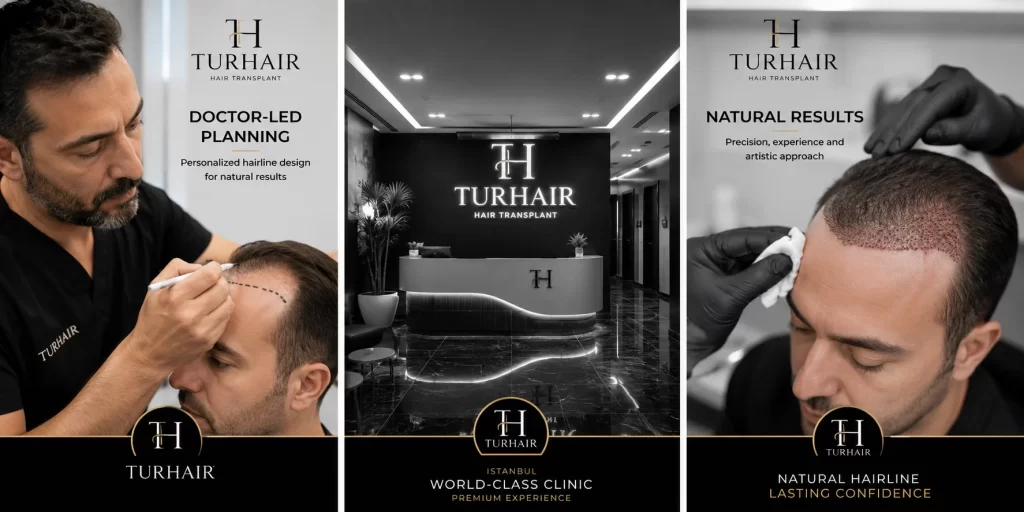
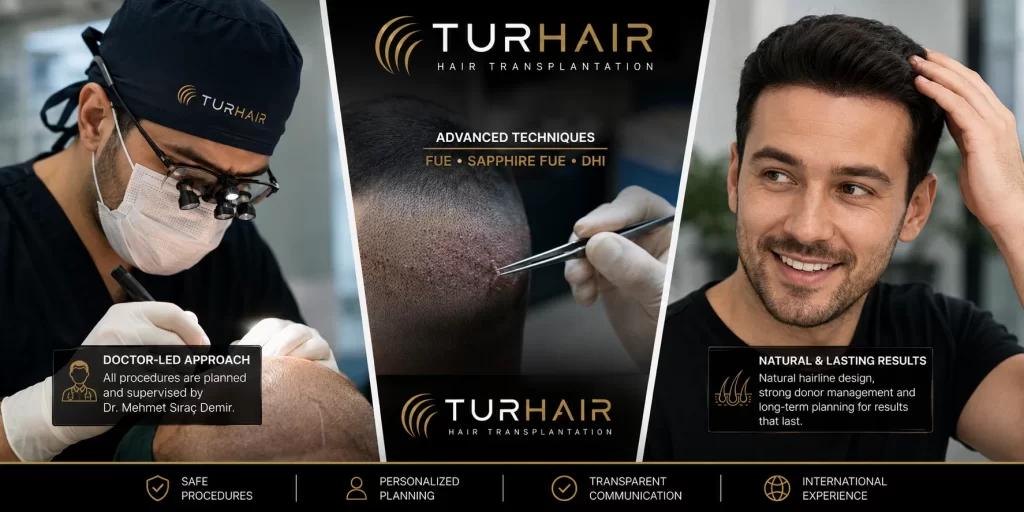
Why TURHAIR Makes the Difference
Premium planning, doctor-focused approach, and natural-looking results.
At TURHAIR, every patient receives an individualized hairline plan based on facial structure, age, and hair loss pattern — not a standard template.
The goal is not just to implant more grafts, but to create balanced, natural density with the right angle, direction, and placement.
TURHAIR gives special importance to protecting the donor area, helping preserve graft quality and future options for the patient.
Instead of a factory-style approach, TURHAIR focuses on careful planning, patient suitability, and long-term aesthetic results.
From consultation to post-operation guidance, patients receive clear information, practical support, and a transparent treatment process.
TURHAIR Difference
Choosing a hair transplant clinic is not only about price. It is about trust, planning, natural design, and protecting your donor area for the future.
That is where TURHAIR stands out.
That is why comparing clinics based only on price can be misleading. To understand the difference between cheap and expensive hair transplant procedures, you must look beyond the number on the quote.
What Is Considered a Cheap Hair Transplant?
A cheap hair transplant is usually a procedure offered at a below-average price compared to the market. These clinics often advertise aggressive discounts, all-inclusive deals, or limited-time offers. For many patients, this can seem attractive, especially when the before-and-after photos look convincing.
However, lower prices may come with trade-offs. In some cases, a cheap procedure means:
- Minimal doctor involvement
- Technicians performing most of the operation
- High daily patient volume
- Less detailed hairline planning
- Faster procedures focused on quantity rather than design
- Limited follow-up care after the operation
This does not mean every affordable clinic is bad. Some clinics in countries like Turkey offer competitive prices because their operating costs are lower, not because the quality is low. That is why patients should not ask only, “How much does it cost?” but also, “What exactly is included in the price?”
What Makes an Expensive Hair Transplant More Costly?
An expensive hair transplant is generally priced higher because of the clinic’s brand, the surgeon’s expertise, the quality of medical planning, and the level of personalized care. In higher-end clinics, the patient often receives:
- Direct consultation and planning by the doctor
- More artistic and customized hairline design
- Stronger focus on donor area protection
- Lower patient volume per day
- Experienced multilingual support staff
- Detailed post-operative monitoring
In some premium clinics, you may also be paying for location, luxury branding, interior design, or strong international marketing. So while a higher fee can reflect better quality, sometimes it also reflects image rather than medical superiority.
TURHAIR vs Other Clinics
See the real difference before you decide
| Feature | TURHAIR | Typical Cheap Clinics | Expensive Clinics |
|---|---|---|---|
| Hairline Design | ✔ Fully Personalized | ✖ Standard Template | ✔ Personalized |
| Doctor Involvement | ✔ High | ✖ Limited | ✔ High |
| Patient Volume | ✔ Controlled | ✖ Very High | ✔ Low |
| Natural Density | ✔ Balanced & Natural | ✖ Over/Under Dense | ✔ Natural |
| Donor Area Protection | ✔ Priority Focus | ✖ Risk of Overharvesting | ✔ Good |
| Aftercare Support | ✔ Continuous | ✖ Limited | ✔ Strong |
| Price vs Value | ★ Best Balance | Low Price / High Risk | High Price / Brand Cost |
The right choice is not the cheapest or the most expensive — it is the clinic that delivers consistent, natural, and safe results.
Cheap vs Expensive Hair Transplant: The Real Differences
When patients compare cheap and expensive options, the real difference usually comes down to quality control, medical involvement, and long-term naturalness. Here are the most important distinctions.
1. Doctor Involvement
One of the biggest differences is who actually performs the critical stages of the procedure. In higher-quality clinics, the doctor is more involved in planning, channel opening, and supervision. In very low-cost clinics, the doctor may only appear briefly while technicians handle most of the operation.
2. Hairline Design
A natural hairline requires artistic judgment, not just technical extraction and implantation. Cheap clinics sometimes use generic hairline designs that may look too straight, too dense in the front, or unnatural over time. More premium clinics usually spend more time designing a hairline that matches the patient’s facial structure, age, and future hair loss pattern.
3. Donor Area Management
The donor area is limited and precious. Poor planning can overharvest it, leaving visible thinning or making future procedures difficult. A better clinic focuses not just on the current session, but on preserving donor capacity for the future.
4. Hygiene and Safety Standards
In reputable clinics, sterilization, patient screening, and medical safety protocols are tightly controlled. Extremely cheap clinics may cut corners in staffing, time allocation, or equipment standards, increasing risk.
5. Aftercare and Communication
Expensive clinics often provide more structured aftercare, with regular check-ins, washing instructions, healing guidance, and access to support teams. Lower-cost clinics may provide basic instructions and limited communication once the patient leaves.
When comparing cheap vs expensive hair transplant options, it is important to evaluate not only the price but also the long-term outcome. Many patients focus on cost alone, but factors such as graft quality, surgeon experience, and aftercare play a crucial role in success. If you want to understand how pricing is structured, check our detailed guide on
3000 grafts hair transplant cost.
Choosing the right technique is equally important.
hair transplant in Turkey cost . However, cheap clinics often compromise on technique and planning.
If you are still unsure, you can explore our complete guide on
hair transplant in Turkey to understand why quality clinics offer better long-term value instead of short-term savings.
Does Expensive Always Mean Better?
No. This is one of the biggest misconceptions in the industry. A high price does not automatically mean better medical results. Some expensive clinics charge more because they are located in costly cities or invest heavily in luxury branding. On the other hand, some affordable clinics deliver excellent results because they operate efficiently and treat many international patients.
The smarter approach is to look for value, not just low price or high price. The best clinic is often the one that offers the strongest balance between medical quality, transparency, experience, and reasonable cost.
What Are the Risks of Choosing the Cheapest Option?
Choosing a clinic only because it is the cheapest can be risky. A bad hair transplant can be more costly in the long run because repair procedures are more difficult, more expensive, and sometimes limited by donor damage. Common risks include:
- Unnatural hairline
- Patchy density
- Scarring or donor depletion
- Poor graft survival
- Infection or slow healing
- Need for corrective surgery
This is why patients should always evaluate a clinic’s medical standards, not only the advertised package price.
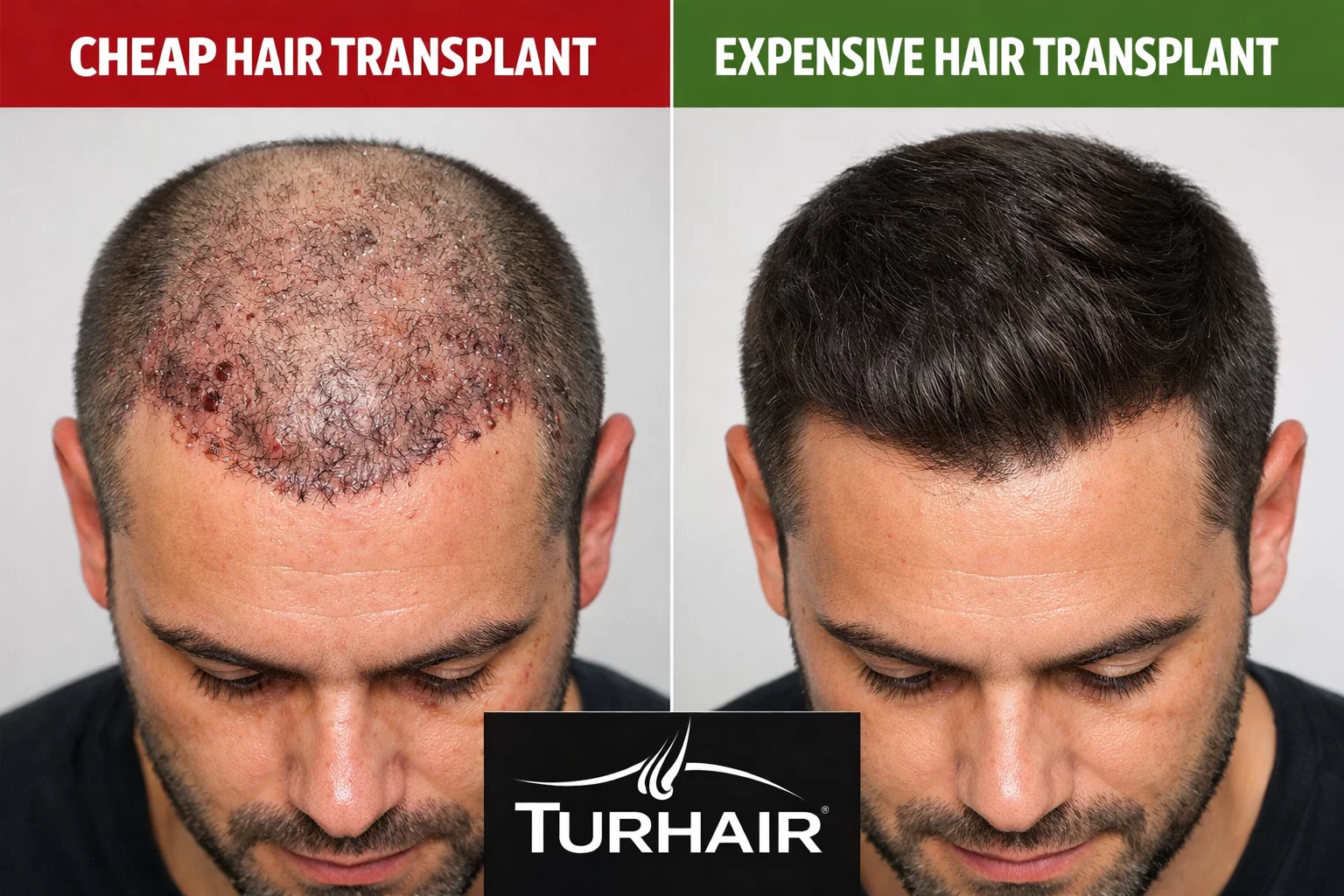
Comparison between cheap and expensive hair transplant results highlighting quality, density, and natural hairline differences by TURHAIR.
How to Judge Value Instead of Price Alone
If you want the best outcome, ask the right questions before booking. A good clinic should clearly explain:
- Who performs each stage of the procedure
- Which technique is recommended and why
- How many grafts are realistically needed
- What the donor area can safely provide
- What is included in the package
- How aftercare works after you return home
You should also review real before-and-after results, look for consistent natural hairlines, and check whether results look good under different lighting and angles. A clinic that is transparent about these details is often a safer choice than one focusing only on discounts.
Cheap vs Expensive Hair Transplant in Turkey
Turkey is one of the best examples of why low price does not always mean low quality. Many patients compare Turkey with the UK, Western Europe, or the US and are surprised to see large price differences. The main reason is lower operational costs and a highly competitive medical tourism market, not necessarily lower expertise.
That said, Turkey also has a wide range of clinics. Some provide outstanding quality and doctor-led planning, while others operate like high-volume factories. So even in a more affordable country, the difference between cheap and expensive still matters.
Final Thoughts: Which One Should You Choose?
When comparing a cheap vs expensive hair transplant, the goal should not be to find the lowest price or the highest price. The goal should be to find the clinic that offers the best medical judgment, natural design, donor protection, and long-term value.
A cheap clinic can be a smart option if it is reputable, experienced, and transparent. An expensive clinic can be worth it if the added cost reflects true doctor expertise and personalized care. But in both cases, the decision should be based on quality, safety, and proven results.
Hair transplantation is not just a cosmetic purchase. It is a long-term medical and aesthetic investment. Choosing carefully now can protect both your appearance and your donor area for years to come.
Long-Term Cost: Cheap vs Expensive Hair Transplant
One of the biggest mistakes patients make when comparing a cheap vs expensive hair transplant is focusing only on the upfront price. In reality, the true cost of a hair transplant is measured over years—not days.
A cheap procedure may seem like a great deal initially, but if the results are poor, the long-term consequences can be significantly more expensive both financially and emotionally.
Cheap Hair Transplant: The Hidden Long-Term Costs
Low-cost clinics often focus on volume and speed rather than precision and planning. While this reduces the initial price, it increases the likelihood of complications or unsatisfactory results.
- Low graft survival rates (sometimes as low as 60–70%) :contentReference[oaicite:0]{index=0}
- Unnatural hairline design
- Patchy or uneven density
- Donor area overharvesting
- Need for corrective surgery
Corrective procedures are usually more complex and more expensive than the original transplant. In many cases, the donor area is already damaged, limiting what can be fixed. :contentReference[oaicite:1]{index=1}
This means a patient who initially chose a “cheap” option may end up paying 2–3 times more over time.
Expensive Hair Transplant: Paying More, Once
Higher-priced clinics typically invest more in planning, technique, and execution. This often leads to better graft survival, more natural results, and fewer complications.
- Higher graft survival rates (often 90%+) :contentReference[oaicite:2]{index=2}
- Better long-term density and coverage
- Stronger donor area protection
- Lower need for repair procedures
While the upfront cost is higher, many patients only need one procedure when it is done correctly the first time.
Technique Matters More Than Price
Another critical difference in the cheap vs expensive hair transplant debate is the technique used. Common methods include:
- FUE (Follicular Unit Extraction)
- DHI (Direct Hair Implantation)
- FUT (Strip Method)
The technique itself is not inherently “cheap” or “expensive.” What matters is how well it is performed. Even the best technique can produce poor results if handled by inexperienced staff.
Price differences often reflect:
- Time spent per graft
- Precision of implantation
- Use of advanced tools and equipment
- Doctor vs technician involvement
Clinic Volume: Factory vs Boutique Clinics
A major but often overlooked factor is how many patients a clinic treats per day.
Low-Cost Clinics (High Volume)
- Multiple patients per day
- Assembly-line approach
- Less time per patient
- Standardized hairlines
Higher-End Clinics (Low Volume)
- One or few patients per day
- Personalized approach
- Detailed planning
- Higher attention to detail
Clinics that handle many patients daily often reduce costs by delegating work to technicians and minimizing consultation time. :contentReference[oaicite:3]{index=3}
Psychological and Aesthetic Impact
A hair transplant is not just a medical procedure—it directly affects your appearance, confidence, and self-image.
A poorly done transplant can lead to:
- Constant need to hide results (hats, styling, fibers)
- Reduced confidence in social or professional settings
- Stress and dissatisfaction
Some patients with bad results choose not to repair them due to cost or donor limitations, living with the outcome long-term. :contentReference[oaicite:4]{index=4}
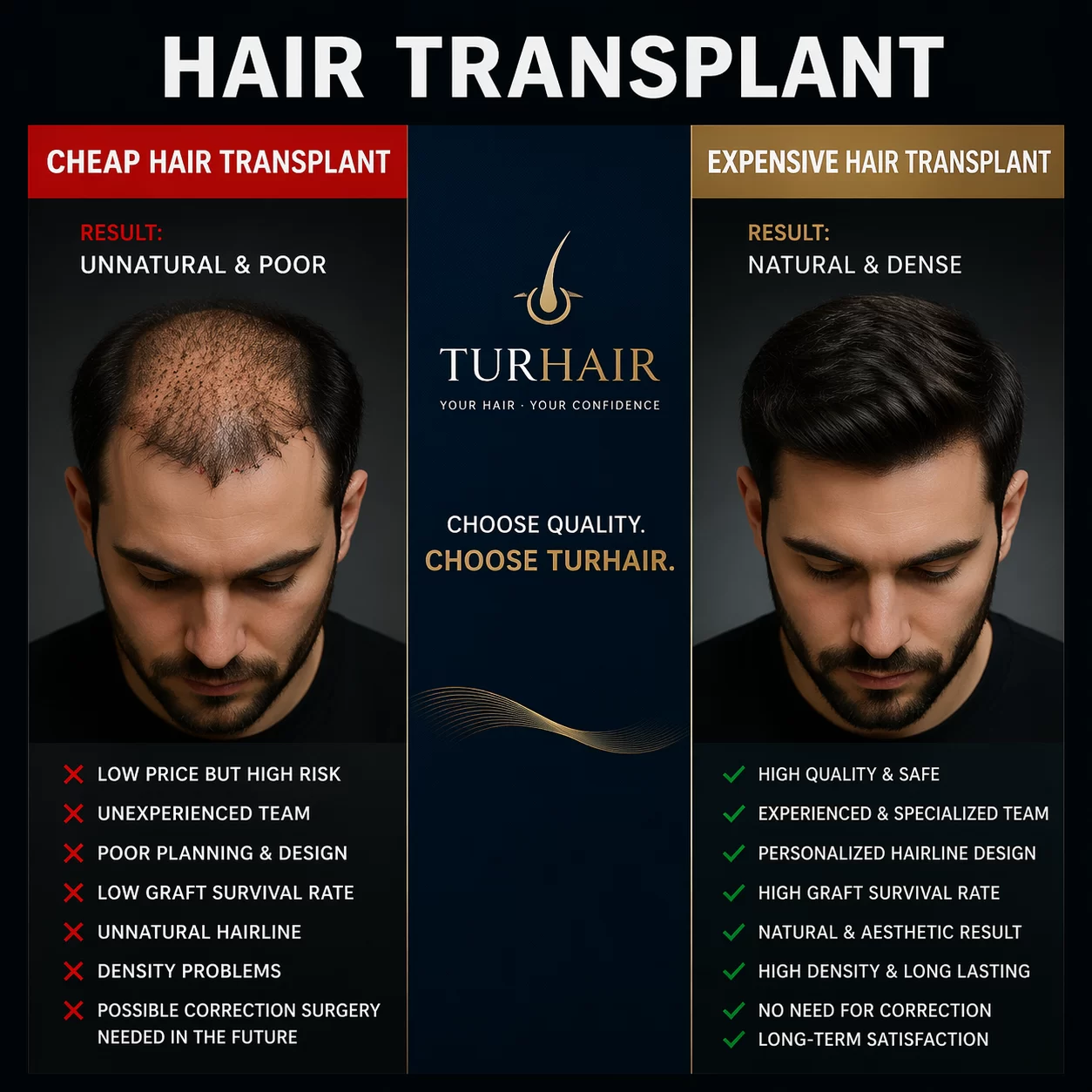
Comparison of cheap vs expensive hair transplant results highlighting risks, quality, and long-term outcomes with TURHAIR
Regulation and Safety Differences
Another key difference between cheap and expensive hair transplants is regulation.
In higher-cost clinics or countries:
- Strict medical regulations
- Certified surgeons perform critical steps
- Better sterilization protocols
In very low-cost environments, there is a higher risk that:
- Unqualified personnel perform surgery
- Safety standards are inconsistent
- Hygiene protocols are weaker
This increases risks such as infection, scarring, or failed grafts. :contentReference[oaicite:5]{index=5}
Cheap vs Expensive Hair Transplant: Summary Table
| Factor | Cheap Hair Transplant | Expensive Hair Transplant |
|---|---|---|
| Price | Low upfront cost | Higher upfront cost |
| Doctor Involvement | Limited | High |
| Hairline Design | Standardized | Personalized |
| Graft Survival | Lower | Higher |
| Risk Level | Higher | Lower |
| Aftercare | Limited | Comprehensive |
| Long-Term Cost | Potentially higher (repairs) | Usually lower (done once) |
Final Verdict: Price vs Value
The real comparison is not cheap vs expensive—it is cheap vs value.
A low-cost clinic can be a smart choice if it maintains high medical standards, experienced staff, and transparent processes. However, extremely cheap offers should always be approached with caution.
On the other hand, an expensive clinic is worth it only if the higher price reflects genuine expertise, careful planning, and consistent natural results—not just branding or luxury marketing.
The best strategy: choose a clinic that balances price, quality, doctor involvement, and proven results. Because with hair transplantation, you are not just buying hair—you are protecting a limited resource that cannot be replaced.
How to Choose the Right Clinic: A Practical Decision Framework
When comparing a cheap vs expensive hair transplant, many patients feel overwhelmed by marketing, price ranges, and promises. Instead of guessing, you can use a structured decision framework to evaluate clinics objectively and avoid costly mistakes.
Step 1: Verify Who Performs the Critical Steps
Ask directly: Who designs the hairline? Who opens the channels? Who implants the grafts?
- Doctor-led planning and channel opening = higher precision
- Technician-only execution = higher variability
A transparent clinic will clearly explain roles and not avoid this question.
Step 2: Assess Real Results (Not Just Marketing)
Look for:
- Consistent hairlines across different patients
- Close-up photos (not only styled or wet hair)
- 12–18 month results (not only early growth)
- Videos under natural lighting
Avoid clinics that only show perfect angles or identical “template” hairlines.
Step 3: Understand Graft Planning
Serious clinics provide a realistic graft estimate and explain:
- How many grafts are needed now
- What remains in the donor for the future
- How density will be distributed
Overpromising very high graft numbers at a low price is a red flag for overharvesting.
Step 4: Evaluate Communication and Aftercare
Before booking, test responsiveness:
- Do they answer detailed questions?
- Do they provide clear post-op instructions?
- Is there follow-up after you return home?
Good aftercare directly impacts healing and final results.
Red Flags in Cheap Hair Transplant Offers
Not all affordable clinics are risky, but certain warning signs are common in very low-cost offers:
- “Unlimited grafts” packages with no medical evaluation
- No clear information about the doctor
- Very high patient volume per day
- Identical hairlines in all results
- Heavy discounts or pressure to book quickly
- No discussion of donor limits or long-term planning
These signs often indicate a production-focused clinic rather than a patient-focused one.
What Actually Drives Natural Results?
Whether a clinic is cheap or expensive, the final outcome depends on a few key technical and artistic factors:
1. Angle and Direction of Grafts
Hair must be implanted following natural growth patterns. Incorrect angles can make hair look unnatural regardless of density.
2. Density Distribution
Natural-looking density is created by strategic placement—not maximum graft count in one area.
3. Hairline Irregularity
A natural hairline is never perfectly straight. Micro-irregularities create realism.
4. Donor Extraction Pattern
Even spacing in extraction prevents visible thinning in the donor area.
These elements require time, experience, and attention—factors that often explain price differences.
Travel Costs vs Clinic Costs
Many patients compare local expensive clinics with cheaper options abroad. But the total cost should include:
- Procedure price
- Flights
- Hotel and transfers
- Medication and aftercare products
- Time off work
In many cases, countries like Turkey still offer a lower total cost even after travel expenses. However, the same rule applies: choose based on quality, not just price advantage.
Is Financing or Paying More Worth It?
Some patients consider financing a more expensive clinic instead of choosing a cheaper option. This decision depends on risk tolerance and expectations.
Paying more may be worth it if:
- The clinic shows consistently natural results
- The doctor is highly involved
- The donor is limited and must be preserved
Choosing a cheaper option may be reasonable if:
- The clinic still meets medical standards
- Results are proven and consistent
- The procedure is minor (e.g., small hairline correction)
Repair Cases: The Biggest Cost Difference
The strongest argument in the cheap vs expensive hair transplant discussion is repair work. Fixing a bad transplant is significantly more difficult than doing it right the first time.
Repair challenges include:
- Limited donor supply
- Scar tissue affecting graft survival
- Need to remove or camouflage old grafts
- Multiple sessions required
Repair procedures can cost more than the original transplant and may not fully restore a natural appearance.
Timeline Expectations: Cheap vs Expensive Clinics
The biological timeline is the same regardless of price, but execution affects the final quality.
- 0–2 weeks: Healing and scab formation
- 2–8 weeks: Shock loss (temporary shedding)
- 3–6 months: Early regrowth
- 6–12 months: Visible improvement
- 12–18 months: Final result
Higher-quality work often results in more uniform growth and better density at the end of this timeline.
Final Insight: The True Difference
The difference between a cheap and an expensive hair transplant is not just price—it is precision, planning, and predictability.
Cheap clinics often optimize for speed and volume. Expensive clinics often optimize for detail and control. The ideal choice is a clinic that balances both: efficient but careful, affordable but not rushed.
Key takeaway: You only have one donor area. Treat it as a limited resource. The right decision is the one that protects it while delivering natural, long-term results.
Hair Transplant Pricing Breakdown: What Are You Really Paying For?
When comparing a cheap vs expensive hair transplant, many patients only see the final number. However, understanding what makes up that price can help you make a far more informed decision.
A hair transplant cost is not just about the procedure itself—it includes multiple layers of medical, operational, and service-related components.
1. Medical Team Expertise
The experience of the surgeon and team is one of the biggest cost drivers. Highly experienced doctors charge more because:
- They have years of specialized training
- They deliver consistent, natural results
- They reduce risk of complications
In cheaper clinics, less experienced teams or technicians may handle most of the procedure.
2. Time Spent Per Patient
Time equals precision. Clinics that spend more time per patient usually achieve better outcomes.
- Cheap clinics: faster procedures, less time per graft
- Expensive clinics: slower, more detailed implantation
3. Equipment and Technology
Advanced tools improve accuracy and graft survival. These include:
- Sapphire blades
- Micromotor extraction devices
- High-quality implanter pens
Better equipment increases cost but can improve outcomes.
4. Clinic Infrastructure
Premium clinics invest more in:
- Sterile operating environments
- Modern facilities
- Trained medical staff
5. Patient Services
Higher-priced packages often include:
- Hotel accommodation
- VIP transfers
- Translation services
- Post-op kits and follow-up care
While these services improve comfort, they do not directly affect medical results—so it’s important to separate comfort value vs medical value.
Marketing vs Reality: Don’t Be Misled
In the hair transplant industry, marketing plays a major role in pricing. Some clinics charge more due to strong branding rather than better medical outcomes.
Be cautious of:
- Influencer promotions without long-term results
- Before-after photos with styling tricks
- “Celebrity clinics” with limited doctor involvement
A higher price should reflect better execution—not just better advertising.
Density vs Naturalness: A Critical Difference
Many cheap clinics advertise “maximum density,” but density alone does not guarantee a natural look.
Cheap Clinic Approach
- Focus on high graft numbers
- Dense front line but weak planning
- Possible unnatural appearance over time
High-Quality Clinic Approach
- Balanced density distribution
- Natural hairline transition
- Long-term aesthetic planning
The goal is not maximum density—it is natural density.
Age and Future Hair Loss Planning
One of the biggest differences between cheap and expensive hair transplants is how clinics plan for the future.
Hair loss is progressive. A good clinic considers:
- Your age
- Family history of hair loss
- Future thinning patterns
Cheap clinics may ignore this and place a low, dense hairline that looks unnatural as hair loss progresses. Premium clinics usually design a hairline that will still look natural 10–15 years later.
Scarring and Donor Area Risks
Improper extraction techniques can damage the donor area permanently.
Risks in Low-Cost Clinics
- Overharvesting
- Visible thinning
- Uneven extraction patterns
Better Practices in Quality Clinics
- Even distribution of extractions
- Preservation of donor density
- Planning for future procedures
Once the donor area is damaged, it cannot be fully restored—making this one of the most critical factors.
Transparency: A Key Indicator of Quality
One of the clearest differences between cheap and expensive clinics is transparency.
A trustworthy clinic will:
- Explain limitations honestly
- Avoid unrealistic promises
- Provide detailed planning
- Show both good and average results
Be cautious if a clinic guarantees perfect results or avoids answering technical questions.
Cheap vs Expensive Hair Transplant: Final Comparison Insight
The difference is not simply about money—it’s about risk vs reliability.
- Cheap = lower upfront cost, higher variability
- Expensive = higher upfront cost, more consistency
However, the smartest patients do not choose extremes. They look for clinics that offer:
- Strong medical involvement
- Proven natural results
- Reasonable pricing
- Transparent communication
Final Conclusion
Choosing between a cheap vs expensive hair transplant is ultimately about understanding value, not just cost.
A cheap transplant can be a good decision if the clinic maintains high standards. An expensive transplant can be worth it if it delivers superior planning and execution. But both can fail if the wrong clinic is chosen.
The best investment is not the cheapest or the most expensive—it is the most reliable.
Take your time, ask detailed questions, and evaluate real results. Because in hair transplantation, the quality of your decision today will define your appearance for years to come.
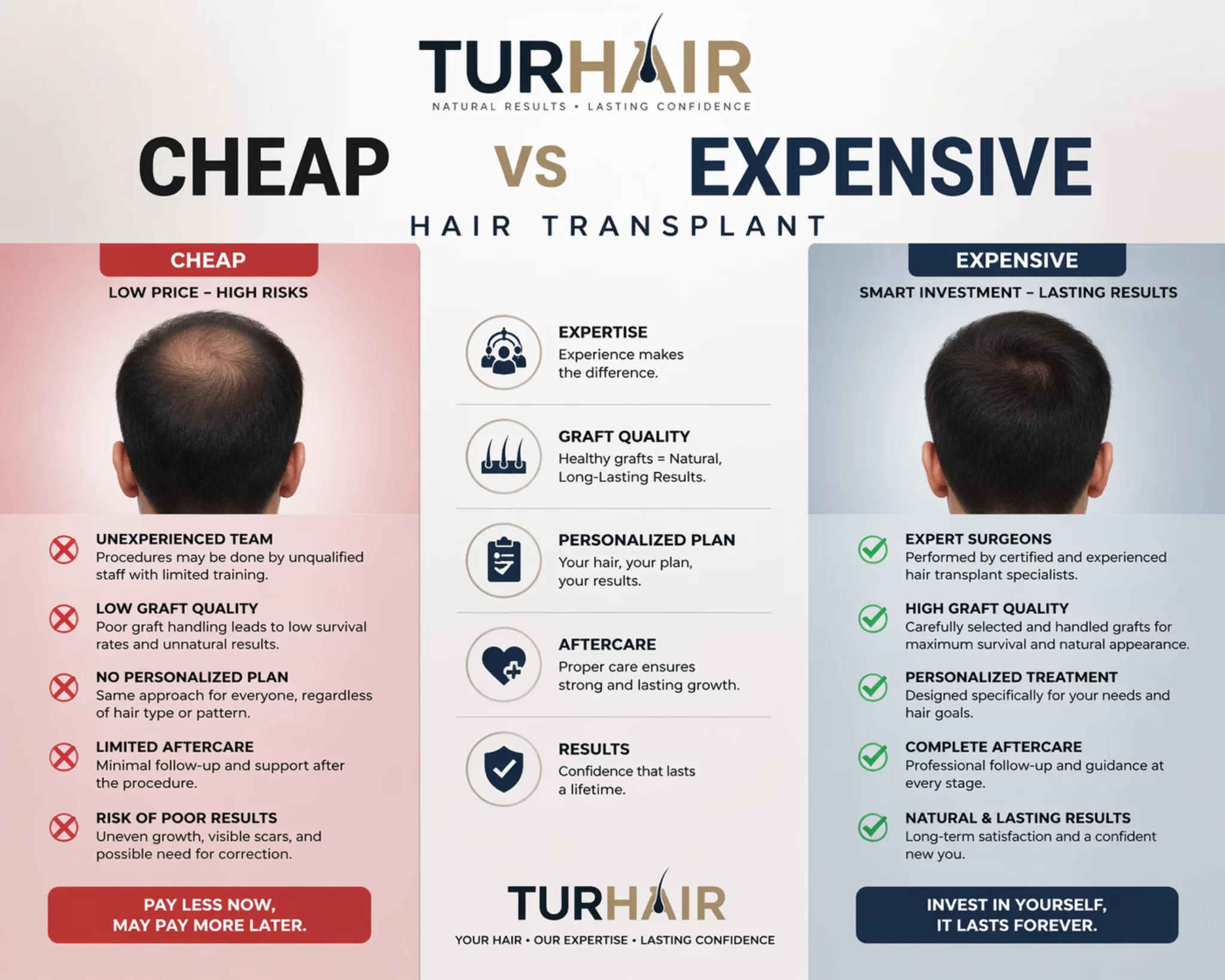
Visual comparison of cheap vs expensive hair transplant procedures highlighting risks, quality, and long-term results
Cheap vs Expensive Hair Transplant: Frequently Asked Questions (FAQ)
Patients comparing a cheap vs expensive hair transplant often have similar concerns. Below are the most common questions answered in a clear and practical way to help you make a confident decision.
Is a cheap hair transplant always risky?
No, not always. A cheap hair transplant can be safe and effective if the clinic maintains proper medical standards, experienced staff, and transparent communication. The risk increases when low prices are combined with high patient volume, limited doctor involvement, and poor planning.
Why are hair transplants cheaper in some countries?
The main reason is lower operational costs such as salaries, rent, and overall expenses. Countries like Turkey can offer competitive pricing without necessarily compromising quality. However, within the same country, quality can vary significantly between clinics.
How do I know if a clinic is worth the price?
Focus on value indicators rather than price alone:
- Doctor involvement in key stages
- Natural-looking results
- Transparent consultation
- Clear explanation of graft planning
- Strong aftercare support
What is the biggest mistake patients make?
The most common mistake is choosing a clinic based only on price or marketing. This often leads to unnatural results or the need for corrective surgery. A hair transplant should be evaluated as a long-term investment, not a short-term deal.
Can a bad hair transplant be fixed?
Yes, but it is more difficult and expensive. Repair procedures depend on the condition of the donor area and the extent of previous damage. In some cases, full correction is not possible, which is why choosing the right clinic initially is critical.
Is it better to wait and save for a better clinic?
In many cases, yes. Waiting and choosing a clinic with proven results and strong medical standards can reduce the risk of poor outcomes and eliminate the need for future repairs.
The debate around cheap vs expensive hair transplant is ultimately about understanding value. Price alone does not define quality. The real difference lies in expertise, planning, execution, and long-term results.
Patients who take the time to research, ask the right questions, and evaluate clinics based on proven outcomes are far more likely to achieve natural, permanent results.
Remember: a hair transplant is not just a procedure—it is a lifelong aesthetic decision. Choosing wisely today can save you from costly corrections tomorrow.