Top 10 Hair Transplant Clinics in Turkey (2026)
October 8, 2026Best Hair Transplant Clinics with Direct Doctor Involvement in Turkey (2027 Guide)
Turkey has become one of the world’s leading destinations for hair transplantation, attracting hundreds of thousands of international patients every year. However, choosing the right clinic has become increasingly difficult, as thousands of facilities now operate throughout the country. Many clinics advertise experienced surgeons, but the level of direct doctor involvement can vary significantly. In numerous high-volume centers, much of the procedure is performed by technicians, while the doctor primarily plays a supervisory role.
If your priorities include a high level of safety, natural hairline design, and planning focused on long-term graft survival, choosing a hair transplant clinic with direct doctor involvement is an important factor to consider.
The quality of the outcome depends on numerous factors, including the experience of the medical team, the patient’s individual characteristics, donor area quality, surgical planning, graft handling, and proper postoperative care. Direct doctor involvement during critical stages also allows for more personalized treatment planning.
Why Does Turkey Have So Many Hair Transplant Clinics with Direct Doctor Involvement?
Turkey has become one of the leading international destinations for hair transplantation, welcoming a large number of patients from abroad every year. Competitive prices are certainly one reason for this popularity, but the country also offers surgeons with specific experience in hair restoration surgery, modern FUE techniques, facilities dedicated to medical tourism, and considerable experience treating international patients.
However, not all Turkish clinics follow the same organizational model. Significant differences exist between facilities where the doctor participates directly in critical stages and high-volume centers where a greater portion of the procedure is delegated to the technical team.
In a clinic with a genuinely doctor-led approach, the main clinical decisions — including patient assessment, donor area analysis, hairline design, planning the number and distribution of grafts, creation of recipient channels, and overall supervision — are made personally by the doctor or under their direct control.
This allows the treatment to be adapted to facial proportions, hair characteristics, donor area capacity, age, individual features, and the potential future progression of hair loss.
In high-volume centers, by contrast, operations may be organized around managing numerous patients simultaneously. Experienced technicians still play an important role within a hair transplant team, but decisions such as hairline positioning, graft distribution, donor area preservation, and recipient channel orientation require careful medical planning.
For this reason, better-informed patients no longer evaluate a clinic solely on price or the maximum number of grafts advertised. Increasing attention is being paid to surgical planning, safety, natural-looking hairlines, and long-term donor area preservation.
A well-planned hair transplant should not be evaluated solely by the number of grafts implanted. The goal is to achieve an aesthetically balanced result that remains compatible with the future progression of hair loss.
Another factor contributing to Turkey’s reputation is the presence of doctors and medical teams who regularly perform hair transplantation procedures. Repeated experience allows them to refine donor area management, graft handling, and the design of hairlines suited to the patient’s age and individual characteristics.
International patients can also benefit from modern facilities, multilingual coordinators, organized packages, and services dedicated to medical tourism.
When comparing clinics, it is useful to look beyond advertising messages. Patients should ask who personally designs the hairline, who creates the recipient channels, how many procedures are performed each day, which stages are carried out by the doctor, and which are performed by the technical team. It is also advisable to evaluate consistently documented before-and-after photographs, reviews from multiple sources, and the surgeon’s professional qualifications.
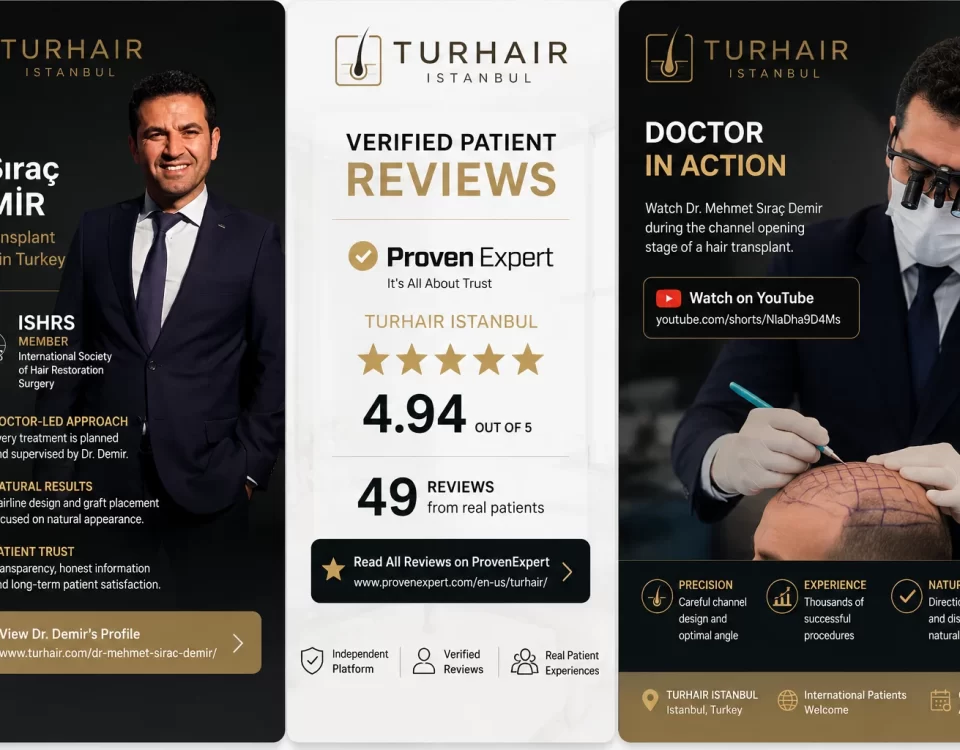
A doctor’s participation in international organizations such as the International Society of Hair Restoration Surgery (ISHRS) can provide additional information about their professional involvement in the field, although membership alone does not guarantee a surgical outcome.
Clinics that limit the number of daily procedures may be able to dedicate more time to the assessment, planning, and supervision of each patient. Nevertheless, the final result remains influenced by many individual variables, including the patient’s biological characteristics and donor area quality.
It is also important to remember that hair transplantation is a permanent medical procedure. Inadequate initial planning can make corrective procedures more complicated, especially when the donor area has already been compromised.
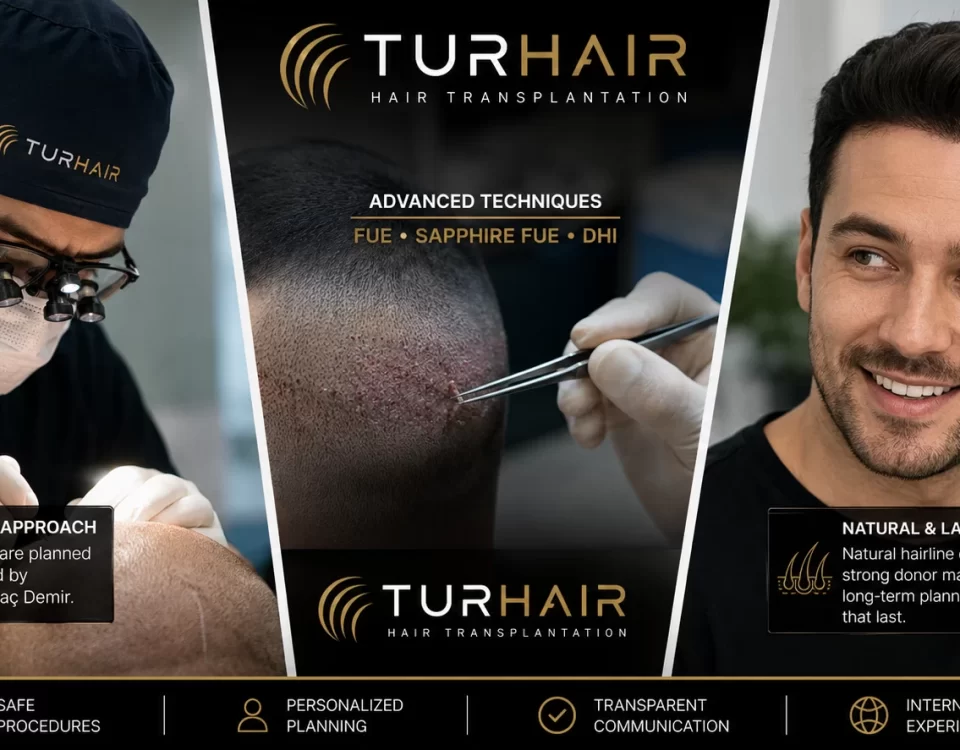
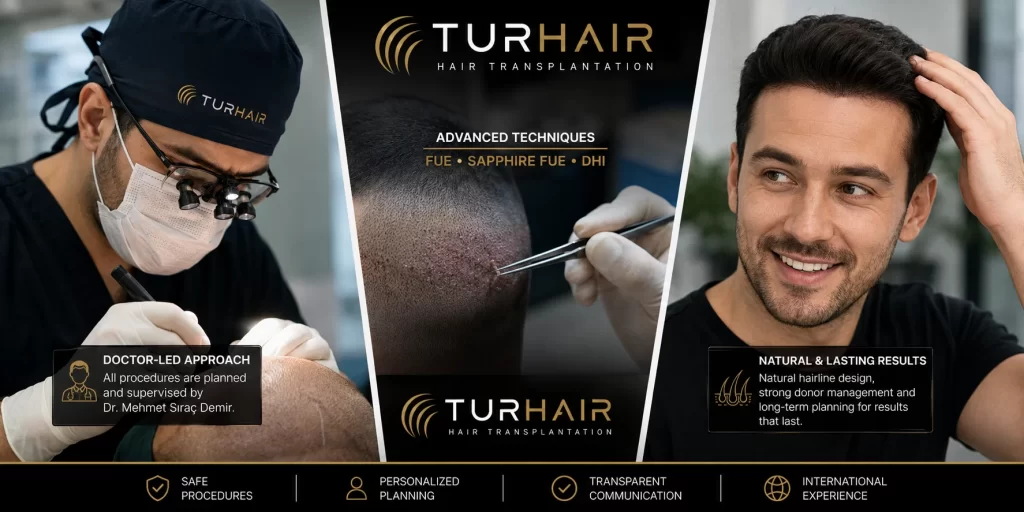
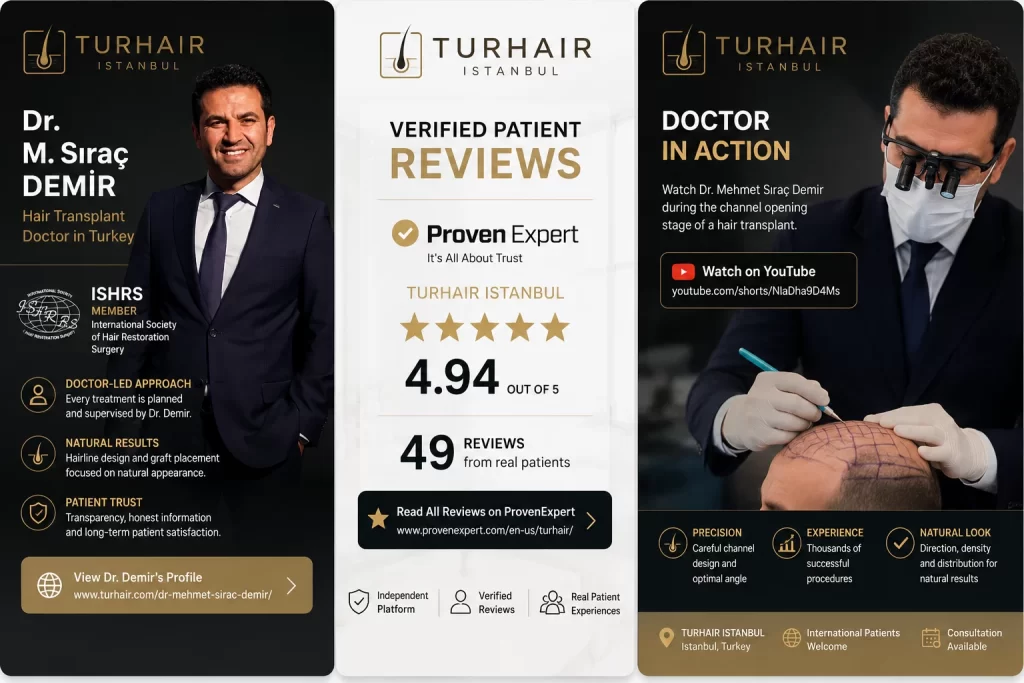
Among Turkish clinics adopting a model with direct doctor involvement, TurHair uses FUE techniques combined with individualized planning under the guidance of Dr. Mehmet Sıraç Demir. The clinic’s philosophy places particular emphasis on conservative donor area management, natural hairline design, and personalized treatment planning.
What Is a Hair Transplant with Direct Doctor Involvement?
A doctor-led approach refers to a model in which the doctor participates directly in the main medical and planning stages, rather than limiting their role to general supervision of the procedure.
In this type of procedure, the doctor may be directly responsible for:
- ✔ Patient consultation
- ✔ Hairline design
- ✔ Donor area planning
- ✔ Supervision of local anesthesia
- ✔ Recipient channel opening or incisions
- ✔ Medical supervision during the procedure
- ✔ Final quality assessment
In some clinics, the doctor may also personally perform graft extraction or implantation, depending on the technique used, the clinic’s organizational model, and the complexity of the case.
Why TurHair Stands Out Among Hair Transplant Clinics with Direct Doctor Involvement in Turkey
TurHair combines direct doctor involvement, personalized surgical planning, a limited number of daily patients, and organized care for international patients.
“Not a Hair Factory. A Doctor-Led Hair Transplant Experience.”
| Comparison Factor | TurHair’s Doctor-Led Approach | Typical High-Volume Clinic |
|---|---|---|
| Medical Consultation | Each patient is assessed based on their hair loss pattern, donor area quality, age, facial proportions, and long-term goals. | The initial assessment may be more standardized and based on preliminary graft estimates and predefined packages. |
| Hairline Design | Dr. Mehmet Sıraç Demir personally plans the hairline, considering facial structure, age, and the potential future progression of hair loss. | Hairline design may be more standardized or delegated to other members of the medical team. |
| Recipient Channel Creation | In the doctor-led package, Dr. Demir personally creates the recipient channels, planning their direction, angle, and density distribution. | In some high-volume models, this stage may be delegated while the doctor maintains a supervisory role. |
| Number of Daily Patients | TurHair limits the number of daily procedures to dedicate more time to planning, medical supervision, and personalized patient care. | Larger facilities may manage multiple patients simultaneously through different medical teams. |
| Donor Area Planning | Graft extraction is planned according to donor density, hair caliber, possible future hair loss progression, and the potential need for additional sessions. | In some commercial models, marketing may place greater emphasis on high graft numbers. |
| Treatment Philosophy | The objective is not simply to transplant as many grafts as possible, but to create a balanced result suited to each patient’s individual characteristics. | Marketing may focus more heavily on concepts such as “maximum grafts,” “unlimited grafts,” or package pricing. |
| Natural Hair Direction | Recipient channels are planned to follow, as closely as possible, the natural growth directions of the frontal area, temples, mid-scalp, and crown. | More standardized planning may offer less personalization of angles and transitions. |
| International Patient Care | Patients may receive assistance with airport transfers, hotel arrangements, interpretation, surgical scheduling, and postoperative care. | The level of assistance may vary depending on the facility, coordinator, and selected package. |
| Hotel Accommodation | Some packages include two nights in a comfortable four- or five-star hotel. | Accommodation may be excluded from the price or offered separately, depending on the clinic. |
| Private Transfers | Transportation between the airport, hotel, and clinic can be organized as part of the patient’s treatment journey. | At some facilities, patients may need to arrange part of their transportation independently or use shared transfers. |
| PRP Support | PRP may be included in certain TurHair packages when specified in the treatment plan. | At other facilities, it may be available as an optional treatment at an additional cost. |
| Postoperative Medications and Products | Postoperative medications, shampoo, foam, and instructions are provided according to the selected package. | Included products and their conditions may vary between clinics. |
| First Hair Wash | The first hair wash and postoperative check-up are organized to show patients how to properly clean and protect the transplanted area. | First-wash assistance may vary according to each facility’s protocol. |
| Follow-Up | TurHair continues to assist patients after they return home through recovery guidance and remote assessments of postoperative progress. | The methods and frequency of follow-up can differ considerably between clinics. |
| Transparency | Patients are informed about the doctor’s involvement, package features, preliminary graft planning, and normal hair growth stages. | It is always important to verify who will be responsible for each stage of the procedure before booking. |
| Patient Experience | The patient journey is organized around comfort, medical guidance, and personalized communication from consultation through recovery. | In centers managing numerous patients simultaneously, the patient journey may be more standardized. |
| Positioning | TurHair is structured for patients seeking direct doctor involvement, a limited number of daily procedures, and an organized hair transplant experience in Istanbul. | Other organizational models may place greater emphasis on volume, standardization, or price; patients should carefully verify the actual features of the services offered. |
What Makes the TurHair Approach Different?
A hair transplant should not be treated as a standardized service. Every patient has a different donor area, hair loss pattern, facial characteristics, and expectations. TurHair combines personalized assessment with direct medical planning and doctor involvement in the stages considered most important to the treatment.
Dr. Mehmet Sıraç Demir evaluates each patient’s needs and develops a plan based on realistically achievable density, natural hair direction, and responsible donor area management. This approach aims to avoid excessively low hairlines, unnecessary extractions, and standardized designs that may not suit the patient’s future hair loss progression.
For international patients who value medical transparency, direct doctor involvement, natural-looking results, and organized medical travel, TurHair is an option worth considering among doctor-led clinics in Turkey.
TurHair Istanbul
Doctor-Led. Patient-Focused. Naturally Personalized.
Choose an approach where treatment is planned around your facial features, donor area capacity, and potential future needs.
Dr. Demir’s Approach to Hair Transplantation in Turkey
A hair transplant requires much more than simply extracting and implanting grafts. It requires medical planning, facial analysis, donor area preservation, proper recipient channel direction, and a personalized long-term strategy.
“The Best Hair Transplant Is Not the One with the Most Grafts. It Is the One That Is Properly Planned.”
| Assessment Area | Dr. Mehmet Sıraç Demir’s Approach | Why It Matters to the Patient |
|---|---|---|
| Doctor-Led Planning | Dr. Demir evaluates the hair loss pattern, donor area capacity, age, facial structure, and long-term goals before defining the surgical plan. | Individualized planning allows the treatment to be adapted to the patient’s anatomy and potential future progression of hair loss. |
| Personalized Hairline | The hairline is designed considering forehead height, facial proportions, age, temple structure, hair characteristics, and possible future thinning. | Personalized design aims to achieve a natural appearance today that remains appropriate as the patient ages. |
| Recipient Channel Creation | In the doctor-led option, Dr. Demir personally creates the recipient channels that influence graft angle, direction, and distribution. | Recipient channel planning helps determine the direction in which transplanted hair will grow. |
| Donor Area Preservation | The graft count is planned according to available density and long-term needs, rather than using the number of grafts simply as a promotional feature. | Responsible management may reduce the risk of visible donor area thinning and preserve options for future treatments. |
| Density Strategy | Grafts are distributed according to aesthetic priorities and individual characteristics, with particular attention to the frontal area and transitions toward the mid-scalp and crown. | Strategic distribution allows efficient use of a naturally limited donor resource. |
| Natural Hair Direction | Recipient sites are planned considering the direction of existing hair in the frontal area, temples, mid-scalp, and crown. | Appropriate angles help transplanted hair blend visually with existing hair. |
| Age-Appropriate Design | Dr. Demir avoids excessively low or aggressive hairlines when they are not appropriate, as these may become difficult to maintain with further hair loss. | A balanced, conservative design may be more sustainable over the long term. |
| Limited Number of Procedures | The organizational model prioritizes a limited number of patients rather than an approach based on high daily volumes. | Lower patient volume allows more time for consultation, planning, supervision, and quality control. |
| Individual Graft Planning | The recommended number depends on the recipient area size, donor area quality, hair caliber, coverage goals, and safe extraction capacity. | The estimate is therefore adapted to the individual patient’s anatomy rather than based on a generic promise of the “maximum number of grafts.” |
| Facial Proportion Analysis | Hairline position is evaluated in relation to the forehead, eyebrows, facial width, temple points, and overall proportions. | The goal is to integrate the hairline with facial features while avoiding an artificial appearance. |
| Realistic Expectations | Realistically achievable density, recovery, shedding, growth stages, and possible limitations are discussed before treatment. | Clear communication allows patients to make more informed decisions. |
| Technique Selection | FUE, Sapphire FUE, or other implantation approaches are evaluated according to patient needs rather than selected solely for their commercial names. | The technique should support the treatment plan, not replace medical judgment or surgical experience. |
| International Patient Experience | International patients receive coordinated assistance with consultation, arrival, transfers, accommodation, surgery day, and postoperative care. | An organized patient journey can simplify the logistics of medical travel. |
| Postoperative Guidance | Patients receive washing instructions, medication guidance, recovery recommendations, and support after returning home. | Following postoperative instructions correctly is important during the initial healing phase. |
| Long-Term Strategy | The plan considers not only currently thinning areas but also possible future progression and the potential need for additional treatments. | Long-term planning helps preserve donor resources if existing natural hair continues to thin. |
| Overall Approach | Dr. Mehmet Sıraç Demir combines doctor-led planning, individualized hairline design, responsible donor area management, and direct involvement in the main aesthetic stages of treatment. | This model is intended for patients who place particular importance on medical responsibility, personalization, and planning focused on natural-looking results. |
What Is Dr. Demir’s Philosophy?
Hair transplantation is both a medical procedure and an aesthetic design process. The result depends not only on the number of grafts used, but also on their distribution, the shape of the hairline, recipient channel angles, and donor area management.
Dr. Mehmet Sıraç Demir’s philosophy focuses on these elements. Rather than applying the same hairline and graft count to every patient, facial structure, existing hair, donor capacity, and the likely future progression of hair loss are evaluated.
For those comparing clinics with direct doctor involvement in Turkey, these are some of the factors worth considering when choosing the facility best suited to their needs.
Doctor-Led Planning
Treatment is designed according to each patient’s hair loss pattern and donor capacity.
Natural Hairline
Shape, subtle irregularities, and density transitions are planned to create a natural appearance.
Responsible Donor Management
Extraction planning aims to preserve the donor area and potential future treatment options.
Limited Patient Volume
A lower-volume model allows more time for supervision and individualized care.
Dr. Mehmet Sıraç Demir · TurHair Istanbul
Designed by the Doctor. Planned with Your Future in Mind.
An approach in which hairline design, donor area strategy, and recipient channels are planned around each patient’s individual characteristics.